 Skip to content


As we head into 2026, marketers are under more pressure than ever. Growth teams are being asked to do more with tighter budgets, longer buying cycles, and far less patience for experimentation that doesn’t pay off.
It’s no longer enough to show short-term lifts or isolated wins. Leadership teams want strategies that scale, hold up under scrutiny, and produce results that don’t disappear next quarter.
That’s where performance marketing comes in.
Performance marketing is a B2B strategy that ties marketing efforts to measurable outcomes, such as high-intent content downloads, email engagement, or sales-ready conversations, so impact is clear and defensible.
This guide breaks down how to build your own performance marketing strategy to drive measurable results in 2026.

What is pay-for-performance marketing?
Pay-for-performance marketing is a model in which you pay only when a specific, pre-agreed result is delivered.
Those results vary depending on the campaign and provider, but common examples include:
- Qualified leads
- Sales meetings or appointments
- Content engagements
- Event registrations or attendance
Why pay-for-performance works especially well in B2B
B2B buying cycles are longer, more complex, and involve multiple stakeholders. Pay-for-performance marketing aligns better with how B2B growth actually happens:
- Fewer buyers, but higher deal values
- Longer consideration phases
- Greater need for intent and relevance
Common use cases for pay-for-performance marketing
Pay-for-performance models can support a wide range of B2B initiatives, including:
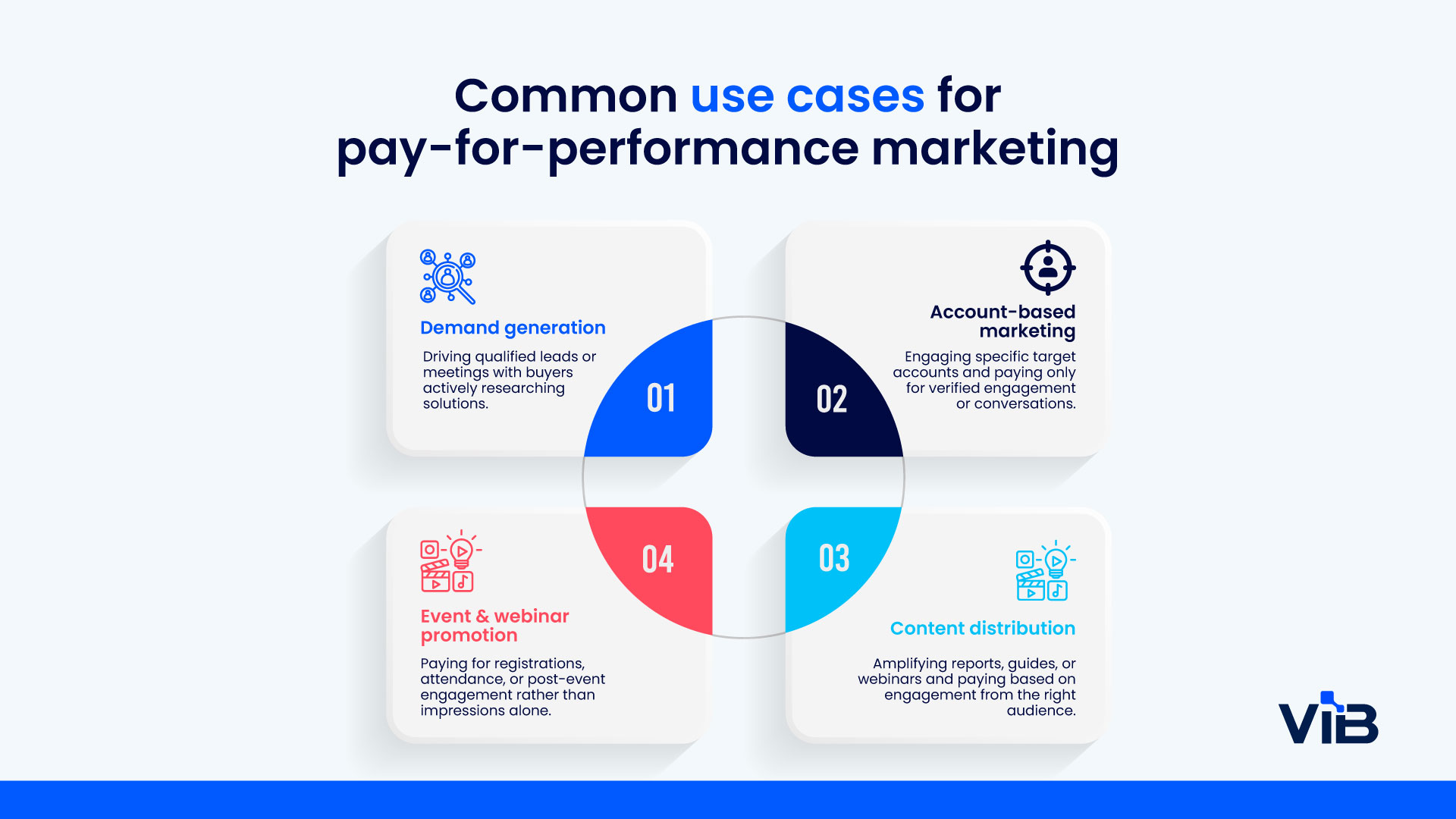
Demand generation: Driving qualified leads or meetings with buyers actively researching solutions.
Account-based marketing: Engaging specific target accounts and paying only for verified engagement or conversations.
Content distribution: Amplifying reports, guides, or webinars and paying based on engagement from the right audience.
Event and webinar promotion: Paying for registrations, attendance, or post-event engagement rather than impressions alone.
Core pillars of B2B tech performance marketing
A strong performance marketing strategy for demand generation is built on a few foundational pillars.
1. Audience precision
Performance marketing only works if you’re targeting the right people. For B2B tech, this means going beyond basic demographics and firmographics. The most effective strategies layer in:
- Ideal customer profile targeting
- Job role and buying committee alignment
- Account-level focus
- Behavioral and intent signals
Precision reduces wasted spend and ensures your message reaches the buyers most likely to convert.
2. Message alignment across the buyer journey
One-off campaigns rarely create demand on their own. Performance marketing thrives on consistency.
That means aligning messaging across awareness-stage education, mid-funnel validation and proof, and late-stage differentiation and urgency.
Each touchpoint should reinforce the same core value proposition while addressing the buyer’s current mindset.
3. Channel accountability
In performance marketing, every channel must earn its place.
Paid media, email, content syndication, and retargeting are not judged by vanity metrics but by their contribution to demand. Channels that consistently underperform are refined or replaced.
This discipline helps teams avoid spreading the budget too thin across tactics that do not deliver.
4. Measurement beyond leads
For B2B demand generation, performance metrics should reflect buying behavior rather than just conversions.
Examples include:
- Engagement from target accounts
- Repeat exposure to key messages
- Movement through buying stages
- Sales acceptance and follow-up
These indicators provide a more accurate picture of demand creation than lead counts alone.

Key strategies for top-level performance marketing
Strategy 1: Design for constraints before designing campaigns
Begin by defining constraints such as budget limits, audience size, sales capacity, and content bandwidth. These guardrails shape smarter decisions about where to invest and how aggressively to scale.
When teams ignore constraints, they overbuild campaigns that cannot sustain momentum. When constraints are acknowledged early, performance marketing becomes more efficient and far more predictable.
Strategy 2: Anchor performance around audiences you can reach again
One of the fastest ways to stall performance is by relying on one-time audiences.
B2B performance marketing works best when marketers can repeatedly engage the same high-fit buyers. This means prioritizing strategies that allow for consistent audience access rather than constantly sourcing new lists or cold segments.
Strategy 3: Treat distribution as a performance lever, not an afterthought 📣
Many teams pour time and resources into content creation, only to see limited results. The issue is rarely the content itself; it’s how it’s distributed.
Performance-driven marketers recognize that even the strongest assets need structured amplification to drive results.
ViB tip: Strategies like email amplification and content syndication can extend visibility without sacrificing audience quality.
Strategy 4: Build campaigns to learn, not just convert
High-performing teams view every campaign as a source of insight, not just a conversion engine.
Instead of asking whether a campaign “worked,” ask what it revealed about audience behavior, message resonance, or buying readiness.
Metrics like engagement depth, content interaction, and repeat exposure often provide more strategic value than raw conversion counts. Campaigns that generate learning compound their impact long after they end.
Strategy 5: Optimize for intent, not volume
Chasing volume is one of the most common mistakes in performance marketing. Instead, prioritize signals that indicate buying intent and readiness, even if that means smaller numbers at the top.
When campaigns align with intent, performance stabilizes, follow-up becomes more effective, and downstream results are easier to predict. In fact, according to a report by Mixology Digital, 93% of B2B marketers saw lead conversion rates increase with intent data.
Strategy 6: Build multi-touch performance systems, not single-channel plays
No single channel can carry a B2B performance strategy on its own. Buyers rarely convert after one interaction. They engage across emails, content, ads, and follow-up touchpoints. Performance strategies that account for this reality outperform those built around isolated tactics.
The goal is not to perfect one channel, but to create coordinated touchpoints that reinforce the same message and value. When channels work together, performance becomes more resilient and less dependent on any single source.
Strategy 7: Prioritize strategies that compound over time
The most effective performance marketing strategies improve with age.
Compounding strategies reuse audiences, extend content lifespan, and build momentum with each campaign. Over time, they reduce cost per result and increase predictability.
How to build a performance marketing plan that drives measurable results

1. Start with a data audit
A performance plan requires understanding what works today. Before allocating spend or creating new content, evaluate:
- Which channels drove the most qualified traffic in the last quarter
- What content and offers produced sales-accepted leads
- Which retargeting audiences were most engaged
- What patterns exist in your highest converting accounts
- Where drop-offs occur in the funnel
The goal is to eliminate assumptions and start from clear insights.
2. Build a quarterly performance roadmap
Performance marketing works best when executed in focused sprints, not scattered activities.
A quarterly roadmap includes:
- Target audience segments
- Key channels
- Planned offers
- Retargeting flows
- Data collection structure
- Optimization cycles
This structure keeps execution tight and ensures every campaign ladders back to revenue outcomes.
3. Prioritize amplification of your strongest assets
One of the most common mistakes in B2B marketing is creating new content instead of amplifying high performers. Performance marketing emphasizes distribution first. Examples of high-leverage opportunities include:
- Amplifying a top-converting gated asset
- Driving traffic to a buyer guide or ROI calculator
- Using email amplification to spike traffic to a key report
- Retargeting traffic from SEO to higher value offers
- Running ABM ads with top-performing webinar assets
The best strategies start by asking, “What is already working that can scale?”
4. Build retargeting structures into every campaign
Retargeting is no longer optional. It is a core performance lever. Your retargeting engine should include:
- Content-based retargeting from reports or high-value pages
- Email retargeting based on opens, clicks, and time spent
- ABM retargeting for accounts showing in market activity
- Dark funnel retargeting through third-party partners
Retargeting improves efficiency by maximizing the value of every click and visit.
5. Align measurement to tangible business outcomes 📊
Performance marketing requires metrics that reflect pipeline quality and revenue impact. Beyond clicks and impressions, strong teams measure:
- High intent conversions
- Sales accepted meeting rates
- Velocity from MQL to opportunity
- Account engagement for ABM campaigns
- Cost per qualified lead
- Lift in ICP traffic
- Percentage of net new target accounts reached
With these metrics in place, marketers can quickly identify what needs to be scaled or cut.
Common pitfalls that slow down B2B performance teams
Even the most experienced marketers fall into these traps:
- Overproducing content instead of distributing proven assets
- Building campaigns without retargeting structures
- Prioritizing lead volume instead of high-value engagements
- Running channels in silos
- Chasing new tactics without establishing a foundation
- Measuring performance without aligning to revenue outcomes
Avoiding these pitfalls is often the difference between unpredictable results and a repeatable growth engine.

How to evaluate the best performance marketing agency for your business
Instead of looking for a name on a list, evaluate agencies using a clear framework. The best performance marketing agencies tend to stand out in the same key areas.
1. A clear and honest definition of performance
The first question is simple: how does the agency define performance?
Strong agencies align performance metrics with business outcomes. They can explain:
- Which KPIs matter most and why
- How those KPIs connect to revenue or buyer movement
- What success looks like in the first 30, 60, and 90 days
If an agency can’t articulate this clearly, performance will likely be vague and hard to defend internally.
2. Access to real B2B decision-makers
Performance is impossible without the right audience.
The best performance marketing agencies don’t rely solely on broad targeting or recycled lists. They have a strategy for reaching actual decision-makers for relevant accounts.
This may include intent-based targeting, vetted B2B audiences, first-party or community-driven data, and smart segmentation by role, industry, or buying stage.
3. Speed to launch and speed to learn
In B2B, slow execution kills momentum.
Top performance agencies prioritize speed without sacrificing strategy. They can launch campaigns quickly, analyze early signals, and optimize in real time.
Look for agencies that make setup and onboarding smooth and straightforward, test and iterate early, and share insights transparently.
4. A focus on quality over volume
The best performance marketing agencies actively manage lead quality. They pay attention to role relevance, company fit, engagement signals, and intent indicators.
Just as important, they’re willing to adjust strategy if quality drops, even if volume looks good on paper.
5. Transparent reporting and accountability
Performance marketing requires trust.
Strong agencies provide easy-to-understand reporting focused on insights, not vanity metrics. It should align with your agreed KPIs and be honest about what is and isn’t working.
If reports feel inflated or overly complex, that’s often a red flag.

Questions you should ask before hiring a performance marketing agency
Before signing a contract, ask direct questions. The answers will tell you far more than a pitch deck.
Consider asking:
- How do you define performance for B2B clients like us?
- How do you identify and prioritize in-market buyers?
- How quickly can campaigns realistically go live?
- How do you adjust when performance plateaus?
- What does optimization look like in practice?
- Can I fully customize my ICP?
- Is the data enriched with firmographics and intent?
- Is validation done in real time?
- Is there a clear process for preventing duplicates or fraud?
- What’s included in reporting and performance insights?
- Do you have access to a high-quality tech buyer audience?
The best performance marketing agencies welcome these questions. They’re not defensive about how results are measured.
How ViB supports performance-driven marketing strategies
ViB is designed to support the strategies outlined above by helping B2B marketers improve reach, relevance, and alignment with intent.
ViB Emails
It amplifies high-performing email and content campaigns by sending them to a curated community of verified B2B tech decision-makers. This helps marketers extend reach while maintaining audience quality and performance accountability.
ViB Syndication
This enables teams to distribute their best content to engaged, opted-in audiences, turning strong assets into ongoing performance drivers rather than one-time plays.
ViB Deal Intent
ViB Deal Intent helps teams prioritize outreach and optimization based on real engagement signals, ensuring focus stays on buyers showing genuine interest.
Together, these solutions support scalable, intent-driven performance strategies without relying on rented lists or short-term tactics.

Building your B2B tech performance marketing plan for 2026
As teams plan for 2026, performance marketing should be viewed as a framework, rather than a single campaign.
Start by asking:
- What demand outcomes matter most to the business?
- Which accounts and audiences should we prioritize?
- How will we measure success across the full journey?
From there, align channels, messaging, and measurement around those goals.
Performance marketing works best when it is intentional, integrated, and continuously optimized.
5 data-driven performance strategies tech marketers can implement now
You can improve performance quickly by applying strategies that align with real buying behavior. These are practical, research-driven actions that help you get better results without overhauling your entire ecosystem.
- Build micro-audiences around real-world problem statements. Segment by the challenges buyers are actively trying to solve, instead of just job title or industry.
- Prioritize content that shortens the sales cycle. Quick insight summaries, competitive comparisons, and ROI-focused content outperform broad thought leadership.
- Run performance syndication with strict ICP filters. Use partner networks that validate audience data to generate actual interest from in-market buyers.
- Use email amplification for moments when scale matters. Product launches, campaigns, and webinars perform better when amplified to a clean, verified list.
- Evaluate vendors based on conversion metrics. Meeting acceptance rate, engagement quality, and SQL conversion tell you far more than CTR or cost per click.
These actions help you focus on results that matter instead of surface-level metrics.

Start 2026 off right with performance marketing
B2B tech performance marketing is no longer optional for demand generation. Buyers expect relevance, leadership expects accountability, and teams need strategies that scale without wasted spend.
By focusing on outcomes, audience precision, and long-term demand creation, performance marketing helps B2B tech teams do more with less and prove the impact of their work. 🚀
As 2026 approaches, the teams that win will be the ones that treat performance marketing as a strategic discipline, not just a tactical play.


