 Skip to content


If you’re a B2B tech marketer, chances are your content library is overflowing with ebooks, guides, reports, webinars, case studies, and templates; yet, only a fraction of that content actually drives measurable results.
You’re not alone. Most teams spend months producing content only to see flat traffic, low conversions, and very little direct attribution.
That’s where content performance marketing comes in.
In today’s noisy B2B landscape, content that just “exists” isn’t enough. Content that performs is what moves the needle. 🚀
This guide breaks down the components of content performance marketing, the KPIs that actually matter, and how B2B tech marketers can use this strategy to extract real value from their content — without producing more, hiring a bigger team, or overhauling their entire tech stack.
What is content performance marketing?
Instead of churning out content and hoping for the best, content performance marketing is a data-driven approach that focuses on how each asset performs across channels and how it contributes to the pipeline.
It blends strategy, amplification, targeting, and optimization so your best content is consistently put in front of the people most likely to take action.
Instead of measuring content success through vanity metrics (views, impressions, time-on-page), you focus on true performance indicators like:
- Conversion rate
- High-intent form fills
- Downstream engagement
- Deal acceleration
- Lead quality
- Revenue influence and attribution
At its core, content performance marketing turns your content library into a working growth engine rather than a storage room full of unused assets.
Why content performance matters more in 2026
In B2B tech marketing, several things have changed dramatically:
1. Decision-makers engage differently
Buyers engage across dozens of micro-touchpoints before speaking to sales. Content now needs to be easily discoverable, immediately valuable, and highly relevant to active business pains
The days of creating a 40-page ebook and crossing your fingers are gone.
2. Budgets are tighter and teams are smaller
Marketers need measurable ROI from every asset. Leadership wants proof that content isn’t just attracting traffic; it’s attracting the right traffic.
3. AI has increased competition for attention
Anyone can produce content now thanks to AI. But very few marketers can consistently produce high-performing content. Performance is now the differentiator. 🔥

The pillars of a strong content performance marketing strategy
Below are the components that separate high-performing content programs from the ones that stall out.
1. Audience insights and intent signals
Great content performance starts with great targeting. You need clarity on:
- ICP segments
- Buyer pains across the decision journey
- Active vs. passive buyers
- Industry-specific needs
- Behavioral intent signals
Audience clarity = higher-performing content.
2. Content built for action, not awareness
Content performance marketing prioritizes assets that drive movement, such as:
- Use case guides
- Benchmarking reports
- ROI calculators
- Industry research
- Webinar summaries
- How-to frameworks
- Competitive insights
These formats support lead generation, validation, and buying decisions.
The best-performing content speaks to a defined segment, builds trust immediately, solves a specific problem, and offers practical next steps.
If awareness content brings people to the table, performance content moves them forward.
3. Full-funnel distribution and amplification
Strong content is meaningless if no one sees it.
High-performing teams use multi-channel content amplification across multiple channels, including email, paid social, sponsored placements, partner channels, and existing customer communities.
This is where many teams struggle: amplification requires time, lists, and resources.
ViB Emails solves this by pushing your content directly to verified and engaged B2B tech buyers, accelerating reach, traffic, and conversions without needing your own lists, a large team, or heavy paid budgets.
A single strong amplification channel can dramatically increase performance.
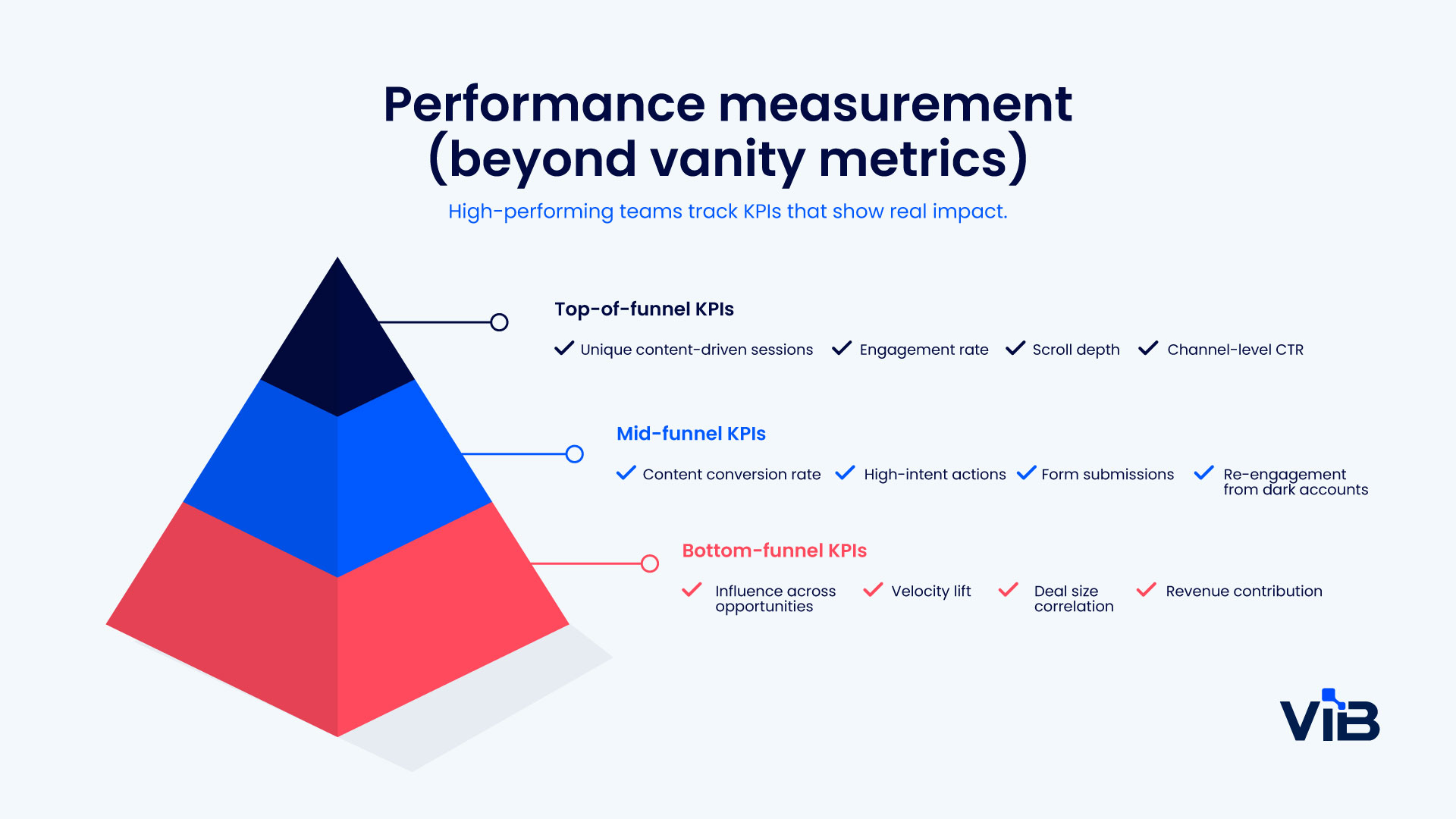
4. Performance measurement (beyond vanity metrics)
High-performing teams track KPIs that show real impact.
Top-of-funnel KPIs
- Unique content-driven sessions
- Engagement rate
- Scroll depth
- Channel-level CTR
Mid-funnel KPIs
- Content conversion rate
- High-intent actions (demo request, pricing click, meeting request)
- Form submissions
- Re-engagement from dark accounts
Bottom-funnel KPIs
- Influence across opportunities
- Velocity lift
- Deal size correlation
- Revenue contribution
Content performance isn’t only about volume; it’s about velocity and quality. 💡
The role of ViB Emails in content performance marketing
While performance marketing includes many levers, one of the highest-ROI channels for B2B tech teams is email amplification—especially when you don’t have strong internal lists, or when organic traffic isn’t enough.
This is where ViB Emails helps accelerate performance:
1. Expands your reach fast
ViB’s community is made up of millions of engaged, verified B2B tech professionals. Your content is promoted directly to buyers who match your ICP, without building your own list.
2. Drives instant traffic to key assets
If you’re launching a new ebook, report, or webinar, ViB Emails can produce a controlled spike in qualified traffic, helping your content gain momentum quickly.
3. Improves downstream performance
Content amplified via ViB Emails typically leads to:
- Higher conversion rates
- More form fills
- More demo requests
- Stronger buyer signals
- Faster movement into nurture or ABM
4. Supports your evergreen content engine
You can use ViB Emails to re-promote high-potential content, ensuring every asset continues to deliver value over time.
How to build a content performance marketing plan for 2026
Here’s a step-by-step framework you can implement right away.
Step 1: Audit your existing content library
Identify your high-performing assets, as well as high-potential but underperforming assets, assets aligned to active demand, and gaps in the buyer journey.
Most marketers discover they already have most of the content they need; it’s just not being leveraged correctly.
Step 2: Map content to your ICP and buying stages
Create clusters around lead generation, consideration and comparison, validation, buying readiness, and customer expansion.
Every content asset should support a specific action or conversion.
Step 3: Build amplification tiers
Not all content needs equal distribution. Use a tier model:
| Tier | Focus | Amplification level |
| Tier 1 | High-value “money content” (reports, webinars, case studies) | Heavy amplification + ViB Emails |
| Tier 2 | Mid-value guides | Lighter paid + social promotion |
| Tier 3 | Supporting blogs | Internal + SEO only |
This ensures your highest-value content reaches high-intent audiences.
Step 4: Add ViB Emails as your performance engine
Use ViB Emails to launch new content, boost monthly traffic, reignite stagnant assets, support campaigns with no list, and increase high-intent conversions.
This helps you create predictable performance without additional headcount.
Content performance isn’t about producing more — it’s about amplifying smarter
Most marketing teams aren’t struggling because they lack content. They’re struggling because their content lacks reach, segmentation, and follow-through.
Content performance marketing solves those problems. And with ViB Emails, B2B tech marketers can amplify their highest-value content directly to engaged tech professionals, unlocking more predictable performance as they plan for 2026 and beyond. If you want to see how this works in practice, the ViB Emails pilot is an easy way to test amplification without overhauling your strategy. ⭐


