 Skip to content


As we head into 2026, marketers are facing a familiar challenge with a new level of urgency. Budgets are tightening, AI is reshaping how buyers search, and leadership teams are asking tougher questions about ROI. The pressure to prove value faster is higher than ever.
That’s why more B2B tech teams are shifting to performance-based marketing as a core part of their 2026 strategy. Instead of paying for exposure or activity, you pay only when a defined result occurs. It’s a way to reduce risk, stretch the budget further, and build a go-to-market engine that responds to real buyer intent.
Below is an advanced, practical framework for building a performance marketing strategy that can actually move the needle and start 2026 off right.
✨ Let’s dive in.
Why performance marketing matters more in B2B tech today
B2B buyers have changed. They run independent research, they avoid sales conversations early in the journey, and they move quickly when a solution directly fits their needs.
Performance marketing helps companies match this behavior by optimizing every channel for measurable engagement and high intent.
Simply put, performance marketing is a results-first approach. You pay only for specific, measurable outcomes—for example, clicks, lead submissions, and content downloads.
That’s different from traditional marketing, where you pay upfront for exposure, regardless of whether those ads generate meaningful interaction or conversions.
The strongest teams use performance marketing to lower customer acquisition costs (CAC), accelerate deals, create a predictable lead flow, identify high-intent buyers faster, and prove ROI to leadership.
The core pillars of a modern performance marketing strategy
1. Targeting that prioritizes quality over quantity
Performance marketing collapses without precise targeting. For B2B tech marketers, that means going beyond surface-level firmographics and leaning into signals that show real buying behavior.
Examples of high-performing targeting strategies include:
- ICP segmentation based on past conversion and retention data
- Behavioral signals taken from on-site interactions
- Keyword intent research mapped to content or offer sequencing
- ABM lists built around high-value accounts and expansion opportunities
Modern performance teams also build adaptive targeting systems. In other words, they use continuous data to refine segments regularly.
2. Channel mix designed for impact, not presence
High-growth B2B teams no longer attempt to “be everywhere.” Instead, they create a channel strategy that is structured around three layers:
- Awareness channels
These channels include paid search, social ads, content distribution, and syndication. They introduce your message to buyers who are actively researching.
- Engagement channels
This includes email, retargeting, and ABM programs. These channels nurture buyers who have already expressed interest.
- Conversion channels
This is where landing pages, meetings, demo requests, and high-intent forms come in. These channels help drive the last mile.
Performance marketing works best when these channels inform one another. For example, traffic from content syndication should feed retargeting ads, which in turn feed email engagement, etc. Each channel plays a role in warming, educating, or converting buyers, rather than operating independently.
3. Creative and messaging that focuses on value, not volume
Performance-based creative is not about being flashy. It is about being clear.
Top performing B2B tech teams develop message frameworks built around:
- Pain points connected to tangible business outcomes
- Specific, differentiated claims supported by data
- CTAs that guide buyers into the next step of their research
- Modular messaging that can be reused across channels
The strongest performance strategies also rely on variant testing. So, instead of launching a new campaign every time something underperforms, marketers test creative, landing page copy, sequencing, and offers until they find what converts best.
4. Offers aligned to buyer intent
In B2B tech markets, the offer is often more important than the channel.
High intent buyers want:
- ROI calculators
- Buyer’s guides
- Deep comparison content
- Case studies
- Access to specialists or solution engineers
Mid intent buyers want:
- Reports
- Trend analysis
- Tactical playbooks
- Problem-solving guides
Low intent buyers want:
- High-level educational content
- Industry benchmarks
- Awareness-driven assets
Performance marketing aligns the offer with the buyer’s journey stage. This leads to stronger conversion rates and higher-quality leads.
How to build a performance marketing strategy that drives measurable results

1. Start with a data audit
A performance plan requires understanding what works today. Before allocating spend or creating new content, evaluate:
- Which channels drove the most qualified traffic in the last quarter
- What content and offers produced sales-accepted leads
- Which retargeting audiences were most engaged
- What patterns exist in your highest converting accounts
- Where drop-offs occur in the funnel
The goal is to eliminate assumptions and start from clear insights.
2. Build a quarterly performance roadmap
Performance marketing works best when executed in focused sprints, not scattered activities.
A quarterly roadmap includes:
- Target audience segments
- Key channels
- Planned offers
- Retargeting flows
- Data collection structure
- Optimization cycles
This structure keeps execution tight and ensures every campaign ladders back to revenue outcomes.
3. Prioritize amplification of your strongest assets
One of the most common mistakes in B2B marketing is creating new content instead of amplifying high performers. Performance marketing emphasizes distribution first. Examples of high-leverage opportunities include:
- Amplifying a top-converting gated asset
- Driving traffic to a buyer guide or ROI calculator
- Using email amplification to spike traffic to a key report
- Retargeting traffic from SEO to higher value offers
- Running ABM ads with top-performing webinar assets
The best strategies start by asking, “What is already working that can scale?”

4. Build retargeting structures into every campaign
Retargeting is no longer optional. It is a core performance lever. Your retargeting engine should include:
- Content-based retargeting from reports or high-value pages
- Email retargeting based on opens, clicks, and time spent
- ABM retargeting for accounts showing in market activity
- Dark funnel retargeting through third-party partners
Retargeting improves efficiency by maximizing the value of every click and visit.
5. Align measurement to real business outcomes 📊
Performance marketing requires metrics that reflect pipeline quality and revenue impact. Beyond clicks and impressions, strong teams measure:
- High intent conversions
- Sales accepted meeting rates
- Velocity from MQL to opportunity
- Account engagement for ABM campaigns
- Cost per qualified lead
- Lift in ICP traffic
- Percentage of net new target accounts reached
With these metrics in place, marketers can quickly identify what needs to be scaled or cut.
Advanced tactics used by high performing B2B tech teams
Use content syndication and email amplification to accelerate traffic
Content distribution is one of the fastest ways to fuel performance channels. Reports, guides, and comparison content become powerful tools for attracting in-market buyers and feeding retargeting pools.

Pair ABM with intent signals
High-performing performance strategies use intent data to identify accounts that are actively researching a problem and prioritize them in campaigns.
Leverage variant testing as an always-on process ⚡
Teams that win in performance marketing test constantly. Headlines, button text, landing page layouts, offer order, and audience segments all undergo structured experimentation.
Create full funnel visibility across channels
A strong strategy connects paid, organic, content, and email analytics into one view. This makes it easier to see where friction exists and where growth opportunities are hiding.
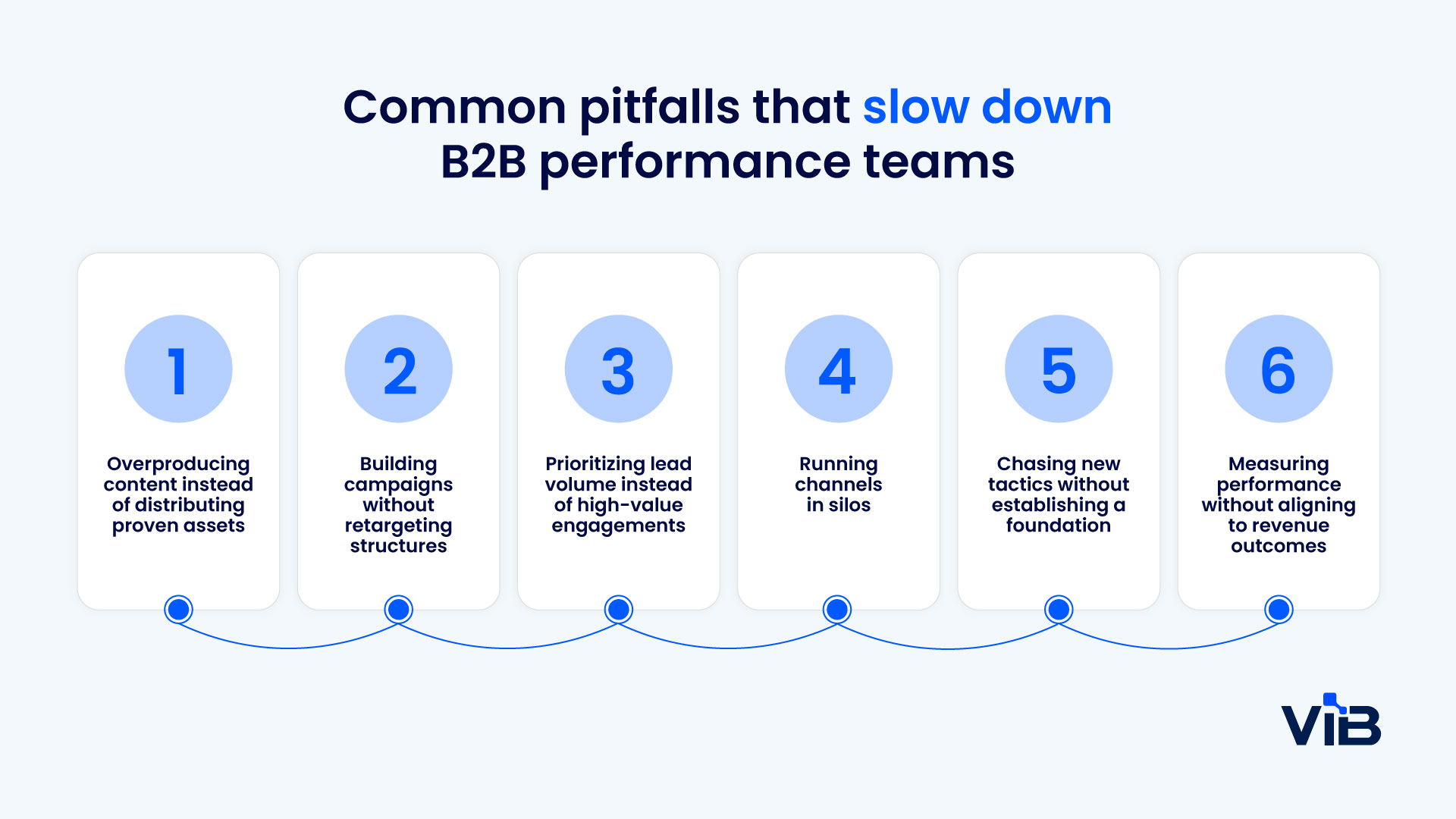
Common pitfalls that slow down B2B performance teams
Even the most experienced marketers fall into these traps:
- Overproducing content instead of distributing proven assets
- Building campaigns without retargeting structures
- Prioritizing lead volume instead of high-value engagements
- Running channels in silos
- Chasing new tactics without establishing a foundation
- Measuring performance without aligning to revenue outcomes
Avoiding these pitfalls is often the difference between unpredictable results and a repeatable growth engine.
How to get started with a performance marketing strategy
The quickest path is not to launch ten new campaigns. It is to sharpen and scale what is already working. Start with:
- A data audit
- A quarterly channel plan
- One strong offer per funnel stage
- A retargeting engine
- Clear measurement
Once these are in motion, you can layer on ABM, email amplification, content syndication, and more complex testing.
Final thoughts
Performance marketing is no longer a tactic for fast-growing B2B tech companies. It is a strategic advantage. The teams that embrace it consistently generate higher-quality engagement, reach the right buyers at the right time, and achieve more predictable, efficient growth.
If you want to start your 2026 marketing strategy off on the right foot, ViB’s solutions are designed to help B2B tech marketers reach verified high-tech buyers with quality and scale.


