 Skip to content


As B2B teams head into 2026 planning, the conversation has shifted. It’s no longer about which channels are trending or which platforms promise the biggest reach. It’s about efficiency, accountability, and making every dollar work harder.
Marketing leaders are being asked to do more with less, prove impact faster, and justify spend with outcomes that sales and finance actually care about. That pressure is forcing a rethink of how budgets are allocated and which models deserve a bigger share of the mix.
This is where pay-for-performance marketing stands out.
Unlike traditional advertising models, where spend is tied to clicks, impressions, or reach, pay-for-performance focuses on tangible outcomes that move prospects closer to a buying decision.
In this article, we’ll break down the real benefits of pay-for-performance marketing, why it works so well for B2B teams, and when it makes the most sense to adopt this approach.
What is pay-for-performance marketing?
Pay-for-performance marketing is a model in which you pay only when a specific, pre-agreed result is delivered.
Those results vary depending on the campaign and provider, but common examples include:
- Qualified leads
- Sales meetings or appointments
- Content engagements
- Event registrations or attendance
Instead of paying for activity, impressions, or promises, pay-for-performance marketing ties spend directly to specific outcomes.
The core benefits of pay-for-performance marketing
1. Lower financial risk
One of the biggest benefits of pay-for-performance marketing is risk reduction.
In traditional models, you pay upfront with no guarantee of results. If a campaign underperforms, the budget is gone, regardless of the outcome.
With pay-for-performance, spend is directly tied to delivery. If the agreed result doesn’t happen, you don’t pay for it. That structure creates built-in accountability and gives marketing teams more confidence when testing new channels, messages, or audiences.
2. Clear ROI and easier reporting
Pay-for-performance marketing makes ROI far easier to track and explain. Instead of reporting on surface-level metrics like impressions or CTR, you can point directly to outcome-based data like:
- Number of leads delivered
- Cost per lead or appointment
- Engagement rates from real buyers
- Conversion to sales conversations
This clarity simplifies internal reporting and helps marketing leaders align more closely with sales and finance teams. When everyone understands what’s being paid for and why, conversations shift from defending spend to scaling what works.
3. Stronger alignment between marketing and sales
Misalignment between marketing and sales is one of the most common challenges in B2B organizations.
Pay-for-performance marketing naturally brings these teams closer together because success is defined by shared outcomes. If marketing is paying for qualified leads or meetings, lead quality becomes non-negotiable.
This model encourages clear qualification criteria and better feedback loops between teams.
The result is fewer wasted handoffs and more productive sales conversations.
4. Higher focus on lead quality, not volume
Traditional demand generation often prioritizes volume: more leads, more clicks, more traffic.
Pay-for-performance marketing flips that mindset.
Because providers are only paid when outcomes are delivered, there’s a strong incentive to focus on quality. Low-intent or poorly matched contacts don’t benefit anyone in this model.
For B2B marketers targeting niche audiences or complex buying committees, this focus on quality over quantity is critical. It helps ensure that effort is spent engaging the right accounts, not just filling a CRM with names.
5. More predictable budgeting and planning
Another major benefit of pay-for-performance marketing is predictability.
When costs are tied to defined outcomes, budgeting becomes more straightforward. You know the cost per result and can model spend based on realistic targets.
This makes it easier to plan campaigns, adjust spend based on performance, and scale successful programs without guesswork.
6. Built-in accountability from vendors and partners
Pay-for-performance marketing changes the relationship between buyers and providers.
Because compensation is tied to results, partners are incentivized to continuously optimize targeting, messaging, and execution. There’s less room for vague reporting or excuses, and more focus on delivery.

Why pay-for-performance works especially well in B2B
B2B buying cycles are longer, more complex, and involve multiple stakeholders. That makes it harder to justify spend based purely on awareness or engagement metrics.
Pay-for-performance marketing aligns better with how B2B growth actually happens:
- Fewer buyers, but higher deal values
- Longer consideration phases
- Greater need for intent and relevance
By focusing on meaningful actions rather than vanity metrics, B2B teams can invest in marketing that supports real buying behavior rather than just visibility.
Common use cases for pay-for-performance marketing
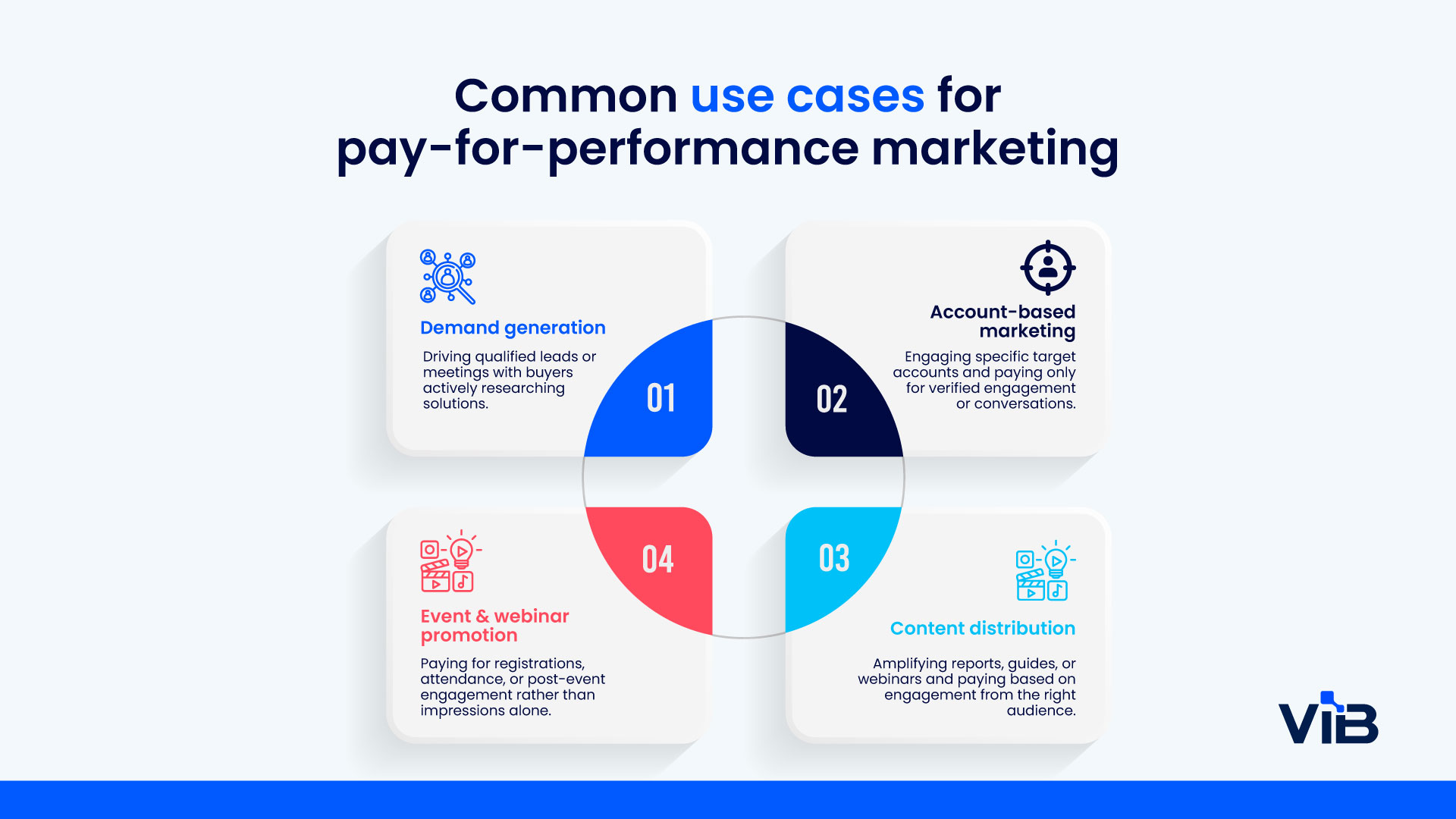
Pay-for-performance models can support a wide range of B2B initiatives, including:
Demand generation: Driving qualified leads or meetings with buyers actively researching solutions.
Account-based marketing: Engaging specific target accounts and paying only for verified engagement or conversations.
Content distribution: Amplifying reports, guides, or webinars and paying based on engagement from the right audience.
Event and webinar promotion: Paying for registrations, attendance, or post-event engagement rather than impressions alone.
How ViB supports pay-for-performance marketing strategies
ViB designs its solutions to support outcome-driven B2B marketing, measuring performance through real engagement and buyer action, not surface-level metrics. And you only pay for real results.
For instance, with ViB Appointments, you can set meetings with qualified B2B tech decision-makers. ViB thoroughly vets each prospect to ensure they meet your targeting criteria. And you only pay for meetings that actually happen.
With ViB Syndication, you can distribute your existing assets to your ICP—and you only pay for qualified leads.
You can get a fully orchestrated webinar with guaranteed, qualified attendance with ViB Webinars.
Together, these solutions make it easier to build pay-for-performance programs that are accountable, measurable, and aligned with revenue-focused goals.
Is pay-for-performance marketing right for your team?
If your team prioritizes efficiency, accountability, and real outcomes, pay-for-performance marketing deserves serious consideration.
The benefits go beyond cost control. They include better alignment, higher-quality engagement, clearer ROI, and a more sustainable approach to growth.
In a landscape where every dollar matters, paying for results, not promises, is becoming the smarter way forward. 🚀


