 Skip to content


B2B marketers are facing tighter budgets, shorter timelines, and bigger expectations. Leadership wants faster results and for every dollar to have a measurable impact. Traditional digital marketing has become harder to justify because impressions and traffic alone no longer signal success.
That’s why performance marketing is becoming essential for B2B tech teams. Instead of paying for exposure, you’re paying for outcomes that directly support your revenue goals. And while performance marketing is often associated with ecommerce, the model has evolved. Today, B2B marketers are using performance marketing to reach real buyers, validate demand, and generate higher-quality engagement without increasing spend 💰.
This blog breaks down what performance marketing actually means in a B2B context, how it differs from traditional digital programs, and how you can apply it to maximize your results.
What performance marketing really means (and why B2B has misunderstood it)
Many marketers hear “performance marketing” and assume it’s about cheap clicks or low-cost leads. In reality, performance marketing is an efficiency model. You only pay when a specific action happens, such as a content download, a meeting booked, or a verified contact delivered.
Where B2B gets stuck is treating performance marketing like a volume game. Ecommerce relies on rapid conversion cycles, but B2B buying cycles are longer and more complex. Real performance in B2B relies on high-quality targeting, validated intent, accurate segmentation, and channels built to reach decision-makers, not random audiences.
The biggest shift is this: Performance marketing isn’t just about lowering cost. It’s about reducing waste, increasing relevance, and aligning your spend with actions that matter.
Performance marketing vs. traditional digital marketing: The real difference
Traditional digital marketing is exposure-driven. You pay for impressions or clicks, and success depends on what happens afterward. There’s value in that approach, but it’s less predictable and harder to tie to revenue outcomes.
Performance marketing flips the model. Instead of paying for traffic, you pay for the result. This model forces:
- Better targeting
- Stronger creative
- Higher-quality data
- Faster optimization cycles
- Greater alignment between marketing and sales
For B2B companies under pressure to show outcomes quickly, this is a compelling shift.
How performance marketing improves B2B efficiency

1. Stronger targeting reduces waste: A performance-based approach encourages marketers to refine their audience criteria. When you pay per outcome, every irrelevant impression becomes a cost.
2. Better qualified leads support faster sales cycles: High-quality leads who already demonstrate intent convert faster and engage more deeply. Removing low-quality leads reduces friction between marketing and sales.
3. Real-time optimization improves learning: Because results are tied to actions, performance channels provide fast feedback. You see what works, what doesn’t, and where the budget should shift.
4. Predictability helps revenue teams plan: Outcome-based spend gives leadership clearer forecasting. You know what each action costs and how many actions are needed to influence revenue.
Key components of a B2B-ready performance marketing strategy
1. Verified audience targeting driven by real intent signals
Without the right audience, performance marketing collapses. B2B teams need targeting based on role, industry, tech environment, company size, and real buying intent. Broad lists or generic audiences create waste, lower engagement, and dilute your message.
Intent signals help you reach people who are actively evaluating solutions or engaging with content related to your product category. This is where efficiency happens.
2. Multi-channel distribution built for measurable outcomes
Performance marketing thrives in channels that support trackable actions. In B2B, those include:
- Email performance marketing ✉️
- Content syndication
- Appointment setting
- Webinar and virtual event promotion
A successful strategy doesn’t rely on every channel. It relies on the right channels, each chosen for outcome potential.
3. Clear performance metrics that matter for B2B
While ecommerce focuses on conversions at scale, B2B must look at outcomes tied to pipeline creation. Metrics that matter include:
- Engagement quality (click-through rate, scroll depth, content interaction)
- Verified contact data
- Meeting quality
- ICP match rate
- Follow-up readiness for sales
The goal is to measure signals that correlate with real interest, not vanity metrics.
Performance marketing pitfalls to avoid
Even strong performance programs can fail if teams make these common mistakes:
- Prioritizing volume over quality
- Focusing on cheap leads instead of relevant ones
- Ignoring intent signals
- Using unclear ICP targeting
- Tracking too many metrics and losing focus
- Not aligning with sales on what “qualified” means
- Expecting shortcuts instead of sustainable results
Performance marketing works best when it’s part of an integrated demand strategy.
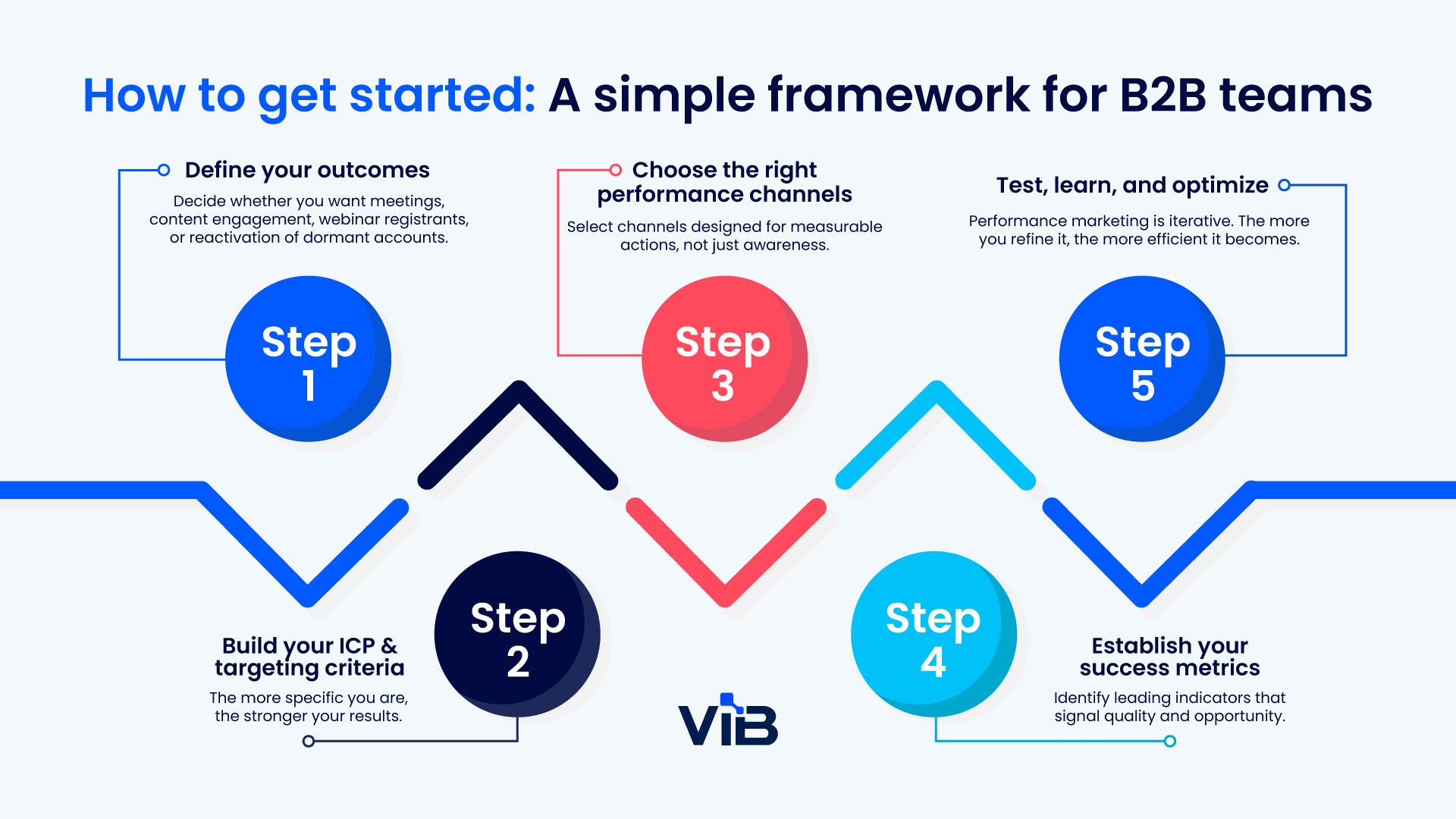
How to get started: A simple framework for B2B teams
Step 1: Define your outcomes
Decide whether you want meetings, content engagement, webinar registrants, or reactivation of dormant accounts.
Step 2: Build your ICP and targeting criteria
The more specific you are, the stronger your results.
Step 3: Choose the right performance channels
Select channels designed for measurable actions, not just awareness.
Step 4: Establish your success metrics
Identify leading indicators that signal quality and opportunity.
Step 5: Test, learn, and optimize
Performance marketing is iterative. The more you refine it, the more efficient it becomes.
How ViB helps B2B marketers with performance marketing
ViB’s solutions are built on performance models that focus on quality, intent, and verified outcomes. Instead of paying for impressions, marketers only pay when:
- A meeting is booked with a qualified lead 🗓️
- A verified contact downloads content
- An ICP match registers for a webinar
- A high-value prospect engages with email promotions
Because the ViB Community consists of highly technical, opt-in IT buyers, results reflect real interest rather than generic list activity. Each action is validated by human review, ensuring accuracy and quality.
This gives B2B marketers a way to scale without hiring more team members or managing complex targeting in-house.
Performance marketing isn’t a shortcut; it’s a smarter way to scale
Performance marketing gives B2B tech companies a more predictable and cost-efficient way to reach real buyers. By paying only for actions that matter, marketers can stretch their budgets, improve targeting, and better support revenue goals.
When combined with high-intent audiences and verified outcomes, performance marketing becomes one of the most effective strategies for modern B2B marketers.


