 Skip to content


Inbound marketing is often framed as a content and SEO-driven motion. Create valuable resources, attract the right audience, and convert interest into engagement over time.
In practice, inbound rarely works without consistent distribution. Content may exist, but without a reliable way to reach the right audience, even strong assets struggle to generate momentum.
Email marketing plays a central role in solving this gap. It provides a direct, repeatable way to connect content with professionals who are actively interested in relevant topics.
Why does inbound marketing often stall without email?
Many inbound strategies rely too heavily on passive discovery.
Content is published, optimized, and shared, but engagement depends on whether the right audience happens to find it. As search behavior shifts and AI-driven summaries reduce direct clicks, this model becomes less predictable.
Without a distribution mechanism, inbound becomes inconsistent. Traffic fluctuates, engagement drops, and valuable content fails to reach the people it was created for.
Email introduces control into that system. It ensures that content is delivered directly to an audience rather than waiting to be discovered.
What role does email marketing play in inbound strategy?
Email marketing acts as the connective layer between content and audience.
Instead of treating each asset as a standalone effort, email allows marketers to sequence content, reinforce messaging, and maintain visibility over time. It turns inbound from a one-time interaction into an ongoing relationship.
In a strong inbound strategy, email supports multiple stages of the buyer journey:
- Introducing educational content to new audiences
- Reinforcing key ideas through follow-up messaging
- Driving repeat engagement with related resources
- Maintaining visibility across longer decision cycles
This consistency is what allows inbound programs to build momentum rather than reset with each campaign.

How does email distribution improve content performance?
Content performance is often less about quality and more about exposure.
Even well-researched assets can underperform if they are not consistently placed in front of relevant professionals. Email distribution ensures that content reaches audiences who are more likely to engage with it.
This creates a compounding effect. As more people interact with content, it drives additional traffic, reinforces messaging, and increases the likelihood of deeper engagement.
Email also allows teams to control timing. Instead of relying on a single launch moment, content can be reintroduced through multiple touchpoints, extending its lifespan and impact.
Which inbound activities benefit most from email marketing?
Not all inbound activities rely on email equally, but several benefit significantly from consistent distribution.
Email marketing is especially effective when supporting:
- Blog content that requires sustained visibility over time
- Research reports and whitepapers that need targeted reach
- Webinar promotion and follow-up sequences
- Product education and category positioning
These assets often represent significant investment. Email ensures they are not dependent on a single channel or moment to succeed.
What challenges limit the impact of email in inbound strategy?
Despite its importance, email marketing can become less effective when audience quality and targeting are limited.
Many teams rely on internal databases that include outdated contacts, inactive subscribers, or professionals who no longer match the ideal customer profile. As a result, engagement declines even when content remains strong.
Other common challenges include:
- Limited reach beyond existing contact lists
- Overlapping messaging across segments
- Difficulty maintaining consistent send cadence
- Low visibility into which audiences are actually engaged
These constraints often prevent email from reaching its full potential within inbound strategy.
How can email marketing extend beyond internal lists?
Expanding email reach is one of the most effective ways to strengthen inbound performance.
Instead of relying solely on owned audiences, teams can introduce their content to professionals who match their target profile but are not yet in their database. This allows inbound efforts to scale without increasing content production.
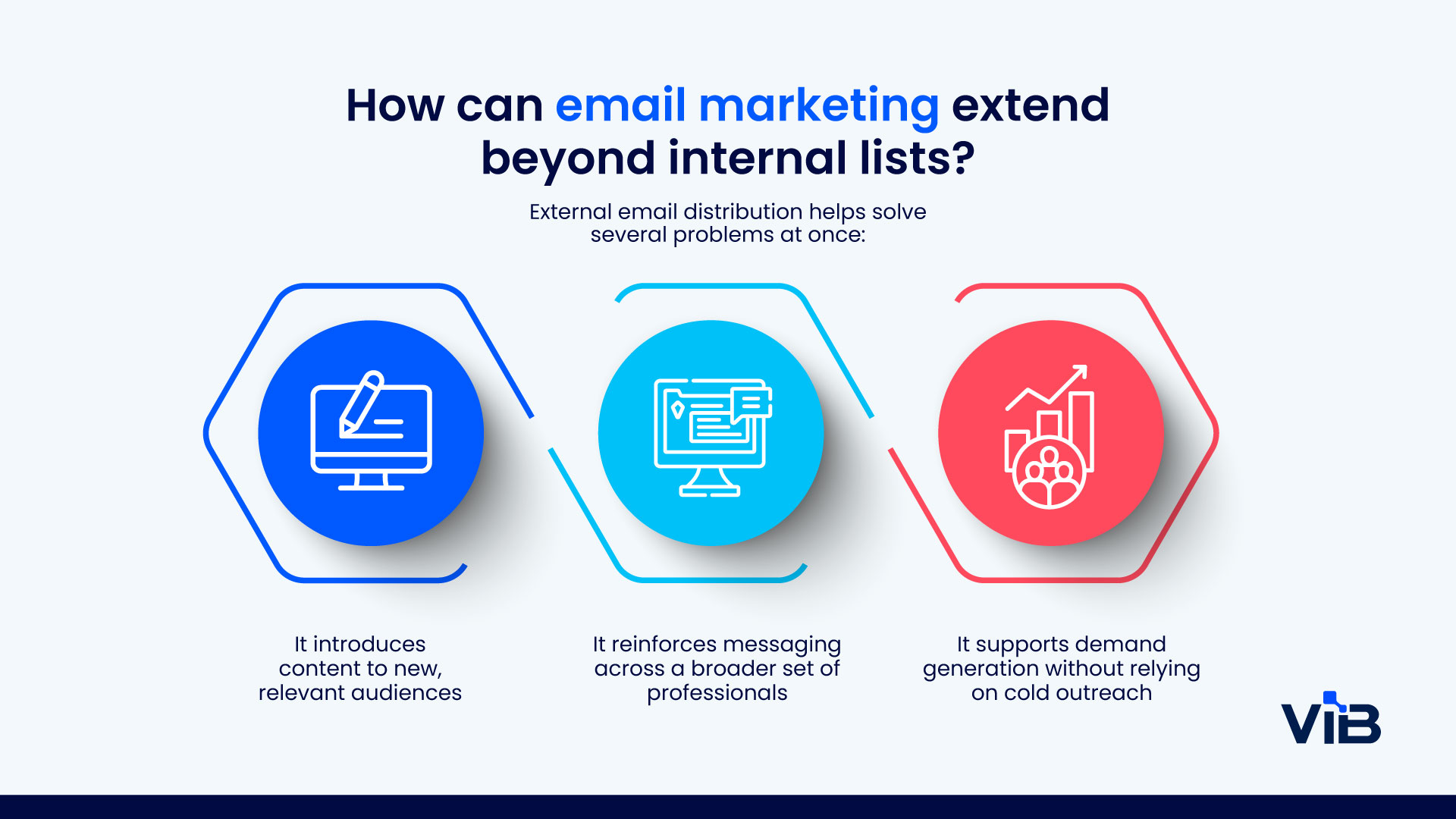
External email distribution helps solve several problems at once:
- It introduces content to new, relevant audiences
- It reinforces messaging across a broader set of professionals
- It supports demand generation without relying on cold outreach
This shift turns email from a retention channel into a growth channel.
How does email marketing support demand generation within inbound?
Email marketing plays a critical role in shaping early-stage demand.
Rather than focusing only on conversions, email introduces ideas and perspectives to buyers before they actively evaluate vendors. This helps influence how problems are understood and which approaches are considered.
Over time, repeated exposure through email builds familiarity and credibility. Buyers encounter consistent messaging across multiple touchpoints, which increases the likelihood of engagement when intent develops.
This is where inbound and demand generation intersect. Email ensures that content does not just exist, but actively contributes to how buyers think.
Where does ViB Emails fit into inbound strategy?
Up to this point, the focus has been on how email supports inbound strategy conceptually. Executing that consistently, however, often requires more reach and targeting than internal teams can achieve alone.
ViB Emails helps extend inbound distribution by delivering content to targeted B2B tech professionals within the ViB Community. Instead of relying solely on internal lists, marketers can place their content directly in front of professionals who match their ideal audience profile.
This approach supports several key goals within inbound strategy.
Expanding audience reach
Internal databases often represent only a portion of the potential audience. ViB Emails helps introduce content to professionals who are actively engaged in industry topics and match specific targeting criteria.
Maintaining consistent visibility
Inbound performance depends on repeated exposure. By distributing content through a broader network, ViB Emails helps ensure messaging appears consistently rather than relying on one-time promotion.
Improving engagement with relevant audiences
When content is delivered to professionals who care about the topic, engagement improves naturally. This leads to stronger interaction with blogs, reports, and other resources.
Rather than replacing internal email programs, ViB Emails acts as a distribution extension. It helps marketing teams execute inbound strategy at scale while maintaining relevance and audience alignment.
What should marketers prioritize when using email in inbound strategy?
For B2B marketers, improving email performance often has a direct impact on inbound results.
The most effective programs focus on a few key priorities:
- Aligning content with specific audience interests
- Distributing content consistently rather than sporadically
- Expanding reach beyond internal contact lists
- Measuring engagement to refine targeting over time
When these elements are in place, email becomes more than a communication channel. It becomes a core driver of inbound success.
Final thoughts
Inbound strategy depends on more than content creation. It requires consistent distribution, audience alignment, and repeated engagement over time.
Email marketing provides the structure that makes this possible. It connects content with the right audience, reinforces messaging, and supports demand generation across long buying cycles.
For teams looking to improve inbound performance, email is not just a supporting channel. It is the mechanism that ensures strategy turns into results.


