 Skip to content


Email remains one of the most effective channels for B2B marketing, with an average ROI of $36 for every $1 spent. (That’s a 3,600% return!)
But here’s the catch: In a world of overflowing inboxes and shrinking attention spans, average B2B emails just don’t cut it anymore.
Whether you’re promoting a webinar, driving downloads, or nudging warm leads to book a demo, your emails need to stand out in order to drive action.
Need proof? Let’s look at some stats:
- According to a study by Statista, more than one-third of consumers delete or ignore branded emails without reading them at least half the time. And 15% say they always delete or ignore them.
- Another study from Statista found that more than 40% of people regularly unsubscribe from brand emails.
- And according to Agility PR Solutions, the most common reasons consumers cited for ignoring marketing emails were: too many emails (55%), irrelevant product recommendations (50%), and unhelpful or uninteresting content (41%).

The best way to improve your email strategy is to make sure you’re emailing the right people. And that means making sure your email list is setting you up for success.
Growing your email list the right way means attracting engaged, opt-in contacts who actually want to hear from you. Done well, it drives better deliverability, stronger engagement rates, and more conversions. Done poorly, it can hurt your sender reputation and waste marketing budget.
In this guide, I’ll cover proven strategies to grow your list organically, key considerations if you’re thinking of buying an email list, and actionable tips to get your campaign going.
Why email list quality matters more than size
Marketers often get caught up in the numbers game—for example, “If we just add 10,000 more contacts, we’ll hit our goals.” But the truth is: a smaller, targeted list can outperform a massive, generic one.
Here’s why:
- Higher engagement—Opted-in subscribers are more likely to open, click, and convert.
- Better deliverability—ISPs reward senders with high engagement, helping your campaigns land in the inbox.
- More ROI—Fewer wasted sends mean more value from every campaign.
In fact, marketers using segmented, opt-in lists can generate up to 760% more revenue from their campaigns than those blasting cold lists. 📈

Proven organic email list growth strategies
Building your list organically takes time, but the payoff in engagement and trust is worth it. Here are some strategies to get you started.
1. Optimize your lead capture forms
- A/B test different placements (homepage, blog sidebar, exit intent pop-ups, etc.).
- Keep forms short. Fewer fields mean more complete submissions.
- Use compelling copy (For instance, “Get exclusive B2B insights every week” is stronger than “Subscribe to our newsletter” because the value proposition is clear upfront).
2. Offer high-value gated content
Create resources your audience can’t resist, like:
- Industry research reports
- Toolkits and templates
- Exclusive webinars and workshops
People are usually happy to provide their email in return for actionable, insightful content.
3. Leverage events for real-time sign-ups
Virtual and in-person events are prime opportunities to grow your list with highly relevant leads. Capture emails during registration, in follow-up surveys, and via exclusive post-event resources.
4. Re-engage your dormant contacts
If you’ve been running campaigns for a while, chances are you have a segment of unengaged leads. Re-engagement campaigns, especially when paired with compelling offers or exclusive content, can breathe new life into old contacts.
5. Partner on co-marketing campaigns
Team up with brands serving the same ICP but offering non-competing services. Share promotion efforts and split the leads. It’s a win-win!
Paid and partnership-based strategies
If you want to grow faster, paid channels and partnerships can get you in front of new, high-fit audiences.
Publish your gated assets on trusted third-party platforms to reach new prospects. (ViB Syndication can help you with that!)
2. Social media lead gen ads
Target your ICP directly on platforms like LinkedIn using lead gen forms that auto-fill for frictionless sign-ups.
3. Sponsored newsletter placements
Find industry-specific publications with loyal subscribers and place relevant offers inside their emails.
4. Strategic community partnerships
Collaborate with niche communities your audience already trusts. (Example: The ViB Community connects you with engaged B2B tech professionals actively researching solutions.)
5. Tap into intent-based email amplification
Platforms like ViB Emails connect you with verified B2B tech professionals who have opted in to receive marketing messages. These aren’t cold lists—they’re warm, active audiences already showing interest in your topic.

List hygiene and retention: Growing the right way
Email list growth strategies aren’t just about adding contacts—it’s also about keeping the right ones.
1. Keep your list clean
- Regularly remove unengaged contacts to protect deliverability.
- Use engagement-based segments to target your most active subscribers.
2. Use double opt-in
Confirming sign-ups not only ensures compliance (hello, GDPR!) but also validates interest.
3. Onboard new subscribers ⚡
Set up a welcome email series that introduces your brand, sets expectations, and delivers quick wins.
Is buying an email list worth it in 2025?
The pressure to fill pipeline fast often tempts marketers to buy a lead list. On the surface, it seems efficient. But is buying an email list worth it? The truth is that it depends. The market has shifted from quantity-first to intent-first. In 2025, marketers need more than names—they need signals, timing, and engagement.
Buying a lead list with no way to nurture or verify intent is like buying a phone book and hoping someone picks up.
Why most purchased lead lists fall short

According to the Demand Gen Report 2025 Benchmark Survey, 67% of marketers say purchased leads rarely convert. That’s because purchase lists often come with these common issues:
1. Poor data quality

Some 66% of marketers say data quality is their biggest lead gen barrier.
Even reputable mailing list companies struggle to keep their data fresh. People change jobs, switch email providers, or abandon accounts altogether. In fact, email databases decay at an average rate of 22.5% per year.
That means you could easily spend thousands on a list where 20–30% of the addresses are invalid. This could lead to sky-high bounce rates, which can hurt your sender reputation.
2. Compliance and legal risks
Privacy and compliance laws have changed the game. Under GDPR (Europe), CAN-SPAM (U.S.), and CASL (Canada), sending emails to people who didn’t opt in can be considered spam—or even illegal.
GDPR penalties can reach up to €20 million or 4% of global revenue. Even if you avoid fines, a damaged domain reputation can cause all your emails—including the legitimate ones—to land in spam folders.
3. Low engagement

Recipients on bought lists haven’t opted in to hear from your brand. That means lower open rates, poor clickthroughs, and higher spam complaints. Several B2B tech sectors, in particular, have the lowest cold email conversion rates across all industries, including SaaS, IT, cybersecurity, and cloud computing.
4. Reputation damage
If too many of your emails bounce or get marked as spam, internet service providers (ISPs) may throttle or block your campaigns. Once your domain is flagged, recovering your reputation is difficult and time-consuming.
For small businesses, this can cripple marketing efforts. For larger organizations, the damage can extend across multiple departments that rely on email to communicate with customers.
When using B2B lead lists make sense
There are still some smart ways to use B2B lead lists—if they’re handled with care:
- Account-based marketing (ABM): When filling out key personas at targeted accounts
- Lookalike audience building: When paired with first-party data to improve targeting
- Outbound warm-up campaigns: When you have layered personalization behind every message
- Reactivating dormant pipeline: When reigniting interest from cold or inactive leads
- Event follow-up targeting: When supplementing attendee data with similar buyer profiles
(ViB Tip: Instead of cold outreach, ViB Deal Intent gives you contacts who’ve already engaged with similar content—and ViB Emails puts your message directly in their inbox at the right time.)
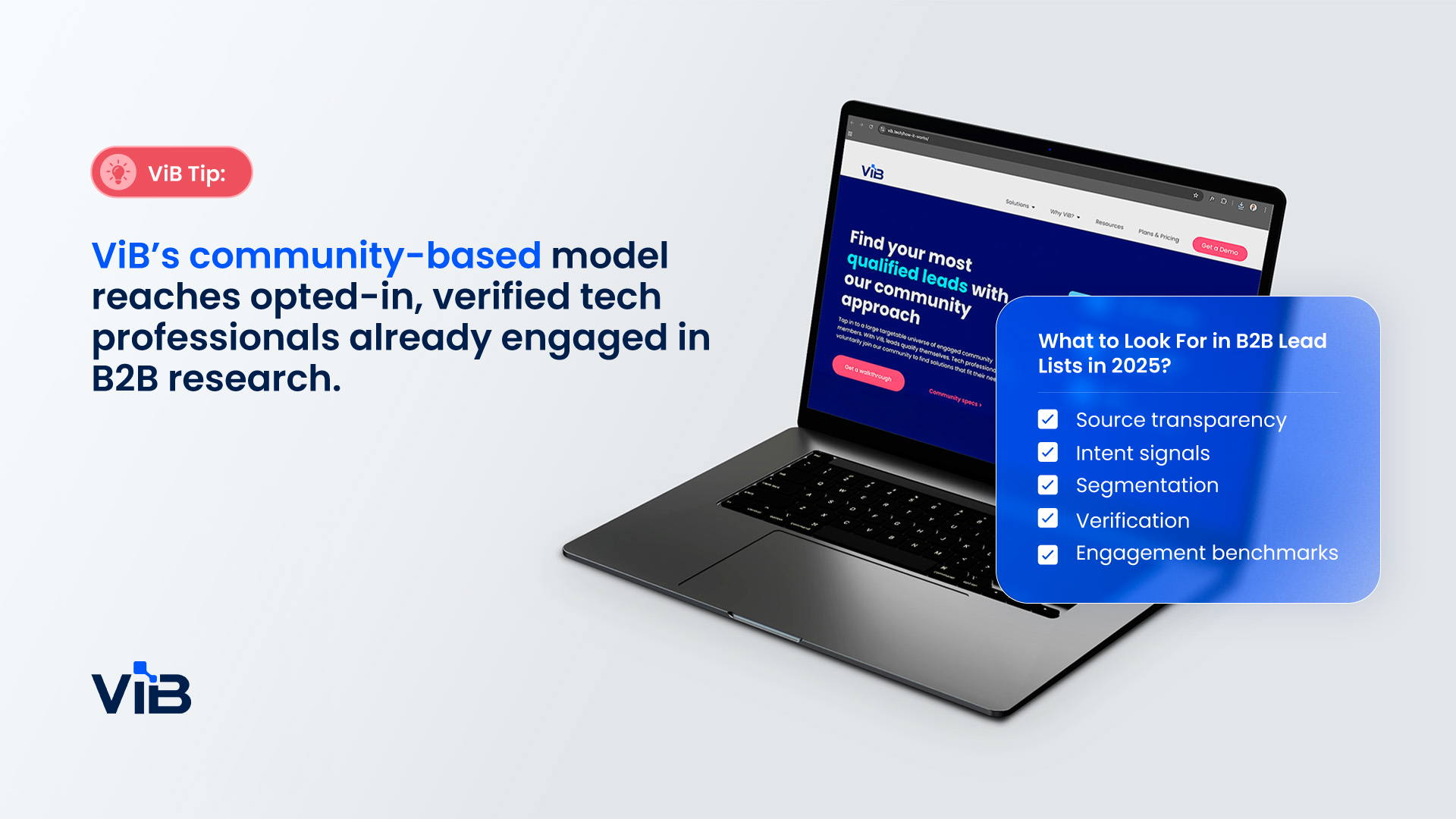
What to look for in B2B lead lists in 2025
Here’s a quick checklist for vetting a lead list before purchasing:
- Source transparency – Is it scraped, purchased, or community-sourced?
- Intent signals – Does the list include behavioral data like content engagement or product searches?
- Segmentation – Can you filter by role, industry, company size, or pain points?
- Verification – Are email addresses and job titles validated recently?
- Engagement benchmarks – Ask for open, click, and reply rates from past campaigns.
(ViB Tip: Unlike cold data dumps, ViB’s community-based model reaches opted-in, verified tech professionals already engaged in B2B research. Learn how ViB net-new leads work.)
Top B2B lead list providers
These platforms focus on delivering accurate, compliant B2B contacts—often enriched with buyer intent and advanced filters.
ViB Deal Intent
ViB leverages its 10M+ IT buyer community to pinpoint the right decision-makers for its clients. Instead of handing you a static list, ViB identifies who is actively researching solutions like yours that align with your ICP, then aligns those accounts to your ICP and use case.
Cognism
A leader in GDPR- and CCPA-compliant data with extensive global coverage, phone-verified mobile numbers, and robust enrichment. Strong for teams targeting multiple regions that need direct dials and compliant workflows.
ZoomInfo
A widely known provider combining a large database with advanced filters, intent data, and deep integrations with sales and marketing platforms. Popular for scale and segmentation.
Apollo.io
Balances affordability and functionality with millions of verified contacts, built-in engagement workflows, and intent signals. A favorite for startups and mid-market teams.
Saleshandy Lead Finder
Offers a large contact universe with accuracy guarantees and AI-driven filtering, helping teams pinpoint decision-makers that fit narrow ICP criteria.
Lusha
Lightweight prospecting via a browser extension and integrations. Good for teams that want quick list building without a heavy stack.
How to vet marketing list providers in 2025
1. Ask providers where their data comes from—and how often it’s refreshed
Make sure your vendor isn’t relying on scraped data or outdated directories. Look for marketing list providers who collect first-party data or who partner with communities where professionals opt in with intent. Ask if their data is refreshed quarterly—or better yet, in real time.
2. Test with a pilot campaign
Before you commit to a full program, run a test with a segment of the list. If your open rates are below 15% and bounce rates above 5%, it’s likely not worth the cost.
3. Confirm privacy compliance
Ensure the provider adheres to current GDPR and CCPA regulations. Request documentation demonstrating their compliance practices, including data processing agreements and privacy policy disclosures.
4. Request engagement benchmarks upfront
Ask providers for average email engagement rates from recent client campaigns. Providers with consistent open rates above 20% and click-through rates above 5% are typically worth considering.
5. Prioritize opt-in, community-based lists
Community-sourced leads consistently deliver higher engagement, response rates, and ROI compared to cold outreach—generating up to 2X reply rates. Because these leads voluntarily opt in, they’re already warm and intent-driven, making them significantly more likely to engage with your campaigns.
🚫 Red flags to avoid when buying B2B lead lists
- Too-good-to-be-true pricing – It usually means the data’s unverified
- No targeting granularity – If you can’t filter by role, tech stack, or buying stage, you’ll waste budget
- Black-box delivery – You should know how your list was built, how often it’s updated, and where each contact came from

How to safely use purchased email lists in 2025
To avoid the pitfalls, follow this five-part checklist:
1. Validate before you send
Run every list through an email verification tool to catch invalids, duplicates, and role-based addresses (like info@ or sales@). Cleaning your list improves deliverability, avoids bounces, and protects your sender reputation. Re-verify lists regularly to keep them fresh and effective.
2. Segment with care
Don’t treat every contact the same. Segment by job title, industry, company size, or pain points, and tailor your messaging to each group. Personalized emails get more opens and replies. A VP of IT at a Fortune 500 company won’t respond to the same message as a small business owner. Match your content to the audience.
3. Warm your domain
Avoid blasting cold lists. Gradually increase email volume to build sender trust. Warming up your domain helps improve inbox placement and avoids spam traps. Start with your most engaged contacts before scaling.
4. Add value before asking
Don’t lead with a pitch. Share useful content first—like a how-to guide, webinar, or report—to build trust. Once they see value, introduce your offer. Giving before asking increases engagement and long-term conversion.
5. Track performance against benchmarks
Track metrics like open rates, CTR, spam complaints, and unsubscribes to gauge list quality and message fit. Use these benchmarks as a baseline for evaluating success:
| Metric | 2025 Benchmark (B2B) | What it means |
| Open rate | 20.8% | Subject lines and sender trust matter more than ever |
| Click-through rate | 3.2% | Strong content and CTAs drive clicks |
| Bounce rate | 2% | High = bad list hygiene or deliverability issues |
| Unsubscribe rate | 0.24% | Higher = irrelevant or overly frequent emails |
| Conversion rate | 2.5% | Offer quality and audience targeting are key |
What makes a B2B email successful?
Now that we’ve covered how to grow your email list, let’s move on to the second part of the equation: crafting the campaign.
Here are the key elements to focus on:
- A hyper-relevant audience (quality over quantity!)
- Clear, value-driven subject lines
- Concise, skimmable content
- Strong CTAs that guide next steps
- A/B testing for subject lines, formats, and timing
Now, let’s get into the examples that bring this to life.
7 B2B email marketing examples to nurture leads
The value-first nurture email
Example: An IT services company regularly shares 2-minute video tips with its mid-funnel leads, like “3 ways to cut cloud costs in 2025.”
Why it works: Instead of pushing a product, this brand delivers quick wins. Thus, it’s educational, relevant, and builds trust over time, priming leads for a deeper conversation later.
The intent-driven outreach
Example: A cybersecurity company sends a targeted offer to contacts who recently viewed a security checklist on their site, offering a free audit with their next consultation.
Why it works: This email capitalizes on recent engagement. It’s personalized, time-sensitive, and built on actual intent.
The thought leadership spotlight
Example: A data analytics company features its CMO’s new guest article—“Why AI dashboards are failing your sales team”—and invites readers to download the full guide.
Why it works: It elevates the brand as a credible voice while subtly introducing a product pain point. No hard sell, just relevance.
The event invite that doesn’t feel like an invite

Example: Instead of a traditional “Save your seat” email, a tech brand sends an invite that starts with “You’re not the only one tired of webinars that waste your time…” and teases a high-energy roundtable with gift card incentives.
Why it works: It leads with empathy, breaks the mold, and creates curiosity—all while delivering a clear CTA.
The re-engagement campaign that gets replies
Example: A SaaS brand sends a short email from a sales rep: “Still exploring tools to speed up [X] in Q3?” with a one-click survey to qualify interest.
Why it works: It feels personal, not automated. And the low-effort response makes it easy for dormant leads to re-engage.
The quarterly roundup email
Example: A cloud infrastructure brand sends a digest with: “Here’s what your peers are reading this quarter,” including their top webinar recording, blog, and a relevant case study.
Why it works: It’s curated, relevant, and focused on peer validation—a key trust builder in B2B buying journeys.
The customer success email
Example: A DevOps company sends a spotlight email highlighting how a fintech client reduced deployment time by 37%, including a video testimonial.
Why it works: Case studies are one of the most persuasive tools in B2B. This one tells a clear before-and-after story, with metrics to back it up.
How ViB solves the email list problem

At ViB, we understand that you need high-quality leads, not just names in a spreadsheet.
ViB Deal Intent delivers verified, in-market leads matched to your ICP, with behavioral intent signals like webinar attendance, report downloads, and topic interest.
ViB Emails helps you turn those warm contacts into booked meetings with targeted, fully compliant outreach.
With both solutions together, you get:
- Verified, first-party leads from 2M+ tech buyers
- Advanced segmentation for pinpoint targeting
- Real-time validation to avoid bounces
- Engagement benchmarks 2.5x higher than cold lists
No list scraping. No spam risks. Just meaningful reach, delivered to an engaged audience.
Side-by-side: ViB vs. email list brokers
| Feature | Traditional Email List Brokers | ViB |
| Audience opt-in | Rarely | 100% opt-in |
| Intent-based targeting | No | Yes |
| Data freshness | Often outdated | Continuously verified |
| Compliance-friendly | Risky | Fully compliant |
| Campaign management | Do-it-yourself | Fully managed + optimized |
| Results & reporting | Limited visibility | Transparent, actionable metrics |
| Lead quality | Low | High |


