 Skip to content


Traffic volatility usually gets blamed on algorithms. That’s a real issue, but it’s only part of the story.
In B2B, your traffic is a lagging indicator of buyer attention. And buyer attention is increasingly fragmented across anonymous research, internal consensus building, and long “no form fill” stretches.
So when your traffic drops, it’s not always because your messaging broke. Sometimes it’s because your distribution did—and that’s exactly where targeted email marketing services for stabilizing B2B traffic can help.
Many B2B teams rely on a stack that’s great at capturing demand, but inconsistent at generating steady awareness and repeat visits.
A typical pattern looks like this: one strong webinar month spikes traffic, followed by a quiet month. A single paid campaign props up sessions, then CAC pressure forces a pullback. A product launch drives a surge, then attention drifts.
Targeted email marketing services help close that distribution gap by giving you an external lane—publisher lists, communities, opt-in partner audiences, or dedicated sends—to put the right message in front of the right ICP slice on a predictable cadence.
In this article, we’ll explore the top targeted email marketing services for B2B, how to evaluate partners to find the right one for your business, and common pitfalls to avoid.
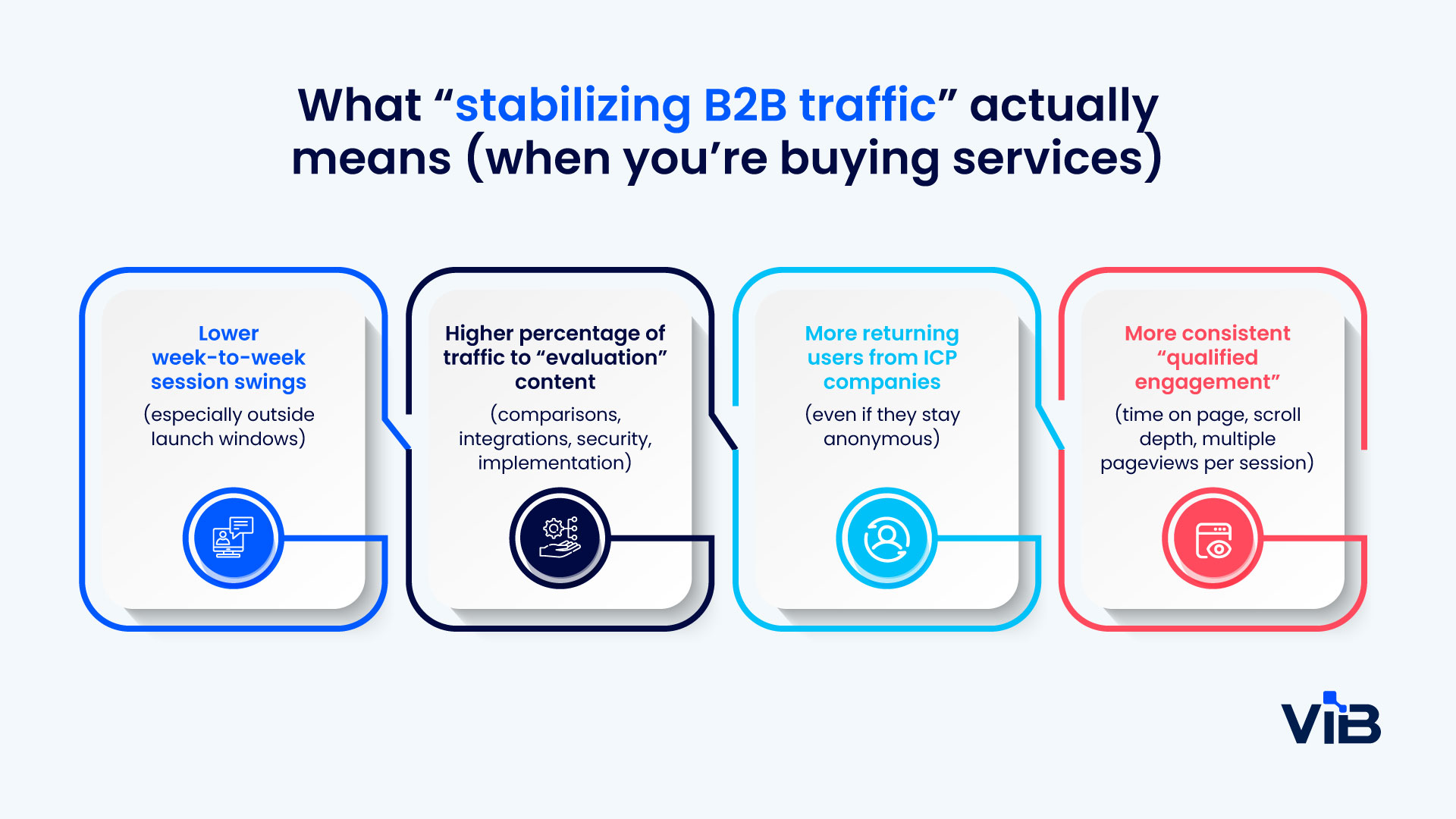
What “stabilizing B2B traffic” actually means (when you’re buying services)
Stabilizing traffic isn’t about hitting a single monthly quota. It’s about reducing variance and increasing downstream quality indicators: repeated visits from target accounts, higher engagement on key pages, and content paths that match real evaluation behavior.
When you’re using targeted email marketing services, stability is usually visible in:
- Lower week-to-week session swings (especially outside launch windows)
- Higher percentage of traffic to “evaluation” content (comparisons, integrations, security, implementation)
- More returning users from ICP companies (even if they stay anonymous)
- More consistent “qualified engagement” (time on page, scroll depth, multiple pageviews per session)
Email is uniquely good at this because it’s schedulable and repeatable. With the right service partner, you also get cleaner reporting than many other top-of-funnel options.
Top targeted email marketing service options for B2B tech marketers (what to consider)
“Top services” depend on your buyer (developers vs. security vs. IT leadership), your offer (ungated asset vs. demo), and whether you’re prioritizing traffic consistency, lead capture, or account reach. The most common provider types B2B tech teams shortlist are:
- Tech professional communities (high relevance, strong engagement; great for consistent, qualified sessions)
- B2B publisher newsletter networks (broad reach; strong for steady sponsorship-driven traffic)
- Intent/data-driven ABM distribution partners (best when you need account and tech-fit controls)
- Content syndication networks (best when you need volume + contact capture, with quality safeguards)
- Vertical specialists (e.g., security, cloud, data, DevOps, ITSM) that can target deep job-function segments
The win isn’t “high opens.” The win is repeatable, attributable site traffic from the right audience—on a schedule you can plan around.
Rule of thumb: If a provider can’t clearly explain who the audience is, how they opted in, and what “targeting” actually means, it’s not built for stability—it’s built for volume.
Top 5 targeted email marketing vendors for stabilizing B2B traffic
Below are five widely used vendor options B2B tech teams consider when they want predictable, schedulable traffic from external email distribution. Each one maps to a different strategy (community sends, newsletter sponsorships, intent-driven targeting, or content syndication).
1) ViB Emails
What it is: ViB Emails sends your campaign to thousands of targeted high-tech prospects in its community to amplify your message, offer, or event.
- Pros: Tech-audience alignment; ICP targeting; schedulable sends; straightforward “bring your HTML + landing page” execution for fast test cycles.
- Cons: Specializes in the B2B tech community; may not be a good fit for other B2B segments.
When it’s a great fit: You want to smooth out traffic between launches by running monthly/biweekly sends to relevant tech segments and iterating on angles that drive repeat engaged sessions (not just clicks).
2) Demandbase (Advertising + intent-driven account targeting)
What it is: An ABM platform typically used to identify, prioritize, and engage target accounts across channels using firmographic and intent signals. While not an “email blast” vendor, it’s often shortlisted for traffic stabilization when the primary KPI is repeat visits and engagement from a specific account list.
- Pros: Strong account controls; good for smoothing traffic from strategic accounts; pairs well with always-on content promotion and retargeting.
- Cons: Not a pure email distribution product; setup and measurement can be heavier than newsletter sponsorships; can be cost-prohibitive for smaller programs.
3) RollWorks (ABM for teams that want account-focused consistency)
What it is: An ABM platform commonly used for account targeting and engagement across channels. Like Demandbase, it’s not primarily an email-list vendor, but it’s frequently used to stabilize traffic quality by keeping your brand in front of specific accounts continuously.
Key details to confirm: targeting granularity, account matching coverage in your regions, reporting by account segment, and how you’ll coordinate ABM “air cover” with periodic email distributions.
- Pros: Account-centric measurement; strong for always-on awareness and repeat visits; can complement email programs by sustaining demand between sends.
- Cons: Not a direct email sponsorship/blast provider; results depend on creative, audience selection, and your ability to keep landing pages aligned with account intent.
4) NetLine (Content syndication network)
Best for: When you want distribution plus potential contact capture (registrations) and are willing to manage lead-quality controls tightly.
What it is: A B2B content syndication network used to promote gated assets (and sometimes ungated content) to opt-in audiences across its distribution. Often used to drive a steadier flow of content consumption while also generating contacts.
Key details to confirm: lead/registration validation methods, suppression options (customers/competitors), field requirements, refund/replacement policy for bad data, and how traffic vs. lead goals are balanced.
- Pros: Can combine traffic and measurable capture; scalable volume; useful for always-on asset promotion across multiple personas.
- Cons: Quality varies by segment and asset; can over-index on form fills vs. true engagement; requires strong routing/nurture to convert into stable pipeline signals.
5) LaunchBit (Newsletter sponsorship marketplace)
What it is: A marketplace/platform used to buy newsletter sponsorship placements across publisher and creator newsletters. This model can be effective for traffic stability because it allows you to reserve recurring placements and diversify across multiple “watering holes.”
Key details to confirm: newsletter vetting standards, audience transparency (subscriber makeup, engagement), brand adjacency controls, whether placements are fixed or auction-based, and what post-campaign reporting you receive.
- Pros: Good for building a repeatable cadence; diversification across newsletters can reduce volatility; typically strong brand-safe placement context when chosen carefully.
- Cons: Performance varies widely across individual newsletters; you may need multiple tests to identify stable “winners”; some placements optimize for clicks rather than deep on-site engagement.
Questions to ask targeted email marketing service providers (use this as a buying checklist)
To keep the focus on traffic stabilization (not vanity metrics), use questions that reveal audience quality, targeting control, and repeatability.
Audience sourcing and consent
- How is the list built (first-party subscribers, partners, co-reg, events)?
- What is the consent model, and how do subscribers opt out?
- How do you manage list hygiene (bounces, inactivity, role changes)?
- Can you explain what “targeted” means operationally (filters available, minimum counts, exclusions)?
Targeting and fit (B2B tech specifics)
- Can you target by job function + seniority (e.g., security leadership vs. practitioners)?
- Can you target by industry, company size, and region?
- Do you support technographics or “tech context” targeting (where relevant)?
- Can you apply account lists (ABM) or exclude current customers/competitors?
Execution, creative, and brand control
- Is this a dedicated send, a newsletter placement, or a native unit?
- Do you support HTML provided by us, or do you rebuild from copy?
- Do you enforce creative requirements (CAN-SPAM/GDPR language, disclaimers, design constraints)?
- Will you share past examples of sponsor placements so we can assess brand adjacency?
Measurement and traffic quality (not just leads)
- What reporting do we get (opens/clicks, device, geo, segment-level performance)?
- Can you pass UTM parameters consistently and on all links?
- Do you provide post-campaign insights (top-performing subject lines, CTA placement learnings, segment deltas)?
- What does “success” look like for your best B2B tech clients beyond CTR (engaged sessions, return visits, content depth)?
Cadence and repeatability (the stability test)
- Can we reserve slots in advance (e.g., monthly/biweekly) to smooth traffic?
- How do you prevent audience fatigue if we run multiple sends?
- What’s your recommended testing plan (segments, creative variants, landing pages) before we scale?
- Are there volume discounts or packages for always-on programs?
Common pitfalls when buying targeted email marketing services (and how to avoid them)
- Buying reach over relevance: Massive sends to loosely defined audiences create noisy traffic that doesn’t return.
- Over-optimizing to CTR: Clicky creative can inflate sessions but reduce on-site engagement (and hurt stability long-term).
- No plan for repeat runs: One send can spike traffic; stability comes from repeatable placements and learnings.
- Weak landing page alignment: “Good email + generic landing page” often produces single-page sessions and low return intent.
- Unclear tracking: If UTM discipline is inconsistent, you can’t learn what’s actually stabilizing traffic.

Conclusion: Stabilize traffic by choosing the right external email distribution partners
Stabilizing B2B traffic is less about finding one “winning channel” and more about building reliable distribution you can run repeatedly.
Targeted email marketing services for stabilizing B2B traffic work best when you treat them like a media channel you can plan and optimize: choose providers with clear audience sourcing, real targeting controls, consistent reporting, and the ability to run an always-on cadence.
Do that well, and your traffic stops being a monthly surprise. It becomes a controllable input you can plan around.


