 Skip to content


If you’re searching for outsourced B2B lead generation, you’re probably looking for a partner that can reliably reach the right accounts, produce real engagement signals, and help your team focus time on the prospects that actually match your ICP.
This guide compares common outsourced lead gen models, what experienced SaaS marketers should ask before signing, and a shortlist of vendors worth evaluating, including ViB.
What “outsourced B2B lead generation” really means in 2026
The term is overloaded. One vendor may mean “outsourced SDR appointment setting.” Another may mean “content syndication,” “intent data,” or “performance marketing with guaranteed volume.”
So before you compare logos and pricing sheets, it helps to map the landscape by how leads are sourced and what you’re actually paying for.
The four main outsourced lead gen models
Most outsourced B2B lead generation vendors fall into one (or more) of these buckets.
- Outbound SDR/appointment setting: They build lists, run email/LinkedIn/calls, and deliver booked meetings.
- Content syndication/lead capture: They distribute your asset to an audience and deliver form fills or opt-ins.
- Community/first-party opt-in networks: They engage an owned or operated audience and deliver opted-in leads that match your ICP.
- Intent and signal providers: They identify accounts showing interest signals, then you activate those signals with your own programs.
Many marketers mix these. For example, you might use syndication to capture early-stage engagement, and outbound SDR support to convert warmed accounts into meetings.

What to ask any outsourced B2B lead generation vendor (before you talk budget)
The fastest way to waste a quarter is to evaluate vendors on volume and unit price alone. Experienced teams pressure-test fit, process, and proof.
1) What’s the sourcing method: rented audiences, scraped data, or opt-in?
This one question explains most “great CPL, disappointing outcomes” stories.
Some vendors rely heavily on scraped or compiled contact lists. Others rely on publisher inventory. Others use a community model where members opt in to topics and programs.
For example, ViB’s approach is built around a proprietary community where members opt in to programs and can consent to be contacted, which is a different starting point than a list-first outbound motion.
2) How tight can targeting get inside your ICP?
“We can target cybersecurity” isn’t targeting. For experienced SaaS marketers, targeting means the specifics that make your ICP your ICP.
- Firmographics: company size bands, regions, industries
- Technographics: known tools, cloud providers, security stack, data warehouse, etc.
- Role and buying group: not just “IT,” but the exact functions and seniority
- Use case and context: the “why now” that makes your message relevant
Permission-based declared intent from specialized providers can add project context such as timelines, business priorities, and stakeholder roles instead of relying only on inferred behavioral signals. Evaluate how this information is collected, how recent it is, and whether it includes appropriate consent.
3) What counts as “qualified,” and who decides?
Qualification is where outsourced lead gen relationships either become scalable or become weekly arguing.
At minimum, define qualification across role fit, account fit, and engagement or declared interest. If a vendor offers pay-per-qualified-lead, get the definition in writing and align it to your actual ICP and routing rules.
4) What’s the expected timeline for signal generation?
Not every channel produces outcomes on the same clock. Community and syndication motions can generate engagement quickly, while sales-led conversions often lag behind. Your vendor should be honest about what’s realistic in weeks 1–4 versus month 3.
Buyers conduct a large portion of their journey before talking directly with vendors, which is why early-stage engagement and signal capture matter.
Comparison shortlist: outsourced B2B lead generation vendors to evaluate
Below is a practical comparison list, organized by primary model. This isn’t a “best of” ranking. It’s a shortlist of vendors that represent common approaches you’ll see in the market.
If you’re building a vendor scorecard, consider adding columns for sourcing method, ICP targeting depth, lead definition, QA process, and engagement reporting.
1) ViB: community-based, opt-in lead delivery with pay-per-lead options
ViB is a good fit when your goal is to prioritize ICP match and opt-in engagement signals, not just contact volume.
Our approach is based on our ViB Community, our proprietary network of high-tech professionals, segmented and nurtured around topic interests. Members can opt in to receive content or participate in vendor-led experiences, so you know you’re reading people who are interested in hearing from you.
How ViB fits a modern lead gen stack: It’s typically most useful earlier in the buyer journey, when you want to create measurable engagement, validate account fit, and generate actionable signals your team can follow up on.
What to look at in the ViB product mix:
- ViB Syndication: promote existing content to matched community members to drive opted-in lead capture.
- ViB Emails: reach the community through vendor-controlled messaging and landing pages, with an emphasis on targeting and lead-capture outcomes.
2) Closinx: outsourced SDR and appointment setting
Closinx positions around outsourced SDR and appointment setting, with messaging focused on outbound prospecting and buying-signal list building.
This model is usually best when you already know your ICP, have clear positioning, and want consistent outbound activity without hiring and ramping an internal SDR team. The risk is that outbound can drift into high volume if messaging and list quality aren’t tightly managed.
3) Konsyg: sales outsourcing plus lead generation services
Konsyg operates in the sales outsourcing and lead generation space, with an emphasis on supporting B2B technology companies.
If your organization wants a partner to run more of the outbound system end-to-end, this “outsourced sales execution” style vendor can be a fit. Just be clear about handoff points, messaging approvals, and what data you get back for learning and iteration.
4) SysBlueprint: pay-per-qualified-meeting positioning
SysBlueprint markets a model where you pay per qualified meeting, with supporting claims around managing tooling and outreach infrastructure.
This can work if your sales team is optimized for meetings and fast follow-up. But it can be a mismatch if your motion needs deeper pre-meeting validation, or if your ICP is narrow and requires careful personalization beyond templated outbound.
5) Centergrowth: managed lead generation system positioning
Centergrowth describes an in-house-built system approach for B2B lead generation, emphasizing control of the stack and process.
This type of vendor can appeal to teams that want a more “systemized” partner, where reporting, calling, and process are standardized. Your evaluation should focus on whether their system adapts well to your specific ICP and category nuances.
6) LeadHaste: outbound lead generation with a modern toolchain
LeadHaste publishes a toolchain-style view of outbound lead generation, referencing common data sources and enrichment tools.
This vendor profile can be useful if you want transparency into the data + enrichment workflow. The key question is whether you’re paying for tools, labor, or outcomes, and how they measure lead quality beyond deliverability and reply rates.
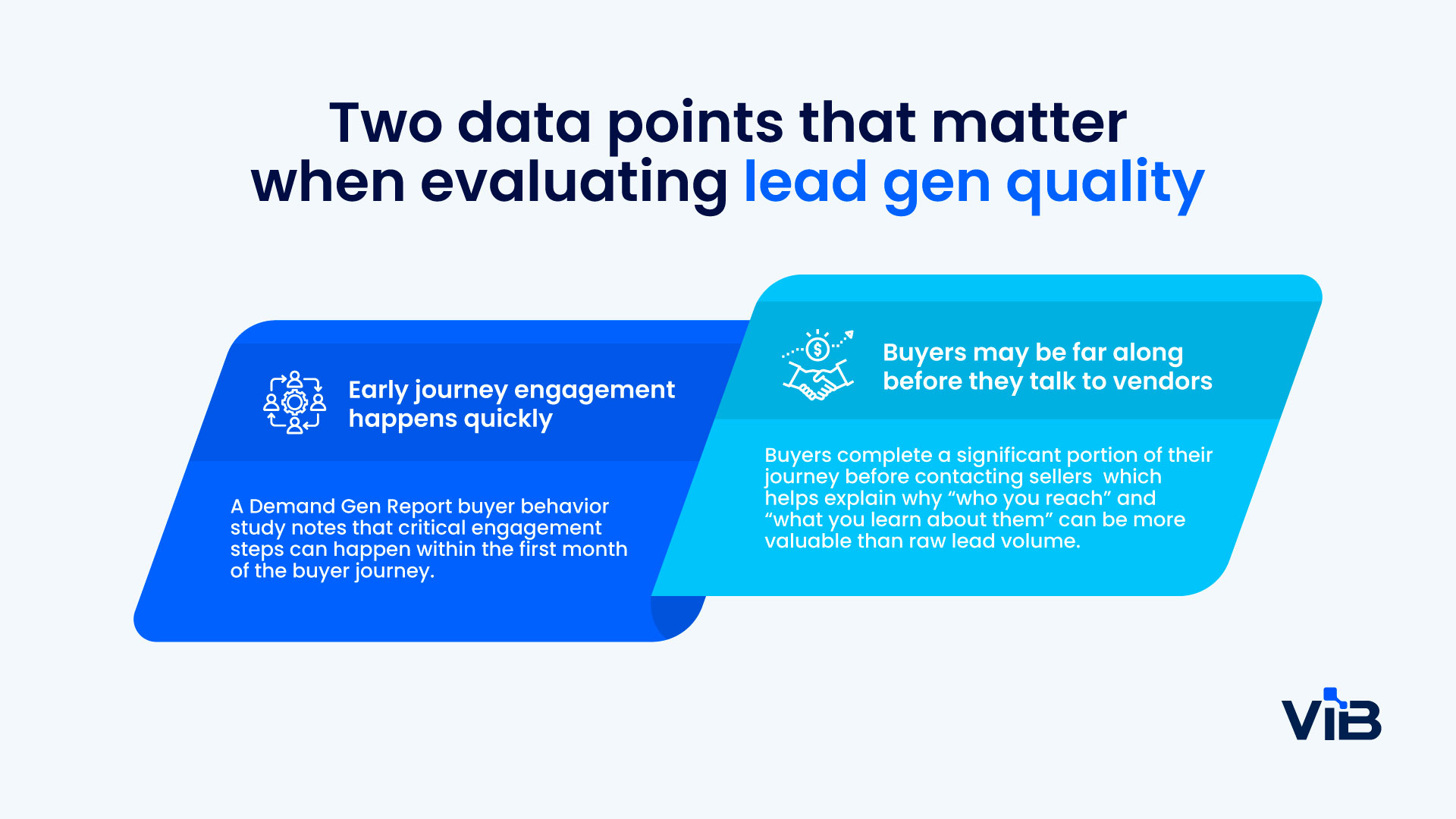
Two data points that matter when evaluating lead gen quality
You don’t need a dozen benchmarks. You need a couple that keep everyone honest.
1) Early journey engagement happens quickly
A Demand Gen Report buyer behavior study notes that critical engagement steps can happen within the first month of the buyer journey, reinforcing why early signal capture and speed of follow-up matter.
2) Buyers may be far along before they talk to vendors
Buyers complete a significant portion of their journey before contacting sellers, which helps explain why “who you reach” and “what you learn about them” can be more valuable than raw lead volume.
Final section: where ViB fits (without pretending it does everything)
If you’re building an outsourced B2B lead generation mix that’s optimized for ICP fit and real engagement signals, ViB is a practical vendor to include in your comparisons.
Conclusion: a smarter way to evaluate outsourced B2B lead generation
The best outsourced lead gen decision usually isn’t the cheapest one. It’s which model matches your ICP, our channel mix, and how you define a qualified lead.
Start by getting crisp on sourcing method and qualification. Then compare vendors across targeting depth, transparency, and the quality of engagement signals you’ll get back.
If your team values opted-in audiences, first-party style engagement, and pay-per-lead options tied to ICP fit, ViB belongs on your shortlist alongside outbound and performance-based providers.


