 Skip to content


Cybersecurity lead generation is a complex category: It involves longer sales cycles, bigger buying committees, higher proof and trust requirements, and constant noise from vendors chasing the same accounts. That’s why it can be trickier to evaluate the best cybersecurity lead generation companies.
Some overpromise leads without any direct access to the B2B tech space. Others flag every online action as a buying signal, without any real context or intent.
And even the best lead gen companies might not be the right fit for you, depending on their solutions. Some vendors help you identify which accounts are showing signals, some help you prioritize buying groups based on research or comparison behavior, and others help you activate that intent into verified, sales-ready conversations.
That’s why we’ve rounded up the best cybersecurity lead generation companies to consider in 2026—plus simple strategies to pick the right partner based on what you actually need: better targeting, better timing, or better conversion to next steps.
The main types of cybersecurity lead generation vendors (and when each wins)
Most vendor lists lump everyone together. That makes shortlists messy, because you end up comparing tools that do different jobs.
Instead, anchor your evaluation on the job-to-be-done. There are four common “jobs” that cybersecurity lead generation vendors typically do:
- Intent and account prioritization: Identify which accounts are heating up, and on what topics.
- ABM orchestration: Unify data, buying stage, audiences, and activation across channels.
- Content syndication and lead capture: Distribute gated content and collect opted-in contacts.
- Lead operations and governance: Cleanse, standardize, route, and de-duplicate leads across sources.
Many teams need a blend. But you’ll buy smarter if you decide which job is primary, then fill the gaps.

The best cybersecurity lead generation companies in 2026 (shortlist)
Below is a practical shortlist. It’s intentionally mixed across the “jobs” above, because most mature teams use a combination.
Not all of these firms position themselves as “cybersecurity-only,” but they’re commonly evaluated for cybersecurity GTM because they support B2B tech with long sales cycles and complex committees.
ViB
Best for: Reaching targeted cybersecurity audiences through email campaigns, webinars, content syndication, and qualified appointment setting
Why it makes this list: ViB combines access to an opted-in technology community with managed demand generation programs designed for complex B2B buying groups.
Strengths: Permission-based technology audience; strong ICP targeting; multiple campaign formats
Watch-outs: Requires a clear ICP, relevant content or offers, and a defined follow-up process to turn engagement into pipeline
Good fit if: You need a managed demand generation partner to expand targeted reach and support measurable engagement across cybersecurity audiences
Informa TechTarget
Best for: Reaching technical buyers during active research phases
Why it makes this list: Delivers first-party intent based on observed research behavior across a large, permissioned audience.
Strengths: High-fidelity research signals; strong IT audience; buying-group visibility
Watch-outs: Requires strong follow-up and operationalization to convert insight into pipeline
Good fit if: You sell to IT and security stakeholders and want content-aligned intent tied to real research activity
Bombora
Best for: Broad account discovery and early-stage intent signals
Why it makes this list: Provides large-scale third-party intent data from its Data Cooperative.
Strengths: Scale; wide coverage; useful for segmentation and trend identification
Watch-outs: Topic surges don’t always indicate real buying intent
Good fit if: You need a wide lens across accounts to inform ABM, outbound, or paid programs
Demandbase
Best for: Account-based targeting, engagement, and measurement
Why it makes this list: Unifies intent, CRM data, and engagement signals to drive account-level execution.
Strengths: Strong targeting and reporting; ABM-focused workflows
Watch-outs: Value depends on execution, not just platform adoption
Good fit if: You’re running a mature ABM program and need better coordination and measurement
6sense
Best for: Prioritizing accounts and orchestrating multi-channel ABM programs
Why it makes this list: Combines intent data with predictive modeling to identify buying stage and coordinate engagement.
Strengths: Buying-stage insights; multi-channel orchestration; account scoring
Watch-outs: Requires process maturity and consistent usage to deliver value
Good fit if: You want a platform layer to turn signals into repeatable GTM plays
NetLine
Best for: Scaling opt-in leads through gated content distribution
Why it makes this list: Large content syndication network designed to drive lead volume.
Strengths: Scale; predictable lead flow; broad reach
Watch-outs: Lead quality varies; requires strong filtering and follow-up
Good fit if: You need to drive top-of-funnel volume and have the nurture systems to qualify leads
Integrate
Best for: Managing lead quality, compliance, and routing across vendors
Why it makes this list: Focuses on improving the consistency and reliability of lead flow.
Strengths: Data governance; validation; operational control
Watch-outs: More valuable as a complement to other vendors than a standalone solution
Good fit if: You’re running multiple lead sources and need better quality control and standardization
G2 Buyer Intent
Best for: Capturing in-market buyers actively comparing vendors
Why it makes this list: Surfaces intent from review-site activity and competitor comparisons.
Strengths: Strong for competitive positioning; clear late-stage signals
Watch-outs: Limited value for early-stage discovery
Good fit if: You compete in a crowded category and need visibility into shortlist behavior
ZoomInfo
Best for: Building account lists, enriching contacts, and enabling outbound
Why it makes this list: Provides broad contact and company data to support execution at scale.
Strengths: Data coverage; enrichment; buying-group mapping
Watch-outs: Doesn’t create demand on its own—needs to be paired with intent or campaigns
Good fit if: Your GTM motion relies heavily on outbound and account coverage
Belkins
Best for: Outbound campaigns and appointment setting
Why it makes this list: Delivers structured outreach programs focused on booked meetings.
Strengths: Execution consistency; campaign management; meeting generation
Watch-outs: Requires strong ICP and messaging to avoid generic outreach
Good fit if: You want predictable outbound execution with a focus on meetings
Martal Group
Best for: Managed outbound and sales development programs
Why it makes this list: Combines outbound execution with ongoing optimization and messaging iteration.
Strengths: Scalable outreach; flexible engagement; iterative approach
Watch-outs: Performance depends on tight alignment and continuous refinement
Good fit if: You need outsourced SDR support with ongoing optimization
ABM Agency
Best for: Highly targeted, account-based campaigns
Why it makes this list: Specializes in one-to-one and one-to-few ABM programs.
Strengths: Personalization; enterprise focus; campaign orchestration
Watch-outs: Less suited for high-volume lead generation
Good fit if: You’re running named-account strategies where quality matters more than volume
CyberEdge Group
Best for: Cybersecurity-specific marketing and demand generation
Why it makes this list: Deep category expertise and established presence in the cybersecurity market.
Strengths: Industry credibility; targeted audience access; research-driven programs
Watch-outs: Narrower scope compared to full-service agencies
Good fit if: You want a partner with deep cybersecurity domain expertise and audience access
How to evaluate cybersecurity lead generation vendors without getting fooled by volume
The most common mistake in cybersecurity lead generation is treating all leads as equal.
They’re not.
A downloaded asset from a student, a single-threaded contact at a non-ICP account, and a multi-role buying group actively researching your category may all show up as “leads”—but they don’t carry the same value.
Instead of measuring volume, evaluate vendors based on how they improve four things: targeting, timing, buying-group coverage, and activation.
Match the agency to your GTM motion
Start by aligning the vendor with how you actually sell.
- Enterprise cybersecurity sales: Prioritize ABM orchestration, account-level engagement, and multi-role visibility
- Mid-market with a clear wedge: Outbound can work—but only if messaging is technically credible
- New or complex categories: Focus on content, education, and distribution before expecting conversion
If the vendor’s model doesn’t match your motion, more leads won’t fix it.
Validate data provenance and permissioning
In cybersecurity, poor data sourcing isn’t just inefficient—it’s a brand risk.
You should be able to answer:
- Where do the signals come from?
- Are contacts permissioned?
- How is engagement observed and validated?
Vague “AI intent” claims without clear sourcing are a red flag. Strong vendors can explain their data in plain terms.
Evaluate buying-group coverage, not just lead quality
Cybersecurity deals are rarely won through a single contact.
You need engagement across the entire buying group, from security leadership to IT and architecture to procurement or compliance.
In a pilot, measure whether the vendor can consistently surface multiple stakeholders within the same account over time.
If you only get one persona, deals will stall later.
Focus on engagement quality, not just form fills
A lead without context creates more work, not more pipeline.
Prioritize vendors that provide:
- Clear engagement signals (topics, behaviors, timing)
- Context for outreach (what triggered the interaction)
- Evidence of real interest (repeat activity, deeper consumption)
If your SDRs have to restart discovery from zero, the lead isn’t qualified.
Design your pilot around speed and relevance
Most pilots fail because they measure the wrong thing.
Instead of asking, “How many leads did we get?”, ask:
- Did we reach the right accounts?
- Did engagement align with real use cases?
- Did we generate signals that sales could act on immediately?
Operationally, that means:
- A defined account list
- Clear signal thresholds
- Pre-mapped messaging and follow-up
Without this structure, even strong vendors look weak.
Evaluation criteria that actually matter in cybersecurity
Use this as a practical scorecard:
- ICP precision: Can the vendor target accounts you can realistically win?
- Signal quality: Are interactions tied to real buying behavior?
- Buying-group depth: Are multiple roles engaged within accounts?
- Channel alignment: Does the delivery method match how security buyers learn?
- Data transparency: Can they clearly explain their sourcing and validation processes?
- Handoff quality: Does sales get usable context, not just contact info?
If a vendor can’t explain how they qualify leads in plain English, assume it’s shallow.
Cybersecurity lead generation pricing: What you’ll actually pay
Once you’ve narrowed down the right type of cybersecurity lead generation vendor, the next challenge is understanding cost.
And this is where most teams get it wrong—not because pricing is unclear, but because they’re measuring the wrong thing.
Most teams treat “cybersecurity lead generation cost” as a single number: CPL. That’s a problem because cybersecurity buying journeys are committee-led, proof-heavy, and risk-sensitive.
This section is a practical framework for experienced B2B SaaS and tech marketers who need to budget, forecast, and negotiate cybersecurity lead generation pricing without getting trapped in vanity CPLs.
We’ll cover pricing models, what actually drives cost, the benchmarks that matter, and how “deal-intent” thinking changes what you should pay for.
Your true cost depends on what you count as a lead, what stage it represents, and how much work it takes to turn that interaction into real buying intent.
Benchmarks
Benchmarks shouldn’t define your strategy, but they can be useful to anchor negotiations with a few credible reference points.
WordStream’s 2025 benchmark analysis shows an average CPL of $70.11 across Google Ads, up from $66.69 in 2024.
And if you’re leaning on LinkedIn for enterprise security audiences, expect higher costs. One set of LinkedIn benchmark estimates puts cybersecurity CPLs in the $90–$200+ range, depending on the offer and funnel depth.
The takeaway: You can’t evaluate cybersecurity lead generation pricing without defining what a “lead” is in your system and what level of intent you’re trying to buy.
Pricing models you’ll see (and what each model incentivizes)
Different vendors package cybersecurity lead gen differently, but most offers land in a few buckets. The trick is understanding what each model encourages the provider to optimize for.
Pay per lead (PPL)
Pay per lead is the simplest performance buy: you pay a fixed fee for each net-new lead delivered. That can look like paying for qualified meetings in an appointment-setting program, or paying for downloads in a content syndication program.
Pay per qualified lead
The natural next upgrade is “pay for qualified lead,” where pricing is tied to agreed fit/validation criteria (e.g., ICP firmographics, role/seniority, verified identity, and basic intent or engagement thresholds). This is one of the lowest-risk, highest-ROI pricing models, because it shifts the risk to the provider. They’re incentivized to deliver quality leads, or they don’t get paid.
Retainer/fixed fee
This is often the most realistic model for enterprise security, because it supports iteration: creative testing, landing page tuning, and segment refinement.
The downside is that accountability can get fuzzy. Without clear leading indicators, you could end up paying a lot with little to show for it.
What actually drives cost in cybersecurity lead generation pricing
Most cybersecurity lead generation programs get expensive for predictable—and often fixable—reasons.
ICP tightness (and the tax you pay for being specific)
Security marketers often define ICP using a long checklist: industry, size, cloud maturity, compliance posture, tooling, and ownership model. That’s a direct input into price. The narrower the audience, the higher your cost to reach and influence enough of them to create consistent engagement. But the ROI tends to be much higher.
Buying group complexity
Security purchases involve multiple stakeholders with competing priorities. Your lead gen cost rises when your program targets only one role.
Practically, that means you need role-based assets and messaging paths. That investment shows up in pricing.
Offer depth
A single gated PDF will often produce cheaper CPLs than a high-value workshop, assessment, or peer-based session.
But cheap doesn’t mean efficient. In security, higher-friction offers can produce stronger qualification signals, especially when paired with the right intent targeting.
Channel economics
Paid search tends to be priced higher because you’re capturing explicit intent. Social and programmatic can be cheaper per click but require stronger filtering, because you’re often creating awareness and prompting research.

Why CPL breaks in cybersecurity
If you only measure leads, you’ll keep paying for names that don’t convert.
In cybersecurity, buying is multi-threaded, research-heavy, and slow. A single form fill rarely reflects real buying intent.
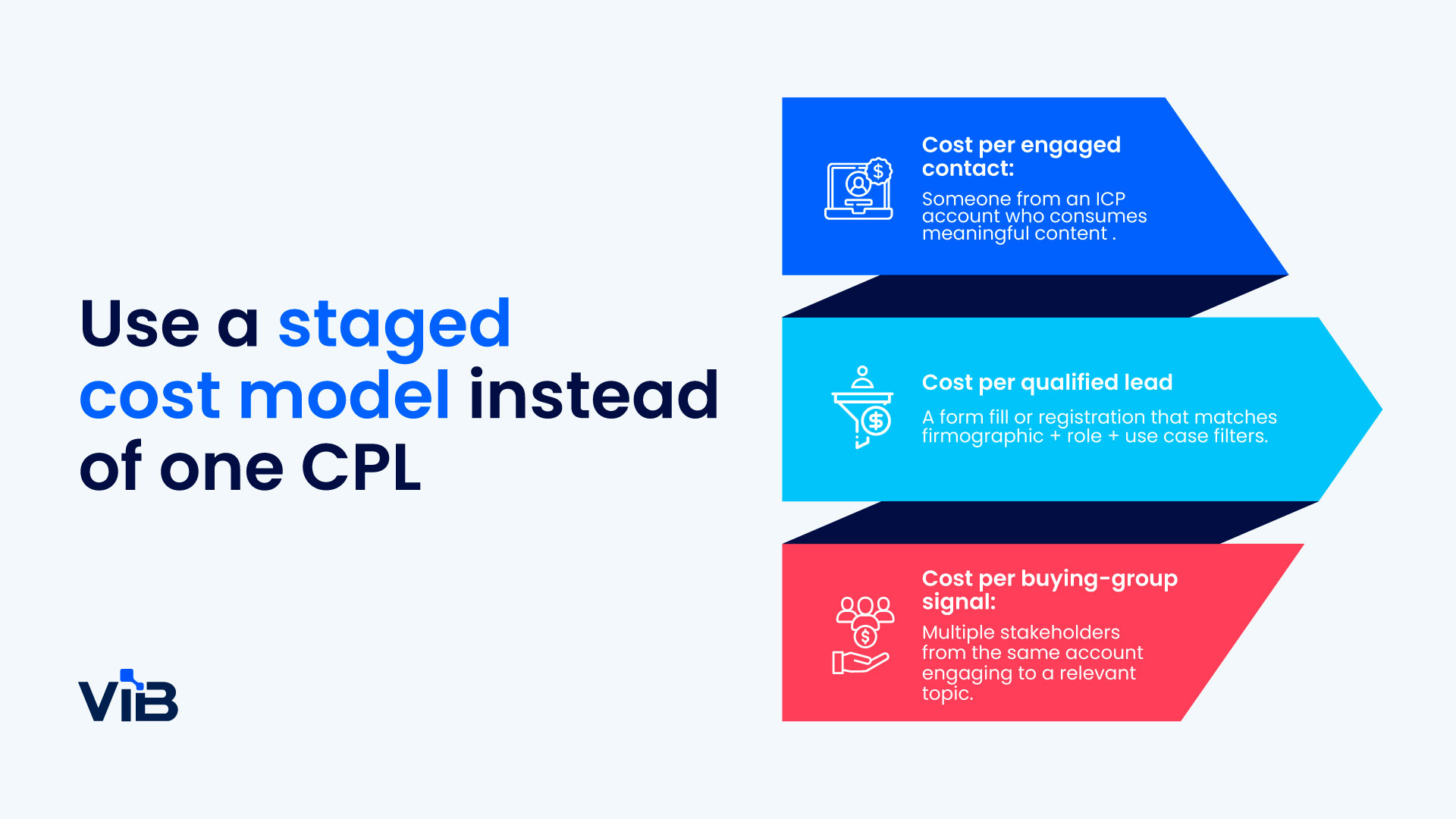
A more reliable model is to price for signals, not submissions.
That means tracking three levels of value:
- Cost per engaged contact: Someone from an ICP account who consumes meaningful content
- Cost per qualified lead: A contact that meets firmographic, role, and use-case criteria
- Cost per buying-group signal: Multiple stakeholders from the same account engaging over time
The goal isn’t to eliminate CPL. It’s to put it in context so you’re paying for momentum, not just activity.
What meaningful intent signals actually look like
- Account-level surge on high-commercial topics (comparisons, alternatives, implementation, pricing)
- Repeat engagement across multiple assets within a tight time window
- Engagement from multiple roles in the same account (security + IT + procurement)
- Return visits to key pages (integrations, deployment model, compliance, security docs)
- Participation in higher-friction formats (briefings, roundtables, technical sessions)
These are the signals that help you pay for meaningful engagement, not just contact capture.
Common pricing traps (and how to avoid them)
Trap 1: Using one benchmark CPL to judge every channel
A $150 CPL on LinkedIn might be excellent if it’s consistently delivering the right accounts and roles. A $70 CPL on search might be poor if it’s mostly students and consultants.
Benchmarks are useful context, but they’re not your target.
Trap 2: Paying for contacts without validating identity and role fit
If your vendor can’t consistently deliver the right seniority and function, your “pricing” is just the cost of cleaning a list.
Trap 3: Treating intent as a magic filter
Intent is helpful, but it’s noisy. That’s why the best pricing conversations focus on how intent is sourced, validated, and activated across channels.
How to budget cybersecurity lead generation pricing without guessing
If you need a usable planning method, build your budget from “cost per engaged ICP account,” then back into channel mix.
Step 1: Pick a planning unit you can actually control
Instead of budgeting for total leads, budget for engaged ICP accounts per month, with clear thresholds (topic intensity, multi-role engagement, repeat sessions).
Step 2: Set a realistic target
As ACV increases, reported CPL can rise sharply. You’re not trying to “hit” those numbers. You’re using them to avoid underfunding an enterprise motion, then blaming the channel when it can’t deliver miracles.
Step 3: Allocate spend by intent stage
Split investment across:
- Capture: search and high-intent placements where buyers are actively researching
- Shape: content and distribution that creates category preference and trust
- Confirm: experiences that validate fit and reduce perceived risk (security posture, deployment, proof)

How to lower cybersecurity lead generation cost without lowering standards
Lowering security costs is about reducing wasted spend and improving the rate of meaningful engagement from the accounts you care about.
Design your campaign around signals, not just submissions
Stop optimizing only for form submits. Optimize for the behaviors that predict real buying activity.
- Account-level engagement: Repeat visits, multi-asset consumption, return frequency.
- Role alignment: Security leadership vs. adjacent IT roles vs students and consultants.
- Problem alignment: Content consumption tied to your core use cases (for example, “ransomware readiness” vs. “general cybersecurity trends”).
Make the offer do the filtering (so the form doesn’t have to)
Examples that tend to reduce junk while improving ICP fit:
- Role-specific briefings (CISO view vs SecOps view) with clear takeaways.
- Evaluation tools (maturity assessments, vendor comparison frameworks) that map to active projects.
- Threat-scenario walkthroughs tied to a realistic environment (industry, stack, and constraints).
Tighten search by building “waste controls” first
In paid search, the fastest savings usually come from controlling waste:
- Negative keyword libraries that explicitly block training, jobs, definitions, and research-only intent.
- Match type discipline for high-cost categories, backed by weekly query reviews.
- Landing pages built for one use case, not “everything we do,” so you can measure real fit.
Budgeting: How to forecast cybersecurity lead generation cost without fantasy math
Forecasting in cybersecurity gets messy because “a lead” doesn’t behave like a simple funnel step. Your forecast should reflect uncertainty and stage conversion.
Start with a range, then narrow with real inputs
Instead of committing to one CPL target, forecast a band and tie it to assumptions you can validate fast.
- Channel CPL band: Based on your last 2–4 quarters and directional benchmarks.
- Qualification rate: What percent matches your ICP filters?
- Engagement depth rate: What percent show multiple meaningful actions within 14–30 days?
- Account clustering rate: What percent have 2+ stakeholders engaging?
Use “cost per account engaged” as your executive metric
If you only report CPL, you’re setting yourself up for constant channel churn. The moment CPL spikes, the channel gets blamed.
When you report cost per engaged account (or cost per buying-group signal), you can make smarter tradeoffs between volume and fit, which is the real constraint in cybersecurity demand creation.

Conclusion: Price the signal, not the submit
Cybersecurity lead generation cost is high because attention is expensive, and trust is earned slowly.
The teams that win don’t optimize for cheaper leads. They optimize for better signals.
They define ICP clearly, design offers that filter for real interest, and measure success at the account level—not the form-fill level.
When you do that, CPL stops being a guessing game. It becomes one input in a system designed to generate consistent, high-quality buying signals.


