 Skip to content


In B2B software, “lead generation vendor” can mean very different things. Some vendors deliver opted-in contacts who downloaded an asset. Others provide account-level research signals. Others help you activate ads and site personalization against a target list.
So the right question usually isn’t “who has the best leads?” It’s “who creates the right type of engagement for my motion, at the stage my buyers are actually in?”
We’ll cover a shortlist of widely used B2B software lead generation vendors across key categories (content syndication, intent, ABM platforms, and review-site intent). Each entry includes best-fit use cases, plus clear pros and cons.
The four buckets most B2B teams end up comparing
Most B2B software lead generation vendors fall into one (or more) of these buckets. Knowing which bucket you’re shopping for makes vendor conversations faster and more honest.
- Content syndication and opt-in distribution: Put your assets in front of net-new audiences and capture engagement.
- Intent data providers: Identify accounts showing interest based on research behavior.
- ABM platforms (or ABX platforms): Combine intent, targeting, ads, measurement, and orchestration.
- Review-site and comparison intent: Capture evaluation-stage activity from buyers comparing options.

A quick reality check on lead “quality”
Even strong vendors can’t override weak strategy. If you don’t have tight ICP definitions, clear exclusions, and fast follow-up, most programs will underperform.
Also, vendor-reported “invalid lead rates” often don’t match what ops sees in CRM. One 2026 survey of 500+ B2B marketing and sales leaders reported an average 22% invalid/unusable lead rate as reported by marketing ops teams.
How to evaluate B2B software lead generation vendors (without getting distracted)
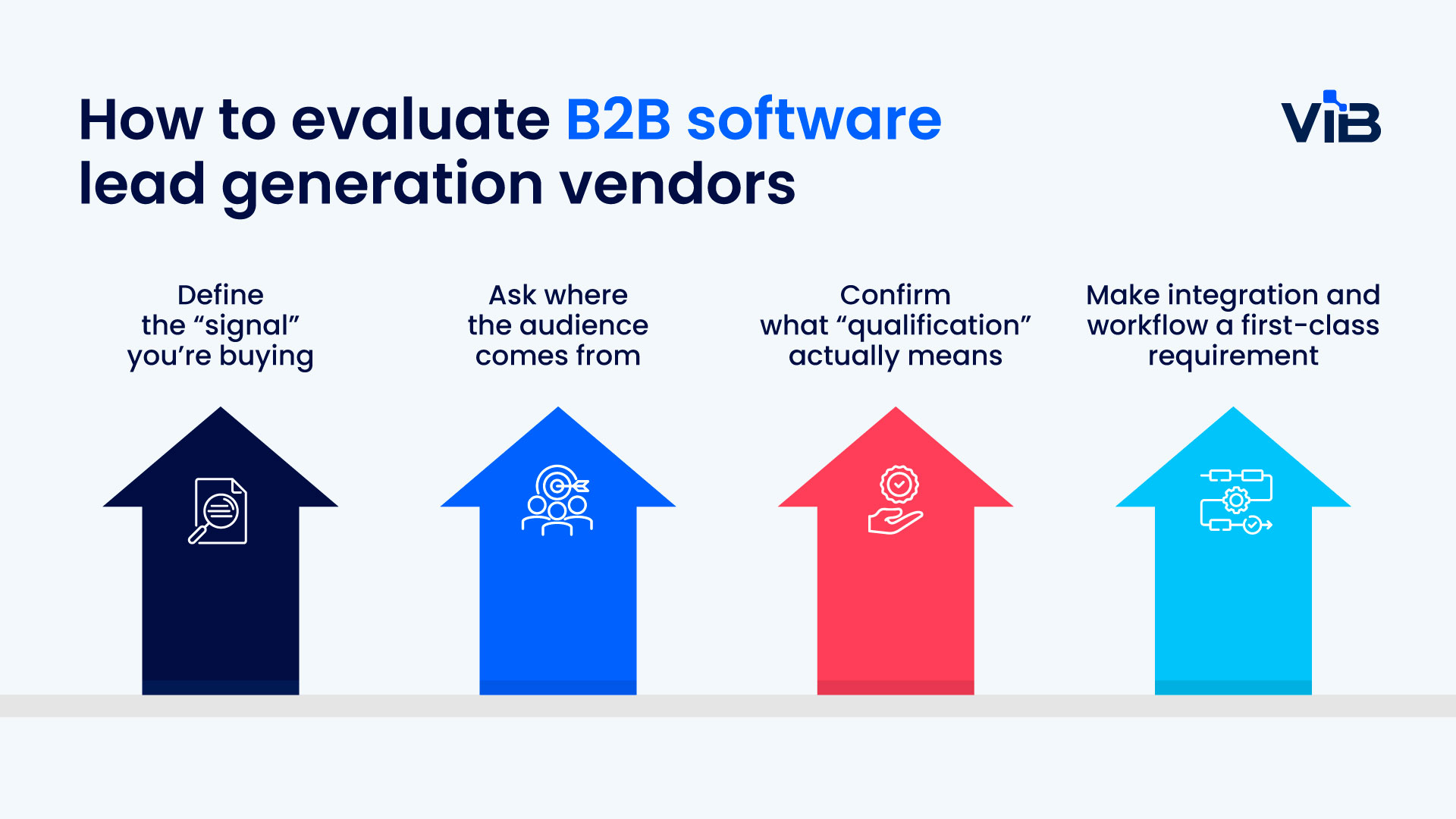
1) Define the “signal” you’re buying
Are you buying opt-in engagement (someone actively requested your content)? Or account intent (a company is researching a topic)? Or evaluation activity (buyers comparing vendors)? These are different signals, with different best practices.
2) Ask where the audience comes from
Some vendors run their own communities. Some rely on publisher co-ops. Some are powered by ad bidstream data. Your performance can vary significantly depending on where the signals originate and how exclusive they are.
3) Confirm what “qualification” actually means
“Qualified” might mean title + company size. Or it might include explicit details on project timing and the decision-making process. Get the definition in writing, then align your routing and scoring to it.
4) Make integration and workflow a first-class requirement
The best program is the one your team can operationalize. If you can’t push fields cleanly into your CRM/MAP, map to accounts, and track follow-up, you’ll lose the value in the handoff.
The best B2B software lead generation vendors to shortlist in 2026
Below is a practical shortlist across content syndication, intent, ABM platforms, and comparison-site intent.
1) ViB
ViB is best for early- to mid-journey engagement and ICP-aligned lead generation through community-based email and content distribution. Its solutions are especially relevant when you want more control over who receives your campaigns and how engagement is captured.
- ViB Syndication focuses on distributing your content to opt-in tech professionals and delivering guaranteed qualified downloads.
- ViB Emails is a strong fit when you want to reach a specific audience segment with message testing, offers, and content that generates measurable engagement signals. (If you’re mapping the motion internally, it pairs naturally with syndication and intent capture.)
Best for: B2B SaaS teams that want predictable content engagement, sharper ICP targeting, and clearer early-stage signals that can inform ABM, outbound prioritization, and nurture.
Pros
- Strong fit for teams that want opt-in engagement with defined targeting (title, level, geography, company attributes, ABM lists).
- Content and email engagement provide useful context for nurture, account prioritization, and more relevant follow-up.
- Natural alignment with practical demand gen workflows: content distribution, engagement, and next-step qualification.
Cons
- If you’re only looking for late-stage comparison signals, ViB may sit earlier than what you’re shopping for.
- Like any syndication or targeted email program, results depend on having the right asset, the right audience filters, and disciplined follow-up.
2) NetLine: large-scale content syndication and lead capture
NetLine is a well-known content syndication and programmatic lead generation network. It’s often shortlisted when teams want scale across many B2B media properties and consistent delivery mechanics.
Best for: Scaling TOFU/MOFU content distribution across broad or multi-industry segments, especially when you have multiple assets and want continuous optimization.
Pros
- Built specifically for content-led lead capture and distribution at scale.
- Network-driven reach across many publisher properties, plus structured campaign launch support.
- Works well as an “always-on” layer for asset promotion when your own channels can’t hit volume targets.
Cons
- Lead quality can vary by topic, offer, and targeting. You’ll need strong exclusion rules and clear routing.
- If you require highly specific, niche audiences, you may need to test multiple assets and filters to find consistent pockets.
3) Informa TechTarget Priority Engine: first-party intent + buying group insights
Priority Engine is a staple in B2B tech, especially for teams selling into IT. It’s positioned around first-party buyer research behavior and access to buying groups.
Best for: Enterprise tech teams that want to prioritize accounts based on research signals and connect that to persona-level insights.
Pros
- Strong narrative and product focus on first-party research behavior and account intent feeds.
- Designed for B2B tech GTM teams, not general B2B.
- Useful when you want to align marketing and SDR outreach timing to research activity.
Cons
- Best-fit is often narrower outside core tech categories and IT audiences.
- Some teams find adoption depends heavily on enablement and consistent weekly workflows.
4) Bombora: third-party topic intent (Company Surge®)
Bombora is one of the most recognized third-party intent data providers. Its Company Surge intent is derived from a large B2B publisher and data partner cooperative, and it’s often used as an upstream intent layer that feeds other platforms.
Best for: Teams with an ABM or outbound motion that can act on account-level topic spikes and route accounts into campaigns quickly.
Pros
- Well-established account-level topic intent signal.
- Broad activation ecosystem via integrations.
- Works well as one ingredient in an account prioritization model, especially when combined with first-party signals.
Cons
- Topic intent is still probabilistic. It tells you “interest,” not buyer readiness.
- You’ll need a clear playbook for what happens when an account surges, or it becomes just another dashboard.
5) G2 Buyer Intent: evaluation-stage comparison signals
G2 Buyer Intent is often positioned as more purchase-proximate than broad topic intent, because it’s based on buyer behavior on G2.
Best for: Competitive categories where G2 is a meaningful research destination and your listing is already strong.
Pros
- Strong signal for “active evaluation” compared to generic interest indicators.
- Pairs well with competitor conquest motions and fast SDR follow-up when the signal fires.
- Clear alignment to review-site optimization: profile, categories, comparisons, and reviews.
Cons
- Coverage is naturally limited to buyers who use G2 for research.
- If your category has low review-site behavior, you may see sparse signals.
6) 6sense: ABM platform and orchestration layer
6sense is an ABM platform used to identify, prioritize, and engage accounts, often combining multiple intent sources and orchestration capabilities.
Best for: Mid-market and enterprise teams that have ABM maturity, defined segments, and the resources to operate weekly account plays.
Pros
- Strong fit when you want intent + activation + measurement in one workflow.
- Useful for aligning channel engagement against a single account view.
- Common choice for scaling account-based programs beyond “one-off” campaigns.
Cons
- Can be overkill if you don’t have the people and process to act on insights weekly.
- ABM platforms don’t replace foundational targeting and messaging work. They expose gaps fast.
7) Demandbase: account-based experience platform with intent and activation
Demandbase is positioned as an account-based experience (ABX) platform that combines account intelligence, intent, advertising, and orchestration. It also has documented intent approaches based on observing content consumption across its network and calculating signal strength.
Best for: Enterprise teams that want a unified account-centric system for targeting, ads, and measurement, especially when advertising activation is a core requirement.
Pros
- Broad ABX footprint: intent, segmentation, advertising, analytics, and integrations.
- Well-suited for account-based advertising workflows and measurement.
- Intent methodology and setup are documented, which helps with governance.
Cons
- To get full value, you typically need ABM maturity plus cross-functional alignment.
- Implementation and ongoing operations can be heavy without dedicated ops support.
8) RollWorks (AdRoll ABM): ABM activation with intent-based segments
RollWorks is an ABM platform known for helping teams activate account-based advertising and use intent signals for segmentation and targeting.
Best for: Teams that want ABM-style targeting and ads with a lighter operational footprint than some enterprise ABM suites.
Pros
- Clear focus on turning intent signals into segments you can activate in campaigns.
- Good fit when paid media is a primary activation path for account engagement.
- Practical tooling for building account targeting playbooks.
Cons
- As with any ABM ad platform, results depend heavily on your account list quality and offer strategy.
- If you need deep buying group intelligence, you may need complementary data sources.
Conclusion: the best B2B software lead generation vendors are the ones that match your motion
The fastest way to waste budget is to compare B2B software lead generation vendors as if they all do the same job. They don’t.
Shortlist based on the signal you need, the stage your buyers are in, and the workflow your team can run every week. Then test two vendors head-to-head with the same ICP filters, the same asset, and the same follow-up SLA.


