 Skip to content


“Appointment setting” used to mean blasting outbound, booking meetings, and hoping enough would turn into real sales conversations.
Today, buyers are harder to reach, less patient with irrelevant outreach, and more likely to do their research without talking to a rep. Gartner found that 61% of B2B buyers prefer a rep-free buying experience, and 73% actively avoid suppliers that send irrelevant outreach.
So when marketers search for B2B appointment-setting tech companies, they’re usually not looking for “more activity.” They’re looking for a cleaner way to generate buyer engagement, validate ICP fit, and help sales spend time with the right accounts.
This guide compares credible options across three categories: (1) community- and audience-based appointment programs, (2) outsourced SDR/appointment services, and (3) the “build it yourself” tool stack (data + engagement). You’ll get practical pros/cons, best-fit scenarios, and pricing models you can actually budget for.
What “appointment-setting” really means in 2026
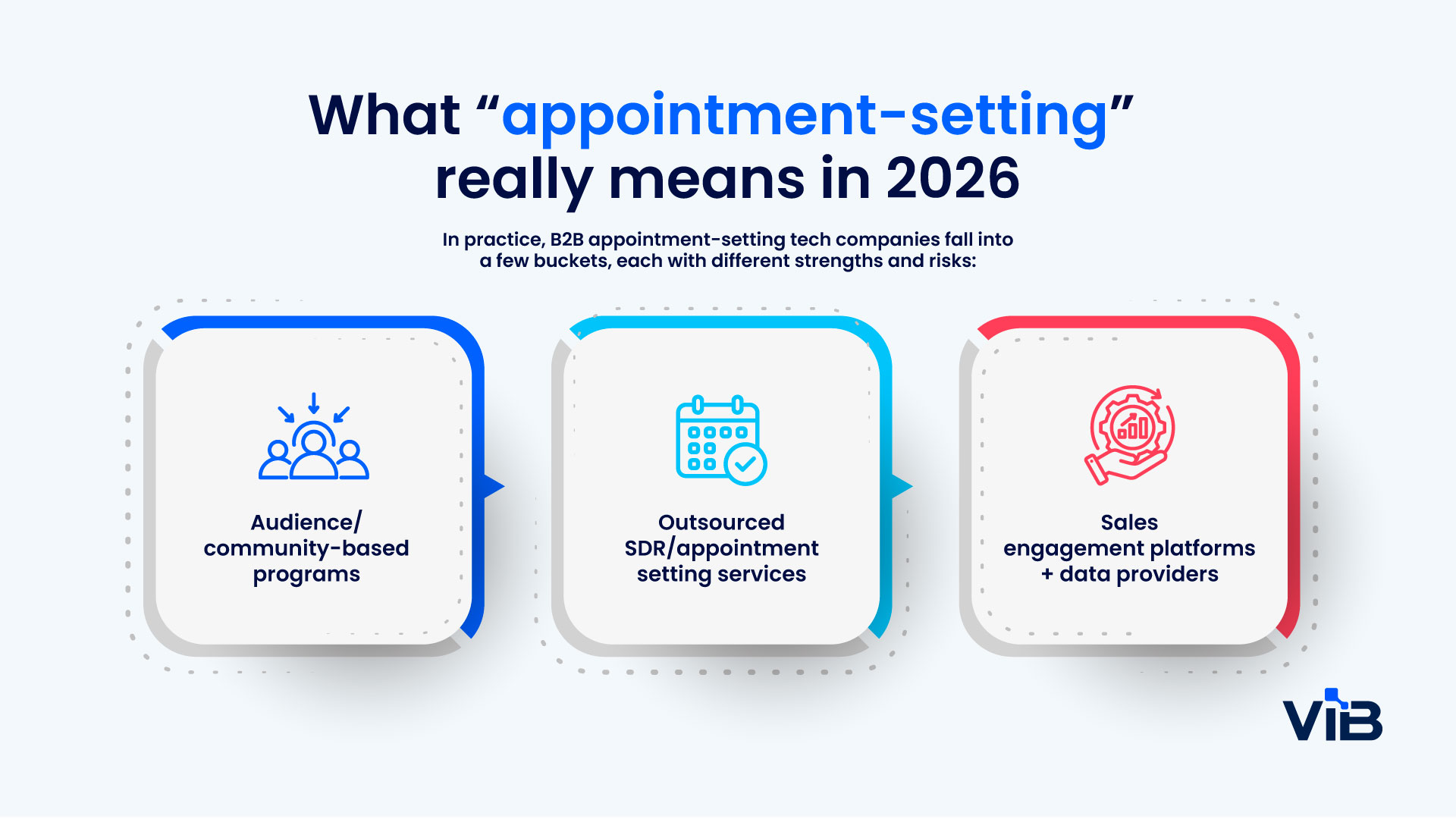
In practice, B2B appointment-setting tech companies fall into a few buckets, each with different strengths and risks:
- Audience/community-based programs: You get introductions or meetings with people who match your ICP, often driven by opt-in engagement rather than cold outbound.
- Outsourced SDR/appointment setting services: A third party runs outbound (email/phone/LinkedIn) as your SDR team, usually on a monthly retainer.
- Sales engagement platforms + data providers: You bring the strategy and people; the vendor provides tools for list building, sequencing, calling, and reporting.
None of these approaches is “best” in a vacuum. The best choice depends on your ICP definition, your team’s follow-up discipline, and whether you’re trying to create new demand or harvest existing demand.
How to evaluate B2B appointment-setting tech companies (without getting distracted)
If you’re an experienced SaaS marketer, you already know the obvious questions (“Is it ICP?” “How many meetings?”). The more useful questions are about mechanics.
1) Ask what drives matching: intent, profile, or volume
Some vendors optimize for activity. Others optimize for alignment with a tight ICP and buyer readiness signals. Those are different systems, and they lead to different downstream outcomes.
If a provider can’t clearly explain why a buyer is engaging (not just who they are), you’ll feel it later in discovery quality and follow-up conversion.
2) Look for proof of relevance, not just “lead delivery”
Relevance is key to building brand trust with target accounts. So, evaluate how the vendor controls relevance: message testing, persona routing, topic gating, suppression rules, and how they handle “wrong person/wrong timing” responses.
3) Separate “appointment set” from “meeting held”
Ask exactly how they define an appointment. Is it “accepted on a calendar” or “attended live”?
Also, ask what they do to improve show rate—for instance, confirmation workflows, rescheduling paths, agenda prep, and whether prospects consented to the meeting in the first place.
4) Budget based on total cost of execution, not vendor fees alone
Even if the vendor runs outreach, you still pay in internal time: routing, speed-to-lead, enrichment, scoring, and post-meeting workflows.
If you’re building in-house, the “stack tax” is real. A common combo is data + engagement + CRM, and each comes with seat costs, implementation, and ongoing ops.
Comparison list: B2B appointment-setting tech companies (and adjacent options)
The options below aren’t all in the same category. That’s intentional. When you’re choosing among B2B appointment-setting tech companies, you’re usually choosing a model, not a brand.
1) ViB Appointments
What it is: ViB Appointments is an appointment program built on ViB’s community-based approach. Thanks to its millions-strong community of verified tech professionals, ViB can target your ICP with precision. And you only pay for meetings that actually take place.
Standout strengths: Building structured buyer engagement earlier in the journey, especially for new account penetration and persona-level matching. Also, ViB’s broader menu (Emails, Webinars, and Syndication) can support an integrated approach if you’re trying to generate consistent account-level activity across channels.
Watch-outs: Like any appointment program, quality depends on how tight your ICP is and how well your internal follow-up is run. You’ll want to align on definitions (what counts as a qualified conversation, how reschedules work, and what “fit” means) before you launch.
Pricing model: Pay-per-appointment-held, starting at $1,400 per appointment.
Best use cases: Mid-market and enterprise SaaS teams running ABM motions, launching into a new segment, or looking to generate net-new account engagement without building a large outbound team.
2) SalesHive
What it is: SalesHive is a done-for-you appointment setting service with an emphasis on outbound execution and operational tracking.
Standout strengths: Outsourced motion that looks and feels like a classic outbound SDR team, but with a vendor managing execution. Helpful if your internal team lacks outbound ops depth (domains, deliverability, sequencing discipline, and reporting).
Watch-outs: You’ll want clarity on list sourcing, messaging control, and how personalization is handled at scale. Outbound that drifts into irrelevance creates brand drag, not just wasted spend.
Pricing model: Tiered pricing plans ranging from $7,000 to $12,000 per month.
Best use cases: Companies with a clear ICP and offer that need consistent outbound execution but don’t want to build an SDR org in-house.
3) Launch Leads
What it is: Launch Leads offers an outsourced appointment-setting model that packages SDR execution, tooling (often including intent platforms), and program management.
Standout strengths: A “complete pod” approach, where the vendor brings both execution and a prebuilt stack.
Watch-outs: Bundled stacks can hide tradeoffs. You may inherit a tool you wouldn’t have chosen (or pay for intent you don’t operationalize).
Pricing model: Prices are custom-quoted.
Best use cases: Series B+ SaaS teams scaling outbound for the first time, where time-to-execution matters more than tooling purity.
4) Apollo
What it is: Apollo is a combined prospecting database and sales engagement tool that many teams use to run outbound in-house.
Standout strengths: Strong value for teams that want one system for list building, enrichment, and basic sequencing. Great for quickly building repeatable outbound motions.
Watch-outs: Apollo doesn’t solve the hard parts by itself: relevance, differentiation, and the “why now” signal. If your team treats it as a volume engine, it’s easy to drift into generic outreach that buyers ignore.
Pricing model: Tiered pricing plans ranging from $49 to $119 per user per month.
Best use cases: Early to mid-stage SaaS with strong SDR management and tight ICP definitions, especially in SMB and mid-market segments.
5) Salesloft (enterprise sales engagement platform)
What it is: Salesloft is a sales engagement platform used by mid-market and enterprise teams for sequencing, calling workflows, coaching, analytics, and rep productivity.
Standout strengths: Better fit when you care about governance, coaching, and consistency across a larger outbound org.
Pros: Strong for scaled teams that need process control and visibility. Helps standardize what “good outreach” looks like across many reps.
Watch-outs: Implementation and admin overhead can be meaningful, and total cost can creep with add-ons and seat expansion.
Pricing model: Custom-quoted, with third-party estimates commonly in the ~$75–$125/user/month range, depending on package and contract structure.
Best use cases: Mature SDR orgs, especially where enablement, QA, and reporting matter as much as raw meeting volume.
6) ZoomInfo (data for appointment-setting motions)
What it is: ZoomInfo is a B2B contact and company intelligence platform often used to power outbound and territory planning.
Standout strengths: When your outreach depends on deep firmographic filters, coverage, and data quality, ZoomInfo can be the “data backbone” behind appointment setting.
Cost signal: Pricing is typically annual and contract-based. Buyer-reported and third-party analyses commonly cite entry points in the five figures annually (for example, one breakdown notes a Professional tier around $14,995/year for three seats and a credit allocation).
Watch-outs: Data doesn’t equal engagement, so you still need a relevance strategy.
Best use cases: Enterprise outbound, ABM account selection, and teams with strong messaging and sequencing capabilities.
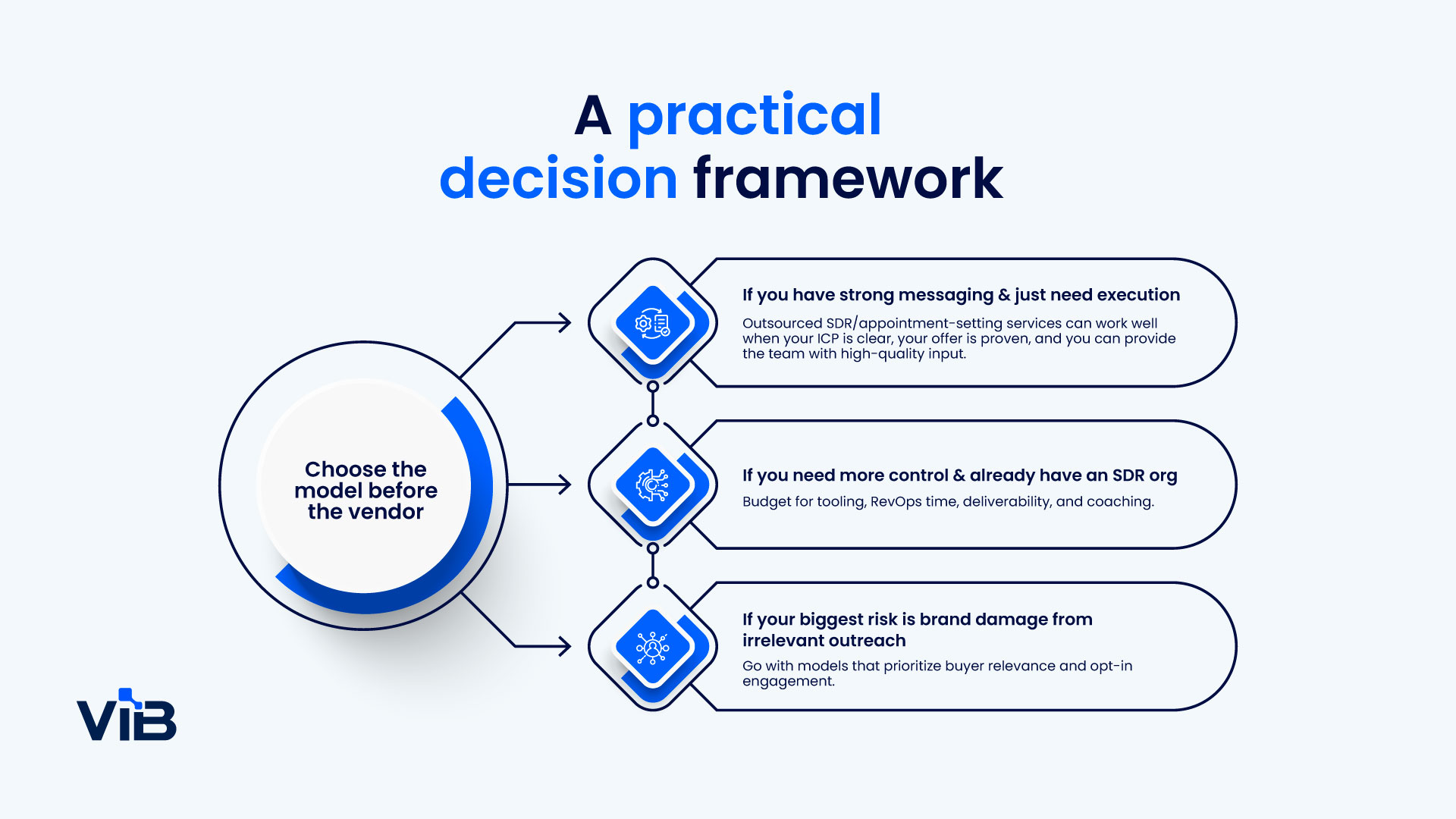
A practical decision framework (choose the model before the vendor)
If you’re evaluating B2B appointment-setting tech companies and you’re stuck, pick the model that matches your constraints first.
If you have strong messaging and just need execution
Outsourced SDR/appointment-setting services can work well when your ICP is clear, your offer is proven, and you can provide the team with high-quality input.
If you need more control and already have an SDR org
Budget for tooling, RevOps time, deliverability, and coaching.
If your biggest risk is brand damage from irrelevant outreach
Go with models that prioritize buyer relevance and opt-in engagement.
This is also where community- and audience-based appointment programs can be attractive, because the motion can be built around matching, education, and buyer enablement instead of pure volume.
Conclusion: The best “appointment setting” is the one your team can operationalize
There’s no universal winner among B2B appointment-setting tech companies. The best choice depends on what you’re optimizing for: speed, control, cost, or buyer relevance.
If you want a service-led outbound engine, consider an outsourced SDR provider. If you want full control and have the internal muscle, build on a data + sales engagement stack. If you want a community-based approach to reaching and engaging the right buyers, ViB Appointments belongs on the shortlist.
Whatever you choose, anchor the evaluation on relevance, ICP fit, and operational reality.


