 Skip to content


If you’re searching for how to get email lists for marketing, you’re likely trying to solve a growth problem, not just a data problem. Most B2B teams already have some contacts, but those lists often plateau in reach, engagement, or relevance.
Building an email list is not just about adding more names. It is about building an audience that actually engages with your content and aligns with your ideal customer profile.
Without that alignment, even large lists fail to support meaningful marketing outcomes.
Why is building an email list harder than it used to be?
Email has remained a core marketing channel, but list growth has become more challenging. Privacy changes, declining form conversions, and increased competition for attention have made traditional tactics less effective.
At the same time, many internal databases degrade over time. Contacts change roles, lose interest, or disengage entirely. As a result, teams may see list size remain stable while engagement steadily declines.
This creates a gap between having contacts and having an audience.
What does a high-quality email list actually look like?
A strong email list is defined less by size and more by relevance and activity. The most effective lists are composed of professionals who match your target audience and actively engage with your content.
Several characteristics tend to define high-quality lists:
- Alignment with your ideal customer profile
- Active engagement with relevant topics
- Accurate and current professional information
- Interest driven by content, not just incentives
When these elements are in place, email becomes a reliable channel rather than an inconsistent one.

How do B2B marketers typically build email lists?
There are several common approaches to building email lists, each with different tradeoffs.
Organic list growth
Organic growth relies on inbound channels such as website forms, gated content, and newsletter sign-ups. This approach builds highly relevant audiences over time but can be slow and unpredictable.
Event and webinar registrations
Webinars, virtual events, and in-person conferences often serve as strong list-building opportunities. These channels can generate high-quality contacts, especially when tied to relevant topics.
However, they require consistent execution and promotion to scale.
Content downloads
Gated assets such as research reports or whitepapers are frequently used to capture email addresses. While effective, this approach depends heavily on content visibility and audience reach.
Without distribution, performance can plateau.
Partnerships and co-marketing
Collaborating with partners allows teams to access new audiences through shared campaigns. This can expand reach but often comes with limitations around ownership and targeting.
Each of these approaches can work, but none guarantee consistent growth on their own.
What challenges limit email list growth?
Even with multiple tactics in place, many teams struggle to scale their email lists effectively.
Common challenges include:
- Limited reach beyond existing audiences
- High competition for attention in crowded channels
- Declining conversion rates on gated content
- Difficulty maintaining data quality over time
These challenges often lead teams to focus on volume rather than relevance, which reduces long-term effectiveness.
How to get email lists for marketing beyond inbound channels?
Expanding beyond inbound channels is often necessary to build a scalable email audience.
Instead of relying solely on website visitors or existing contacts, marketers can introduce their content to professionals who are not yet in their database but match their target profile.
This approach shifts list building from passive to proactive. Rather than waiting for sign-ups, teams place their content in front of relevant audiences and capture engagement through distribution.
When done correctly, this method maintains relevance while increasing reach.
What role does audience quality play in email performance?
Audience quality has a direct impact on how email marketing performs.
Large but misaligned lists tend to produce low engagement, inconsistent results, and limited contribution to broader marketing goals. Smaller, well-targeted audiences often outperform larger lists because the content resonates more directly.
This is why many experienced teams prioritize:
- Targeting over scale
- Engagement over raw list size
- Relevance over frequency
Improving list quality often has a greater impact than increasing volume alone.
Where does ViB Emails fit into email list growth?
Up to this point, the focus has been on how teams build email lists through internal efforts. Scaling that approach, however, often requires access to audiences beyond what internal channels can provide.
ViB Emails helps extend email reach by connecting B2B marketers with targeted professionals within the ViB Community. Instead of relying only on internal databases, marketers can distribute their content to audiences that match their ideal customer profile.
This approach supports several key objectives.
Expanding beyond internal lists
Internal email lists often represent only a portion of the potential audience. ViB Emails allows marketers to introduce their content to professionals who are already engaged with relevant industry topics.
Maintaining relevance at scale
Because distribution is aligned with specific targeting criteria, content reaches professionals who are more likely to engage. This helps maintain quality while expanding reach.
Supporting ongoing list growth
As professionals engage with distributed content, marketers can capture new contacts who have already demonstrated interest. This creates a more sustainable approach to building an email audience.
Rather than replacing organic list-building strategies, ViB Emails acts as a distribution extension. It helps marketers scale their reach while maintaining alignment with their target audience.
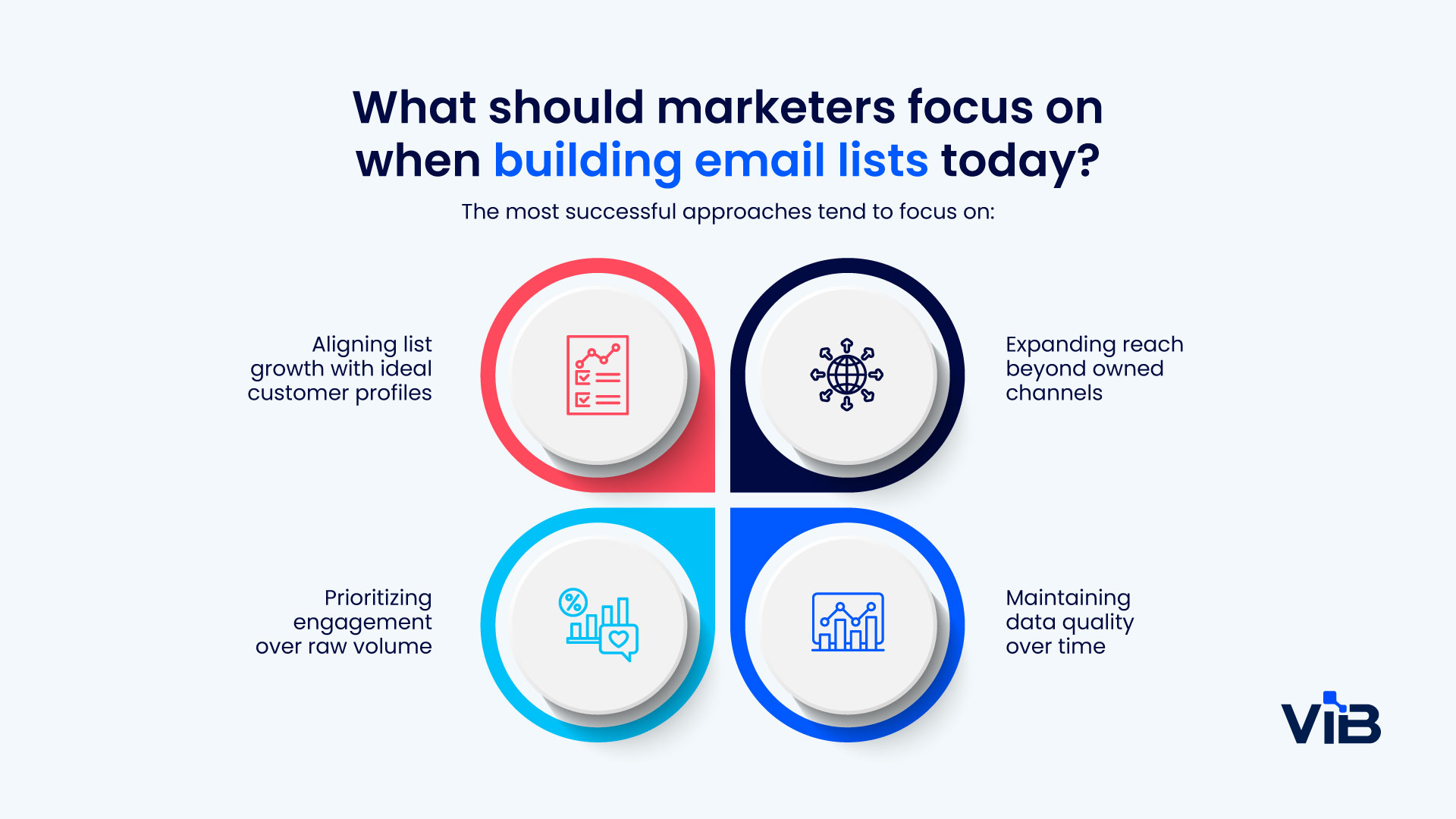
What should marketers focus on when building email lists today?
Building an effective email list requires a combination of strategy, targeting, and consistent execution.
The most successful approaches tend to focus on:
- Aligning list growth with ideal customer profiles
- Expanding reach beyond owned channels
- Prioritizing engagement over raw volume
- Maintaining data quality over time
When these elements come together, email lists become more than a database. They become a reliable channel for reaching and influencing the right audience.
Final thoughts
Learning how to get email lists for marketing is not just about acquiring contacts. It is about building an audience that supports long-term engagement and demand generation.
As inbound channels become less predictable, expanding reach through targeted distribution becomes increasingly important. Teams that balance organic growth with proactive audience expansion are better positioned to sustain performance over time.
For B2B marketers, the goal is not just a bigger list. It is a more relevant and engaged one.


