 Skip to content


Most experienced SaaS marketers already know how to build solid assets. The harder problem is getting those assets in front of the right people at the right moment, in a way that creates measurable engagement and clear ICP-fit signals.
“More impressions” won’t cut it if the audience is wrong, the experience is gated to death, or the follow-up feels disconnected from what the buyer actually consumed.
This article is a practical playbook for advanced B2B content distribution. It focuses on reach, engagement quality, and signal generation across channels.
Why B2B content distribution feels harder in 2026
Two shifts are colliding: Buyers want more control, and buying groups are more complex. That combination changes how distribution should work.
For one thing, buyers want less irrelevant outreach and more self-directed research. Gartner found 61% of B2B buyers prefer a rep-free buying experience, and 73% actively avoid suppliers who send irrelevant outreach.
For another, the “research phase” is not a neat, linear stage you can flood with top-of-funnel ads. Gartner’s research shows that the B2B buying journey “loops” through multiple buying jobs (problem identification, solution exploration, requirements, supplier selection, validation, consensus).
What’s more, you’re rarely influencing a single decision-maker. Gartner also reports that buying groups can span 5 to 16 people across multiple functions, and that 74% of B2B buyer teams experience unhealthy conflict during decision-making.
That matters for distribution because you’re not just trying to “reach a lead.” You’re trying to create enough shared understanding that internal buyers can align.
What “good” looks like: outcomes that matter for experienced teams
If your content distribution plan is built purely on scale, you’ll get activity, but you’ll also get misfires: wrong roles, wrong intent, wrong timing.
A better framing for B2B content distribution is: How reliably can we place the right asset in the right inbox or feed, for the right ICP segment, and capture a usable engagement signal?
Experienced marketers don’t need more MQL debates. You need a distribution system that improves downstream decisions.
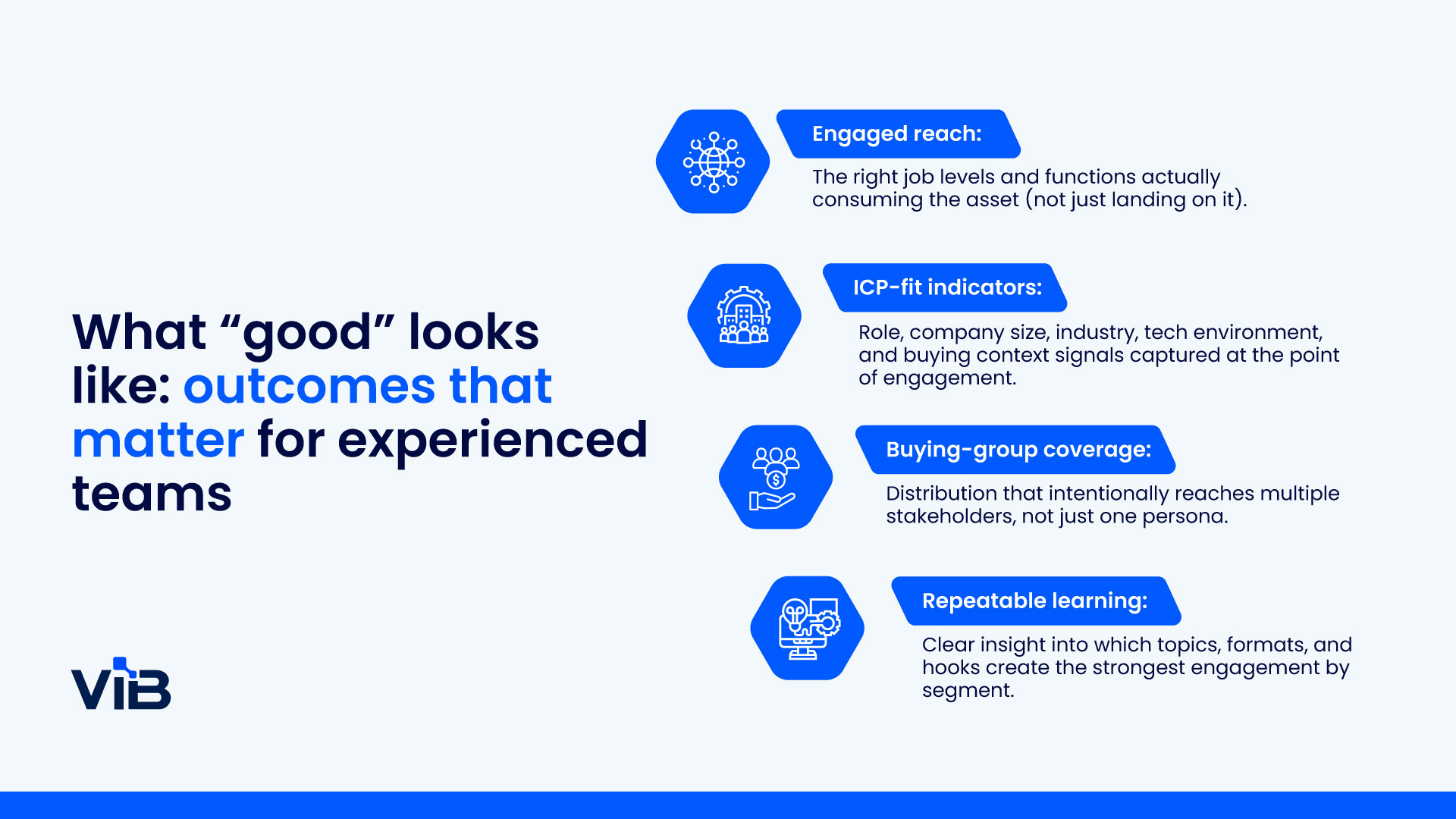
Here are the outcomes worth optimizing for in B2B content distribution:
- Engaged reach: the right job levels and functions actually consuming the asset (not just landing on it).
- ICP-fit indicators: role, company size, industry, tech environment, and buying context signals captured at the point of engagement.
- Buying-group coverage: distribution that intentionally reaches multiple stakeholders, not just one persona.
- Repeatable learning: clear insight into which topics, formats, and hooks create the strongest engagement by segment.
In other words, distribution should generate clarity about who’s engaging, why they care, and what to do next.
The advanced B2B content distribution framework: asset, audience, signal
Every part of your B2B content distribution system should be designed across three variables.
1) Asset: what job does this content do?
Map each asset to a buyer job, not a funnel stage. For example, a “security buyer’s guide” might support requirements building and validation. A competitive teardown can support supplier selection and consensus creation.
This mapping helps you choose channels and targeting. It also shapes what you ask for at conversion (if anything).
2) Audience: who needs to believe this for a decision to happen?
For buying groups, distribution should be designed for coverage. That doesn’t mean persona spam. It means identifying the few roles that create momentum (economic owner, technical evaluator, security/risk, operations, end user leader) and planning purposeful touches for each.
One practical approach: Build “role-specific entry points” into the same core idea. Same topic, different framing. If your distribution partner or channel can’t support that kind of segmentation, you’ll feel it in lead quality and follow-up confusion.
3) Signal: what did they do that changes our next move?
Clicks aren’t useless, but they’re often too shallow. Stronger signals include:
- Asset-level engagement (which topic, which format).
- Declared context (use case, timeline, environment) when it’s appropriate to ask.
- Repeat engagement across multiple touches.
- Buying-group spread (multiple stakeholders from one account engaging with related assets).
That’s what turns B2B content distribution from “traffic” into something your revenue team can actually use. 👍
Two distribution plays that work well together: email amplification and content syndication
In practice, two tactics pair especially well for experienced teams: targeted email amplification and content syndication.
Email amplification is how you drive fast, controlled reach to a defined ICP slice. Syndication is how you place high-value assets in front of net-new audiences who won’t find you through your owned channels.
Play 1: targeted email amplification for “message-market fit” testing
Use targeted email distribution to quickly validate positioning, offers, and creative angles. It’s also ideal when you have a fixed moment in time: an event, a report launch, or a product narrative shift.
What makes this advanced (and not just “send more emails”) is tight segmentation and clean learning loops. You’re trying to learn which messages generate engagement from the accounts and roles that matter.
Play 2: content syndication to expand reach without relying on your domain
Content syndication gets a bad reputation when it’s treated like a shortcut for bulk leads. But when used well, it’s one of the most practical ways to scale distribution of substantial assets (research reports, deep guides, buyer toolkits) into new audiences.
The key is to treat syndication as an audience signal system, not a form-fill machine. Your success depends on targeting, how the asset is promoted, and what gets captured at conversion.
Focus on quality audiences, explicit consent, and engagement that stands up to follow-up.
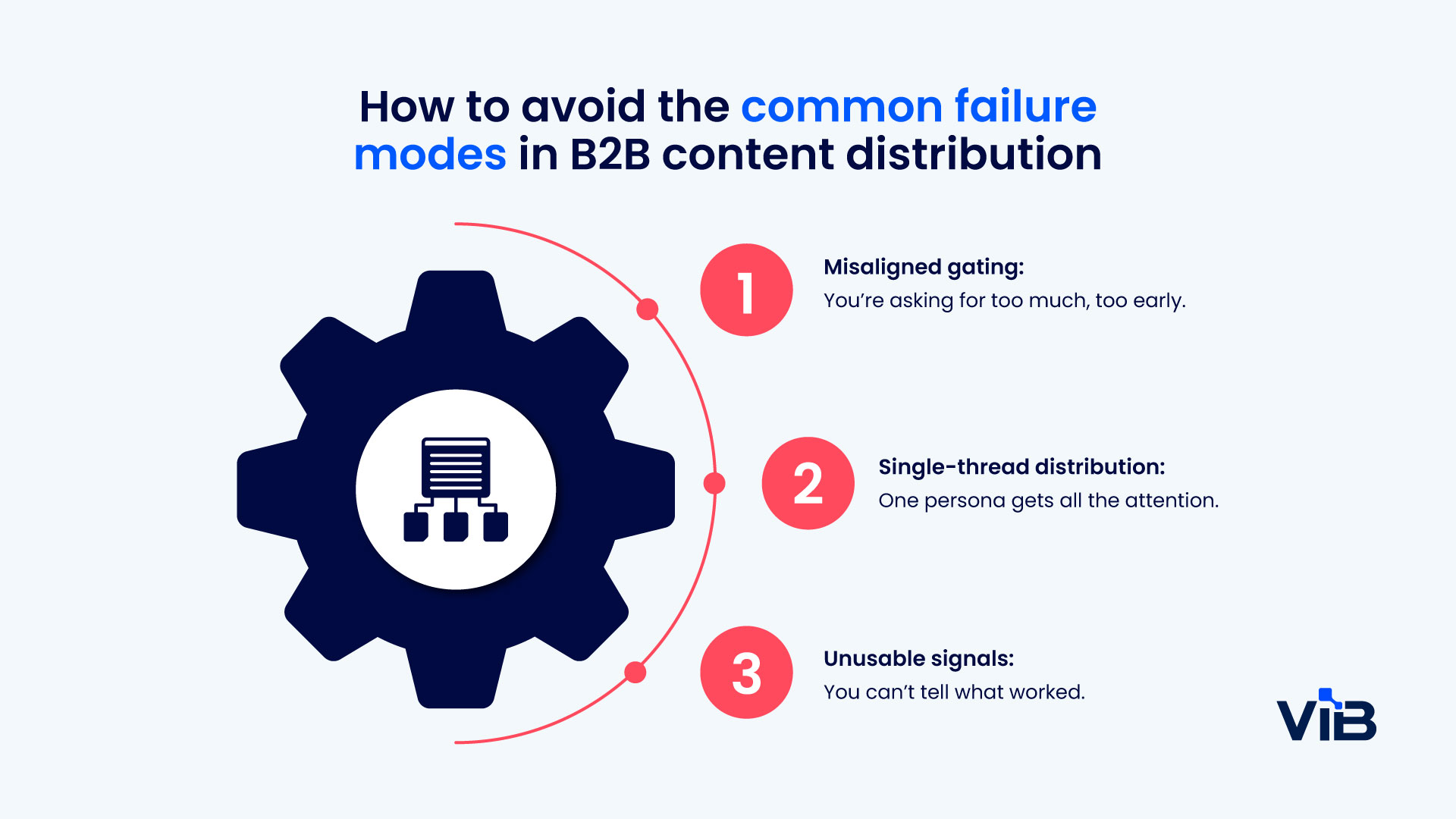
How to avoid the common failure modes in B2B content distribution
Most distribution underperforms for a handful of predictable reasons. If you fix these, results usually improve without reinventing your whole mix.
Misaligned gating: you’re asking for too much, too early
Over-gating creates friction and low-quality conversion behavior. Under-gating creates weak routing and follow-up. The fix is progressive profiling and right-sized asks based on the asset’s job.
Single-thread distribution: one persona gets all the attention
Buying groups are messy. If your distribution speaks to only one “champion persona,” you’ll struggle to achieve internal alignment. Consensus is hard, and your content needs to help groups agree.
Unusable signals: you can’t tell what worked
If all you capture is a name and an email, you’re flying blind. Design your distribution so that every conversion tells you something actionable: the role, the priority use case, and what they engaged with.
This is where simple choices matter: landing page structure, follow-up experiences, and how you tag campaigns in your systems.
A practical measurement model for B2B content distribution
Attribution will never be perfect. But you can still measure distribution in a way that improves decisions each month.
- Audience quality: % of engagement from target job levels, functions, and firmographics.
- Engagement depth: asset consumption, repeat touches, and downstream content views.
- Account signal: multiple stakeholders engaging over a short window is often more meaningful than any single conversion.
- Content learning velocity: how fast you can test, learn, and refine positioning across segments.
Where ViB fits
If you’re building a tighter B2B content distribution system around email amplification and syndication, you’ll eventually hit a constraint: audience access.
You can improve creative, refine segmentation, and strengthen nurture. But if you can’t reliably reach net-new, ICP-fit professionals, you’ll keep recycling the same small pool of known contacts.
ViB’s solutions are designed to put your message and assets in front of targeted tech audiences beyond your house list.
ViB Emails: when you need targeted reach and fast engagement signals
ViB Emails is a great fit when you have a strong offer or asset and want to amplify distribution to specific tech profiles. It’s beneficial for time-bound pushes (events, webinars, new research) and message testing across ICP slices.
ViB Syndication: when you want scalable distribution of flagship assets
ViB Syndication is a fit when you already have strong content (reports, guides, toolkits) and want to reach audiences who won’t discover it organically. We use tight targeting controls to reach your ICP and guarantee qualified downloads that meet your criteria.
Conclusion: build a distribution system that creates clarity
B2B content distribution works best when it’s engineered for relevance, buying-group coverage, and usable engagement signals.
If you anchor every play on the asset’s job, target the stakeholders who shape consensus, and measure signals that actually change your next step, you’ll get more than “leads.” You’ll get a clearer view of ICP fit and stronger engagement from the buyers you’re trying to reach.And when you’re ready to expand beyond your own database, tools like ViB Emails and ViB Syndication can support that strategy by extending reach while staying focused on your ICP. ✅


