Skip to content


If you’re marketing webinars in B2B tech or SaaS, you already know the hard part isn’t writing copy or spreading the message. The hard part is driving the right registrations, then turning attendance and interactions into clean engagement signals your team can actually use. This post is a set of webinar marketing examples built for that reality.
But before we get to the examples, it helps to define “good” in a way that doesn’t collapse into vanity metrics.
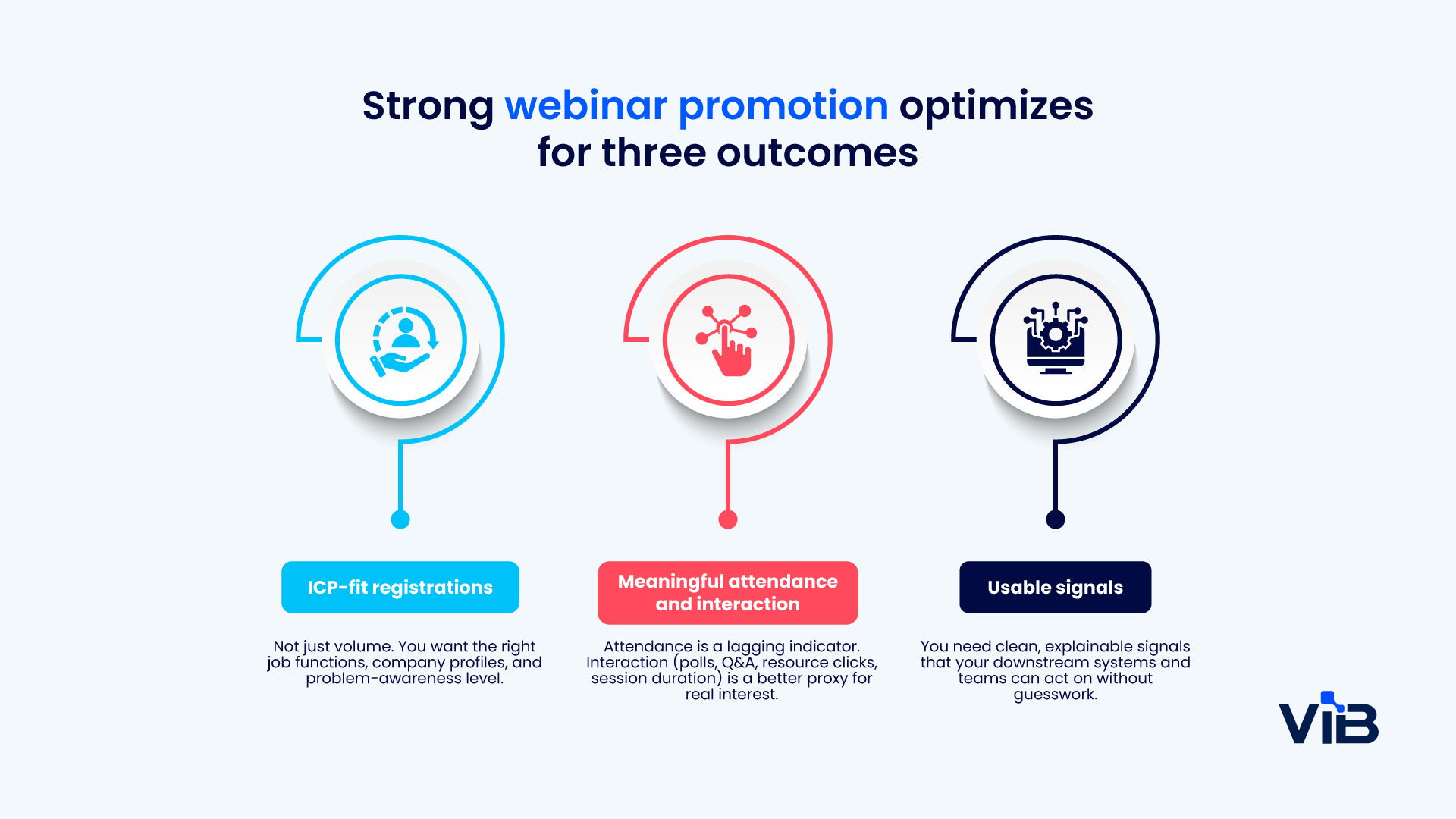
Strong webinar promotion optimizes for three outcomes
1) ICP-fit registrations: Not just volume. You want the right job functions, company profiles, and problem-awareness level.
2) Meaningful attendance and interaction: Attendance is a lagging indicator. Interaction (polls, Q&A, resource clicks, session duration) is a better proxy for real interest.
3) Usable signals: You need clean, explainable signals that your downstream systems and teams can act on without guesswork.
A realistic benchmark mindset
Here are a few benchmarks worth keeping in your head. ON24 reports an average registration-to-attendance conversion rate of 57%, plus an average webinar engagement time of roughly 51 minutes.
Yet, Goldcast’s 2025 benchmark report shares an overall 33% attendance rate, with meaningful variance by day and time.
The takeaway: Your promotion system matters because small shifts in who registers and who shows up change the quality of the engagement you can generate afterward.
Webinar marketing examples for B2B teams promoting upcoming webinars
Each example includes a scenario, what to build, and what “good” looks like in practice.
Example 1: The two-lane invitation strategy (problem-aware vs. solution-aware)
Scenario: You have one webinar topic, but two very different audience mindsets.
What to do: Build two invitation tracks that lead to the same registration page, but use different framing.
Lane A (problem-aware): The invite leads with the operational symptom and what they’ll learn. It avoids vendor language and avoids assuming they’re shopping.
Lane B (solution-aware): The invite leads with the approach category, tradeoffs, and a decision framework (how to choose, what to look for, what can go wrong).
How this shows up in copy: Two subject lines, two hero sections, two sets of bullets. Same speakers and agenda.
How you evaluate it: Compare attendance rate and in-webinar engagement by lane. ON24 notes that webinars generate a lot of interaction data (polls, downloads, surveys) that can help you understand interest.
Example 2: The “3-email spine” that protects deliverability and still drives lifts
Scenario: You’ve tested “more emails,” and it doesn’t reliably improve results. Sometimes it hurts.
What to do: Use a tight three-email structure, then add branching only when behavior warrants it.
- Announcement: Who it’s for, what they’ll leave with, and why now.
- Credibility + agenda: Concrete segments, live demos or teardown moments, plus the “why these speakers.”
- Reminder with a single decision: “Join live” plus 1 supporting bullet. No second CTA.
Branching rule: If someone clicks but doesn’t register, send a short “what you’ll get” clarification. If they register, shift to calendar + reminders.
Why this works: It keeps the core motion simple. It also creates clean cohorts for analysis (openers, clickers, registrants, attendees).
Example 3: “Value first” landing page with personalization by segment
Scenario: Your email clicks are fine, but registration conversion is soft. You suspect the page isn’t meeting intent.
What to do: Personalize the landing page’s top half by segment (industry, role, or use case). Keep the form stable.
What changes by segment: headline, 3 bullets, and a “you’ll learn” section. Everything else stays consistent.
ON24 reports that personalization correlates with stronger performance, including significantly higher registrations from personalized landing pages.
How you evaluate it: Track registration conversion rate by segment and the downstream engagement rate for each segment during the event.
Example 4: “Show-up insurance” reminders that earn the click (not just nag)
Scenario: Registrations look healthy, but attendance is inconsistent.
What to do: Make each reminder add new utility, so it’s not a repeat of the original pitch.
- T-24 hours: “Here’s the worksheet/checklist we’ll use live.”
- T-2 hours: “Here are the 3 questions we’ll answer.”
- T-10 minutes: clean join link + “we’ll start on time.”
Why this works: The reminders become mini-content drops. That creates an extra engagement surface even before the webinar starts.
How you evaluate it: Compare the attendance rate and average engagement duration across webinars that used “utility reminders” vs. plain reminders.
Example 5: Partner co-marketing that doesn’t split the message
Scenario: You’re running a joint webinar (vendor + integration partner, or vendor + customer). Historically, results are messy because both sides promote differently.
What to do: Standardize the “promise” and let each partner localize only the intro line.
Build: one core abstract, one landing page, one shared calendar description, one speaker bio block. Give partners 2–3 intro variants to choose from.
What you gain: cleaner attribution and clearer signal quality by source. You’ll also reduce the “wrong expectations” registrants that show up disengaged.
Example 6: Paid retargeting that’s keyed to “webinar intent,” not “brand awareness”
Scenario: You have traffic, but webinar registrations from paid are low-quality or expensive.
What to do: Retarget only high-intent website behaviors that map to the webinar topic.
Audience examples: visitors to 2+ pages in the relevant solution area; visitors who spent 60+ seconds on a technical doc; visitors who viewed a competitor comparison page.
Creative example: not “Join our webinar,” but “Bring your questions: live teardown of X workflow” or “See the decision criteria for Y.”
How you evaluate it: cost per attendee and cost per high-engagement attendee (poll response, Q&A, resource click).
Example 7: Sales-assisted invites that don’t feel like “sales emails”
Scenario: Your reps are willing to help, but they don’t want to spam accounts. You don’t want them to, either.
What to do: Give reps a short invite that looks like a thoughtful forward, not a campaign blast.
Structure: one sentence of why it’s relevant, one line on who’s speaking, and one line on what question it answers. Then the link.
Make it measurable: unique tracking for each rep or team. The goal is learning which account sets respond to which webinar themes.
The hardest problems webinar promotion teams run into (and how the examples address them)
Problem 1: Registration volume hides weak ICP fit
If you only optimize for registrations, you’ll often “win” with broad topics and generic copy.
But you’ll pay for it later: low interaction, low watch time, and noisy post-webinar follow-up.
That’s why several webinar marketing examples above rely on segmentation (two-lane invites, personalized landing pages, intent-based retargeting). They trade a little volume for cleaner engagement signals.
Problem 2: Attendance variability makes results hard to forecast
If you compare benchmarks, you’ll see why forecasting is hard.
The fix isn’t pretending there’s one “correct” number. It’s building a reminder system and a content utility system that improves show-up quality over time.
Problem 3: You can’t operationalize the signal
A webinar can generate a lot of interaction data (poll responses, downloads, questions).
But if you don’t design your promotion and webinar experience around a few intentional signals, you’ll end up with “interesting data” instead of usable data.
How to choose the right example for your next webinar (a quick decision guide)
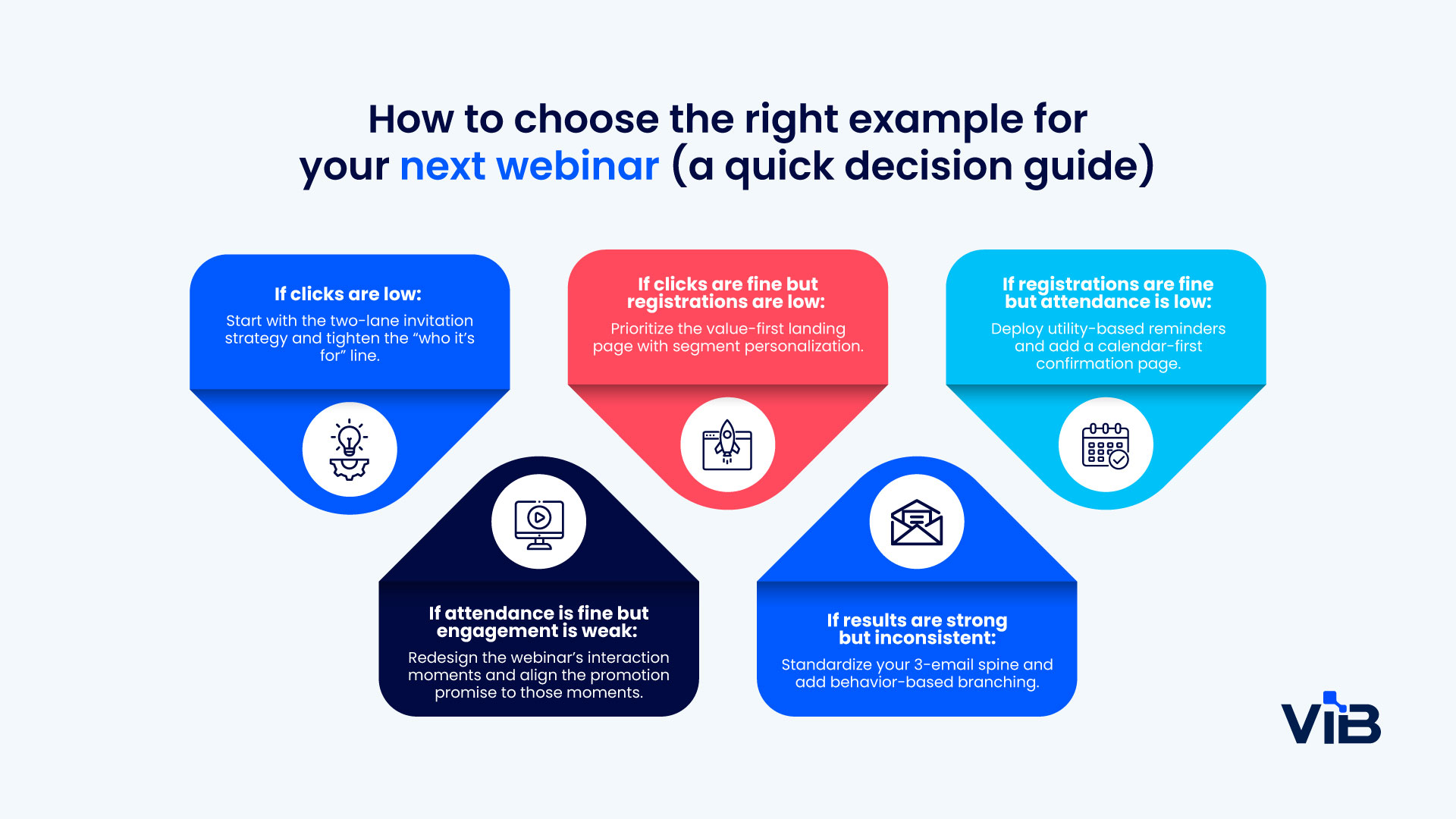
Here’s a simple way to pick which webinar marketing examples to deploy first, based on what’s currently breaking.
- If clicks are low: start with the two-lane invitation strategy and tighten the “who it’s for” line.
- If clicks are fine but registrations are low: prioritize the value-first landing page with segment personalization.
- If registrations are fine but attendance is low: deploy utility-based reminders and add a calendar-first confirmation page.
- If attendance is fine but engagement is weak: redesign the webinar’s interaction moments (polls, resources) and align the promotion promise to those moments.
- If results are strong but inconsistent: standardize your 3-email spine and add behavior-based branching.
Where ViB fits when you need help scaling the promotion motion
If you already have strong webinar content but want more consistency in who you reach and how you generate engagement signals, this is where support infrastructure matters.
ViB is one option B2B marketers use to extend webinar reach.
ViB Emails can support the invitation layer of your webinar program, especially when your in-house list is saturated or when you’re testing new topics for ICP fit.
In the context of the webinar marketing examples above, ViB Emails can map cleanly to:
- Two-lane invitations (different framing for different audience mindsets)
- Partner-style distribution without the coordination overhead
- Consistent “3-email spine” execution so you can measure cohorts cleanly over time
ViB Webinars can help when your goal is to run webinars that drive measurable engagement: the kinds of interactions you can use to learn what resonates, which segments leaned in, and which topics deserve a follow-up event.
Conclusion: treat webinar promotion as a system, not a one-off blast
The most useful webinar marketing examples aren’t “clever subject lines.” They’re repeatable plays that improve ICP fit, attendance quality, and the strength of the engagement signals you generate.
Start with one or two examples that match your constraint, then standardize them. Over time, that’s how webinar promotion becomes predictable enough to scale without burning out your list or your team.