 Skip to content


If you’re trying to benchmark B2B SaaS lead generation cost, you’ve probably noticed an annoying trend: everyone has a “normal” range, and none of them match what you see in the real world.
That’s because lead cost isn’t a single number. It’s the result of your ICP precision, channel mix, asset quality, verification standards, and how strict you are about fit.
This article breaks down what experienced B2B SaaS marketers can reasonably expect to pay today, how the major pricing models work, where costs hide, and why “cheap” leads often become expensive.
What “B2B SaaS lead generation cost” actually includes (and what it doesn’t)
Finance wants predictability, so cost per lead (CPL) becomes the headline number.
But CPL is just the invoice divided by the number of leads delivered. It usually doesn’t include your internal costs for processing, enriching, routing, and follow-up.
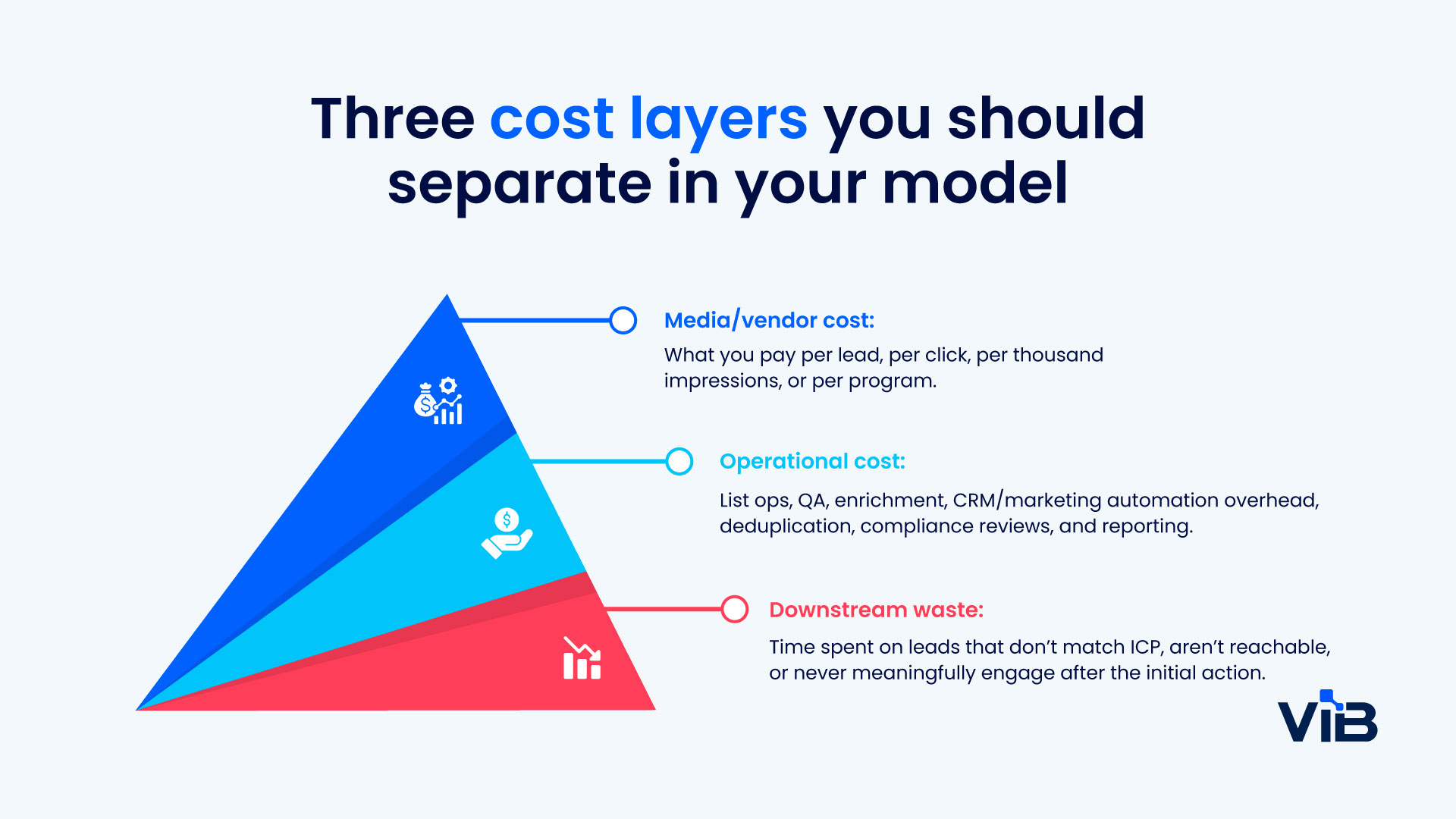
Three cost layers you should separate in your model
- Media/vendor cost: What you pay per lead, per click, per thousand impressions, or per program.
- Operational cost: List ops, QA, enrichment, CRM/marketing automation overhead, deduplication, compliance reviews, and reporting.
- Downstream waste: Time spent on leads that don’t match ICP, aren’t reachable, or never meaningfully engage after the initial action.
When marketers complain that a channel “doesn’t work,” it’s often because the last layer quietly dwarfs the first.
Current benchmarks: What B2B SaaS marketers are paying (and why the ranges are wide)
Any benchmark needs context. A $90 lead and a $900 lead can both be “right,” depending on ICP, seniority, and the action you’re paying for.
With that said, recent benchmark reporting still converges on a familiar pattern: SaaS lead costs rise quickly as you narrow targeting and move to higher-intent actions. Some 2025 benchmarking puts SaaS/software CPL ranges in the low hundreds up through several hundred dollars, especially when requirements tighten.
Similarly, many benchmarks put LinkedIn B2B CPL in a broad range (often in the tens to low hundreds), but it can climb quickly with senior targeting and narrow audiences.
Deal size matters too. Norwest’s 2025 B2B benchmark report shows CPL increasing materially with annual contract value (ACV).
A more useful way to think about benchmarks: Pay for the action you need
Instead of asking “What’s the average CPL for B2B SaaS?”, ask “What’s a reasonable cost for this buyer action from this ICP?”
Leads often look “cheap” on paper until you apply strict QA rules (job function, seniority, company size, industry, geography, exclusions, and dedupe windows).
But, while you might have to pay a higher “per-unit” cost for a tighter fit and verification, the usable volume also tends to rise.
The main pricing models in B2B SaaS lead gen (and where each one can go wrong)
If you want to control B2B SaaS lead generation cost, you need to know what you’re actually buying. Different vendors sell different “units.”
1) CPC / CPM (paid media)
You’re buying traffic (clicks or impressions), not leads.
This model can be great when you have strong conversion paths, clean tracking, and enough volume for testing. It gets painful when landing page conversion is low, audience targeting is off, or bots and low-intent clicks creep in.
2) CPL (content syndication)
You’re buying a contact plus an action (usually a download/registration) that’s tied to an asset. Many programs are delivered on a cost-per-lead basis.
This model is easier to forecast than media buying. The risk shifts to lead definition and lead acceptance criteria.
3) Pay-per-meeting / pay-per-appointment
You’re buying scheduled time, usually with strict targeting criteria.
This is where costs can look high at first glance, but it may reduce internal effort if the vendor handles sourcing, qualification, scheduling, and replacements for out-of-spec leads.
4) Retainers (agencies and outsourced SDR)
You’re buying a team and a motion. CPL may be “backed into” after the fact.
Retainers can work well when you need a strategic system and ongoing experimentation. They can disappoint when goals aren’t defined in operational terms (ICP, volumes, QA rules, contactability standards, and cadence), or when reporting is vague.
Why quality usually costs more (and why it can still be cheaper)
Most experienced SaaS marketers have lived the same story:
You buy 500 “leads” at an attractive CPL. Then ops flags duplicates, sales flags wrong personas, deliverability bounces, and your team spends weeks debating attribution.
If you’re paying for leads, quality should be defined in a way your CRM can enforce. Practical quality standards often include:
- ICP match: Job function, seniority, industry, company size, region, and exclusions.
- Contactability: Valid email, reduced bounce risk, and reasonable completeness of required fields.
- Freshness: Recent activity date and dedupe rules against your CRM and recent vendor deliveries.
- Proof of action: Evidence that the person engaged (downloaded, registered, attended, applied).
When vendors can’t operationalize these standards, “lead quality” becomes a recurring argument rather than a controllable input.
How to estimate ROI without pretending you can predict revenue
Marketers sometimes try to force a straight-line model from lead to closed-won. That’s rarely honest, especially for earlier-stage actions like content downloads and webinar registrations.
A better approach is to model ROI in layers: cost per ICP engagement, cost per sales-accepted contact (or whatever your internal “usable” definition is), and cost per meaningful next action (reply, meeting request, second engagement, multi-touch progression).
A simple model that many teams can implement in a week
- Define lead acceptance rules in writing (your vendor contract should mirror this).
- Track rejection rate by reason (ICP mismatch, duplicate, unreachable, missing data).
- Track engagement rate after delivery (second touch within 14–30 days is a good start).
- Track cost per accepted lead, not just cost per delivered lead.
- Compare vendors on the accepted lead volume of the target ICP, not raw lead volume.
This approach respects how B2B buying works. It also makes vendor comparisons far less emotional.
Where costs spike: The real drivers behind B2B SaaS lead generation cost
If your CPL has jumped year over year, you’re not alone. Lead costs are influenced by competition, audience saturation, and channel dynamics.
The biggest cost drivers are usually controllable, though. Here’s what most directly moves price.
1) ICP precision and seniority
Narrow audiences cost more to reach, especially in high-demand job families (security, data, cloud, IT leadership).
2) The action you’re buying
A download is not the same as a live attendee. A form fill is not the same as an applied meeting. Expect the unit cost to scale with friction and intent.
3) Verification standards and lead replacement policies
If a vendor stands behind strict fit requirements and continues delivery until the agreed number of in-spec leads is met, that changes your risk profile.
If they don’t, then you’re the one eating the cost of the mismatch.
ViB’s cost structure changes the risk math
ViB has solutions for every marketing budget and needs gap:
- ViB Emails (starting at $2,200 per send): We’ll send your email to members of our ViB Community that match your ideal customer profile. Choose from add-ons that let you send to specific ABMs or target audiences.
- ViB Syndication (starting at $45 per lead): Syndication is another reliable top-of-funnel tactic to generate downloads of your high-value content. We’ll actively promote your assets to our members who match your ICP until we meet your qualified lead goal.
- ViB Webinars (starting at $15,500 per event): Get a fully orchestrated webinar, including your choice of a registrant or attendee guarantee. You provide your topic and speakers, and we’ll do the rest: plan, promote, host, track, and deliver a guaranteed number of leads at the end.
- ViB Appointments (starting at $1,400 per meeting): ViB Appointments effectively generates mid-funnel leads for your sales team. We share your message with your target audience and they apply to meet with you if your solution aligns to their needs. Our pay-for-performance model means you only pay for quality meetings that happen.
Why this can outperform cheaper options in ROI terms
Two vendors can quote the same CPL and deliver radically different outcomes in your CRM.
If Vendor A delivers 300 leads at a $60 CPL with a 30% rejection rate, you effectively pay ~$86 per accepted lead before accounting for the internal time spent triaging. If Vendor B delivers 300 leads at an $85 CPL with near-zero rejection, it may be the lower-cost option in practice.
ViB’s structure is designed to reduce that rejection-driven “hidden tax,” because out-of-spec leads don’t count toward the contracted goal.
What “results-driven” should mean for earlier-journey programs
For syndication, webinars, and other early-journey tactics, a credible results conversation focuses on:
- How consistently the vendor hits the ICP fit
- How they define and enforce lead acceptance
- How reliably they deliver volume without loosening targeting
- What signals you get to improve nurture (topic, role, pain points, and follow-up timing)
That’s the ground where ROI is actually controllable.

Conclusion: The smartest way to manage B2B SaaS lead generation cost
The most useful takeaway isn’t a single benchmark number. It’s this: B2B SaaS lead generation cost only makes sense when you define the “unit” you’re buying and measure what happens after delivery.
When you compare vendors, don’t start with CPL. Start with acceptance criteria, rejection rates, and the operational drag of fixing bad inputs.
If you’re evaluating options, the most practical next step is to map your current funnel math around accepted leads and follow-on engagement. Then compare how different vendors price and guarantee those inputs.


