Skip to content


If you’re responsible for lead generation for SaaS companies, you’re probably feeling the squeeze from both sides. 😣
Buyers do more research on their own, reach out on their own terms, and have preferred vendors already in mind. Meanwhile, internal teams still want “more leads,” faster, with clearer proof that they match your ICP.
This post is for experienced B2B SaaS marketers who are done with surface-level advice. We’ll focus on what actually drives engagement, signal generation, and ICP fit, plus how to operationalize it across channels without burning out your database (or your SDR team).
Why lead generation for SaaS companies is harder than it looks
SaaS lead gen breaks down when teams treat it like a volume game.
The reality is that many buyers form strong preferences before they ever talk to a seller. According to 6sense’s 2025 Buyer Experience Report, buyers go with their “pre-contact favorite” roughly 80% of the time.
So if your strategy is mostly “capture demand,” you’re already late to the game. Modern lead generation for SaaS companies has to do two jobs at once: create demand earlier and detect real intent sooner.
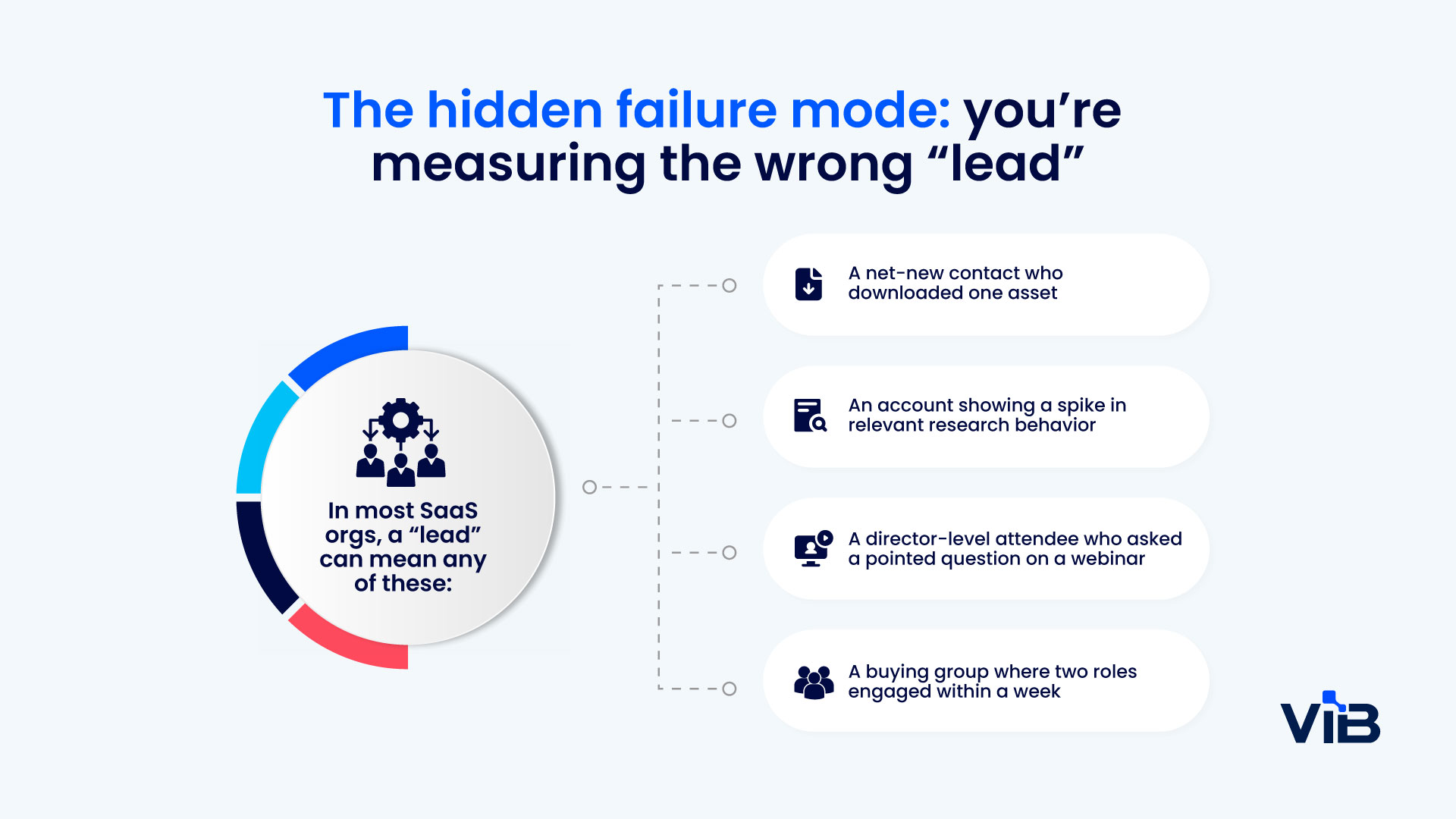
The hidden failure mode: you’re measuring the wrong “lead”
In most SaaS orgs, a “lead” can mean any of these:
- A net-new contact who downloaded one asset
- An account showing a spike in relevant research behavior
- A director-level attendee who asked a pointed question on a webinar
- A buying group where two roles engaged within a week
Those aren’t interchangeable. If you score and route them the same way, you’ll either swamp sales with noise or starve them of real buying signals.
The response isn’t more touches. It’s better segmentation, sharper offers, and cleaner signals.
The outcomes that matter (and what to optimize for)
If you want lead generation for SaaS companies to perform in 2026, align your program to outcomes that map to buyer progress, not vanity volume.
Here are four outcomes worth building your operating system around:
- ICP-confirmed engagement: the right personas consuming the right topics
- Buying group traction: more than one stakeholder engaging within a short window
- Intent strength: behavioral + contextual signals that suggest an active initiative
- Conversion velocity: speed from first meaningful touch to “next step” (demo, workshop, evaluation call, etc.)
Notice what’s missing: obsessing over MQL volume in isolation.
Strategy 1: Tighten ICP and segment by “reason to buy,” not just firmographics
Firmographics are necessary, but they’re rarely sufficient.
Experienced SaaS marketers achieve better lead quality by segmenting by the reason an account would care right now. That usually ties to one of these:
- Change in strategy (new exec, new initiative, new market)
- Change in constraints (security/compliance pressure, cost pressure)
- Change in environment (new tech stack decision, vendor consolidation)
- Change in risk (incident, outage, audit, churn spike)
This is where your messaging gets easier. You’re not trying to be broadly “relevant.” You’re relevant to a specific moment.
Practical build: A two-layer ICP that doesn’t collapse under scale
Use a two-layer model:
- Layer 1 (hard filters): industry, size, region, required tech, regulated vs non-regulated, etc.
- Layer 2 (moment filters): triggers that indicate urgency or priority (initiative timing, tool change, compliance deadline, etc.)
Layer 1 keeps your targeting sane. Layer 2 creates the lift. That lift is what your outbound, webinar, and syndication programs should be built to detect and amplify.
Strategy 2: Use intent signals to prioritize engagement plays (not just “who to contact”)
Intent data is often misused as a list source. The better use is orchestration.
In plain terms: Intent signals should tell you which play to run for a segment, not just which SDR should send the next email.
At a basic level, intent data helps you understand buying interest and journey stage based on research behaviors across channels.
Here’s a practical mapping you can steal:
- Light intent (topic exploration): run educational webinar invites, POV content, comparison guides
- Medium intent (problem + solution research): run role-specific emails with a single “next step” ask, plus a short asset that matches their job
- Strong intent (vendor + evaluation behavior): run high-touch offers like private briefings, 1:1 consults, or appointment-style conversations
This keeps you from throwing “book a demo” at people who are still building their internal POV. It also gives sales warmer context when outreach starts 🙂
Strategy 3: Make webinars an intent engine, not a one-off event
Webinars work best for lead generation for SaaS companies only when the topic is tightly aligned to an active initiative.
One reason webinars remain effective is that they generate multi-signal engagement within a short time window: registration, attendance, questions asked, poll responses, and post-event clicks.
For advanced SaaS marketers, the most valuable outcome of a webinar is not attendance. It’s clarity: do they have the problem, and do they want to do something about it soon?
Three design choices that improve that clarity:
- Use a decision framing: “How to choose X when Y is true” beats “Intro to X.”
- Build in interactive moments: polls and live Q&A force buyers to self-identify.
- Create two exit paths: one for “I’m evaluating soon” and one for “I’m learning.” Different follow-up, different scoring.
If your webinars are purely top-of-funnel education, that’s fine. Just don’t pretend they’re doing mid-funnel work without the right structure.
Strategy 4: Stop treating email as a channel and start treating it as a sequencing layer
Email still anchors most SaaS lead generation motions, but the job has changed.
It’s less about blasting “nurture” and more about sequencing the right message to the right micro-segment at the right time, then using replies and clicks as engagement signals you can route intelligently.
The key is not chasing “industry averages.” It’s using benchmarks to diagnose whether you have a targeting problem, a deliverability problem, or an offer problem.
If you want email to create usable signals (not just activity), build sequences around one idea:
Every touch should make it easier for the buyer to say a clear yes or no.
That means:
- One persona per sequence (don’t mash IT + Security + Finance together)
- One “reason to care” tied to a trigger or initiative
- One ask per email (a question, a short choice, or a low-lift next step)
- A follow-up plan that adds information, not just “bumping this”
When you do this well, the goal isn’t immediate conversion. It’s extracting a clean signal: interest, timing, ownership, and next step.
Strategy 5: Treat content syndication like targeting plus distribution (not “lead buying”)
Content syndication can be a strong lever for lead generation for SaaS companies, especially when organic reach is inconsistent.
But it only works when you control for two things: target definition and asset-to-intent alignment.
A “good” syndication asset does at least one of these:
- Signals project timing (planning now vs. researching for later)
- Signals ownership (who owns the initiative)
- Signals constraints (compliance, security, budget model, integration needs)
- Forces a choice (build vs. buy, consolidate vs. best-of-breed, etc.)
If your asset is generic, the only thing you’ll learn is that someone likes reading generic content. That’s not an actionable signal.
How to choose the right lead gen mix for your SaaS (based on the constraints you actually have)
Most SaaS teams don’t have a “lead gen” problem. They have a constraint problem.
Pick the mix based on what’s limiting you right now:
- If you lack top-of-funnel reach: syndication + webinar programming + partner channels
- If you lack conversion to next steps: fix segmentation, offers, and sequencing; add higher-intent interactions
- If you lack ICP fit: rebuild targeting around “reason to buy,” tighten lists, and stop scoring generic engagement 📝
- If you lack timing visibility: add explicit intent capture (surveys, qualification questions, intent programs)
This sounds basic, but it’s where experienced teams separate. They stop stacking tactics and start removing bottlenecks.

A practical next step: Use ViB to generate targeted engagement
If your priority is lead generation for SaaS companies with better ICP alignment and measurable engagement, ViB’s current services can support your execution.
- ViB Webinars offers full-service webinars with registrant or attendee guarantees, helping teams build a consistent audience.
- ViB Appointments facilitates qualified 1:1 meetings based on clear ICP and qualification criteria, helping teams move from engagement to relevant sales conversations.
- ViB Syndication offers ICP-based content distribution that’s designed to support targeted reach while keeping asset-to-intent alignment (so syndication produces usable signals, not just downloads).
- ViB Emails offers email-based distribution and promotion designed to reach specific ICP segments and capture engagement signals that can inform routing and follow-up.
Conclusion: the new bar for lead generation for SaaS companies
Lead generation for SaaS companies works best when you treat it as a system for creating and capturing buyer signals, not a machine for producing form fills.
Tighten ICP around “reason to buy.” Use intent to choose the right plays. Build webinars and email as signal engines. And treat distribution (including syndication) as targeting plus relevance, not list buying.
When you do that, lead gen becomes more predictable, more measurable, and a lot more useful for the teams that have to act on it.