 Skip to content


Most teams don’t struggle because they don’t know the definitions.
They struggle because “sales qualified lead” and “opportunity” are used as control points in their revenue process. Those labels trigger routing, follow-up, forecasting, and attribution. When the labels are inconsistent, everything downstream gets noisy.
We’ll also cover how to use earlier-stage buyer signals (the kind that show real research and project motion) to improve SQL quality and create cleaner opportunity creation, without pretending you can force outcomes.
Why “sales qualified lead vs. opportunity” is a marketer problem (not just a sales ops debate)
On paper, it’s simple: an SQL is a qualified person, and an opportunity is a qualified deal.
In reality, the SQL-to-opportunity line is where teams hide the mess: unclear ICP fit, shallow discovery, inconsistent meeting quality, and “we’ll know when we see it” stages that change every quarter.
When the definitions blur, you get predictable symptoms:
- Marketing gets blamed for “bad leads” even when the real issue is inconsistent sales qualification criteria.
- Sales creates opportunities too early to hit activity targets, then closes them out later (and marketing takes the attribution hit).
- Lifecycle reporting becomes a debate rather than a decision-making tool.
The fix isn’t arguing about semantics. It’s defining what must be true before a record moves from SQL to opportunity, and making sure your upstream programs can actually produce those truths.

Definitions that are useful in the real world
What a sales qualified lead (SQL) should mean
A sales qualified lead is a lead that’s vetted for fit and demonstrated need and is ready for direct sales follow-up.
For experienced SaaS marketers, an SQL implies sales has enough to run a credible next step (discovery, evaluation planning, technical validation) without guessing.
In practical terms, a good SQL usually has:
- ICP fit: right segment, right environment, right constraints.
- Problem clarity: a real job-to-be-done, not just curiosity.
- Access: a person who can influence the buying group, even if they’re not the signer.
- Mutual next step: the prospect agreed to a specific follow-up action.
What an opportunity should mean
An opportunity represents a sale or a pending deal.
That sounds obvious, but it’s the difference that matters: an opportunity is not just “a qualified person.” It’s an active buying motion your organization can pursue with a defined path.
Most teams should treat opportunity creation as a higher bar than SQL because it triggers forecasting behavior, sales stage automation, and executive attention.
Sales qualified lead vs. opportunity: the two questions that separate them
If you’re trying to align teams fast, you can simplify the sales qualified lead vs. opportunity distinction into two gating questions.
1) Is the buyer verified and relevant (SQL)?
“Verified” means you can trust the identity, role context, and why they engaged.
“Relevant” means they’re inside your ICP and their use case matches what you actually win.
This is where SQL belongs: high-confidence handoff to sales for deeper discovery.
2) Is there a defined buying motion (opportunity)?
“Defined buying motion” means you have credible evidence that a project exists, stakeholders are involved (or will be), and there’s a timeline tied to a decision.
That evidence doesn’t have to be perfect. But it does have to be stronger than “they took a meeting.”
What should change operationally when an SQL becomes an opportunity
To keep this grounded, here’s what should change in your systems and processes when you cross the line from SQL to opportunity.
What changes in the CRM record model
Many orgs create an opportunity only after a meeting. That’s common, but it’s not the point.
The point is: opportunity creation should coincide with a shift from person-based qualification to deal-based qualification.
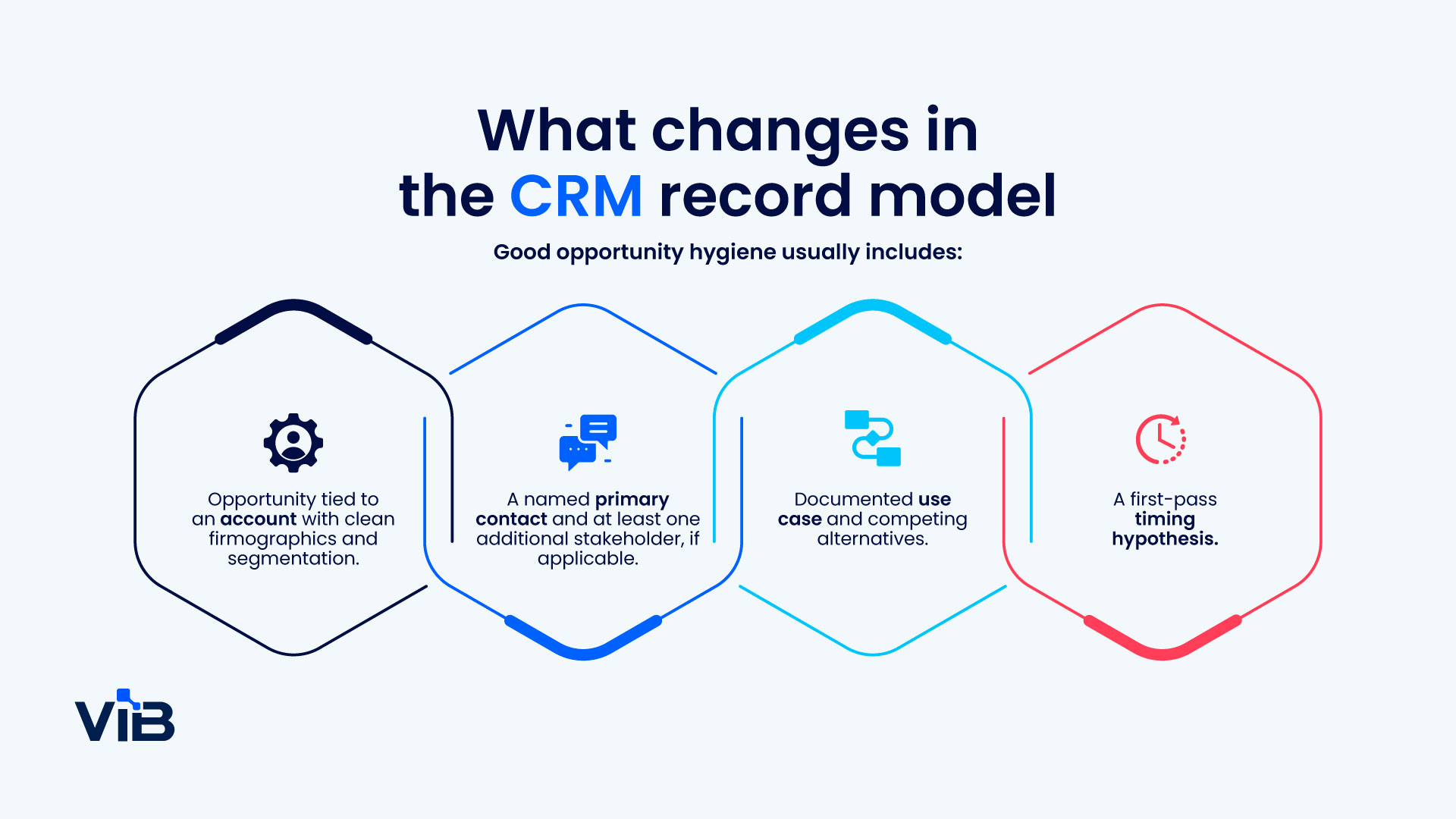
Good opportunity hygiene usually includes:
- Opportunity tied to an account with clean firmographics and segmentation.
- A named primary contact and at least one additional stakeholder, if applicable.
- Documented use case and competing alternatives (even if “status quo”).
- A first-pass timing hypothesis (buyer-driven, not sales-driven).
What changes in measurement and expectations
SQL metrics are about response speed, meeting progression, and qualification consistency.
Opportunity metrics are about the quality of stage progression: are the right deals being created, and are they moving for real reasons?
That’s why teams that create opportunities too early often “look busy” while their stage conversion rates collapse.
Why this line is getting harder: buyers want self-serve, and signals stay fragmented
One reason the SQL vs. opportunity debate keeps resurfacing is that buyer behavior keeps drifting earlier and quieter.
Gartner reported that 61% of B2B buyers prefer a rep-free buying experience.
That doesn’t mean sales is irrelevant. It means your early-stage “proof” of interest often happens outside of your owned channels, before the buyer is willing to talk.
So marketers are left with a tough mandate: generate enough verified engagement to justify sales time, without over-rotating on shallow activity that creates false positives.
The practical qualification framework: what you need before you call it an SQL (and what you need before you create an opportunity)
You don’t need a 40-field taxonomy to fix this. You need a short list of non-negotiables that sales and marketing both respect.
SQL minimums (tight enough to protect sales time)
Use these as SQL minimums when you want SQL to mean “worth a serious follow-up,” not “someone engaged.”
- Verified persona match: titles/roles that show up in closed-won buying groups.
- ICP match: segment, region, tech environment, and constraints that your team can win in.
- Clear trigger: what made them raise their hand (initiative, problem, deadline, change event).
- Consent and next step: they agreed to be contacted and to a specific follow-up action.
Opportunity minimums (tight enough to protect reporting integrity)
Here’s a clean baseline for opportunity creation in complex B2B deals.
- Project exists: not “interested,” but “evaluating / planning / replacing / standardizing.”
- Timing window: an estimated decision timeframe provided by the buyer.
- Stakeholder path: who else is likely involved, and how the primary contact will bring them in.
- Problem and success criteria: what “good” looks like, in plain language.
If your CRM rules can’t enforce all of this, aim for consistency on the top two: project existence and timing window.
Where early journey signals matter (and where they don’t)
Intent and engagement signals can help, but only if you treat them as inputs to qualification, not substitutes for it.
The biggest risk is promoting someone to SQL because their account “surged,” while your reps still don’t know who the buyer is or what’s driving the initiative.
The best use of signals is to answer two marketer-grade questions:
- Which accounts look like they’re actively exploring a category we win in?
- Which contacts are willing to share enough context to qualify ICP fit and next steps?
When you can do that reliably, you reduce “SQL inflation,” and you create cleaner opportunity creation downstream.
How ViB Appointments can support SQL-to-opportunity quality
If your goal is to tighten the handoff between marketing and sales, ViB Appointments can help create structured conversations with ICP-matched buyers based on qualification criteria agreed upon upfront.
Using declared intent context as a qualification input
Permission-based declared intent from specialized providers can add context such as project timing, business goals, stakeholder roles, and stated requirements.
From a process standpoint, this information can support your “opportunity minimums” without relying only on anonymous activity. Map the relevant details into the same gating fields you already use for qualification and routing, but do not treat them as automatic proof that an opportunity exists.
A practical way to use declared intent is as an additional qualification layer for:
- Higher-confidence SQLs: because persona, initiative, and timing may be clearer at handoff.
- More disciplined opportunity creation: because project existence and timing can be validated during discovery.
- Better first calls: because sales can begin with relevant context instead of relying only on a form submission.
ViB Appointments: structured conversations with ICP-fit buyers
ViB Appointments focuses on scheduling meetings with relevant prospects based on the targeting and qualification criteria you agree on upfront.
You can define what “qualified” means for a meeting, align it with your SQL definition, and then measure outcomes such as meeting-to-SQL acceptance and SQL-to-opportunity creation with less ambiguity.
If you’re dealing with SQL/opportunity confusion today, Appointments tend to work best when you:
- Write your qualification criteria in the same language as your CRM required fields.
- Require a clear initiative statement (why now), not just “interested in learning.”
- Decide upfront whether a completed appointment should automatically create an SQL, or only after sales confirms the notes.
If you want to evaluate how ViB Appointments could fit alongside your existing programs, align its targeting and meeting criteria with the qualification requirements already documented in your CRM.
Conclusion: treat SQL as “ready for real discovery,” and opportunity as “a real buying motion”
The cleanest way to manage the sales qualified lead vs. opportunity debate is to stop treating them as stages you “advance” people through and start treating them as evidence thresholds.
SQL means you’ve verified fit and relevance, and there’s a mutual next step worth sales time. Opportunity means there’s a credible project with a clear timeline and a path to stakeholders.
When your team aligns on those thresholds, your lifecycle reporting gets calmer, your follow-up becomes more consistent, and your programs can be optimized around what buyers actually do: research quietly, share context selectively, and engage when the next step feels useful.


