 Skip to content


Cybersecurity marketers deal with two realities at once: high stakes and high noise.
The industry is flooded with competitive content, fear-driven messaging, vendor fatigue, and buying groups that get risk-sensitive quickly. For many teams, the problem isn’t a lack of leads. It’s a lack of signals and clean qualification.
Meanwhile, buyer behavior continues to shift toward self-serve research. Gartner reported that 61% of B2B buyers prefer a rep-free buying experience.
And across the journey, buyers mix channels heavily. McKinsey’s B2B research finds that customers use an average of 10 interaction channels.
So if you’re looking for a cybersecurity content syndication network, you’re probably not simply looking for “more leads.” You’re looking for a partner that can reliably create the right engagement signals across the right accounts, without polluting your CRM or wasting SDR cycles.
In this guide, we’ll go deep on how cybersecurity syndication networks work, what to measure, and which networks are actually available right now. We’ll also break down a strategy to transform content syndication from a form-fill engine to a distribution and signal program.
Let’s dive in.
Available cybersecurity content syndication networks (with practical pros and cons)
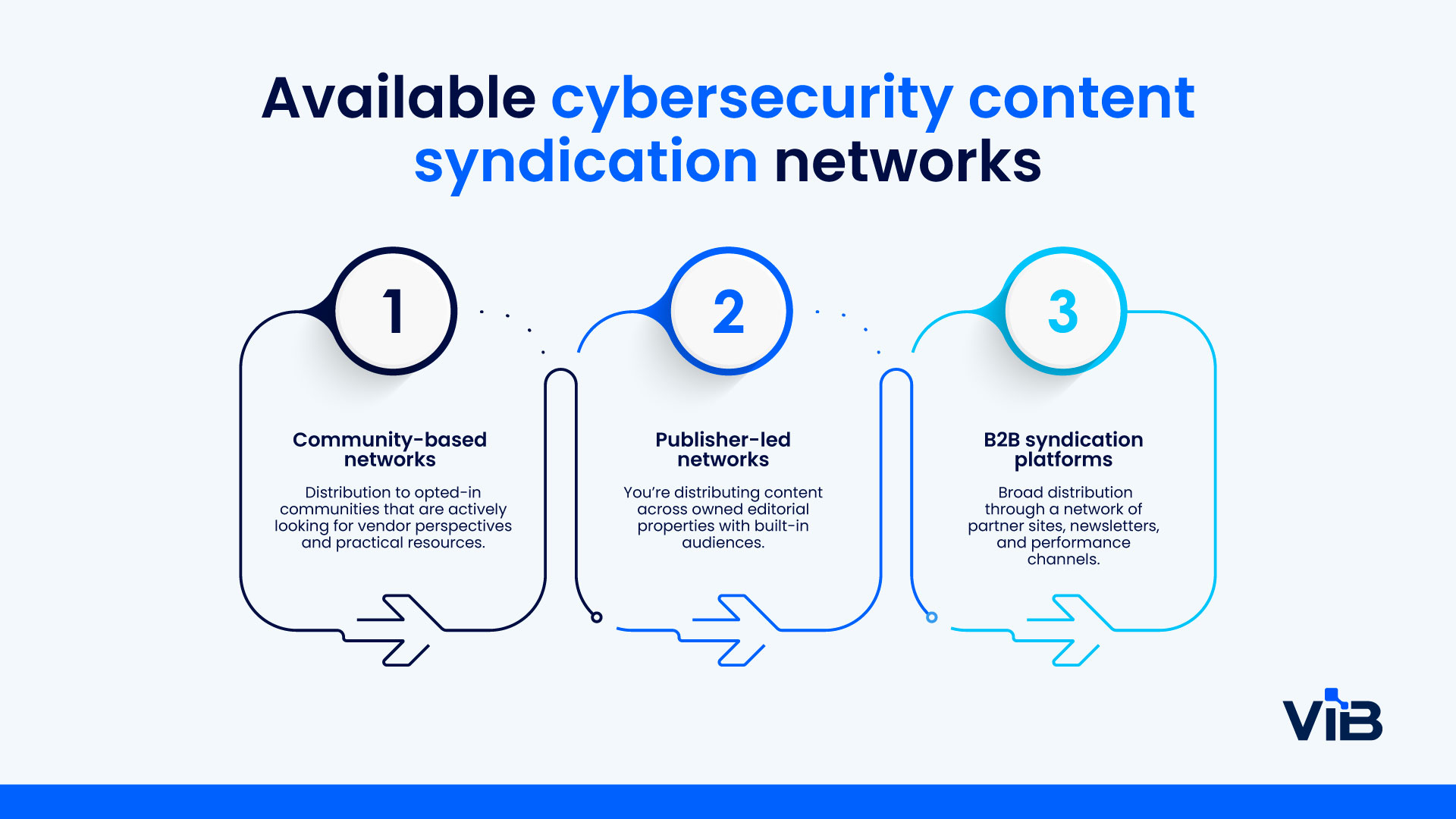
In practice, cybersecurity content syndication networks tend to fall into three buckets:
- Community-based networks: Distribution to opted-in communities that are actively looking for vendor perspectives and practical resources.
- Publisher-led networks: You’re distributing content across owned editorial properties with built-in audiences (often strong for IT/security research behaviors).
- B2B syndication platforms: Broad distribution through a network of partner sites, newsletters, and performance channels (often optimized for volume and CPL control).
Below is a marketer-focused list of cybersecurity syndication networks you can actively evaluate. This isn’t exhaustive, but it covers many of the networks cybersecurity teams regularly shortlist.
ViB Syndication
ViB Syndication distributes your top assets to our millions-strong opt-in community of technology professionals. It allows for targeting by attributes such as job titles, seniority, geography, company size, industries, and even ABM lists.
In practice, this tends to work well when you’re trying to validate messaging, build net-new engagement with the right profiles, and generate consistent top-of-funnel consumption from accounts you care about.
Pros
- ICP-focused targeting (including ABM list support) and promotion designed to put assets in front of your ICP.
- Lead quality controls via a qualified download guarantee and vetting against targeting specs (useful when you’re trying to keep your CRM clean).
- Works well for security categories where you’re trying to build engagement before conversion happens in other channels.
Cons
- Not a “set it and forget it” fix. You still need a strong nurture and account follow-up motion to translate engagement into downstream outcomes.
- Creative and offer strategy matters. If your asset is too product-heavy, your engagement signals will be weaker and your learnings less useful.
Best-fit use cases
- Reaching net-new security practitioners and leaders who match your ICP, especially when organic reach is capped.
- Testing which topics drive the strongest early engagement before you scale paid social or events.
- Supporting ABM coverage by putting high-value assets in front of named accounts and tracking consumption signals.
Informa TechTarget
Informa TechTarget’s content syndication is closely tied to its editorial ecosystem and intent signals, with a focus on reaching buying team members who are actively researching relevant topics.
Pros
- Strong for IT/security research behavior and contextual alignment, especially for established security categories.
- Intent-driven workflows can support account prioritization and messaging refinement.
Cons
- Can skew toward “research mode.” That’s useful, but it may require more patience and better nurturing to realize full value.
- Packaging can be complex if you’re trying to unify intent, syndication, and downstream activation across tools and teams.
Best-fit use cases
- Enterprise cybersecurity targeting where buying groups do deep third-party research.
- Teams running account-based plays that need account-level intent context to inform distribution and follow-up.
NetLine
NetLine is a long-standing B2B content syndication and lead gen network, reaching over 125 million unique visitors and generating 700K leads per month across 300 industry sections.
Pros
- Large distribution reach and broad category coverage (helpful when you need scale).
- Operational flexibility, including self-serve options and performance-based syndication programs.
- Integrations and partner ecosystem (for example, NetLine appears in the Demandbase partner marketplace).
Cons
- Quality variance is real at scale. You’ll want strict filters, validation rules, and a clear rejection workflow.
- Offer-content matching matters. Broad networks can underperform if you push niche assets without tight targeting.
Best-fit use cases
- Scaling cybersecurity awareness assets across multiple segments (SMB, mid-market, enterprise) with tailored targeting per segment.
- Filling specific nurture tracks with net-new opted-in contacts and measuring lift in downstream engagement.
Foundry
Foundry provides demand gen solutions that can include content syndication as part of broader programs, often tied to intent and editorial ecosystems across its portfolio.
Pros
- Strong publisher roots and access to tech audiences, which can help with credibility and contextual fit.
- Good option for integrated programs where syndication is one part of a coordinated mix.
Cons
- Less “single knob” control if you want a pure-play syndication motion with highly specific optimization.
- Results depend heavily on package design and how your content aligns with where readers are in their research.
Best-fit use cases
- Cybersecurity marketers who want publisher adjacency and brand-safe environments for high-trust categories.
- Teams combining intent, media, and content offers across a single partner.
Madison Logic
Madison Logic ABM Content Syndication around guiding buying groups and deepening account engagement, often paired with broader ABM approaches.
Pros
- ABM-aligned approach that’s easier to map to account coverage, buying-group reach, and orchestration goals.
- Emphasis on transparency and lead validation, which helps when stakeholders are skeptical of syndication.
Cons
- Heavier planning lift if you’re early in ABM maturity or don’t have tight account lists.
- Requires solid content mapping to buying stages, or engagement signals will be noisy.
Best-fit use cases
- Enterprise security teams running account-centric programs and needing consistent engagement across buying groups.
- Marketers who want syndication to connect more directly to account prioritization and follow-up.
DemandScience (content syndication + intent layers)
DemandScience positions its content syndication around opt-in leads, ICP targeting, and layered intent to reach likely buyers.
Pros
- Intent and ICP layering are helpful in crowded security categories where “interest” is easy to fake but harder to sustain.
- Clear expectations on delivery mechanics, like guaranteed CPL and defined lead volumes (useful for planning).
Cons
- You still need a strong nurture design to turn early intent into meaningful downstream actions.
- Be careful with over-reliance on “guarantees”. Focus on lead definitions, validation, and signal transparency, not just volume.
Best-fit use cases
- Teams that want a structured, measurable top-of-funnel program with defined ICP filters.
- Cybersecurity marketers combining syndication with ABM orchestration and intent-driven follow-up.
How to evaluate cybersecurity syndication networks beyond CPL
If you’re choosing syndication partners using only CPL and lead volume, you’re going to repeat the same problems most teams complain about: low acceptance, weak follow-up rates, and sales frustration.
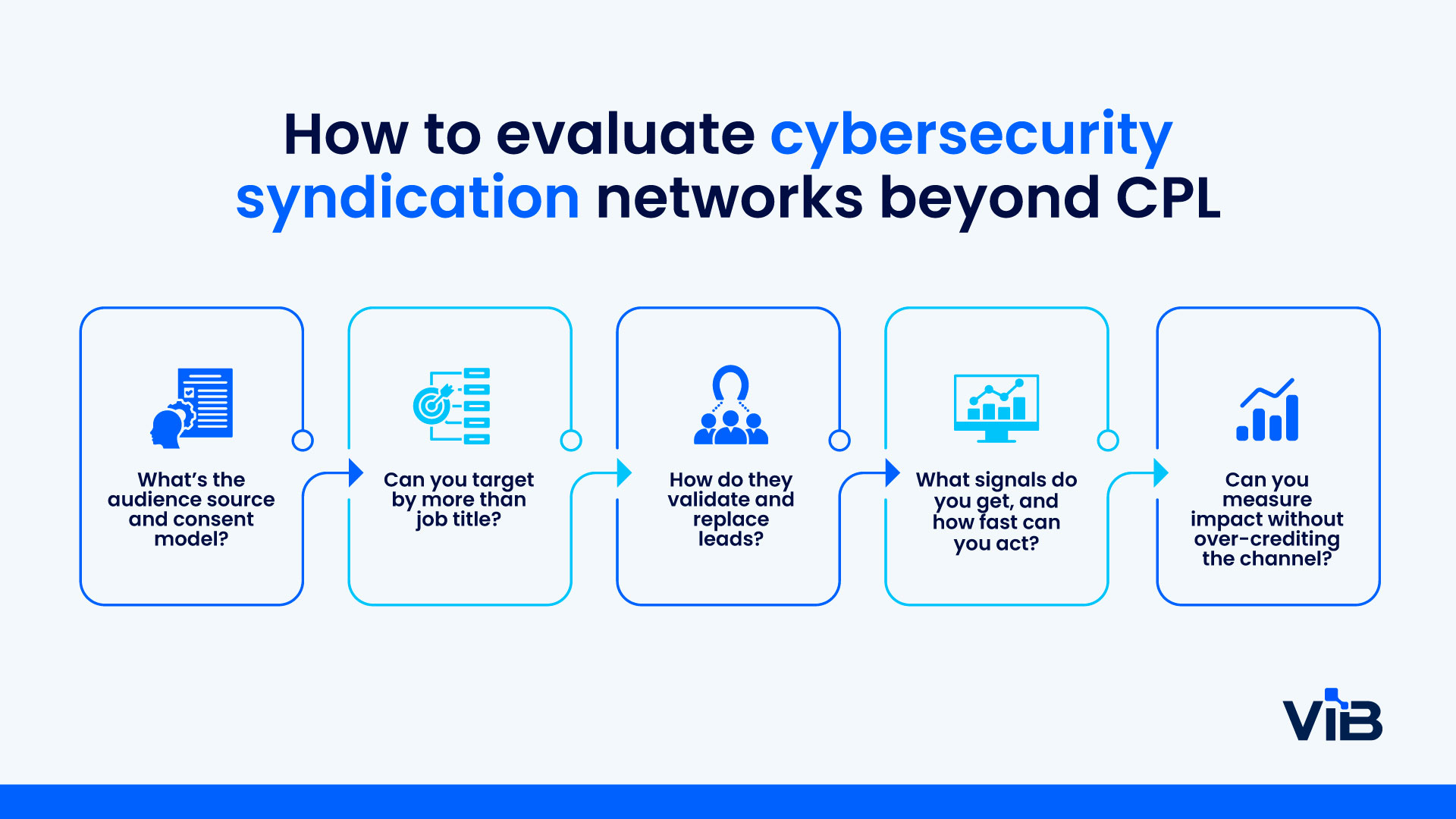
Instead, evaluate networks using five operational questions that map to real outcomes.
1) What’s the audience source and consent model?
Ask where contacts come from and how permission is captured at the point of conversion. Some vendors emphasize “permissioned” audiences and additional consent at form submission, which matters for compliance and downstream nurture performance.
For cybersecurity audiences, this can be the difference between “someone downloaded a PDF” and “someone actually expects to hear from vendors.”
2) Can you target by more than job title?
Cybersecurity buying groups are messy. Titles are inconsistent, and “Security Engineer” can mean anything from endpoint operations to detection engineering to cloud security.
Prioritize networks that support layered targeting, such as seniority, company size, industry, geography, and technographics, and apply exclusions you care about (e.g., students, consultants, competitors, very small firms, and so on).
3) How do they validate and replace leads?
Lead validation is not an admin detail. It changes how confident you can be in nurture and sales follow-up.
At a minimum, you want clear definitions of what counts as “qualified,” a replacement policy, and visibility into the reasons for rejections.
4) What signals do you get, and how fast can you act?
Experienced teams don’t just want names. They want signals they can operationalize in near real time: topic interest, asset engagement, intent surges, and account clusters.
5) Can you measure impact without over-crediting the channel?
Content syndication is often an earlier-journey channel. That’s not a weakness, but it does mean measurement needs to focus on what it’s good at: qualified engagement, ICP coverage, buying-group penetration, and nurture lift.
If your attribution model only “counts” last-touch demo conversions, you’ll undervalue syndication and overvalue retargeting.
Cybersecurity content syndication strategy: From form-fills to real engagement
Most syndication programs don’t fail because the vendor is “bad.” They fail because the strategy is under-specified.
In many cases, teams do a thoughtful job evaluating vendors—audience quality, targeting, CPL, validation rules—but stop short of defining how syndication is supposed to function inside their broader demand system.
So the program defaults to what’s easiest to measure: form-fills.
That’s where things break down.
Without a clear strategy for what counts as meaningful engagement, how content maps to buying stages, and what should happen after someone converts, even high-quality distribution turns into low-confidence leads.
The result is familiar:
- Marketing sees volume, but not progression
- SDRs see names, but not context
- Pipeline impact becomes hard to prove
The shift is subtle but important: high-performing teams treat syndication as a signal-generation system rather than a lead source.
That means designing the program intentionally—starting with how success is defined, how content filters for intent, and how engagement is operationalized downstream.
The sections below break down how to do exactly that.
Set the right success metrics before you pick content
Cybersecurity syndication can go sideways if the scoreboard is wrong.
If the only KPI is cost-per-lead, you’ll optimize toward the easiest conversion, not the best engagement. That’s how you end up with big volumes of low-signal contacts that your team doesn’t trust.
Instead, define two layers of measurement:
Layer 1: Delivery and integrity metrics
These confirm the program is operationally healthy.
- Contact validation rate (email, company, role)
- Duplicate rate (net-new vs. existing database)
- Suppression compliance (customers, competitors, partners, exclusions)
- Time-to-delivery (how quickly leads arrive after engagement)
Layer 2: Engagement and progression metrics
These indicate whether you’re reaching the right audience.
- Asset completion rate (not just “download”)
- Repeat engagement within 14–30 days
- Lift in target-account web activity during and after delivery
- Meeting acceptance rate for only the highest-signal segment (not the whole file)
One helpful benchmark: Pipeline360’s 2024 report shows that many teams report inquiry-to-MQL conversion rates for content syndication leads in the 15%–50% range, underscoring how widely outcomes vary by program design and definitions.
Use benchmarks as boundaries, not promises. Your definitions, your ICP, and your content mix matter more than the median.
Build the content architecture: Syndicate for signal
In cybersecurity, content tends to fall into two camps: thought leadership that’s easy to consume, and deep technical content that’s hard to finish.
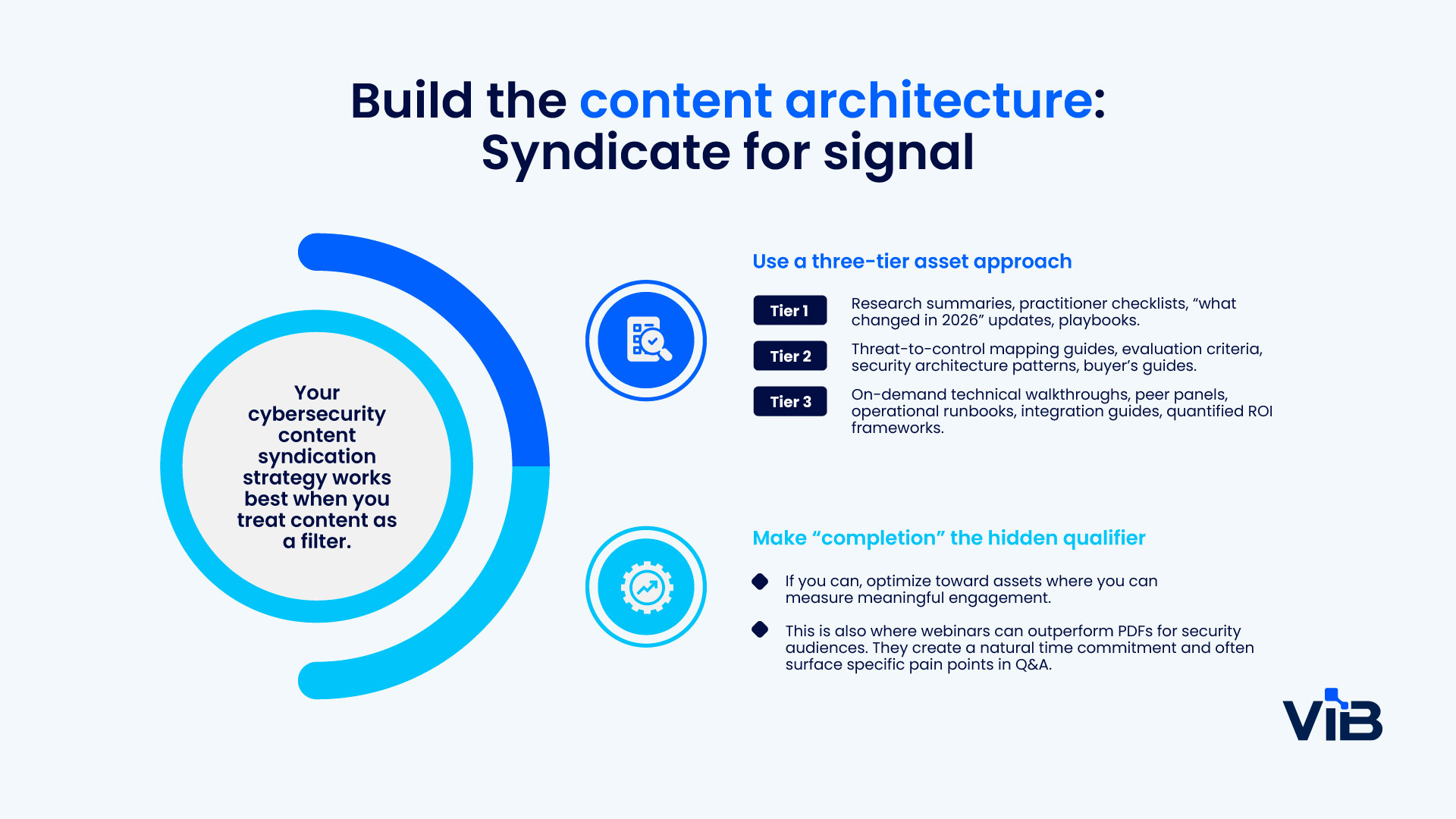
Your cybersecurity content syndication strategy works best when you treat content as a filter.
Use a three-tier asset approach
- Tier 1 (broad, high-consumption): Research summaries, practitioner checklists, “what changed in 2026” updates, playbooks.
- Tier 2 (problem-aware to solution-aware): Threat-to-control mapping guides, evaluation criteria, security architecture patterns, buyer’s guides.
- Tier 3 (high-signal): On-demand technical walkthroughs, peer panels, operational runbooks, integration guides, quantified ROI frameworks.
Tier 1 fuels audience growth and account coverage. Tier 2 builds category alignment. Tier 3 is where you earn the right to start real conversations, because the content itself requires intent and attention.
Make “completion” the hidden qualifier
If you can, optimize toward assets where you can measure meaningful engagement (attendance, watch time, multi-step interaction). That’s often more predictive than a single form submit.
This is also where webinars can outperform PDFs for security audiences. They create a natural time commitment and often surface specific pain points in Q&A.
Targeting and gating: The “quality” outcome is designed
Most lead-quality issues aren’t mysterious. They’re usually caused by one of three design mistakes: loose targeting, weak gating, or treating every responder the same.
1) Target buying groups, not single personas
For cybersecurity, buying influence is shared among security leadership, IT operations, infrastructure, and, sometimes, procurement or risk. Your filters should reflect that reality.
A practical approach is to define two persona clusters:
- Primary evaluators: security engineering, SecOps, IT infrastructure, cloud security
- Economic and risk influence: CISO/VP Security, IT leadership, GRC/risk
Then map content tiers to clusters. Tier 3 should skew toward primary evaluators and hands-on leaders. Tier 1 can include broader IT and risk roles.
2) Use “hard exclusions” to protect spend
Experienced teams set firm exclusions early. This keeps the channel clean and improves stakeholder confidence. Consider exclusions like:
- Students and academic domains
- Very small companies that never convert for you
- Job functions that never influence adoption
- Countries/regions you can’t support
- Competitors and known consultancies (unless intentionally included)
3) Add friction where it improves truth
More fields don’t automatically mean better data. But the right friction can improve honesty and segmentation.
For example, asking a single forced-choice question tied to your strategy can be more useful than adding three generic demographic fields. Think: “Which environment is this most relevant to?” or “What’s driving your evaluation this quarter?”
The operational workflow that makes syndication work in cybersecurity
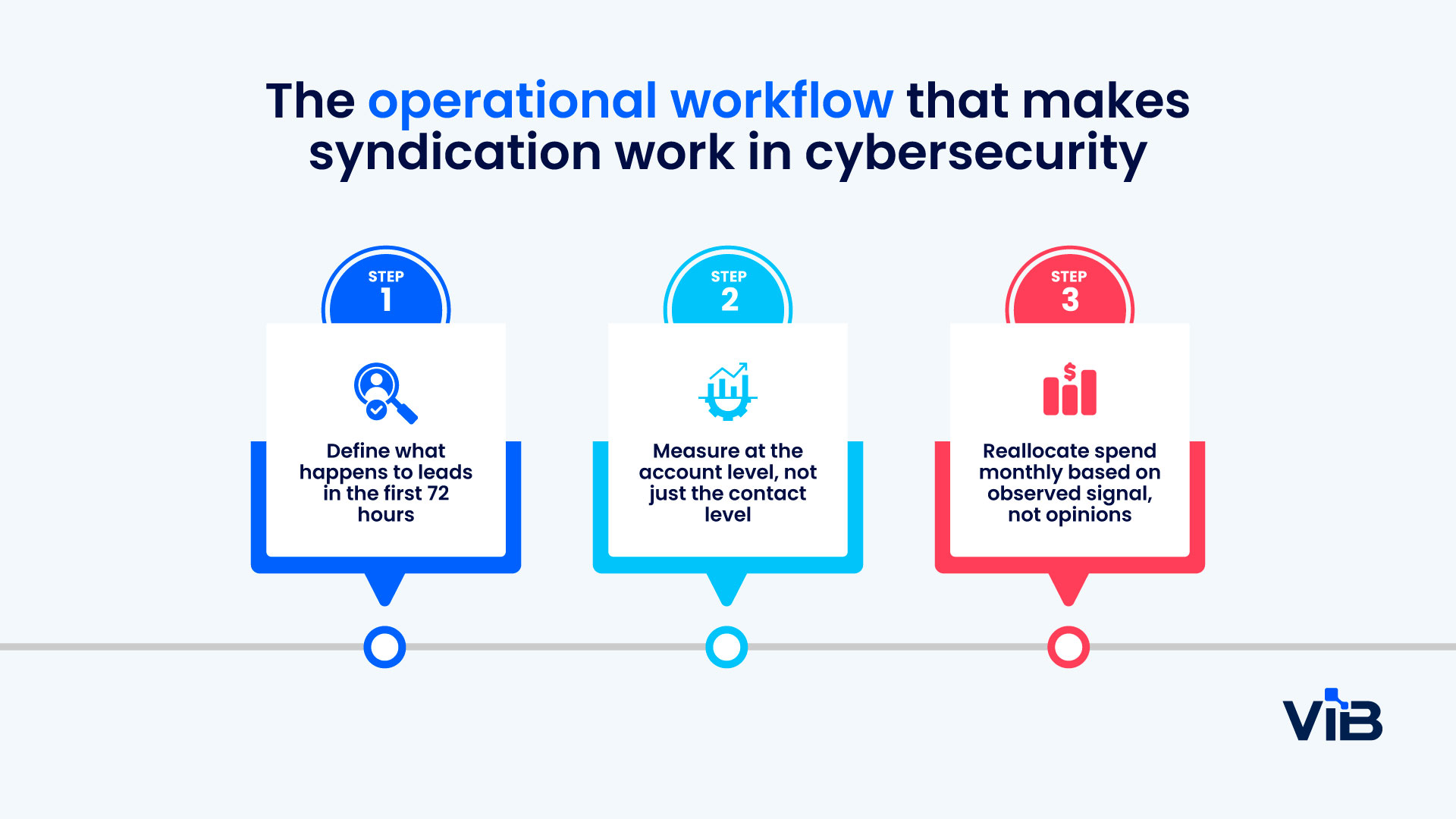
Syndication works best when it’s run like a system.
Step 1: Define what happens to leads in the first 72 hours
Split routing by engagement tier:
- Tier 1 responders: enter nurture; watch for repeat engagement and account lift
- Tier 2 responders: fast follow with a “choose your next step” email (not a hard sell)
- Tier 3 responders: prioritize for human follow-up, ideally with context on what they consumed
Step 2: Measure at the account level, not just the contact level
Track whether target accounts show broader behavior changes during the program: more direct traffic, more product page views, more return visits, more branded search, more engagement from adjacent roles.
This is where syndication becomes a signal generator instead of a list-builder.
Step 3: Reallocate spend monthly based on observed signal, not opinions
If a segment produces contacts but no repeat engagement, tighten the role mix or swap in a more demanding asset. If a segment produces fewer leads but much higher multi-touch engagement, protect it and expand it carefully.
A note on trust: why verification and transparency matter more in cybersecurity
Security audiences are trained to distrust things that feel too easy. That includes overly aggressive gating, unclear consent language, and low-transparency distribution.
So the channel design should answer three questions clearly:
- Who is this for (and who is it not for)?
- Why is the content worth the time?
- What will happen after they engage?
Conclusion: A cybersecurity content syndication strategy should be a signal program
In cybersecurity, content syndication works when you treat it as a managed system for reaching the right audiences and capturing meaningful engagement signals.
That means choosing content that filters for seriousness, designing targeting and exclusions that protect quality, and measuring outcomes that reflect how security buying groups actually behave.
When you do that, syndication becomes a reliable way to expand account coverage, validate messaging, and create practical next steps for your broader marketing and sales motions.


