 Skip to content


If you’re marketing B2B software in 2026, the best B2B software lead generation strategies look less like a one-channel playbook and more like a system: capture buying signals, match them to your ICP, and then earn attention with relevant content and offers.
Buyer behavior is pushing us here. In a Gartner survey of 632 B2B buyers, 61% said they prefer a rep-free experience, and 69% reported inconsistencies between seller websites and sales conversations.
So your lead gen strategy has to win earlier: before the form fill, before the demo request, and often before the buyer is ready to talk to anyone.
What’s changed in B2B software lead generation (and why tactics need an upgrade)
The main shift isn’t that channels stopped working. It’s that buyers now do more work in private, across more touchpoints, with more people involved.
Gartner describes the B2B buying journey as non-linear, with buyers revisiting “jobs to be done” rather than moving step-by-step through a neat funnel.
In practice, that means your lead gen can’t rely on one big gated asset or a single outbound sequence. You need multiple ways to detect interest, create engagement, and validate fit.
Engagement is the new leading indicator
Because buyers self-educate, your earliest measurable “wins” usually look like content consumption, repeat visits, clicks on topic clusters, event registrations, and third-party research behavior.
The best teams treat those signals as a routing and prioritization layer, not a replacement for positioning, creative, or nurture.
The highest-leverage B2B software lead generation strategies right now
Below are strategies that tend to hold up across categories like cybersecurity, data infrastructure, dev tools, and enterprise SaaS. They’re written for experienced marketers who already run multi-channel demand gen, and want more control over lead quality and buying context.
1) Build a signal-first targeting model (before you scale spend)
Most “lead quality” problems start upstream: targeting that’s too broad, too static, or based solely on firmographics.
A stronger approach is to define your ICP in two layers:
- Fit signals: industry, size, stack compatibility, regulatory context, maturity indicators (hiring, funding stage, cloud migration patterns).
- Interest signals: topic research, competitor comparisons, integration research, pricing, and implementation behaviors.
This is where intent data earns its keep. It helps you stop treating all “target accounts” as equally ready for the same message.
Make the model operational by mapping it to actions: who gets ads, who gets a content syndication offer, who gets a human outreach prompt, and who stays in nurture.
2) Use content syndication as a controlled distribution engine, not a volume play
Content syndication has a reputation problem because many programs optimize for quantity. For software marketers, the better use case is controlled distribution: specific titles, specific accounts, specific topics, and clear expectations on what counts as a qualified engagement.
This aligns with how content preferences are evolving. Demand Gen Report’s 2024 content research highlights a shift toward more digestible, shareable assets, as buyers move fast and self-serve more of their journey.
Practical improvements that make syndication perform better for B2B software:
- Topic-to-intent alignment: distribute content that matches a buying task (evaluation, implementation planning, risk reduction), not just a product category.
- Offer design: test “decision support” assets (benchmarks, checklists, templates) versus broad thought leadership.
- Sales-ready packaging: pass along what the buyer engaged with, so follow-up is contextual and short.
If you can’t explain why the buyer would care today, syndication becomes a blunt instrument. When you can, it becomes an efficient way to generate verified interest signals inside accounts you actually want.
ViB Syndication is designed to distribute your assets to a high-tech audience and turn that distribution into measurable engagement signals you can act on.
3) Treat email as an amplification channel (and measure it like a marketer in 2026)
Email still works, but the way you judge success has to evolve. Opens are noisy due to privacy and filtering, so experienced teams rely more on clicks, replies, landing-page engagement, and downstream account activity.
Benchmarks vary by list quality and segment, but HubSpot reports an average B2B email open rate of around 39.5%.
Use benchmarks as guardrails, not goals. Your bigger advantage comes from precision: tighter segmentation, clearer offers, and fewer sends to the wrong people.
How to make email contribute to modern lead gen
Three email motions tend to produce the cleanest engagement signals for B2B software:
- Problem-to-proof sequences: one pain point, one point of view, one proof asset (benchmark, teardown, ROI model).
- Event-based reactivation: “new report,” “new integration,” “new compliance update,” “new pricing model,” with a specific CTA.
- Account-specific follow-ups: triggered by a signal (content engagement, intent spike, webinar attendance), not a calendar date.
ViB Emails can help you amplify a message, offer, or event to a targeted high-tech audience, with an emphasis on reaching the right roles and capturing engagement.
4) Prioritize buying-stage offers (not just top-of-funnel content)
Most B2B software programs are heavy on awareness and light on “evaluation help.” That’s a miss, because buyers spend a lot of time validating risk, implementation effort, and stakeholder alignment.
Strong mid-journey offers include:
- Security and compliance mapping sheets
- Integration checklists by stack
- Implementation plans and timelines
- Role-based evaluation guides (IT, security, finance, ops)
- Peer benchmarks and “what good looks like” data
These offers are also easier to align with intent signals. If a buyer is researching “SOC 2,” “Okta integration,” or “migration timeline,” you can meet them with something genuinely useful.
5) Make lead gen a routing problem: speed, context, and ICP fit
When teams say “lead gen isn’t working,” they often mean the handoff isn’t working. The fix is rarely another channel. It’s tighter routing and clearer next steps.
Operationally, that means defining what happens when someone engages:
- High fit + high interest: fast follow-up with a contextual message tied to the asset or topic.
- High fit + medium interest: nurture with a short series aligned to the buyer’s job-to-be-done.
- Medium fit + high interest: validate data, confirm role, and route to the right segment or partner motion.
- Low fit: suppress quickly to protect sender reputation and sales time.
This is where marketers earn trust internally. You’re not promising outcomes you can’t control. You’re building a system that creates repeatable, interpretable signals.

Where intent fits in B2B software lead generation strategies (and where it doesn’t)
Intent is valuable because it helps you time your outreach and tailor your message. It’s limited because it’s still a proxy for what’s happening inside the account.
Most intent frameworks revolve around aggregating digital behaviors like keyword research, competitor comparisons, and solution research patterns.
The practical move is to combine intent with verification steps. For example, use intent to decide who enters a program, then use engagement (content consumed, questions asked, follow-up actions) to decide what happens next.
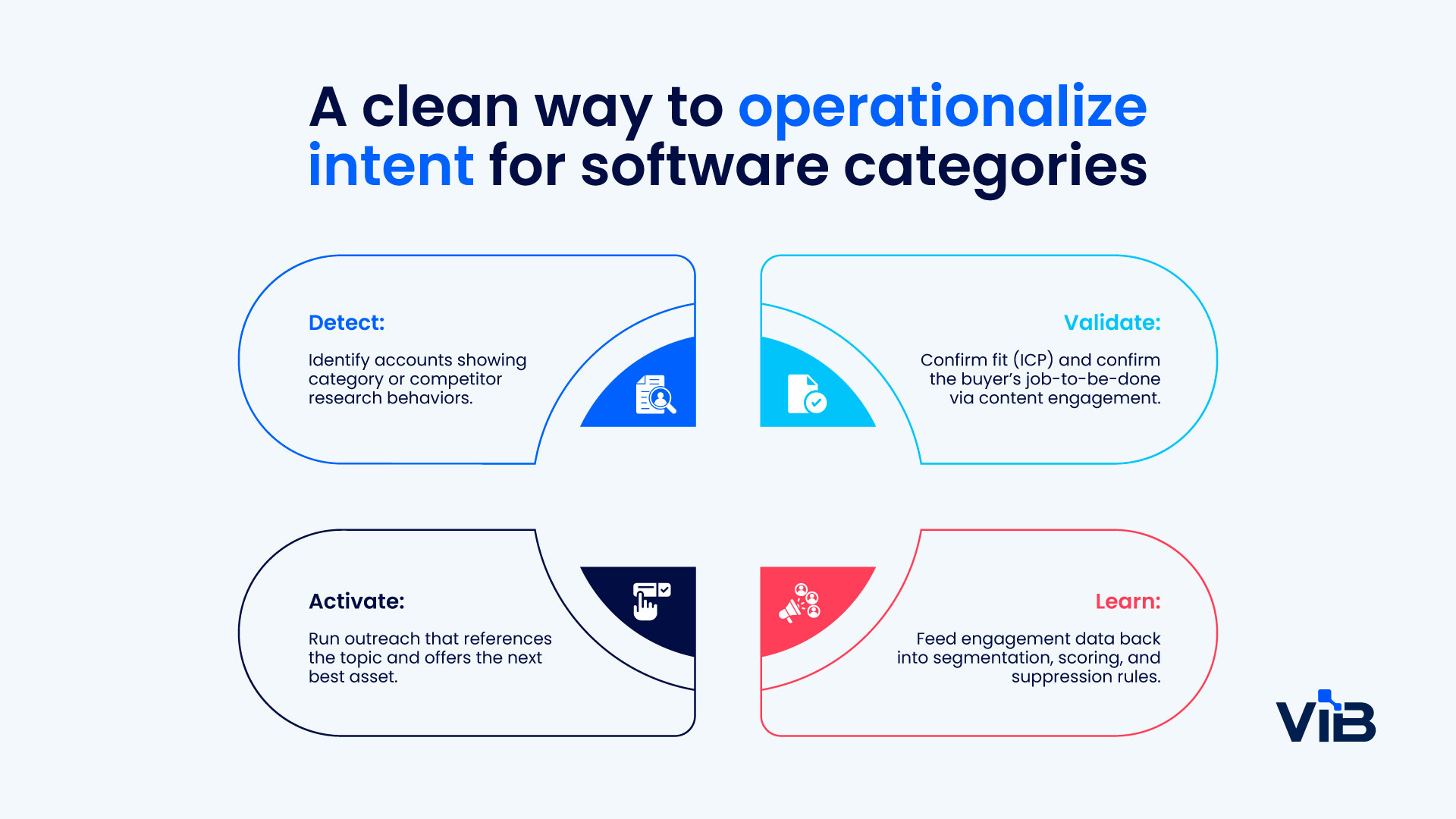
A clean way to operationalize intent for software categories
Here’s a simple model that works well when you sell into technical buying groups:
- Detect: identify accounts showing category or competitor research behaviors.
- Validate: confirm fit (ICP) and confirm the buyer’s job-to-be-done via content engagement.
- Activate: run outreach that references the topic and offers the next best asset.
- Learn: feed engagement data back into segmentation, scoring, and suppression rules.
This keeps your strategy grounded. You’re building momentum with the right accounts, not forcing artificial “readiness.”
How ViB supports these strategies
If your goal is better B2B software lead generation strategies, the question to ask vendors isn’t “Can you deliver outcomes?” It’s “Can you help us create consistent, interpretable buying signals with ICP-fit prospects?”
ViB (Virtual Intelligence Briefing) is built for that earlier part of the journey: getting your message, assets, and offers in front of the right high-tech audiences, then turning engagement into usable signals.
ViB Emails: fast, targeted message amplification
Use ViB Emails when you have a clear message and a tight audience, and you want to generate engagement you can track and learn from.
Good fits include: webinar invitations, new benchmark reports, product-category explainers for a specific vertical, and integration-focused content.
ViB Syndication: distribute high-intent assets to the right tech audience
Use ViB Syndication when you want to scale content distribution while keeping control over who sees what. This is especially useful when your organic and paid channels can’t efficiently reach niche technical roles, or when you need more consistent engagement volume in a specific segment.
Using permission-based declared intent to add context
When you need more confidence than broad behavioral intent can provide, permission-based declared intent from specialized providers can add context about project timing, business priorities, and stakeholder involvement.
Use this information alongside ICP fit, first-party engagement, and human qualification. A declared timeframe can help prioritize follow-up, but it should not be treated as definitive proof that a prospect is ready to purchase.
How to combine these elements into a practical strategy
If you want a simple, marketer-friendly way to put this together, here’s a common sequencing that keeps the focus on engagement and fit:
- Start with ViB Syndication to distribute one or two high-value assets tied to an evaluation job-to-be-done.
- Layer in ViB Emails to amplify a time-bound offer—such as an event, new report, or integration guide—to the same segment.
- Use first-party engagement and permission-based intent signals from trusted sources to prioritize accounts, then tailor follow-up based on the content and topics they engaged with.
This approach keeps you in control. You’re not hanging your plan on a single hero channel or attribution model. You’re building a repeatable system to generate and act on buying signals.
Conclusion: the best lead gen strategies win earlier, with better signals
The most effective B2B software lead generation strategies in 2026 aren’t louder. They’re sharper.
They start with fit, use intent and engagement to create timing and relevance, and rely on practical offers that help buyers do real evaluation work. They also treat lead gen as an operating system: targeting, distribution, measurement, and routing.
If you want a next step grounded in marketer reality, ViB Emails and ViB Syndication can help you reach targeted technology audiences and generate measurable engagement you can act on.


