 Skip to content


B2B marketers are under more pressure than ever to prove what’s working. Traffic alone is not enough. Engagement is not enough. Even lead volume on its own is no longer convincing unless those leads actually progress, convert, and influence revenue.
That is exactly why performance marketing has become such a critical approach for B2B lead generation.
Instead of guessing which campaigns might work, performance marketing focuses on measurable outcomes, optimization, and accountability at every stage of the funnel. 🎯
In this guide, we’ll break down what performance marketing really means in a B2B context, why it matters for lead generation, and the strategies that consistently deliver results for high-consideration B2B buying cycles.
What performance marketing means for B2B
At its core, performance marketing is a results-driven approach where success is measured by specific actions rather than exposure. Those actions might include form fills, demo requests, content downloads, or booked meetings.
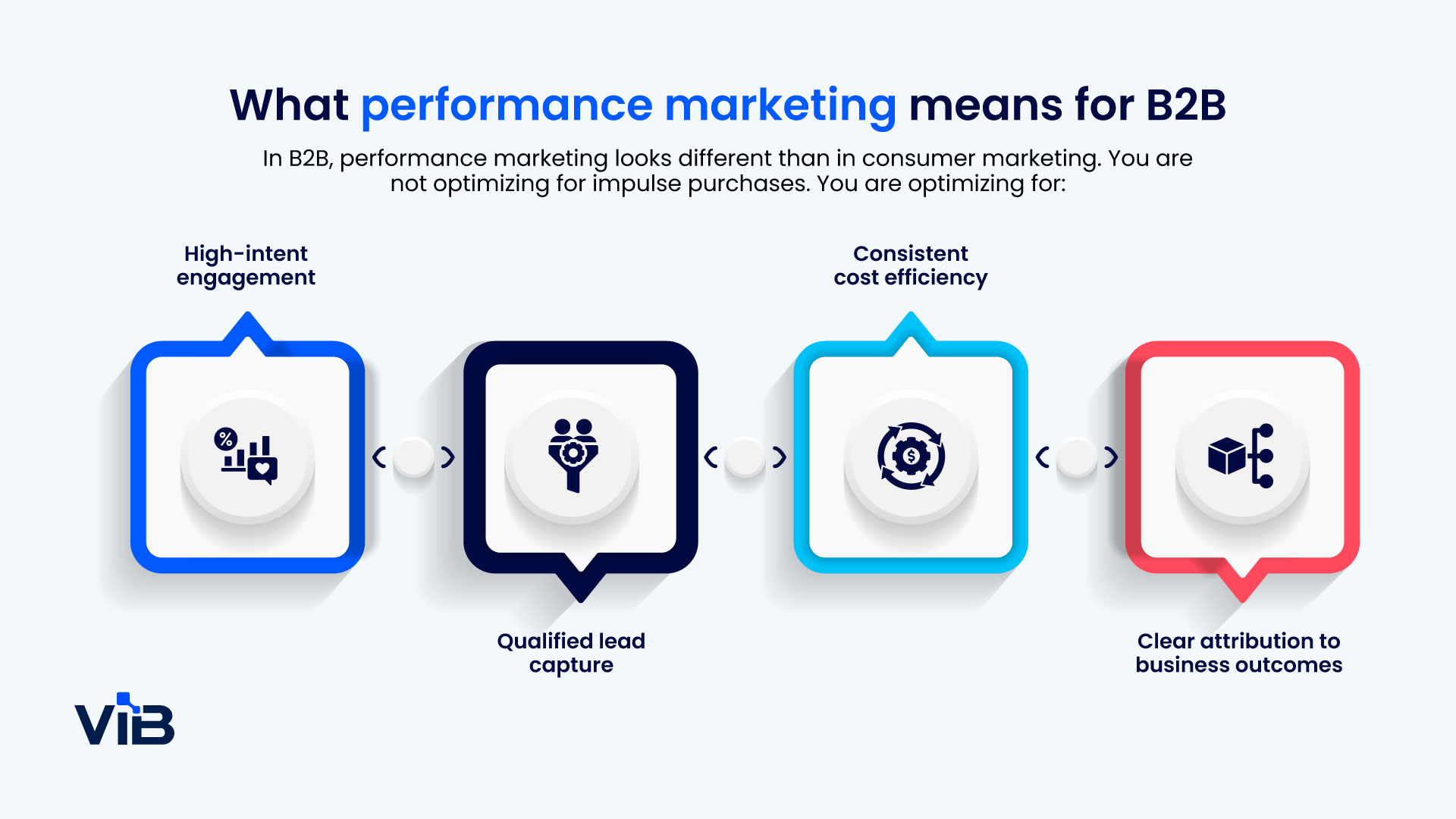
In B2B, performance marketing looks different than in consumer marketing. You are not optimizing for impulse purchases. You are optimizing for:
- High-intent engagement
- Qualified lead capture
- Consistent cost efficiency
- Clear attribution to business outcomes
B2B buying decisions typically involve multiple stakeholders, longer research cycles, and higher deal values. Performance marketing helps bring structure and accountability to that complexity by tying spend to clearly defined results.
Instead of asking, “Did this campaign get impressions?” performance marketing asks, “Did this campaign drive the right leads, at the right cost, and at the right time?”
Why performance marketing is essential for B2B lead generation
Lead generation is the backbone of most B2B growth strategies, but not all leads are created equal. Traditional approaches often prioritize volume, which can overwhelm sales teams with contacts that are not ready or relevant.
Performance marketing flips that mindset by focusing on quality and intent.
Clear ROI and accountability
With performance marketing, you can clearly see which channels, campaigns, and messages are driving conversions and which ones are not. That makes it easier to double down on what works and cut what does not.
Better alignment between marketing and sales
Because performance marketing tracks actions rather than impressions, it creates a shared language between marketing and sales. Both teams can align around what qualifies as a lead, how leads are scored, and which behaviors signal readiness.
More efficient use of budget
When budgets are tied to performance metrics like cost per lead or conversion rate, spend becomes easier to justify (and optimize). You’re no longer paying for exposure alone. You’re paying for outcomes.
Core performance marketing strategies for B2B lead generation
There is no single channel that guarantees success. Strong performance marketing programs combine multiple tactics, all optimized toward measurable results.
Paid search and intent-driven PPC
Paid search is one of the most effective performance channels for B2B lead generation, especially when targeting high-intent keywords.
The key is focusing on queries that indicate buying or evaluation behavior, such as:
- “Best [solution] for [industry]”
- “[Category] software pricing”
- “[Use case] tools for B2B”
Landing pages should be built specifically for conversion, with one clear action, minimal friction, and messaging aligned to the keyword intent. Continuous testing of headlines, CTAs, and form length can significantly improve results over time.
LinkedIn advertising for B2B audiences
LinkedIn is a cornerstone of B2B performance marketing because of its precise targeting options. You can reach decision-makers based on job title, seniority, company size, industry, and even specific accounts.
Performance-focused LinkedIn campaigns often include:
- Sponsored content driving to gated resources
- Lead gen forms optimized for completion
- Retargeting ads based on engagement
The most effective campaigns balance strong value messaging with clear next steps, rather than overly promotional language.
Retargeting to capture lost demand
Not every prospect converts on the first visit. In B2B, that’s expected.
Retargeting allows you to re-engage users who have already shown interest, whether they visited a product page, downloaded content, or interacted with an ad. Because these users are already familiar with your brand, retargeting campaigns often deliver lower costs and higher conversion rates. 🔁
The key is segmenting retargeting audiences by behavior and serving messaging that reflects where they are in the buying journey.
Gated content designed for performance
Whitepapers, guides, reports, and case studies are great tools for B2B lead generation. In a performance marketing framework, these assets are not created just for awareness. They are built to convert.
High-performing gated content typically:
- Solves a pain point for a specific audience
- Demonstrates expertise and credibility
- Leads naturally into a follow-up conversation
Marketers should closely track download rates, completion rates, and downstream engagement to evaluate success.

Email amplification and lead nurturing
Email remains one of the most measurable and scalable performance channels in B2B, delivering an ROI of $36 for every $1 spent. When executed correctly, it can drive highly targeted traffic, re-engage dormant audiences, and support content launches.
Performance-focused email programs rely on:
- Clean, segmented audiences
- Messaging aligned to intent and role
- Continuous testing of subject lines, copy, and CTAs
Rather than blasting generic messages, performance marketing uses email strategically to move leads closer to meaningful action. 📩

Key metrics to track for B2B performance marketing
To succeed with performance marketing, you need the right metrics. Vanity metrics alone won’t tell the full story.
Some of the most important KPIs for B2B lead generation include:
Conversion rate
Measures how effectively traffic turns into leads. This applies to landing pages, forms, and gated assets.
Cost per lead (CPL)
Shows how efficiently the budget is being used. Monitoring CPL over time helps identify optimization opportunities.
Lead quality indicators
Behavioral signals such as page depth, repeat visits, and content engagement help assess whether leads are truly relevant.
Channel-level performance
Understanding which channels drive the strongest engagement allows marketers to reallocate spend strategically.
Tracking these metrics consistently enables continuous improvement rather than one-time optimization.
Common challenges and how to overcome them
Even strong performance marketing programs face obstacles. Here are some of the most common ones, and how to manage them.
Attribution complexity
B2B buyers use multiple channels. Using multi-touch attribution models can provide a more accurate view of influence.
Sales and marketing misalignment
Clear definitions of what constitutes a qualified lead, combined with regular feedback loops, help keep teams aligned.
Data and privacy limitations
As tracking becomes more restricted, first-party data and intent-based strategies become increasingly important. Performance marketing must adapt without sacrificing measurement.
How ViB supports performance marketing for B2B lead generation
Performance marketing only works when you can reach the right audience, measure real engagement, and turn interest into action. That’s where ViB comes in.
ViB helps B2B marketers drive performance by connecting campaigns to high-intent, hard-to-reach tech decision-makers across multiple touchpoints. Instead of relying on broad targeting or rented lists, ViB focuses on audience quality, intent signals, and outcomes that actually matter.
With ViB, marketers can:
- Reach verified B2B tech buyers actively researching solutions
- Drive targeted traffic to high-value pages, content, and offers
- Capture qualified leads tied to real engagement, not vanity clicks
- Support long buying cycles with consistent, performance-tracked exposure
Because ViB campaigns are built around measurable actions, marketers gain clearer visibility into what’s working and where to optimize. The result is a performance marketing engine that prioritizes lead quality, efficiency, and accountability, helping teams generate demand without sacrificing scale or control.
Final thoughts on performance marketing for B2B lead generation
Performance marketing has shifted how B2B companies think about lead generation. It replaces assumptions with data, volume with intent, and guesswork with optimization.
By focusing on measurable actions, aligning channels to clear outcomes, and continuously refining strategy, performance marketing creates a more sustainable and scalable approach to B2B growth. 🚀


