 Skip to content


If you’re searching for B2B appointment setting companies, you’re probably not looking for “more meetings.” You’re looking for the right meetings, at the right time, with the right buying group members.
That sounds obvious, but in practice, it’s where most appointment programs break down: misaligned ICP, weak context, and a follow-up motion that treats every conversation like it’s late-stage.
Buyer behavior makes this harder than it used to be. Gartner found that 61% of B2B buyers prefer a rep-free buying experience, and 73% actively avoid suppliers who send irrelevant outreach.
So the bar is higher. It’s not just about booking calls. It’s about earning conversations without creating future resistance.
What “appointment setting” means now (and why definitions matter)
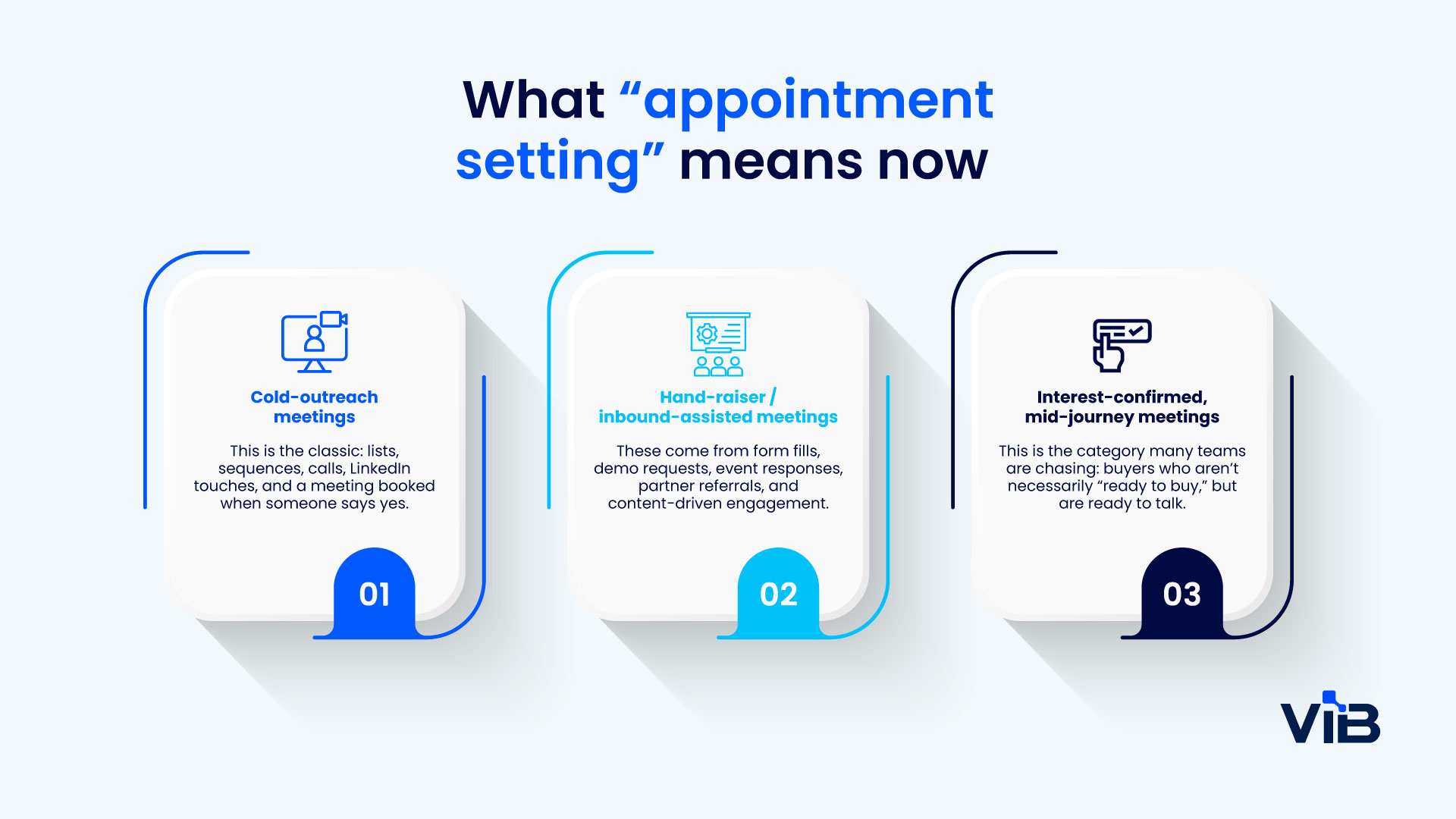
In many orgs, appointment setting gets lumped into SDR output. But most experienced SaaS marketers know there are at least three different “meeting types” hiding under that label.
1) Cold-outreach meetings (high volume, high variance)
This is the classic: lists, sequences, calls, LinkedIn touches, and a meeting booked when someone says yes. It can work, but it’s sensitive to list quality, deliverability, domain reputation, and messaging discipline.
The failure mode is predictable: meetings happen, but they’re thin on context. The prospect shows up confused. The AE spends 20 minutes resetting the conversation.
2) Inbound-assisted meetings (lower volume, higher intent)
These come from form fills, demo requests, event responses, partner referrals, and content-driven engagement. They’re often higher-quality, but harder to scale quickly because you’re constrained by audience, distribution, and timing.
3) Interest-confirmed, mid-journey meetings (the sweet spot for many teams)
This is the category many teams are chasing: buyers who aren’t necessarily “ready to buy,” but are ready to talk because the problem is real, the timing is plausible, and the solution category fits.
This is also where language matters. You’re not “closing.” You’re generating engagement signals, validating ICP fit, and earning the right to keep the conversation going.
Why B2B appointment-setting companies struggle in today’s buyer journey
If you’ve run appointment-setting before, you’ve probably encountered at least one of these issues. None are new, but they’re amplified by how buyers research now. 6sense reports that buyers often don’t engage sellers until they’re about two-thirds of the way through their journey, and that buyers initiate contact over 80% of the time.
That means your appointment-setting partner needs smarter targeting, better context, and a tighter definition of “qualified.”
The “meeting at all costs” trap
When a vendor is measured only on the number of meetings booked, they’ll optimize for the path of least resistance. That usually means softer qualification, broader targeting, and messaging that overpromises just to get a calendar accept.
It feels good in a dashboard. Then show rates drop, win rates don’t move, and the sales team stops trusting the source.
Dark funnel reality: you can’t convert what you can’t see
Many buying signals happen anonymously. 6sense notes that just 3% of website visitors self-identify via form fills, which makes “wait for inbound” a tough strategy on its own.
Appointment setting can help here, but only if the motion respects the buyer’s pace. Over-aggressive outreach can create negative signals.
Misalignment between marketing’s ICP and sales’ reality
Many marketers treat their ICP as static, and they’re tied firmly to firmographics. Fewer have a working definition tied to conversion outcomes.
If your appointment-setting company is qualifying against a static checklist, but sales qualifies with “do we actually win here,” you’ll get friction fast.
How to evaluate B2B appointment-setting companies (beyond the obvious)
Most vendor comparisons focus on price per meeting, volume, and channels. Those factors matter. But experienced marketers should evaluate the system behind the meeting.
1) Ask how they create and validate ICP fit
Great appointment-setting companies don’t just “target titles.” They design constraints that map to your actual win conditions.
- Do they support targeting by role and seniority, geography, company size, industry, and tech environment?
- Can they work from an ABM/TAL list without watering it down?
- How do they handle excluded segments (competitors, customers, students, consultants)?
You’re looking for a partner who treats ICP as a conversion hypothesis, not a filter. ✅
2) Qualify the meeting definition (and operationalize it)
“Qualified meeting” should be a documented standard that sales and marketing both accept. If it’s vague, you’ll end up debating outcomes call by call.
At a minimum, define:
- Attendance requirement: what counts as held vs. no-show?
- Role requirement: which personas qualify, and which are useful but non-qualifying?
- Use-case requirement: what problem statements indicate real alignment?
- Disqualifiers: what must be present to reject the meeting confidently?
This isn’t bureaucracy. It’s how you prevent a good channel from getting shut down because of a few bad weeks.
3) Look for evidence that they protect your brand in-market
Ask for examples of their outreach or meeting request flow. Review it like a brand campaign, not a sales script.
If the messaging is too pushy, too generic, or too claim-heavy, it can create long-term friction with accounts you actually care about.
4) Confirm how feedback flows back into optimization
A meeting is not the outcome. It’s a data point.
The best B2B appointment-setting companies have a built-in loop to learn:
- Which segments accept meetings but don’t convert to next steps
- Which messages drive interest but attract the wrong persona
- Which objection themes show up repeatedly
- Which competitors get mentioned early (and why)
If a vendor can’t tell you what they learned last month, they’re not running a system. They’re running a grind.
Performance outcomes that matter more than raw meeting count
In mature SaaS orgs, appointment setting is one input to a broader revenue system. So you need KPIs that reflect real business value, without pretending every call is a buying event.
Track “engagement signals” as first-class metrics
Not every meeting should be judged by immediate progression. Many are simply confirming timing, stakeholders, and problem shape.
Useful leading indicators include:
- Meeting hold rate (scheduled vs. held)
- Right-person rate (persona + level match)
- Problem clarity (did they articulate a real pain?)
- Next-step rate (agreed follow-up, even if it’s weeks out)
- Account expansion signals (new stakeholders pulled in)
This approach keeps the program honest without forcing every conversation into a late-stage frame. 👍
Measure downstream impact carefully (and fairly)
Attribution is messy when buyers spend most of their time researching independently.
So when you evaluate an appointment-setting company, don’t just ask, “Did this meeting create revenue?” Ask, “Did this meeting increase certainty, accelerate evaluation, or expand stakeholder access?”
Common use cases where appointment setting works best
Appointment setting isn’t a universal fix. But it can be high-leverage in a few scenarios that experienced teams will recognize.
New category, unclear demand, or repositioning
If you’re creating a category (or shifting to a new ICP), you need conversations that validate language and pain. Appointment setting can generate those conversations faster than waiting for organic discovery.
Enterprise deals where stakeholder mapping is the real work
In an enterprise, the “first meeting” is often just the start of stakeholder expansion. A strong appointment-setting partner should help you consistently reach the roles that influence the evaluation, not only the easiest titles to book.
ABM programs that need air cover
ABM without enough human conversations can turn into “ads plus hope.” Appointment setting can act as a structured way to create account-level engagement when your accounts won’t self-identify.
That said, you’ll want close coordination with your intent, paid, and content motions so the meeting request doesn’t feel random.
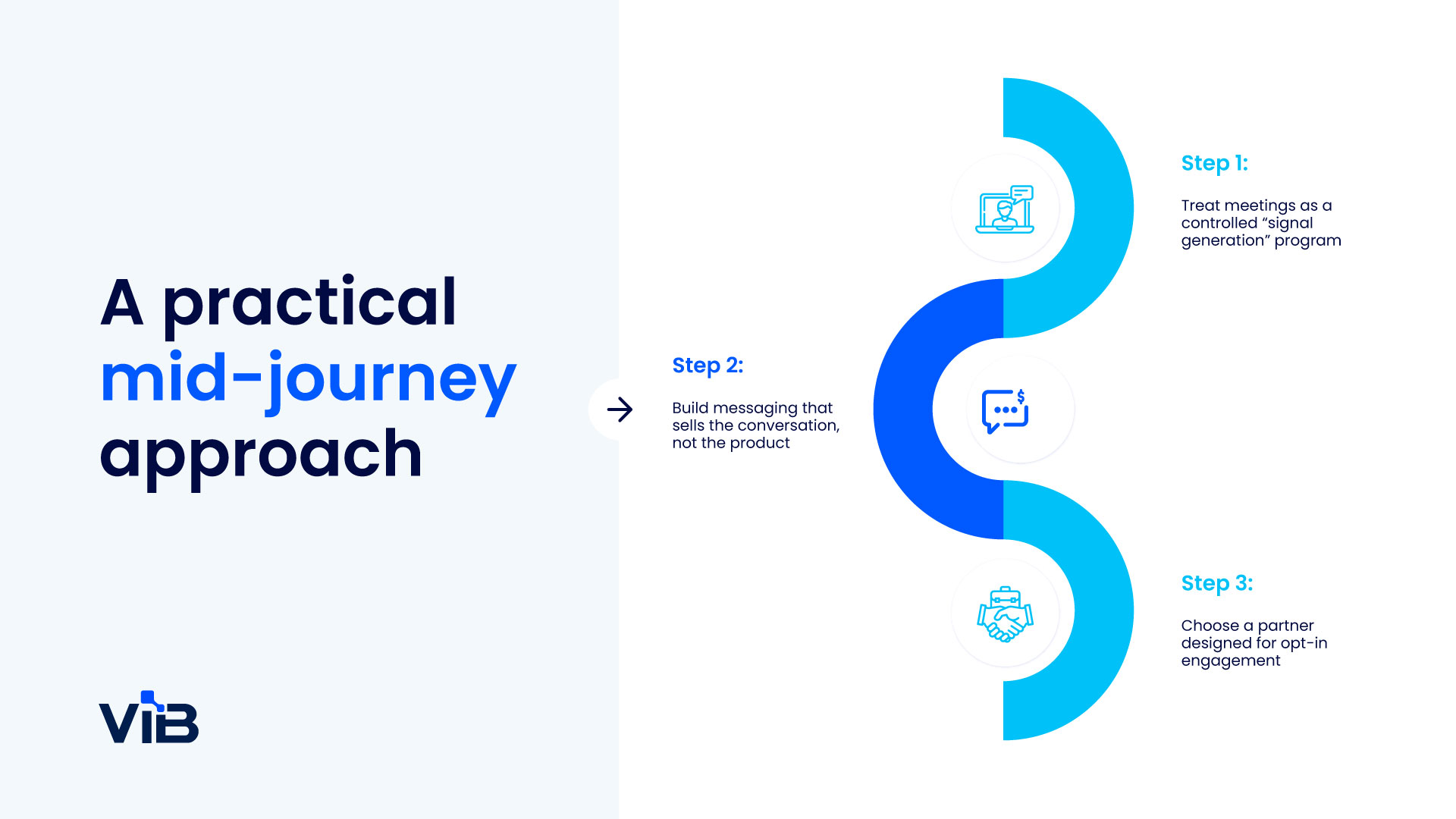
A practical mid-journey approach
Here’s a pragmatic way to think about getting value from B2B appointment-setting companies without over-optimizing for late-stage outcomes.
Step 1: Treat meetings as a controlled “signal generation” program
Your goal is to generate consistent, comparable signals from the market:
- Which ICP segments lean in fastest
- Which pains create urgency
- Which competitor narratives show up
- Which personas are reachable right now
That shifts the posture from “book and pitch” to “engage and learn,” which tends to produce better conversations anyway.
Step 2: Build messaging that sells the conversation, not the product
If buyers want control, your meeting invite should give it to them: clear value, clear agenda, and clear who it’s for.
This is where a lighter-touch model can outperform aggressive SDR scripting.
Step 3: Choose a partner designed for opt-in engagement
ViB Appointments is built around opt-in interest: professionals in ViB’s community apply to meet when the message aligns with their needs.
That matters because it supports the positioning many SaaS teams need right now: not “guaranteed revenue outcomes,” but qualified engagement, stronger ICP-fit conversations, and better market feedback.
Conclusion: Pick B2B appointment setting companies that optimize for fit, not just volume
The best B2B appointment-setting companies don’t win by booking the most meetings. They win by consistently creating conversations that match your ICP, respect buyer timing, and generate actionable signals for marketing and sales.
If you take one thing from this guide, make it this: define the meeting, protect the message, and build a feedback loop. When those pieces are in place, appointment setting becomes a scalable way to earn more of the right conversations—without burning your market in the process. 🚀


