 Skip to content


Email is one of the most overused channels in B2B marketing, and still one of the most misunderstood.
Most performance marketing email campaigns fail quietly. Messages get sent, dashboards fill with opens and clicks, and downstream impact remains unclear. The issue isn’t that email doesn’t work. It’s that many teams treat email volume as performance instead of treating email as a performance channel.
For experienced B2B tech marketers, the challenge is no longer sending better emails. It’s designing performance marketing email campaigns that reach the right audience, drive real engagement, and support measurable outcomes. 📧
What actually defines a performance marketing email campaign?
A performance marketing email campaign is not defined by send volume or open rate. It’s defined by whether the campaign creates meaningful action from the right audience.
High-performing teams evaluate email performance by asking:
- Who received the message, not just how many
- Who engaged in a meaningful way
- What happened after the click
When email is measured this way, it becomes a strategic lever rather than a broadcast tool.

Why are opens and clicks no longer enough
Opens and clicks are easy to track, but they rarely tell the full story. They can signal curiosity without intent, or activity without relevance.
Performance marketing email campaigns focus on downstream signals. Engagement quality, repeat interaction, and follow-on behavior matter more than surface metrics.
How email gets misused in performance marketing campaigns
Most email campaigns struggle because they are constrained by the same limitations: small lists, list fatigue, and declining engagement over time.
As databases age, marketers are forced to send more frequently to achieve the same results. This creates a negative loop where performance appears stable while audience quality erodes.
Performance marketing email campaigns break this cycle by prioritizing reach expansion and relevance, not frequency.
Where performance expectations get misaligned
Most email performance issues come from how the channel is positioned, not how it’s executed.
Common misalignments include:
- Using email as the first touch instead of a follow-up channel
- Treating clicks as a proxy for readiness
- Optimizing frequency instead of sequencing
When those expectations are corrected, email stops feeling unpredictable and starts behaving like a reliable performance lever.
What determines whether an email campaign creates a real signal
Email performance is ultimately decided before the message is sent.
The strongest performance marketing email campaigns are built around who is likely to care right now, not how large the audience is or how often messages go out. When email is sent to people without a clear reason to engage, metrics can still move, but signal quality drops.
Performance improves when email is treated as a precision channel, one designed to surface intent rather than manufacture activity.
Why email performance depends on context, not cadence
Email rarely fails because it’s sent too little or too much. It fails when it arrives without context.
Messages perform best when they align with something the recipient is already thinking about, researching, or evaluating. When that alignment exists, frequency becomes secondary, and engagement reflects real interest instead of habit.
This is why performance marketing email campaigns focus on timing against buyer context, not just calendar schedules.
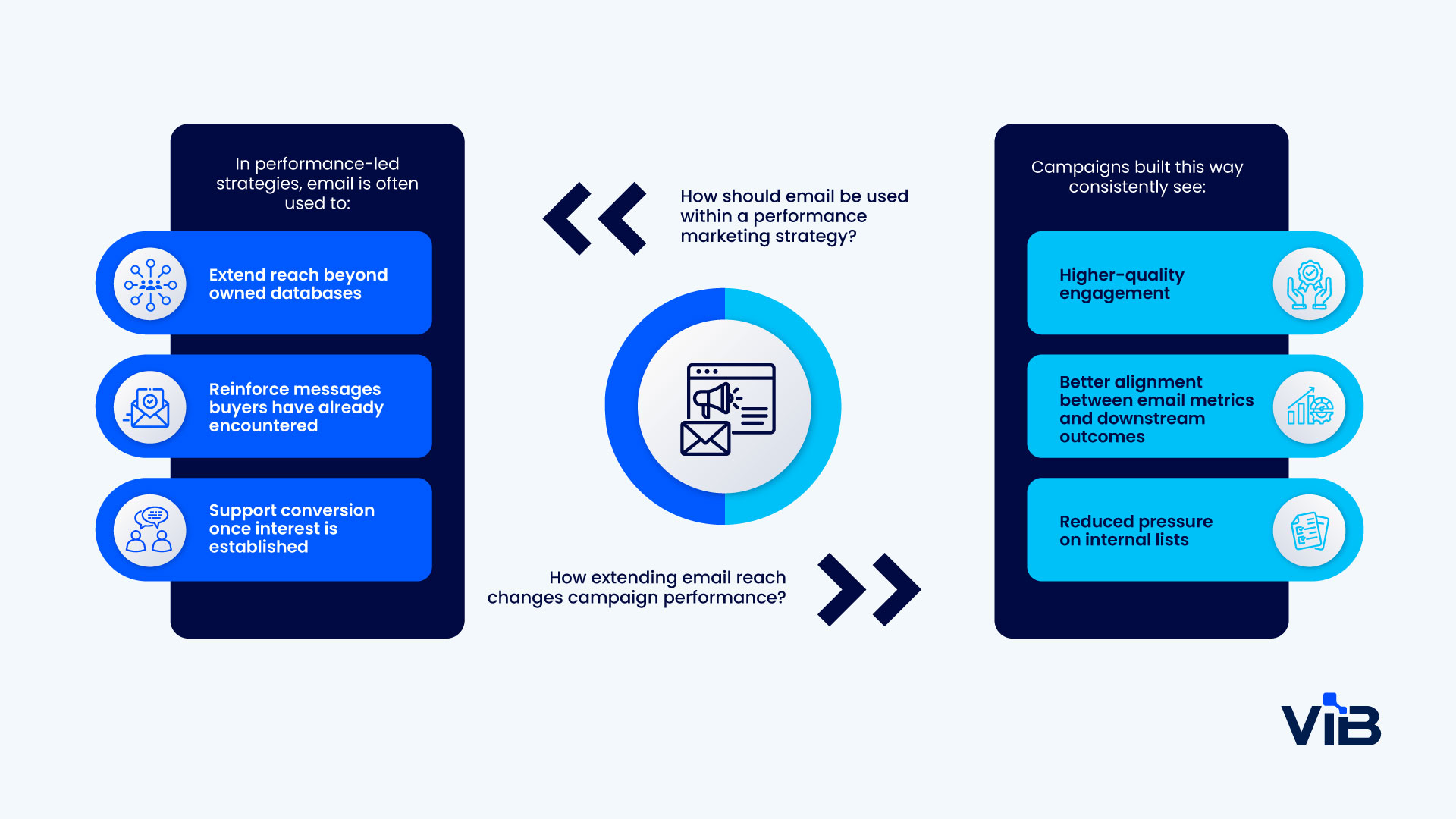
How should email be used within a performance marketing strategy?
Email performs best when it reinforces momentum rather than trying to create it from scratch.
In performance-led strategies, email is often used to:
- Extend reach beyond owned databases
- Reinforce messages buyers have already encountered
- Support conversion once interest is established
Used this way, email strengthens the entire performance ecosystem instead of acting as a standalone tactic.
How extending email reach changes campaign performance
Extending email reach fundamentally changes what performance looks like.
Instead of repeatedly sending to the same contacts, marketers can introduce their message to new, ICP-aligned buyers who are already interested in the topic. This shifts performance from squeezing more out of shrinking lists to expanding opportunity responsibly.
Campaigns built this way consistently see:
- Higher-quality engagement
- Better alignment between email metrics and downstream outcomes
- Reduced pressure on internal lists
If you’re curious what that looks like, a ViB email pilot gives you a low-risk way to test how your existing messages perform when they’re amplified to a vetted audience of high-intent tech buyers.
Where do ViB Emails support performance marketing email campaigns?
Once strategy and measurement are clear, execution depends on the right delivery model.
If you want to see how this type of delivery fits into your broader performance strategy, our team can walk you through how teams are using email to extend reach without burning their lists.
ViB Emails supports performance marketing email campaigns by extending your existing email messages to a curated community of verified, high-tech decision-makers that match your ICP. ViB manages audience targeting, delivery, and reporting, allowing marketers to expand reach, protect list health, and measure real engagement without relying on rented lists or oversending.
This approach allows email to function as a true performance channel, one that scales without sacrificing relevance.
What should experienced marketers prioritize moving forward?
Performance marketing email campaigns are not about sending more emails. They are about sending the right message to the right audience at the right moment.
Teams that succeed will focus on audience expansion without dilution, relevance over frequency, and performance metrics that connect to real outcomes.
When email is treated as a performance engine instead of a broadcast tool, it becomes one of the most reliable drivers in the B2B marketing mix. 🤝


