B2B tech marketing teams are heading into 2026 with a familiar problem: bigger targets, tighter budgets, and far less patience for tactics that look good on paper but fail to deliver tangible outcomes.
Impressions, clicks, and form fills still matter, but they’re no longer enough on their own. Leadership wants proof that marketing is contributing to demand, not just activity. That’s why performance marketing has become such a critical part of modern B2B demand generation strategies.
When done right, B2B tech performance marketing creates a clear line between spend, engagement, and revenue impact. It allows teams to test faster, optimize smarter, and focus resources on what actually moves the needle. 📈
In this guide, we’ll break down what B2B tech performance marketing really means, how it supports demand generation, and how to build a strategy that works in today’s buying environment.
What is B2B tech performance marketing?
At its core, B2B tech performance marketing is an approach where every campaign is tied to measurable outcomes. Instead of optimizing for surface-level metrics, performance marketing focuses on results such as qualified engagement, account-level intent, meeting creation, and influenced revenue.
For B2B tech companies, this is especially important. Long sales cycles, complex buying committees, and high-value deals mean marketing needs to do more than drive volume. It needs to build demand with the proper accounts over time.
Key characteristics of B2B tech performance marketing include:
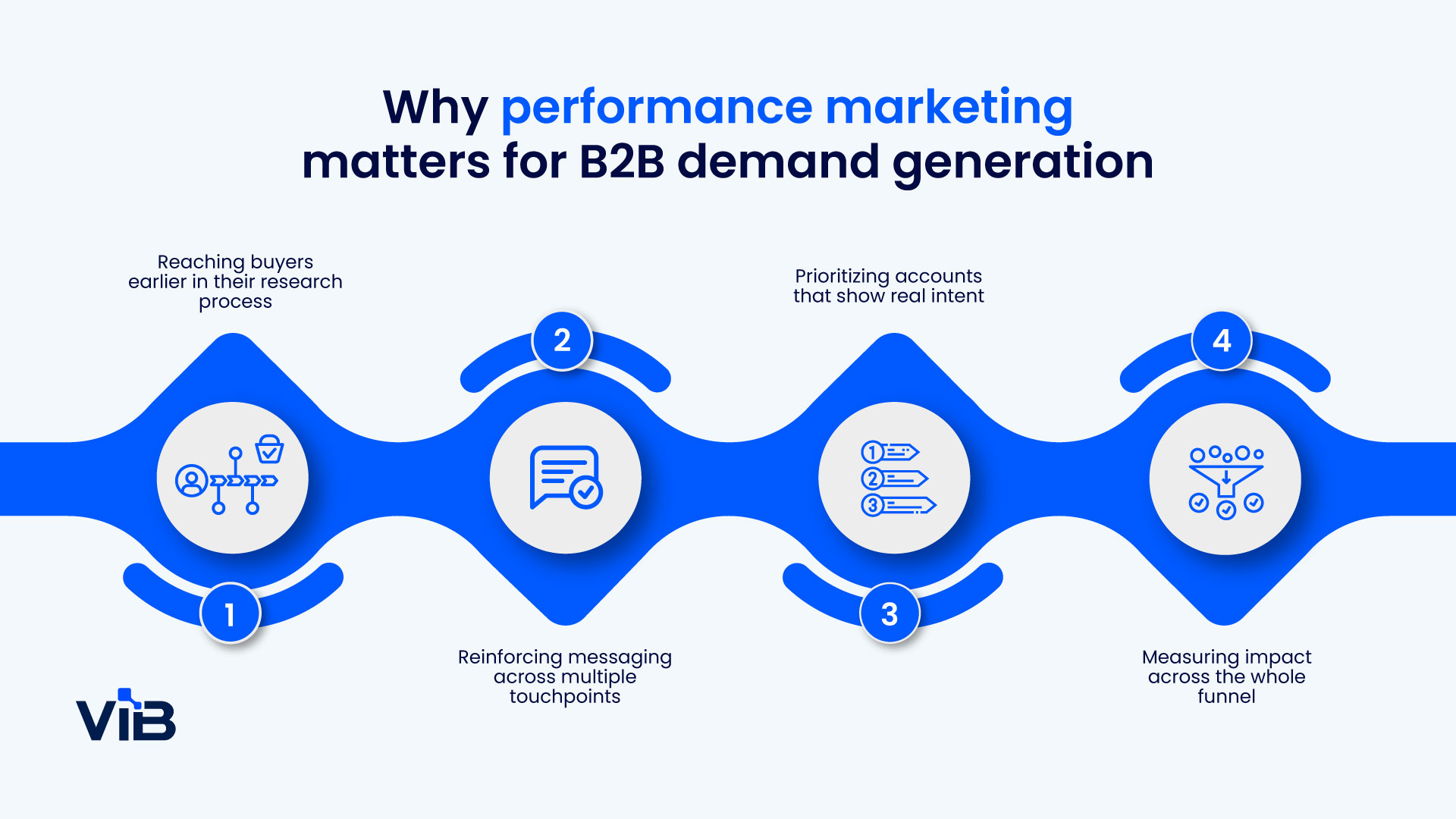
Why performance marketing matters for B2B demand generation
Demand generation isn’t about capturing interest that already exists. It’s about creating and shaping interest before a buyer is even ready to raise their hand.
By the time a prospect fills out a form, much of the buying decision may already be made.
Performance marketing allows B2B tech teams to engage earlier, stay visible longer, and adapt messaging based on real signals rather than assumptions.
Core pillars of B2B tech performance marketing
A strong performance marketing strategy for demand generation is built on a few foundational pillars.
1. Audience precision
Performance marketing only works if you’re targeting the right people. For B2B tech, this means going beyond basic demographics and firmographics. The most effective strategies layer in:
Precision reduces wasted spend and ensures your message reaches the buyers most likely to convert.
2. Message alignment across the buyer journey
One-off campaigns rarely create demand on their own. Performance marketing thrives on consistency.
That means aligning messaging across awareness-stage education, mid-funnel validation and proof, and late-stage differentiation and urgency.
Each touchpoint should reinforce the same core value proposition while addressing the buyer’s current mindset.
3. Channel accountability
In performance marketing, every channel must earn its place.
Paid media, email, content syndication, and retargeting are not judged by vanity metrics but by their contribution to demand. Channels that consistently underperform are refined or replaced.
This discipline helps teams avoid spreading the budget too thin across tactics that do not deliver.
4. Measurement beyond leads
For B2B demand generation, performance metrics should reflect buying behavior rather than just conversions.
Avoiding these mistakes requires upfront alignment and a willingness to test, learn, and adjust over time.
How performance marketing supports long-term demand generation
One misconception is that performance marketing only delivers short-term wins. In reality, it can be a powerful driver of long-term demand when applied correctly.
By continuously engaging the same high-value accounts with relevant messaging, performance marketing:
This approach complements outbound sales and shortens the path from awareness to conversation.
Where ViB fits into B2B tech performance marketing
Performance marketing doesn’t rely on a single tactic. It works best when multiple strategies are aligned around demand outcomes.
For instance, ViB supports B2B tech performance marketing with solutions that prioritize audience quality, measurable engagement, and campaign impact.
ViB Emails
ViB Emailshelp performance-driven teams amplify content and campaigns to a highly targeted B2B tech audience. Instead of blasting large lists, campaigns focus on relevance, engagement, and measurable response signals.
This makes email a performance channel again, not just a distribution tactic.
ViB Webinars
ViB Webinars helps teams run educational events that generate measurable registration, attendance, and engagement data across targeted audiences.
This supports demand generation earlier in the buying cycle while providing clear signals for follow-up and content planning.
ViB Appointments
For teams ready to move from demand to conversations, ViB Appointments provides a performance-based way to secure meetings with qualified B2B tech decision-makers.
ViB Syndication
ViB Syndication supports demand generation by distributing high-value content to the right B2B tech audiences at scale. Instead of chasing volume, syndication focuses on engagement quality and audience fit.
This allows performance marketers to extend reach while maintaining accountability across campaigns.
Together, these solutions support a performance-first approach without forcing a hard pivot away from strategy or buyer experience.
Building your B2B tech performance marketing plan for 2026
As teams plan for 2026, performance marketing should be viewed as a framework, rather than a single campaign.
Start by asking:
What demand outcomes matter most to the business?
Which accounts and audiences should we prioritize?
How will we measure success across the full journey?
From there, align channels, messaging, and measurement around those goals.
Performance marketing works best when it is intentional, integrated, and continuously optimized.
Start 2026 off right with performance marketing
B2B tech performance marketing is no longer optional for demand generation. Buyers expect relevance, leadership expects accountability, and teams need strategies that scale without wasted spend.
By focusing on outcomes, audience precision, and long-term demand creation, performance marketing helps B2B tech teams do more with less and prove the impact of their work. 🚀
As 2026 approaches, the teams that win will be the ones that treat performance marketing as a strategic discipline, not just a tactical play.
Ready to see how ViB can work for you?
Let’s talk about your goals and show you exactly how our solutions can help you reach the right buyers—fast.
Post-Meeting Intelligence is a survey-based service that gathers unbiased feedback from prospects after your sales meetings. It’s available exclusively as an add-on to ViB Appointments. This service helps fill post-meeting data gaps, answering key questions like:
Which product or service features resonated most with the prospect?
How could the sales call have been improved?
What hurdles might prevent closing the deal?
What next steps align with the prospect’s pace and interest?
Does the prospect have the budget for our solution?
Instead of leaving your sales reps to guess after the call, ViB acts as a neutral third party to survey the prospect. We gather first-hand data to close the feedback loop—giving you clear insights to refine your approach and boost your chances of winning the deal.
ViB uses a pay-per-qualified-meeting-held pricing model—meaning you only pay for completed appointments with leads who fit your targeting criteria.
Unlike fee-for-service providers, there’s no risk of paying for no-shows or getting stuck with a retainer fee for low meeting volume. You only pay for successful meetings. That’s part of our core values as a trusted demand generation partner—and we deliver on it through our unique community-based approach.
ViB Deal Intent does the qualification all for you — helping you skip the lengthy nurturing process. And with comprehensive deal intent at your fingertips, you can personalize your approach and enter conversations fully informed, increasing your chances of closing deals faster.
In particular, if you’re a startup or have a smaller market presence, ViB Deal intent can help to uncover net new accounts and projects that you might not have been organically invited to, ultimately accelerating your prospecting efforts.
We’re glad you asked! Both of these solutions generate qualified sales leads and appointments, and tap into the same ViB Community.
However, unlike ViB Appointments, ViB Deal Intent is a more mid to bottom-of-funnel sales lead generation service, as there are additional steps to confirm that the lead is in an active project, and to derive comprehensive deal intent. This enables a deeper level of personalization and produces valuable original data.
ViB Deal intent provides explicit intent data from zero-party data sources. In other words, it’s really our process of generating pre-qualified business opportunity leads, and the results you get, that differentiate us from other B2B sales leads generation companies and intent data providers. Here’s how we’d sum it up:
Leads are self-verified to be in a confirmed project in your intent category, and in the next 6-12 months. In other words, they have told us that they are actively seeking solutions like yours.
There’s full consent. Every prospect delivered will have agreed to be contacted by solution providers like you! This means they’re more likely to be genuinely interested, and likely to convert into opportunities.
We get it, choosing the best B2B content syndication services provider can feel like a maze. So let’s break it down.
There are quite a few ways ViB Syndication stands out from other B2B content syndication platforms. For one, other platforms primarily use a native advertising model that targets a general audience of readers segmented by vague readership patterns like location, time, and browser type. Meanwhile, ViB’s audience is made up of tech end users who have opted in to receive content that matches their business needs. Each user is carefully targeted, using a range of B2B customer segmentation strategies like firmographics and psychographics (interests).
Another key difference is our pricing model. With ViB, we follow a pay-per-qualified-download model. It’s a more specific type of pay-per-lead model, where you only pay for the leads that meet your criteria. This is different from other platforms that function more like ads and use a pay-per-click or pay-per-impression model. Our approach ensures that you get the most out of your investment and only pay for qualified leads that are actually interested in your content. No wasted clicks or impressions here!
Lastly, paid content syndication vendors might require you to use complex bidding platforms, which could take some time to onboard. With ViB, we’ll simply need your asset, targeting criteria and lead goal, and we’ll handle the rest so you can focus on what you do best.
ViB Syndication uses a unique approach, where we generate leads from our community of tech end users. Essentially, our leads are members of our ViB Community, where they come to discover new tech and tell us about their interests and contact details.
By using this community-based approach, we’re able to provide you with contact data that is self-verified and directly from the source (zero-party data). Our community members choose to receive content that aligns with their interests and business needs. Through ViB Syndication, we then promote your content to them until we reach your qualified lead guarantee. So rest assured, you’ll generate engaged and qualified leads who are genuinely interested in what you have to offer. It’s a win-win!
Free content syndication requires you to pitch your content to relevant publications and websites, hoping they mention it, extract content, give you credit, or even place a backlink. You can also republish your content on sites you own, which counts as a free syndication strategy.
Paid content syndication removes all that extra effort and “risk”, by having an external partner promote your content for a fee. Ps. you can also see more on the blog: Free vs. Paid Content Syndication — Which Works Best for B2B Tech Companies?
Outsourced sales development representatives (SDRs), sometimes called business development representatives (BDRs), need to pitch your brand and solution to prospective clients, and then manually qualify leads—a process that leaves room for error. Outsourcing to SDRs can be especially challenging for high-tech companies. Training often takes weeks, as SDRs need to understand complex solutions and communicate technical details accurately. This can be time-consuming and costly, increasing the risk of setting meetings with prospects who don’t understand your brand or solution.
Common issues with outsourced SDRs include:
Struggling to understand niche tech solutions and relay technical details
Misrepresenting your brand
Delivering leads that don’t match your targeting criteria or buyer personas
Long onboarding and training timelines
Fee-for-service pricing models that charge regardless of results
ViB Appointments is different. We tap into a community of millions of high-tech professionals. Our platform-driven approach puts you in control of your message and targeting—without the need to train SDRs on your product. You can launch in days, not months. Plus, our pay-per-completed meeting model lowers your risk—you only pay for successful appointments.
At ViB, we don’t rely on cold calling at all!
Traditional B2B cold calling services gather contact data from various sources like company directories, business databases, trade shows, industry events, social media, and referrals. They may also buy or rent targeted lead lists from B2B data providers. Reps then use cold outreach to manually qualify prospects and set up meetings.
ViB takes a different approach. Our community-based model taps into a network of millions of high-tech decision makers to source qualified, targeted prospects. We promote your solution on our community portal, where members voluntarily opt in to meet with you. Because they self-qualify—without any hard selling—they’re typically more interested, leading to higher conversion rates.
That’s the best part. Our contacts are self-verified, meaning they’ve given us their information voluntarily, and opted-in to receive emails that align with their interests and business needs. This zero-party data approach keeps our data accurate, relevant and compliant.
Quality and speed! We rely on our engaged ViB Community instead of public and possibly sketchy sources on the web that could contain non-compliant B2B data lists.
Plus, instead of selling B2B contact lists, we take a white-glove approach to help you run each email campaign. This helps you skip all the steps around list cleaning, brand training, launching campaigns, and worrying about email sender domain reputation, which is a common concern when buying lead lists from B2B data providers. You’ll simply go straight to seeing engaged email leads.
We’re all about getting you the most qualified B2B contacts. We source our contact information directly from our ViB Community of tech professionals who have opted in to receive emails that match their interests or business.
You may also like:
Best cybersecurity content promotion services (2026)
 Skip to content