 Skip to content


B2B targeting used to be relatively straightforward: Pick an industry and job title, run ads, and hope.
Now, it’s a different game. Buyers do more research without sellers, buying groups are bigger and messier, and most outbound is ignored if it’s even slightly off.
In this post, we’ll look at what’s changed in B2B targeting, what actually improves ICP fit, and how to operationalize B2B targeting with signals, content, and activation plays that don’t rely on empty volume.
Why B2B targeting feels harder than it should
Many teams struggle because “targeting” is being asked to solve too many problems at once: awareness, engagement, qualification, and sales readiness.
And buyer behavior keeps moving earlier and more independently. Gartner describes the B2B buying journey as “looping” across six buying jobs (such as solution exploration, validation, and consensus creation), rather than a neat funnel you can map to a single persona.
At the same time, outreach tolerance is low. Gartner found that 73% of B2B buyers actively avoid suppliers who send irrelevant outreach. That’s not a conversion-rate problem; it’s a positioning and data discipline problem.
The hidden failure mode: targeting for reach instead of relevance
When teams target for reach, they tend to optimize for match rate and volume. That’s how you end up with “ICP-fit” lists that still don’t convert.
When teams target for relevance, they optimize for context: what changed, why now, which stakeholders care, and what problem the account is trying to solve.
Relevance is harder to scale, but it’s the difference between engagement and being ignored.
Start with ICP, but define it like an operator (not a slide)
You don’t need another ICP template. You need an ICP definition that can drive consistent decisions across acquisition channels, scoring, and follow-up.
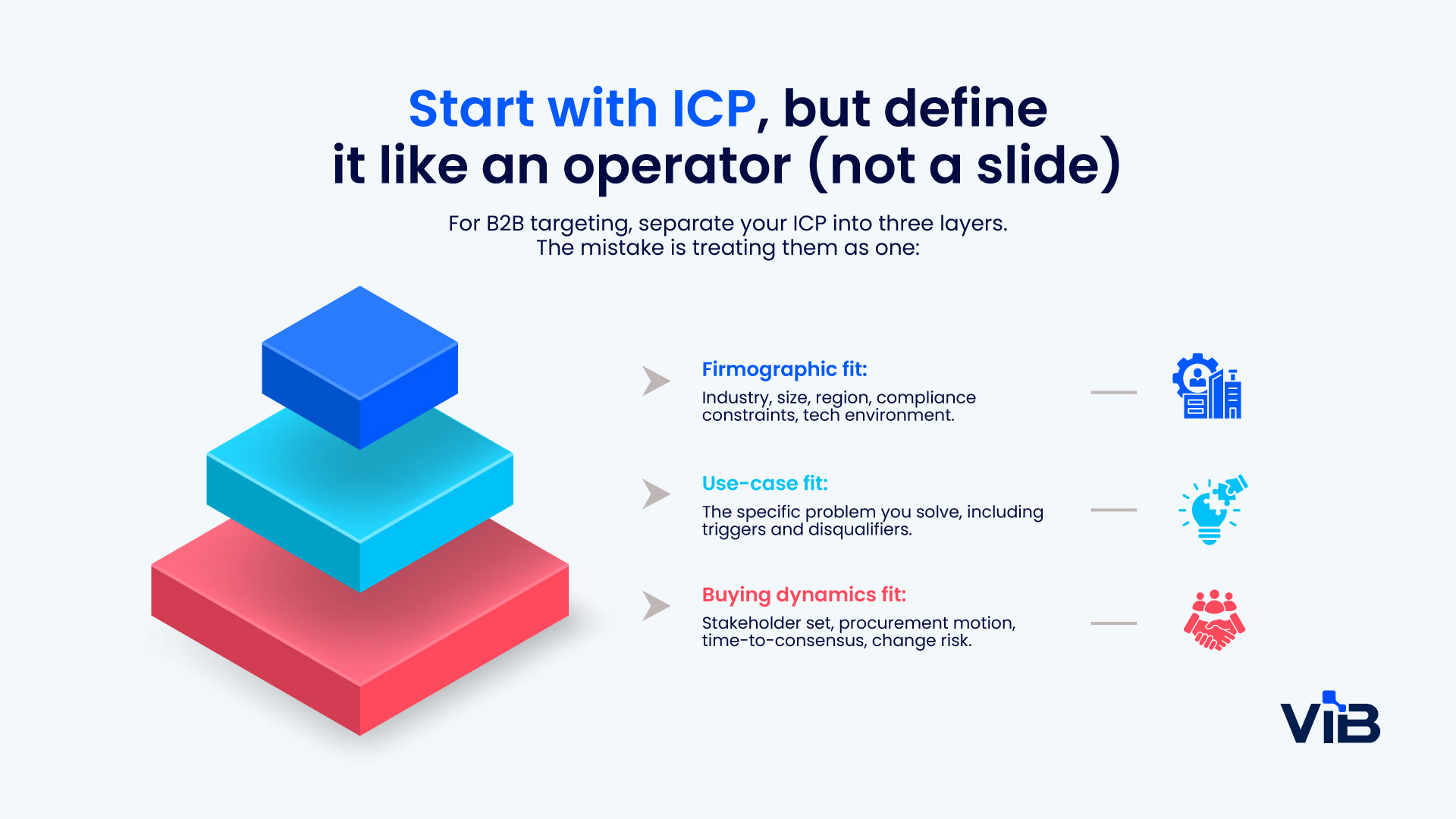
For B2B targeting, separate your ICP into three layers. The mistake is treating them as one:
- Firmographic fit: industry, size, region, compliance constraints, tech environment.
- Use-case fit: the specific problem you solve, including triggers and disqualifiers.
- Buying dynamics fit: stakeholder set, procurement motion, time-to-consensus, change risk.
Firmographics get you a list. Use-case fit gets you engagement. Buying dynamics fit gets you qualified conversations.
Make room for buying groups (because “the persona” isn’t real)
Most targeting systems still behave like one lead equals one buyer. But buying groups don’t work that way.
Gartner reports that buying groups can range from five to 16 people across several roles, and that 74% of teams experience “unhealthy conflict” during the buying process. What’s more, teams that reach consensus are 2.5x more likely to be satisfied with the deal.
Simply put, creating consensus is a critical part of the B2B market’s job.
In practice, that means you should target at least three stakeholder categories per account:
- Economic and operational owners (budget, outcomes)
- Technical evaluators (risk, architecture, security)
- Users or workflow owners (adoption, day-to-day impact)
If your targeting only reaches one of the three, you’ll get “interest” without internal movement.
Signal-based B2B targeting: how to use intent without fooling yourself
Intent data can tighten B2B targeting fast, but only if you treat it like a signal, not a verdict. At a category level, intent is often inferred from behavioral patterns (content consumption, research activity).
That’s useful, but it has two common failure modes:
- False urgency: assuming research equals a near-term evaluation.
- Wrong problem: targeting the right company for the wrong use case.
Your job is to turn signals into better sequencing and better messaging, not instant qualification.
A practical signal framework: 3 tiers that change what you do next
To operationalize B2B targeting, classify account signals into tiers that map to actions.
- Tier 1: fit-only (firmographic + basic technographic). Action: steady awareness and category education.
- Tier 2: interest signals (content engagement, topic spikes, competitor comparisons). Action: problem framing and requirements-building assets.
- Tier 3: explicit project signals (confirmed initiative, timeline, stakeholders). Action: direct invitations to deeper engagement and evaluation support.
Content and offers that improve targeting performance (without chasing volume)
Great B2B targeting fails if the offer is wrong. Experienced marketers usually have enough assets. The gap is matching the asset to the buying job the account is in, then distributing it in a way that preserves audience quality.
Align offers to buying jobs, not funnel stages
Using Gartner’s six buying jobs as a lens, you can map offers that naturally fit what buyers are doing.
- Problem identification: “what changed” brief, risk landscape update, internal business case outline.
- Solution exploration: comparison guide, category teardown, buyer’s shortlist checklist.
- Requirements building: requirements template, security questionnaire pack, architecture patterns.
- Supplier selection + validation: proof framework, reference-style webinar, evaluation plan.
- Consensus creation: stakeholder one-pagers by role, rollout plan, change-management toolkit.
This is where targeting and content strategy actually meet. If your offer assumes evaluation but the account is still building requirements, you’ll see low engagement and “bad lead” complaints.
Use webinars for buying-group alignment, not just lead capture
Webinars are still one of the cleanest ways to engage multiple stakeholders at once, especially when the topic helps buyers validate decisions internally.
ON24 found 57% of B2B webinar registrations convert to attendees. That’s a solid benchmark when you’re planning acquisition and reminders.
The higher-leverage move is to structure the webinar to reduce internal uncertainty and give attendees language they can reuse with peers. That’s consensus support, not a product demo. 🙂
Activation plays that make B2B targeting “real” in the CRM
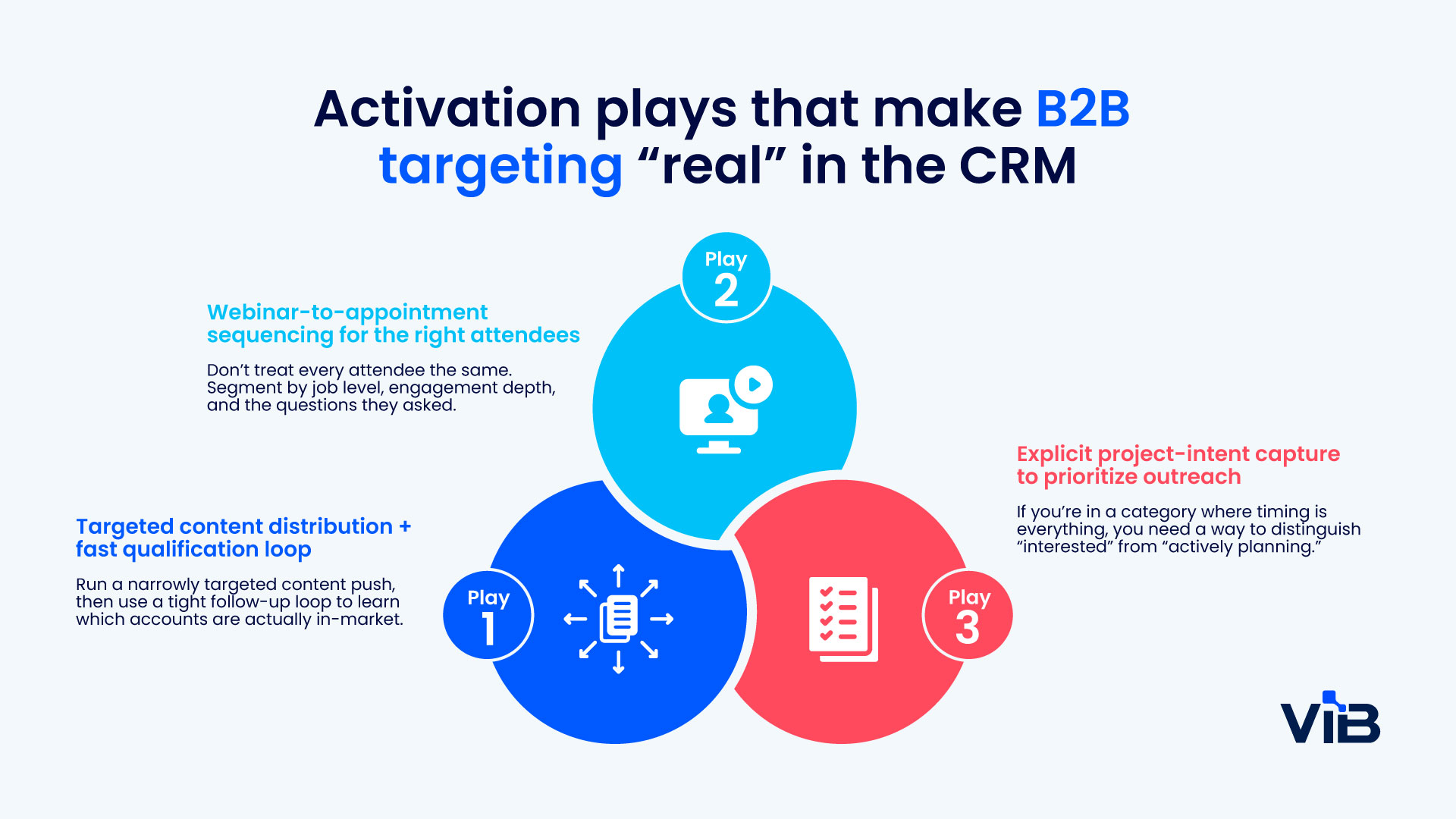
B2B targeting isn’t finished when you select accounts. It’s finished when your activation makes the buyer’s next step easy.
Here are activation patterns that tend to outperform “one channel, one message.”
Play 1: Targeted content distribution + fast qualification loop
Run a narrowly targeted content push (one asset, one pain, one persona cluster), then use a tight follow-up loop to learn which accounts are actually in-market.
Key detail: the follow-up shouldn’t ask for a meeting first. Ask a high-signal question first. For example: “Are you exploring this in the next 6–12 months, or just benchmarking?”
Play 2: Webinar-to-appointment sequencing for the right attendees
Don’t treat every attendee the same. Segment by job level, engagement depth, and the questions they asked.
Then offer a next step that fits their role. Technical evaluators get an architecture review invite. Workflow owners get a peer workflow session. Execs get a “what this change looks like operationally” briefing.
This is where targeting pays off twice: first in who shows up, then in who advances.
Play 3: Explicit project-intent capture to prioritize outreach
If you’re in a category where timing is everything, you need a way to distinguish “interested” from “actively planning.”
Some programs gather explicit project details directly from prospects, including timelines and stakeholder involvement.
That’s a different input than inferred browsing behavior. It can improve prioritization and relevance, as long as your team treats it as “ready for deeper engagement,” not a guaranteed outcome. ✅
Where ViB fits: enabling earlier-journey engagement and ICP-fit signals
If your B2B targeting strategy is strong but execution is bottlenecked by distribution, audience quality, or inconsistent signal capture, a partner like ViB can help.
ViB is built around community-based targeting and early-journey engagement, designed to help you reach the right tech buyers and generate cleaner fit and intent signals before late-stage evaluation.
Use ViB Syndication when you need controlled top-of-funnel targeting
ViB Syndication promotes a single asset to ICP-matched community members until you hit a qualified lead goal. This supports B2B targeting when you want engagement from the right accounts and cleaner intent signals based on what buyers actually consumed.
Use ViB Webinars when buying-group engagement is the goal
ViB Webinars is a full-service webinar option with a guaranteed audience—useful when you have a strong topic but want more reliable attendance.
Use ViB Emails when you need direct, ICP-matched distribution
When you need reach inside a specific ICP slice, ViB Emails helps put your message or offer in front of relevant community members—without relying on broad ad targeting.
Conclusion: B2B targeting is a system, not a list
The strongest B2B targeting programs don’t obsess over perfect filters. They build a system that combines fit, signals, buying-group realities, and activation that respects where buyers are in their journey.
Use firmographics to narrow. Use signals to sequence. Use buying jobs to shape offers. Then measure success the right way: engagement quality, ICP fit, and the consistency of the next step.
When you treat targeting as an operating model, your channels start working together. And your buyers feel like you actually understand what they’re trying to do.


