 Skip to content


If you’ve been in B2B tech or SaaS marketing for a while, you already know the uncomfortable truth: most “performance” reporting is tidy, but not true.
Dashboards tend to over-credit easy-to-track channels, under-credit human moments, and ignore the buying group. That’s how teams end up “hitting CPL targets” while pipeline quality quietly degrades.
This post is a practical, experienced marketer’s guide to measuring performance marketing in B2B in a way that holds up in a forecast call. It’s built around what works when journeys are messy, channels are fragmented, and the buying committee is anonymous until it isn’t.
Why measuring performance marketing in B2B feels broken right now
There are three common measurement traps that even seasoned teams still fall into:
Trap 1: Treating attribution as a truth machine (it’s a model)
Multi-touch attribution is useful, but it’s not infallible.
In B2B, attribution is especially fragile because the “buyer” isn’t one person, identity resolution is imperfect, and offline influence is real. When your org treats the model as the truth, you end up optimizing only for what the model can see.
Trap 2: Over-optimizing for lead-based metrics
Lead metrics aren’t inherently bad. The problem is that they often become the goal rather than a diagnostic.
If you sell to mid-market or enterprise customers, “more leads” is often the wrong answer. Better answers look like: more engaged stakeholders in target accounts, higher meeting show rates, higher stage-to-stage conversion, and cleaner ICP adherence.
Trap 3: Measuring only what happens in your systems (not what drives the deal)
Gartner’s research on buying journeys emphasizes that buyers loop through tasks and touchpoints, rather than moving cleanly through a funnel.
That’s why “influenced pipeline” often feels inflated. It’s capturing traces of activity, not proving what moved the buying group forward.

A measurement mindset that actually works
Before you pick metrics, you need to decide what you’re trying to prove.
Most B2B performance marketing measurements should roll up to one of these defensible statements:
- Efficiency: We can generate qualified pipeline at or below a target CAC payback or cost-per-dollar of pipeline.
- Effectiveness: We’re increasing pipeline creation and/or win rate in target segments.
- Coverage: We’re expanding buying-group engagement inside priority accounts.
- Velocity: We’re helping deals move faster through stages, reducing time-in-stage and drop-off rates.
Once you pick the claim, the measurement gets cleaner because you can separate the signal from the noise.
The modern B2B performance measurement stack
The mistake isn’t using funnel metrics; it’s using only one layer of metrics and calling it “performance.”
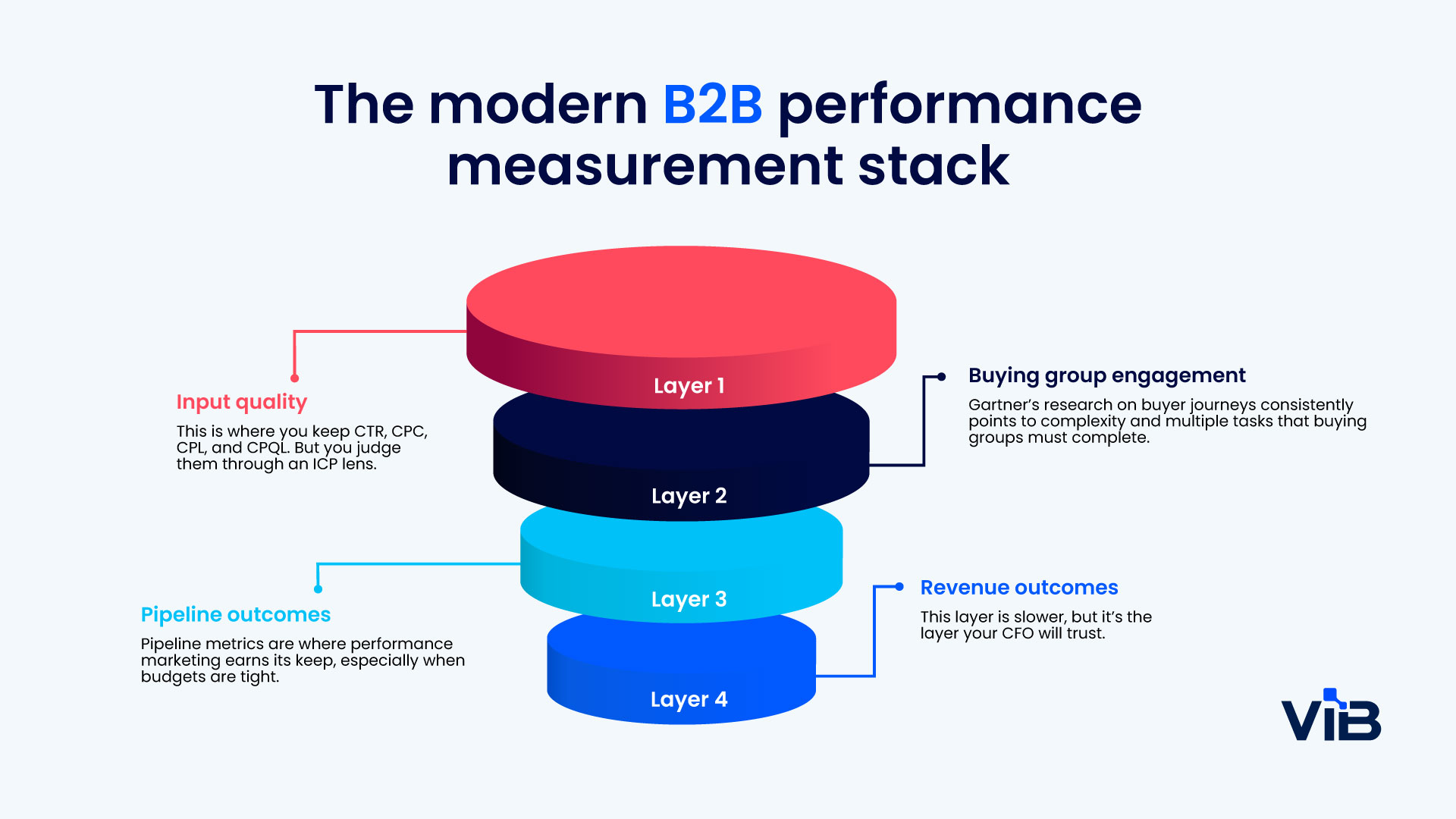
A more reliable approach is a layered scorecard: input quality, buying group engagement, pipeline outcomes, and revenue outcomes.
Layer 1: Input quality
This is where you keep CTR, CPC, CPL, and CPQL. But you judge them through an ICP lens.
Practical checks that reduce false confidence:
- ICP match rate by channel (firmographics, role, geography, and tech stack, if relevant).
- Spam/bot filtering rate (especially on content syndication and paid social).
- Duplicate and competitor rate (quietly destroys SDR efficiency).
- Time-to-first-human-touch (handoff and routing friction is a performance issue).
If Layer 1 is weak, everything else is math gymnastics.
Layer 2: Buying group engagement
This is where most teams still under-measure.
Gartner’s research on buyer journeys consistently points to complexity and multiple tasks that buying groups must complete. That’s why one “MQL” is rarely the unit that matters.
What to measure instead:
- Account penetration: engaged contacts per target account (and by persona).
- Engagement depth: repeat sessions, return visits, multi-asset consumption, webinar attendance, demo follow-up.
- Task progression signals: content mapped to “requirements building,” “validation,” “consensus,” not just “top/mid/bottom.”
Layer 3: Pipeline outcomes
Pipeline metrics are where performance marketing earns its keep, especially when budgets are tight.
But “pipeline influenced” alone won’t convince anyone. Focus on outcomes that sales can’t shrug off:
- Opportunity creation rate from target accounts by channel.
- Stage conversion rates (SAL → SQL → Stage 1 → Stage 2, etc.).
- Disqualification reasons tagged consistently (no budget, wrong persona, no project, competitor lock-in).
- Meeting show rate and meeting-to-opportunity rate (often where “lead quality” becomes real).
If you can’t tie campaigns to opportunity creation and early-stage conversion quality, you’re still stuck in activity reporting.
Layer 4: Revenue outcomes
This layer is slower, but it’s the layer your CFO will trust.
Key measures that matter in B2B tech:
- Win rate by sourced channel and segment.
- Sales cycle length and time-in-stage (especially from first meeting to closed-won).
- ACV/ARR mix (are you sourcing deals that sales wants?).
- Net revenue retention influence when performance supports expansion motions.
Revenue attribution will never be perfect. The goal is directional accuracy that drives better decisions.
Measurement patterns by channel
Different channels “perform” in different ways. The mistake is forcing them into one KPI.
Paid search: High-intent capture, easy to over-credit
Search is often high spend and high impact, and it tends to show up late in attribution.
To measure it properly, track:
- Conversion quality by query cluster (problem-aware vs vendor-aware vs competitor).
- Downstream opportunity creation and win rate, not just demo fills.
- Share of search for category terms over time (directional brand demand signal).
Content syndication and third-party placements: Scale plus scrutiny
Third-party ecosystems matter because buyers trust them. Gartner has highlighted the value buyers place on third-party interactions.
But syndication is where measurement discipline separates good programs from “lead dumps.” Watch:
- Contact validity and match rates (deliverability, role relevance, firmographic accuracy).
- Speed-to-meeting for the best-fit segments.
- Meeting show rate by publisher and asset.
Webinars and virtual events: Influence engine that needs better instrumentation
Webinars rarely “source” the deal cleanly. They do move buying groups toward validation and consensus.
Measure webinars like a progression tool:
- Attendance rate and watch time (registrations are vanity).
- Audience composition (ICP + personas + existing open opportunities).
- Post-webinar next-step rate (meeting set, product session booked, technical deep dive requested).
One practical tip: Create a “webinar influence” field that your SDRs can confirm in discovery. It’s not perfect, but it’s real-world data your CRM doesn’t naturally capture.
Where ViB fits: Turning measurement into repeatable pipeline outcomes
Once you’ve built the layered measurement model, you’ll usually find one bottleneck: You can measure what matters, but you can’t reliably produce enough high-quality buying-group interactions to hit pipeline targets.
This is where ViB can help. Here’s how:
- ViB Emails: Support Layer 1 and Layer 2 by generating controlled, trackable engagement from defined audiences, with clear downstream measurement (reply rates, meeting progression, opportunity creation).
- ViB Syndication: Best used when you instrument quality hard: validation, ICP match, and conversion to meetings, not just CPL. This fits Layer 1 (input quality) plus Layer 3 (pipeline creation) when executed with tight controls.
- ViB Webinars: Strong Layer 2 lever for buying-group progression (requirements, validation, consensus). Measure with attendance quality, role coverage, and next-step rate. [Link to ViB Webinars page]
- ViB Appointments: Directly supports Layer 3 with sales-usable meetings, where show rate, meeting quality, and meeting-to-opportunity conversion become your core KPIs.
The practical takeaway: The more you tie each motion to a specific layer of measurement, the less you’ll argue about attribution. You’ll know what success looks like before launch, and you’ll have the right proof after. 🎯


