 Skip to content


If you’re running demand gen for a B2B SaaS or tech company, you’ve probably felt the squeeze.
Budgets want “performance.” Sales wants “quality.” Finance wants “proof.” And buyers want to do most of the work without talking to anyone.
So performance marketing for B2B companies can’t just be “run paid, optimize CPA, call it a day.” The playbook has to account for buying groups, long evaluation cycles, and signal capture across channels, not just form fills.
What “performance” really means in B2B (and why most teams mis-measure it)
In B2C, performance often maps cleanly to a transaction. In B2B, “performance” is a chain of evidence.
You’re trying to prove that your programs reached the right accounts, influenced the right roles, and created meaningful engagement that sales can act on when the timing is right. ⏱️
Performance marketing for B2B companies isn’t about one KPI
If your weekly scorecard still centers on CPL alone, you’re leaving yourself exposed. CPL can go down while quality collapses, or while you only reach easy-to-convert roles that don’t influence decisions.
Forrester’s research shows that the typical buying decision involves 13 internal stakeholders and 9 external influencers.
That’s why “one lead = one opportunity” attribution thinking breaks so fast in B2B.
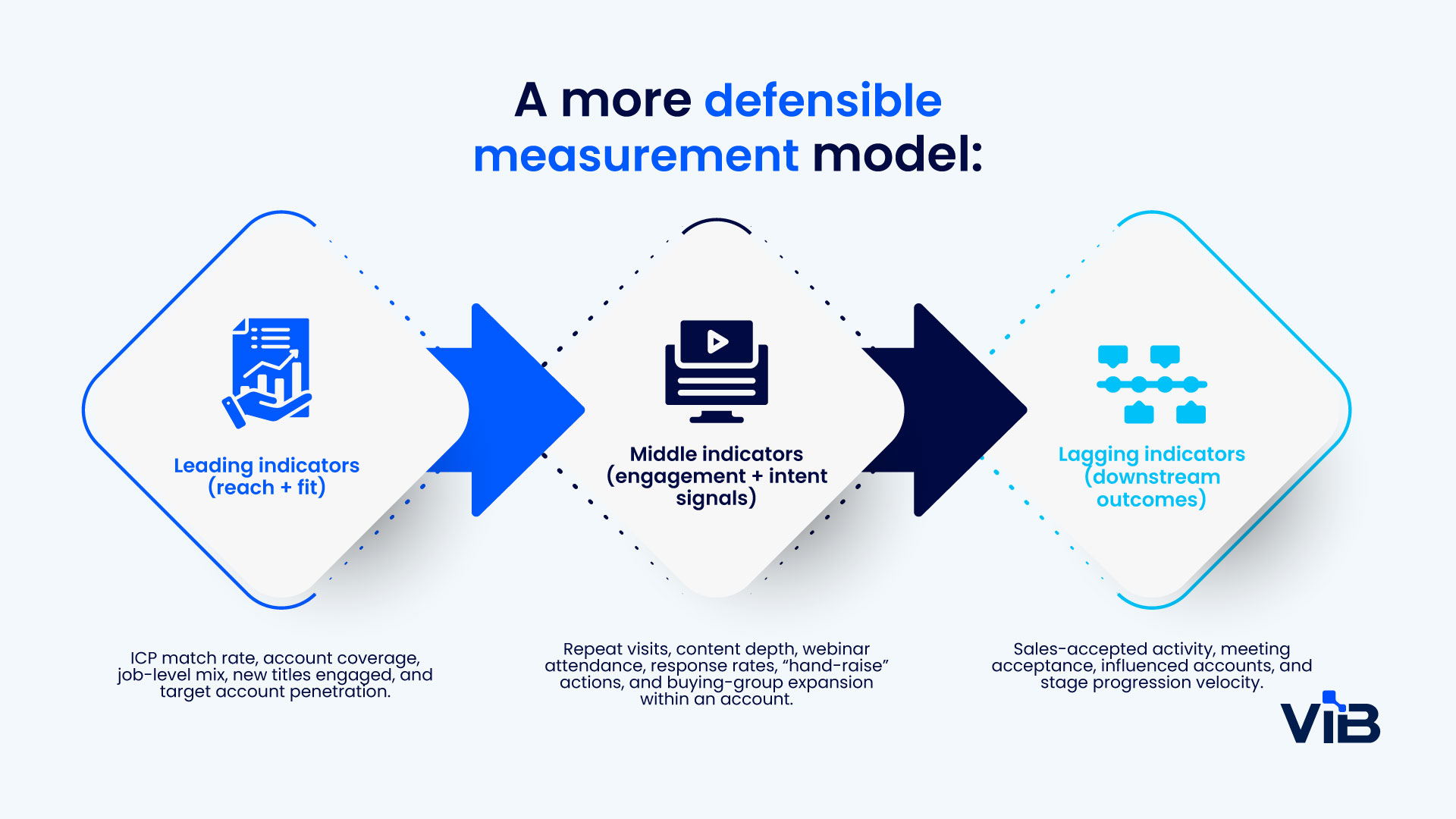
A more defensible measurement model: leading, middle, lagging indicators
Here’s a structure that tends to survive scrutiny in boardrooms and revenue meetings.
- Leading indicators (reach + fit): ICP match rate, account coverage, job-level mix, new titles engaged, and target account penetration.
- Middle indicators (engagement + intent signals): repeat visits, content depth, webinar attendance, response rates, “hand-raise” actions, and buying-group expansion within an account.
- Lagging indicators (downstream outcomes): sales-accepted activity, meeting acceptance, influenced accounts, and stage progression velocity.
This framing keeps performance marketing for B2B companies honest. It also lets you optimize earlier signals without pretending you control the whole buying cycle.
Strategies that actually improve performance marketing for B2B companies
These are the moves that experienced teams use to drive measurable impact, even when attribution is messy.
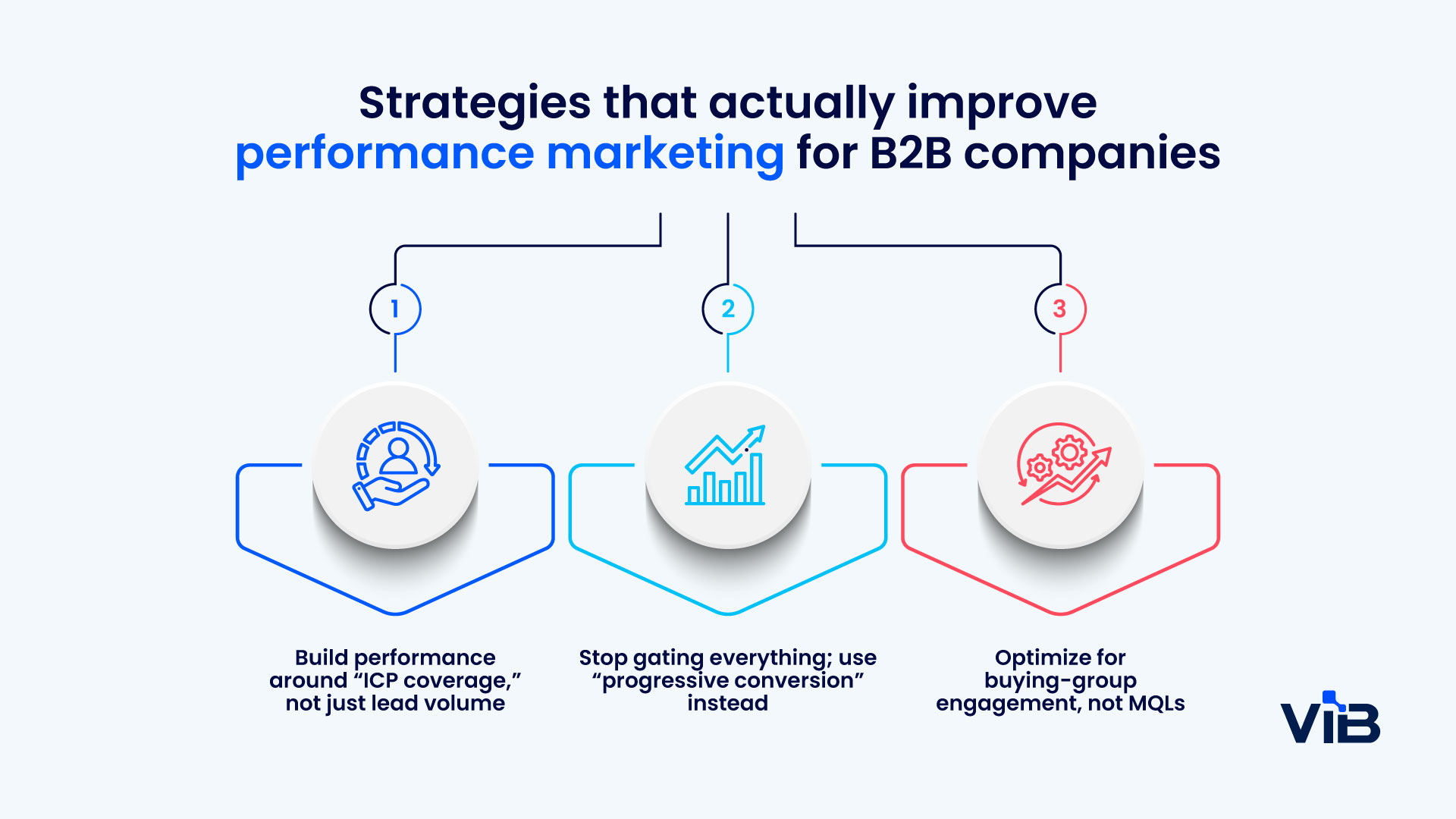
Build performance around “ICP coverage,” not just lead volume
Start every quarter by defining a coverage goal: “How many ICP accounts will we engage, and how deeply?”
Then align channel tactics to that goal:
- Paid social: reach + role-based sequencing
- Content syndication/distribution: scalable top-of-funnel content consumption from the right personas
- Webinars: high-intent, high-context engagement that pulls in multiple stakeholders
This turns performance marketing for B2B companies into a deliberate system rather than a weekly lead chase.
Stop gating everything; use “progressive conversion” instead
Gating can still work, but only when the value is obvious. The alternative is progressive conversion: offer a low-friction first step, then earn deeper actions later.
Example progression:
- Ungated POV article
- Short “checklist” download
- Webinar registration
- Interactive assessment
- “Talk to an expert” (only after signals stack)
This respects buyer preference for self-serve learning while still generating measurable engagement signals.
Optimize for buying-group engagement, not MQLs
One conversion is not the finish line. The real win is expanding engagement across the account.
Here are some practical tactics:
- Create role-specific follow-ups: Use different framing for security vs. IT vs. finance.
- Use webinar Q&A and polls as signal capture: What they ask often matters more than that they attended.
- Retarget by depth: Build audiences by time-on-page, return visits, or key page views, not just “visited site.”
How to connect performance marketing to outcomes without pretending you control the whole deal
Most experienced marketers don’t need a lecture on attribution models. They need a practical way to defend decisions when data is incomplete. 📊
Use “account lift” and “signal lift” reporting
Instead of trying to tie every dollar to a single downstream event, report lift across defined cohorts.
- Account lift: target accounts exposed vs. not exposed; compare engagement rate, return visits, key page views, or sales activity.
- Signal lift: before vs. after the campaign; track increases in high-intent actions such as webinar attendance, product page depth, demo requests, or multi-role engagement.
Your job is to generate the right engagement and signals so you show up at the right moment, with the right message.
Make your funnel definitions match reality
If your internal definitions still treat “new leads” as the ultimate unit, you’ll keep fighting sales and finance.
Many teams are moving toward:
- Engaged account (ICP account with meaningful activity)
- Engaged buying group (multiple roles engaging)
- Sales-ready conversation (clear hand-raise or validated need)
It’s not just semantics. It changes what you optimize, and it reduces the pressure to force every program into a last-click ROI box.
How ViB can help you elevate your strategy
At some point, every performance marketing team hits a scaling ceiling: same channels, same audiences, diminishing returns.
ViB can expand reach inside your ICP while preserving targeting control. That matters because you can’t force outcomes on a timeline in B2B. You can, however, create consistent, measurable engagement with the right accounts. ✨
ViB Syndication for controlled top-of-funnel engagement
When you need predictable distribution for a high-value asset (benchmark report, technical guide, security checklist), ViB Syndication can help you drive content consumption among the right roles at scale.
The key is using syndication as a signal engine, not a volume engine:
- Align one asset to one audience segment
- Route follow-up based on asset-topic intent (not just “downloaded”)
- Measure ICP match rate and downstream engagement lift by account
ViB Webinars to generate high-context engagement signals
Webinars work best when they’re treated like a product: clear audience, specific promise, and a tight experience.
ViB Webinars offers full-service virtual events with an attendance guarantee and post-event data, which can be helpful as intent signals and messaging feedback.
ViB Emails to expand reach and validate message-market fit
When your owned lists are saturated, you still need a way to test offers and positioning with the right profiles.
ViB Emails supports performance marketing for B2B companies by helping you:
- Reach net-new ICP audiences without rebuilding campaigns from scratch
- Pressure-test subject lines and messaging angles
- Create an engagement baseline you can compare across segments
Conclusion: Make performance marketing a system, not a channel report
Performance marketing for B2B companies works best when it’s engineered around how B2B buying actually happens: self-serve research, large buying groups, and extended timelines.
That means measuring what you can influence with integrity: ICP coverage, buying-group engagement, and signal lift. Then you optimize creative, offers, and channels against those realities.
If you do that, your “performance” story gets clearer, your programs get easier to scale, and your team spends less time defending numbers that were never meant to carry the whole narrative.


