 Skip to content


Most “performance” programs in B2B don’t fail because the channels are wrong. They fail because the B2B performance marketing process is missing the connective tissue between buyer reality, measurement reality, and revenue reality.
Buyers want to self-serve. Gartner has reported that 75% of B2B buyers prefer a rep-free experience. Meanwhile, buying decisions are made by groups, not a single “lead.” Forrester has shown that buying groups of three or more are the norm, and a meaningful share of orgs sell to groups of 10+ people.
So if your process still optimizes to MQL volume, last-touch ROI, and “lead-to-opportunity” in a straight line, you’re not just behind. You’re measuring the wrong thing.
What “performance” really means in a B2B performance marketing process
In B2B tech and SaaS, performance marketing isn’t “paid social + Google Ads.” It’s an operating system for predictable outcomes.
A modern B2B performance marketing process has to do three jobs at once:
- Create demand when most of the market isn’t actively shopping.
- Capture demand when buying groups enter the exploration and selection phases.
- Convert demand with the right information, proof, and human help at the right moment.
That sounds obvious. But here’s the hard part: Buyers don’t move through your funnel in a straight line. Gartner’s research shows buyers loop across problem identification, solution exploration, requirements building, supplier selection, validation, and consensus creation.
If your team wants real performance, your process must align with those buying jobs, not your internal stage definitions.

The core failure modes that break performance in B2B
Let’s name the issues teams experience, even with strong execution.
Failure mode 1: Treating intent as a single signal
Most teams over-weight one type of intent (usually web activity) and under-weight “human intent” (explicit needs, constraints, timelines, and internal dynamics).
That mismatch shows up in two places: SDR productivity (lots of conversations but few real opportunities) and forecast quality (pipeline that looks good until it doesn’t).
Failure mode 2: Optimizing to leads instead of buying groups
A single form fill rarely maps to a real deal. Buying groups form, dissolve, and re-form.
If your process doesn’t deliberately expand from “inbound lead” to “account-level consensus,” you’ll keep winning clicks and losing deals.
Failure mode 3: Relying on channel attribution as a truth source
Attribution is a model, not a fact. Cookie loss, dark social, and buying group behavior will keep widening the gap between what happened and what your dashboards can prove.
A better goal is decision-grade measurement: enough clarity to choose what to do next, not a perfect replay of every touchpoint.
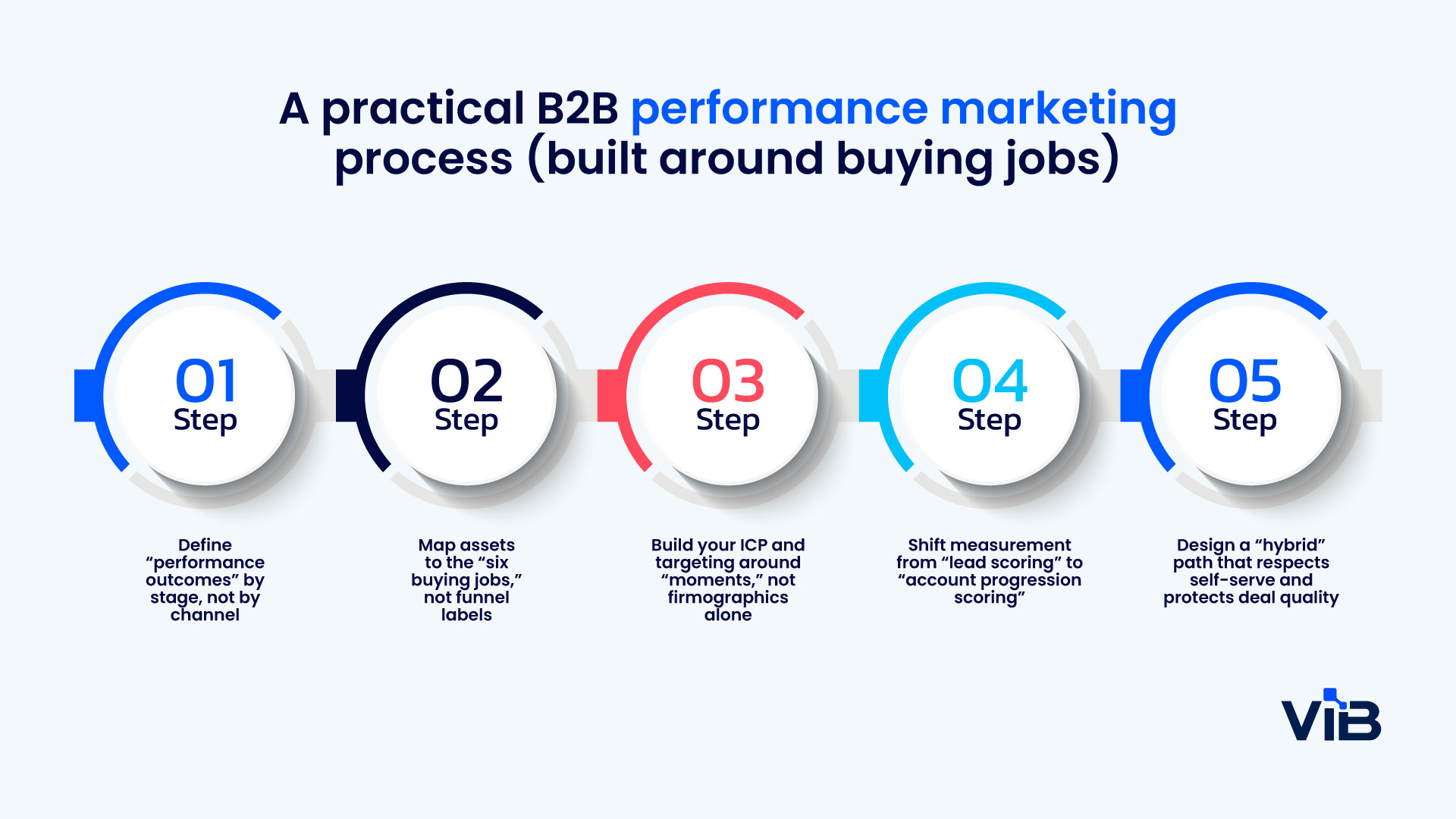
A practical B2B performance marketing process (built around buying jobs)
Here’s a field-tested way to structure your process so it performs even when attribution is imperfect and buying behavior is messy.
Step 1: Define “performance outcomes” by stage, not by channel
Start by writing down the outcomes you’re trying to create at each point in the journey. Not the assets. Not the spend. Outcomes. Examples include:
- Market demand: growth in qualified account engagement and category interest.
- Active evaluation: growth in high-fit account coverage, multi-threading, and validated pain.
- Late-stage: lower no-show rates, higher sales acceptance, improved stage conversion.
This helps you stop blaming channels for what is actually a process definition problem.
Step 2: map assets to the “six buying jobs,” not funnel labels
Run a quick audit of your content and experiences against Gartner’s six buying jobs:
- Problem identification: POV content, benchmarks, “why change” narratives.
- Solution exploration: category comparisons, use-case libraries, integration maps.
- Requirements building: evaluation checklists, security packets, RFP-ready guidance.
- Supplier selection: proof points, implementation plans, pricing logic.
- Validation: reference paths, risk mitigation, ROI sensitivity analysis.
- Consensus creation: internal sell decks, stakeholder-specific summaries, rollout plans.
When performance stalls, the root cause is often that you’re overproducing in “exploration” and underinvesting in “requirements,” “validation,” and “consensus.” That’s where deals die quietly.
Step 3: Build your ICP and targeting around “moments,” not firmographics alone
Firmographics are important to your ICP, but they’re not the be-all and end-all. The real lift comes from identifying moments that change conversion probability, including:
- new executive ownership
- security/compliance events
- platform migrations
- tool consolidation mandates
- budget unlock windows (renewals, fiscal planning)
You don’t need perfect data for this. You need consistent definitions and a way to prioritize accounts when those moments appear.
Step 4: Shift measurement from “lead scoring” to “account progression scoring”
Lead scoring breaks because it assumes one person equals one deal. Account progression scoring works better because it measures buying group momentum.
Examples of progression signals that tend to correlate with real pipeline:
- number of distinct stakeholders engaging (role diversity matters)
- repeat engagement with validation assets (security, pricing, implementation)
- explicit needs captured in conversations (constraints, timeline, must-have requirements)
- meeting quality indicators (attendance rate, agenda adherence, next step clarity)
One practical tip: Treat “stakeholder coverage” as a KPI. If you’re not expanding your footprint inside the account, you’re risking the deal.
Step 5: Design a “hybrid” path that respects self-serve and protects deal quality
Gartner notes that digital commerce is preferred by many buyers, but also highlights issues such as purchase regret when the process is overly self-serve and lacks sufficient support.
The takeaway for performance teams: Don’t force human contact early. Instead, make human help available at high-friction moments.
That often means investing in:
- technical Q&A formats (not just product demos)
- peer-style learning events that surface real objections
- structured evaluation accelerators (requirements workshops, migration planning)
When this is done well, you’ll notice fewer “interested but not now” outcomes and more buyer-led next steps. That’s a real performance unlock. 🚀
How to operationalize the B2B performance marketing process across teams
A process only works if it survives contact with your org chart.
Align on a single definition of “pipeline quality”
High-performing teams define pipeline quality in observable terms. Not “good fit,” but specific criteria such as stakeholder roles, timeline clarity, and problem severity.
Document it. Then use it for campaign planning, SDR enablement, and closed-lost analysis.
Run performance reviews by buying job coverage, not channel ROAS
Channel reviews tend to create unproductive arguments because each channel captures different intent levels. Instead, review performance by which buying jobs you successfully enabled.
Ask questions like:
- Where are deals stalling: requirements, validation, or consensus?
- Which assets are actually used in late-stage cycles?
- Are we creating enough opportunities for multi-threading?
This keeps the team focused on buyer progress, which is the real driver of revenue outcomes.
Build a deliberate “proof engine” for late-stage conversion
The late stage is where performance marketers can stand out. Most teams still treat it as “sales owns it.”
In practice, marketing can provide repeatable proof formats: industry-specific ROI narratives, implementation derisking strategies, and stakeholder-specific one-pagers. That content doesn’t just help close. It helps protect win rates when competitors copy your top-of-funnel plays.
If you’ve ever watched a well-qualified deal die in procurement, you already know why this matters. 😬
Where ViB fits when you need to scale outcomes (without breaking the process)
If your B2B performance marketing process is sound, the next constraint is usually execution capacity: reaching the right people, creating real conversations, and capturing credible intent signals without flooding sales with noise.
ViB can help combine reach, targeting, and mid-funnel conversion into one coordinated motion.
Using ViB Emails to create targeted awareness that maps to buying jobs
ViB Emails can be used when you have a clear message tied to a buying job (for example, “requirements building” or “validation”), and you need to distribute it to a targeted audience efficiently.
Using ViB Syndication to scale high-intent content consumption
When you already know which assets move deals forward (security guides, evaluation checklists, implementation plans), syndication can help you scale that consumption among ICP accounts. ViB Syndication is designed to promote your chosen content to targeted community members and generate qualified downloads.
Using ViB Webinars to drive validation and consensus creation
Webinars tend to perform best when they’re not “product updates.” They work when they reduce perceived risk and help stakeholders align. ViB Webinars offers full-service events with lead guarantees, helping teams operationalize this without overloading internal resources.
Using ViB Appointments to turn engagement into real conversations
As buying gets more self-serve, many teams struggle to identify when a stakeholder is ready for a real conversation. Buyers may prefer digital paths, but that doesn’t eliminate the need for human interaction at key moments.
ViB Appointments supports this “human help at high-friction moments” approach by setting targeted 1:1 meetings with relevant professionals. The service can help teams create structured opportunities for conversation when buyers need deeper context, technical discussion, or help evaluating their next steps.
Putting it all together: The process checklist
If you want a tighter, more scalable B2B performance marketing process, use this as a final gut-check before you add budget or channels:
- We define performance by outcomes (progression, conversion, deal quality), not by channel metrics alone.
- Our content and experiences map to real buying jobs, especially validation and consensus creation.
- We measure buying group momentum at the account level, not just individual leads.
- We provide a hybrid path: self-serve by default, human help at friction points.
- We can scale targeted reach and real conversations without degrading lead quality.
When you get those right, “performance” becomes a repeatable system for pipeline.


