

B2B marketers are producing more content than ever, but that does not mean buyers are actually seeing it.
As AI-generated content floods the market and more users rely on AI summaries instead of traditional search results, visibility has become much harder to earn. That is one reason more companies are investing in b2b saas syndication networks to expand reach and get content in front of real decision-makers.
Content syndication is no longer just a lead generation tactic. The strongest programs now help marketers improve visibility, validate demand, support ABM efforts, and accelerate early-stage engagement.
The challenge is that not all syndication providers operate the same way.
Some focus on scale. Others prioritize audience quality, intent alignment, or industry specialization.
For SaaS marketers, choosing the right syndication strategy can directly impact lead quality, campaign efficiency, and downstream conversion performance.
According to Demand Gen Report, B2B buyers continue consuming multiple pieces of content before engaging with vendors directly. That makes strategic content distribution more important than ever.
Why are b2b saas syndication networks becoming more important?
Organic reach has become harder to sustain.
Paid media costs continue rising. Email engagement fluctuates. Social algorithms constantly change. Even strong content can struggle to gain traction without distribution support.
That creates a major problem for SaaS marketing teams.
Great content alone is no longer enough.
Why does content distribution matter more now?
Many SaaS companies still treat distribution as an afterthought.
The content gets published, shared on LinkedIn once or twice, added to an email campaign, and then forgotten.
But buyers rarely discover content through a single channel anymore.
They engage across search, social, newsletters, webinars, paid media, and third-party content ecosystems.
That is where syndication networks help extend visibility beyond owned audiences.
Are internal databases becoming less effective?
Many SaaS companies repeatedly market to the same contacts.
Over time, engagement declines. Audiences become fatigued. Open rates fluctuate. Conversion rates become inconsistent.
Syndication networks help marketers reach new audiences aligned with their ICP without relying entirely on internal reach.
That becomes especially valuable for companies entering new markets or supporting large-scale campaigns.
What should marketers evaluate in syndication providers?
Not all syndication providers deliver the same value.
Some prioritize lead volume at the expense of quality. Others focus on highly targeted audiences with stronger engagement potential.
The right fit depends on campaign goals.
Does the network specialize in B2B technology audiences?
Audience relevance matters more than raw scale.
A syndication provider focused on broad business audiences may generate high lead counts but weaker downstream conversion.
For SaaS marketers, industry alignment is critical.
The strongest providers support targeting based on industry, company size, job function, seniority, technology category, and buying intent.
That targeting precision helps improve campaign efficiency significantly.
How transparent is lead quality?
Lead quality should never feel like a black box.
Marketers should understand how contacts are sourced, how qualification works, and whether intent signals are incorporated into targeting strategies.
Transparency matters because poor data quality eventually creates problems for both marketing and sales teams.
Intent-driven targeting is becoming increasingly important in SaaS marketing because it helps align content campaigns with active buyer research behavior.
Why does content format matter in syndication campaigns?
Not every asset performs equally in syndication.
Some formats naturally generate stronger engagement depending on audience stage and campaign goals.
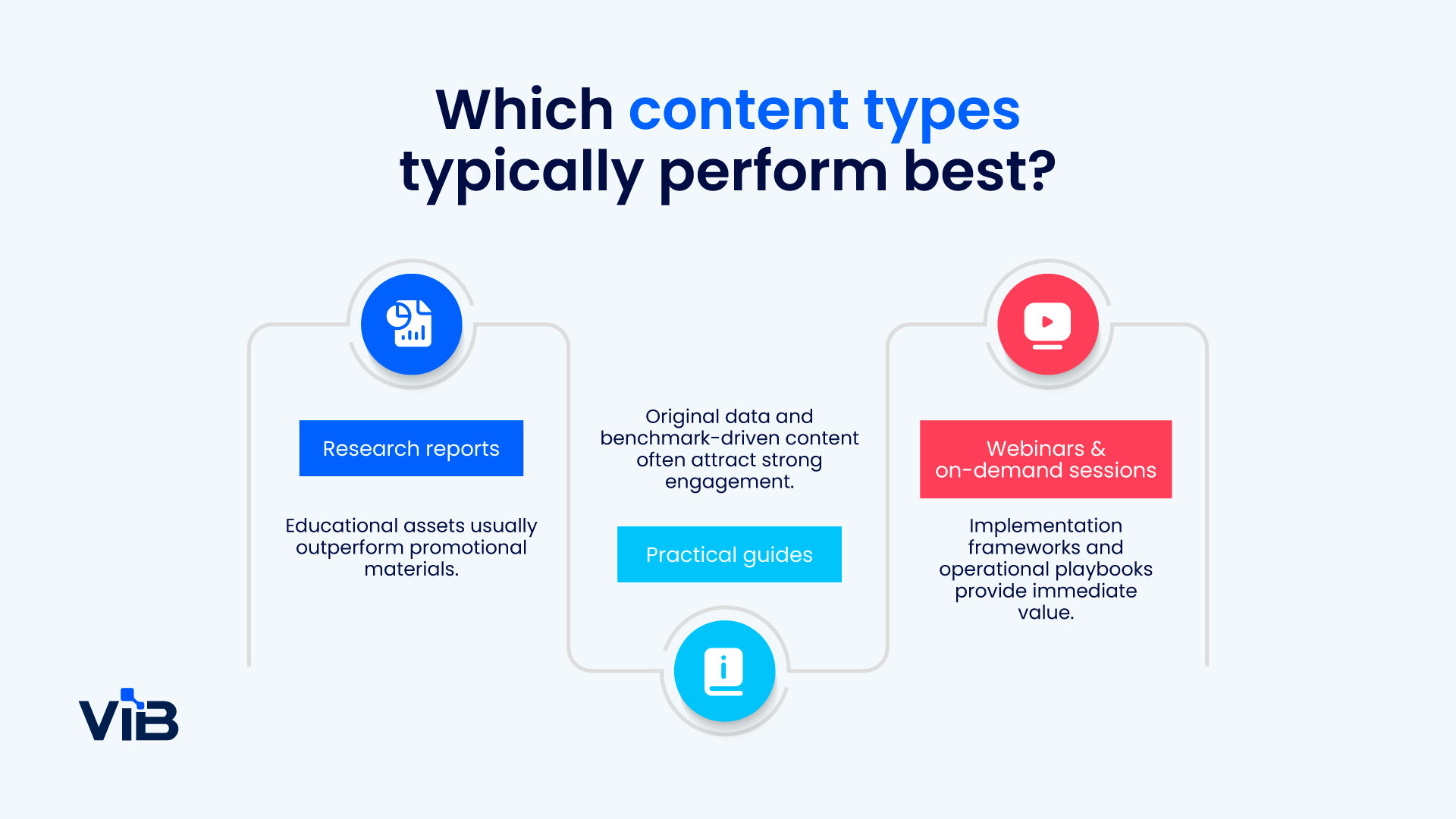
Which content types typically perform best?
Educational assets usually outperform promotional materials.
Research reports
Original data and benchmark-driven content often attract strong engagement because buyers want industry insight and validation.
Practical guides
Implementation frameworks and operational playbooks tend to perform well because they provide immediate value.
Webinars and on-demand sessions
Webinar-based syndication campaigns can help marketers attract buyers actively researching specific problems or trends.
The key is making the content feel useful instead of overly product-focused.
Why do overly promotional assets struggle?
Buyers rarely exchange information for sales-heavy content.
The strongest syndication campaigns focus on helping the audience understand a challenge, evaluate an opportunity, or improve performance.
Educational positioning consistently drives stronger engagement quality.
How should SaaS marketers measure syndication success? 📊
Too many teams evaluate syndication campaigns using only CPL.
That creates a narrow view of performance.
A lower-cost lead does not always create better business outcomes.
The strongest SaaS marketers evaluate syndication through a broader demand generation lens.
Are the leads actually engaging?
Lead quality should extend beyond form fills.
Marketers should evaluate email engagement, webinar attendance, sales responsiveness, account fit, and downstream opportunity influence.
These signals provide a much clearer picture of campaign quality.
Is the campaign influencing the right accounts?
Some campaigns generate fewer total leads but create stronger engagement among high-value accounts.
That often matters far more than raw volume.
This is especially true in ABM-focused SaaS environments where account quality outweighs scale.
Are syndication campaigns supporting other channels?
Strong syndication programs often improve performance across additional marketing channels.
For example, syndication can help fuel retargeting campaigns, email nurture programs, and sales enablement workflows.
It can also work alongside ViB Emails to reinforce messaging and keep target accounts engaged across multiple touchpoints.
Why are intent-driven syndication strategies growing?
Modern SaaS buyers are harder to engage than ever.
That is why intent-based targeting is becoming a bigger part of syndication strategy.
Instead of distributing content broadly, marketers can focus on buyers already researching related technologies or operational problems.
This improves efficiency and often increases downstream conversion quality.
What does intent-based syndication improve?
Intent-driven syndication can help marketers improve lead relevance, reduce wasted spend, prioritize active buyers, and support better sales timing.
That becomes especially valuable in competitive SaaS categories where timing heavily influences conversion potential.
Why does timing matter so much?
Many SaaS purchases happen within narrow buying windows.
If marketers engage accounts too early, interest may fade. Too late, and competitors may already control the conversation.
Intent-driven syndication helps marketers engage buyers while active research behavior is already happening.
That creates stronger alignment between content distribution and real market demand.

Where does ViB fit into b2b saas syndication networks?
Many SaaS companies already produce strong content.
The bigger challenge is consistently getting that content in front of the right technology buyers.
ViB Syndication helps B2B technology marketers distribute content through the ViB Community, connecting campaigns with verified technology professionals aligned to specific audience criteria.
Rather than focusing purely on lead volume, ViB Syndication supports targeted distribution strategies designed to improve audience relevance and engagement quality.
This helps SaaS marketers expand reach, support account-based initiatives, and generate more meaningful early-stage engagement from content campaigns.
What should marketers prioritize moving forward? 🚀
Content production is no longer the hardest part of SaaS marketing.
Distribution is.
The strongest b2b saas syndication networks help marketers extend reach strategically, improve audience targeting, and support long-term demand generation goals.
That means syndication should not be treated as a standalone lead source.
It should function as part of a larger strategy that includes content development, intent data, nurture programs, webinars, paid media, and sales alignment.
The marketers seeing the best results today are focusing on audience quality, timing, and engagement relevance rather than chasing the highest lead totals.
That shift is what ultimately turns syndication into a scalable growth channel for SaaS marketing teams.


