 Skip to content


If you’re an experienced B2B tech or SaaS marketer looking to improve your content marketing program, you don’t need another list of “write more blogs” advice.
You need specific B2B content marketing ideas that survive the 2026 reality: fewer meaningful buyer interactions, more self-directed research, and greater scrutiny of whether content creates measurable engagement and ICP fit.
Gartner Digital Markets found buyers are interacting with fewer vendors, with average vendor engagements dropping from 3.2 to 2.5 (and 2.18 in the U.S.). That means every touch matters more than it used to.
This article is built for that environment. You’ll get advanced, practical plays you can run with a lean team, plus guidance to prove progress without promising outcomes you can’t control.
What “good” looks like for B2B content in 2026
Before the ideas, align on the target. Most teams aren’t short on content; they’re short on content that produces observable intent signals.
In 2025 research, 6sense reported that 95% of buyers ultimately choose a vendor from their “Day One shortlist.” In other words, they’re locking in on their preferred vendors almost instantly in the buyer journey.
So the goal of your content marketing program is to:
- Earn a spot on the Day One shortlist by showing relevance fast
- Generate engagement signals (topic interest, role fit, urgency indicators)
- Reduce uncertainty with proof, detail, and specificity
- Create “next-step readiness” without forcing a hand-raise too early
One more shift to keep in mind: LinkedIn’s own research highlights how hard it’s gotten to measure long-term impact: 87% of B2B marketers say it’s getting harder to measure long-term campaign impact.
That doesn’t mean measurement is impossible. It means you need clearer intermediate milestones: engagement depth, repeat consumption, persona-level resonance, and account-level activity lift.
The measurement layer most teams skip (and why it blocks scale)
Many B2B content marketing ideas fail because they’re launched without answering the question: What will we count as success in the first 30–60 days, before revenue shows up?
Define signal tiers, not a single KPI
Use three tiers so you can optimize without overreacting:
- Tier 1 (attention): opens, clicks, video completion, and landing page scroll depth.
- Tier 2 (engagement): webinar poll responses, downloads, multi-asset sessions, return visits.
- Tier 3 (readiness): demo/pricing clicks, comparison views, “implementation” content consumption.
Webinars are especially strong for Tier 2 because they create interactive moments you can score and segment on.
Build a “topic-to-action” map
This is how you avoid random acts of content.
For each core topic (say, “cloud security posture management”), map:
- What problems indicate ICP fit
- What role-specific objections show up (security, IT, finance, app owners)
- What “next question” a serious evaluator asks
- What asset answers that question best (email brief, webinar, deep guide, checklist)
Once you have this, you can run the ideas below as a connected system instead of one-off campaigns.
15 B2B content marketing ideas that experienced SaaS marketers can actually use
These aren’t “content types.” They’re plays with a purpose, an ideal channel, and a measurable outcome.

1) The “decision criteria” briefing (built for buyers using AI search)
Create a crisp asset that lays out decision criteria, trade-offs, and what to ask vendors.
It performs well because it’s not vendor-centric. It’s buyer-centric. It also tends to get cited internally.
2) Competitive comparison pages that don’t read like a hit piece
Comparison pages tend to be too thin or overly aggressive.
Build comparisons around: feature scope, operational requirements, time-to-value constraints, and “best for” situations. Include clear “when not to choose us” statements to increase trust.
3) The “implementation reality check” series
Publish content that answers what actually happens after a buyer says yes: stakeholders, sequence, timeline variables, risk points, and success metrics. ✅
This is where serious buyers self-identify. It’s also where you learn if you’re attracting the right accounts.
4) Role-based “objection handling” emails (not nurture fluff)
Experienced marketers already run email programs. The upgrade is role-based sequencing tied to specific objections.
Example: A security leader gets risk, compliance, and change-management content. A RevOps leader gets details on integration, governance, and reporting.
Keep each email to one idea and one action. No newsletters pretending to be strategy.
5) A “minimum viable category education” landing page
If your category is noisy, create a page that defines:
- What the category is (and isn’t)
- Who owns the problem internally
- Common failure modes
- Evaluation checklist
This isn’t beginner content. It’s alignment content for buying groups.
6) Webinars designed for interaction, not just attendance
Most webinars are “a talk with slides.” The better version is an interactive format where the engagement is the product. 🎯
ON24 reported an average registration-to-attendee conversion rate of 57% and an average engagement time of 51 minutes in 2024.
Design your webinar to generate signals you can act on:
- 2–3 polls that qualify maturity and urgency
- One “choose your path” moment (breakout tracks or topic forks)
- A resource drop that maps to the intent stage (evaluation checklist vs. implementation guide)
7) The “quarterly buyer questions” editorial calendar
Instead of planning content around product launches, plan around the top 10 buyer questions that show up in sales calls, review sites, and security questionnaires.
Each quarter, refresh answers based on what changed (regulations, platforms, threat models, pricing norms).
8) Customer-proof content that’s not a case study
Case studies are great, but buyers also want proof that matches their context.
Try “proof packs” by segment: a 1-page bundle of metrics, screenshots, implementation notes, and quotes aligned to one ICP slice.
9) The “anti-template” sales enablement doc (for consistency)
Create one internal doc that standardizes how your team explains:
- What you do in one sentence
- Who it’s for (and not for)
- Top 5 differentiators, with evidence
- Top 5 objections, with honest answers
This improves content consistency across ads, emails, webinars, and partner channels.
10) Content syndication that’s built on fit and context (not volume)
Syndication can work when you treat it like distribution for a single message to a specific ICP slice.
The mistake is treating it like a dump truck for every asset you’ve ever made.
Pick one high-performing asset, wrap it in the right framing, and use it to learn: which roles, industries, and account tiers engage deeply.
11) The “integration story” series (your buyers’ real constraint)
In SaaS, buying decisions often hinge on integration and governance, not feature lists.
Create content that documents patterns, such as common integration architectures, ownership models, and operational runbooks. This attracts serious evaluators.
12) The “security and trust center” content refresh
If you sell into enterprise customers, your trust-building content isn’t optional.
Refresh your trust center with buyer-friendly summaries: what’s certified, what’s monitored, and how incident response works. Keep it readable and current.
13) The “budget justification” kit
Give champions what they need to sell internally: a value narrative, the risks of inaction, an implementation plan, and stakeholder impact.
This kit is content marketing. It lives late in the journey, but it’s created by marketing.
14) The “what changed this year” executive brief
Once per year, publish an executive brief that summarizes what changed in the problem space: regulation, vendor landscape, buyer expectations, and common failures.
This is a strong webinar companion asset and a great reason to re-engage dormant accounts.
15) The “choose your own benchmark” webinar follow-up
After a webinar, don’t send a recording link and call it a day.
Send a follow-up in which attendees self-select their biggest challenge and receive a tailored bundle. ON24 notes that nurture sequences can increase on-demand attendance and overall attendance.
How to choose the right ideas (without building a content factory)
You don’t need all 15. Pick 3–5 based on where you’re weak today.
Use this quick filter:
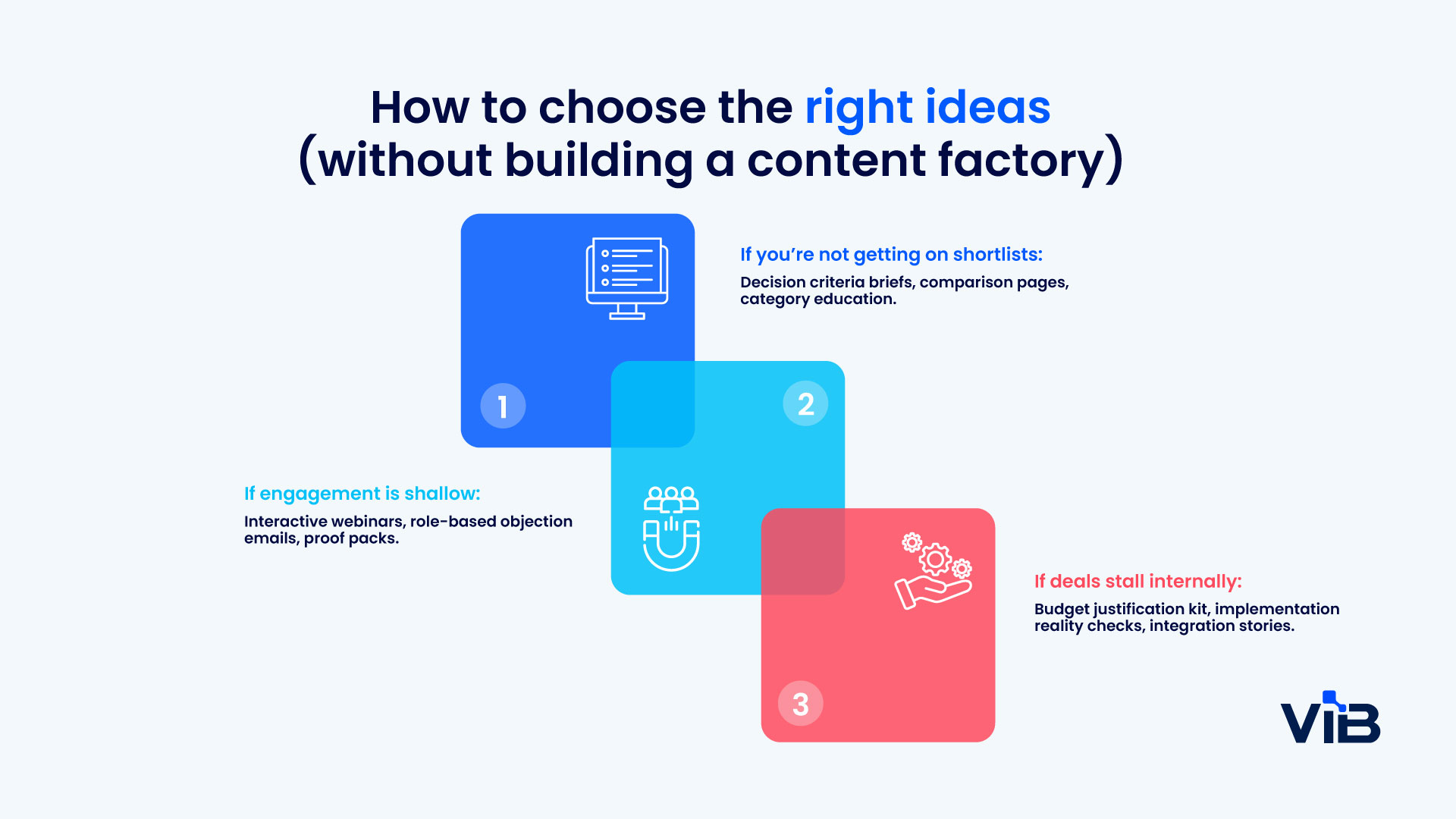
- If you’re not getting on shortlists: decision criteria briefs, comparison pages, category education.
- If engagement is shallow: interactive webinars, role-based objection emails, proof packs.
- If deals stall internally: budget justification kit, implementation reality checks, integration stories.
And keep a simple operating rule: every new asset should either (1) create a new signal or (2) strengthen an existing one.
How ViB helps scale early-journey engagement without overpromising
At some point, the bottleneck isn’t ideas. It’s distribution to the right audience with enough context to generate real engagement signals.
That’s where ViB’s solutions can support your strategy.
ViB Emails for targeted engagement and message testing
If you want to validate messaging fast, email can be a clean way to learn what resonates by role, problem, and vertical.
Used well, it helps you identify which topics pull the strongest engagement and which segments look like your best-fit ICP.
ViB Syndication for controlled distribution of one strong asset
Syndication works best when it’s tight: one asset, one audience, one intent hypothesis.
That lines up with the approach in this post: use syndication to create measurable consumption signals and learn which ICP slices engage most deeply.
Learn more about ViB Syndication.
ViB Webinars for interactive signal generation at scale
If webinars are already part of your mix, the next step is to design them to capture structured signals: poll responses, Q&A themes, resource clicks, and on-demand behavior.
That’s also where you can turn one event into a month of content, without creating net-new topics every week.
The key positioning note is simple: these programs help earlier in the journey through engagement, signal generation, and ICP fit learning. They’re not a promise of outcomes you can’t control.
Learn more about ViB Webinars.
Conclusion: Better B2B content marketing ideas start with better intent design
The strongest B2B content marketing ideas aren’t the most creative. They’re the most intentional.
When buyers engage with fewer vendors, you need content that quickly earns trust and generates actionable signals.
Pick a small set of plays, instrument them with signal tiers, and optimize based on what your best-fit accounts actually do. That’s how you build a program that scales.
If you want to extend reach without turning your team into a content factory, pairing strong assets with targeted email, syndication, and interactive webinars is a practical next step. 📈


