 Skip to content


Most experienced B2B marketers aren’t struggling to “get data.” They’re struggling to trust it, connect it to their ICP, and activate it fast enough to matter.
That’s why searches for B2B marketing data providers are rarely about list buys anymore. They’re about intent, identity, enrichment, governance, and turning messy signals into coordinated execution.
This article breaks down how to evaluate B2B marketing data providers (especially intent sources), how to avoid common failure modes, and how to design programs that generate earlier-stage engagement and better-fit account prioritization. We’ll also share how ViB supports that strategy.
What B2B marketing data providers actually provide (and what they don’t)
“Data provider” has become an overloaded label. In practice, most providers fall into a few functional buckets that map to different jobs in your GTM system.
Core provider categories you’ll run into
- Firmographic and technographic data: company attributes, tech stack signals, hiring, funding, etc. Useful for segmentation and ICP modeling. 📊
- Contact data: people-level records. Quality varies wildly by region and role; governance matters.
- Identity and enrichment: domain matching, account resolution, deduplication, MAP/CRM hygiene.
- Intent data: behavioral signals that suggest research activity or buying exploration, often at the account level.
- Activation layers: integrations, orchestration, and routing into MAP, CRM, ABM ads, and workflows.
The big misconception: adding a new data source doesn’t fix a weak operating model. Data can sharpen prioritization, personalization, and timing. But it can’t compensate for unclear ICP definitions, mismatched messaging, or routing chaos.

Intent data: first-party, second-party, and third-party signals (and why the mix matters)
Intent data is digital behavior that helps you infer interest and the likelihood of next steps. Some sources are closer to a buying decision; others are more like early curiosity. Both can be valuable if you treat them differently.
First-party intent: your owned channels
First-party intent includes product pages visited, webinar attendance, email engagement, trial activity, and other interactions you can directly observe. It’s the cleanest signal you’ll get, but it’s limited to people who already found you.
Second-party intent: high-context signals from a trusted partner
Second-party intent generally comes from platforms where the provider has a direct relationship with the user (such as review and comparison sites). Gartner highlights that software buyers spend just two minutes on average on a vendor’s site, and hours looking at independent sources.
Examples include review-site activity such as product profile views and comparisons.
Third-party intent: broad coverage, lower specificity
Third-party intent typically aggregates research behavior across wide networks. The upside is scale and earlier discovery. The tradeoff is signal ambiguity: you often get topics/keywords without the “why now” context you’d get from a review comparison or a pricing page revisit.
In reality, mature teams blend the three. You use first-party to confirm engagement, second-party to understand shortlist behavior, and third-party to spot category exploration earlier than your own traffic would allow.
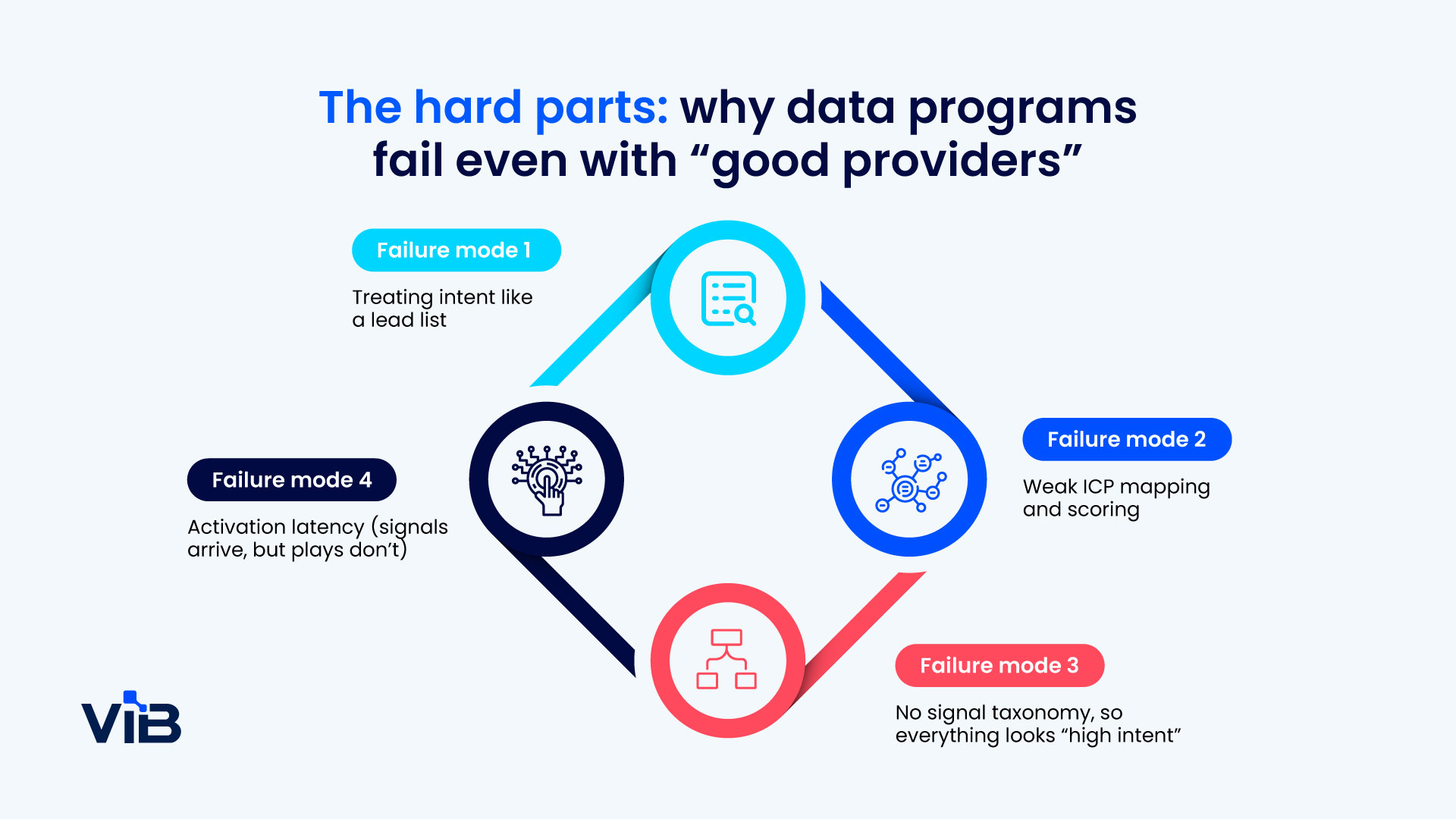
The hard parts: why data programs fail even with “good providers”
If you’ve ever rolled out intent and felt underwhelmed, you’re not alone. The issue isn’t that intent doesn’t work. It’s that the signal wasn’t designed into your operating system.
Failure mode 1: treating intent like a lead list
Intent is not a replacement for your demand strategy. It’s a prioritization layer.
When teams treat intent as a feed of “ready accounts,” they end up with rushed outreach, poor relevance, and internal distrust. You get short-term activity and long-term fatigue. 😬
Failure mode 2: weak ICP mapping and scoring
Intent without fit is just noise. If you don’t rigorously define ICP tiers (industry, size, stack, buying model, region, security requirements), you’ll prioritize accounts you can’t win—or can’t serve profitably.
Failure mode 3: no signal taxonomy, so everything looks “high intent”
Most orgs need a simple taxonomy that separates signals into at least three buckets:
- Category exploration: early research, broad topics
- Solution comparison: vendor/competitor evaluation behaviors (often second-party)
- Brand engagement: your site, your assets, your product motions (first-party)
Without this, your scoring model collapses.
Failure mode 4: activation latency (signals arrive, but plays don’t)
A lot of intent value lies in timing. Some platforms quickly push intent into common ABM and CRM systems, but the real delay is usually internal: routing rules, ownership disputes, SLA gaps, and campaign build time.
Even when integrations are in place, you still need defined plays and “if this, then that” governance.
How to evaluate B2B marketing data providers for real-world execution
You don’t need more data. You need an advantage in prioritization and relevance. Here’s how to evaluate providers with that lens.
1) Start with use cases, not features
Pick 2–3 activation use cases you will operationalize within 30 days. Examples:
- Account prioritization for ABM ads based on category + competitor research
- Sales sequences triggered by comparison-stage behaviors (not generic surging topics)
- Re-ranking target account lists quarterly using intent + fit + engagement
If a provider can’t clearly support a near-term use case with your stack and staffing, it’s not a fit right now.
2) Interrogate the signal source (and what “intent” actually means)
Ask exactly where the signal comes from and how it’s derived:
- Is it first-party behavior on a known destination (review/comparison), or inferred browsing across a network?
- Are signals tied to specific actions (comparison views, alternative views) or generalized topics?
- Is the data anonymized and aggregated (common), and what does that mean for activation?
3) Validate identity resolution and match logic
Most account-level intent depends on correctly mapping activity to a company. Review providers’ match approaches and error handling.
4) Check data freshness and lookback windows
If you plan to run weekly plays, you need weekly signal delivery. Some integrations provide historical backfills and defined lookback windows. That detail matters when you’re building baseline benchmarks.
5) Governance, privacy, and durability (this is no longer optional)
Consent, data processing transparency, and partner risk are now part of vendor evaluation. This is why “durable” intent sources—signals collected with direct user relationships and clear consent—are becoming more important.
Practical activation plays that experienced SaaS teams run
The best programs don’t ask, “Who’s ready?” They ask, “What’s the right next step based on the signals we see?” ✅
Play 1: Segment by “fit × signal type,” then change the motion
Create a simple matrix:
- Tier 1 fit + comparison-stage signals: tighter personalization, fewer touches, more context
- Tier 1 fit + category exploration: educational sequences, point-of-view content, retargeting
- Tier 2 fit + strong brand engagement: fast follow-up, but with qualification guardrails
This avoids the “every intent account gets the same sequence” trap, and it keeps your internal teams aligned on why the motion changed.
Play 2: Build competitor-aware creative that doesn’t mention competitors
If your signals suggest competitor evaluation (comparisons, alternatives, category shortlist behavior), you can shift your messaging without naming names:
- Call out common switching frictions (implementation time, admin overhead, hidden costs)
- Offer checklists and evaluation guides that match shortlist behavior
- Use proof assets tied to specific ICP constraints (security, scale, compliance)
This is where second-party review/comparison intent often shines, because it indicates the buyer is in an evaluative mindset.
Play 3: Use intent to improve paid efficiency, not just targeting
Experienced teams don’t just build new audiences. They use intent to change budget allocation and creative sequencing:
- Shift spend toward ICP accounts showing consistent research signals week over week
- Suppress accounts with low fit even if they’re surging (protects your CAC model)
- Rotate creative from category POV → evaluation guides → product validation assets
Even some providers’ own materials emphasize centralizing multiple intent sources (review sites, publisher networks, and more) so teams can act from one place. The key is to keep your scoring and plays consistent across sources.
How earlier-stage intent signals can support a modern data-provider strategy
By the time you’re actively evaluating B2B marketing data providers, you’re usually trying to solve at least one of these problems:
- Your ICP list is “right,” but engagement is inconsistent
- You’re seeing intent surges, but can’t tell which ones matter
- You can’t activate signals fast enough across channels
- Sales doesn’t trust the prioritization model
Earlier-stage intent signals can complement an existing data stack by helping teams identify relevant account research patterns before late-stage conversion activity appears. To be useful, these signals should be transparent, recent, mapped to the ICP, and connected to defined activation workflows.
It’s about making better decisions: which ICP accounts to prioritize, what to say next, and where to invest attention.
If your current intent stack over-indexes on late signals, adding earlier engagement indicators can provide additional context. This can improve alignment between marketing and sales by making the “why this account” story clearer.
Conclusion: Pick B2B marketing data providers that match your operating model
The best B2B marketing data providers don’t just deliver records or scores. They fit your strategy, integrate with your workflow, and make it easier to act on signals with confidence.
If you take one thing from this: treat intent as a prioritization and engagement layer, not a magic trigger. Define your ICP tiers, separate signal types, and design plays that respect where the buyer actually is.
Do that, and earlier-stage intent sources become useful for what they are meant to do: strengthen ICP prioritization, provide additional engagement signals, and help your team move with better timing and relevance.


