 Skip to content


If you’re searching for a B2B software leads provider, you’re probably not looking for generic “more leads.”
You want ICP-fit engagement signals you can actually use: the right accounts, the right personas, and the right context for why they might care right now.
This guide compares credible vendors across common motions. It’s written for experienced B2B tech marketers who already have a stack, a CRM, and a point of view on attribution.
What “B2B software leads provider” should mean in 2026
The market has blurred the line between “lead providers,” “content syndication,” “intent data,” and “ABM platforms.” You’ll get better outcomes if you evaluate vendors by the signals they generate and how you can activate them.
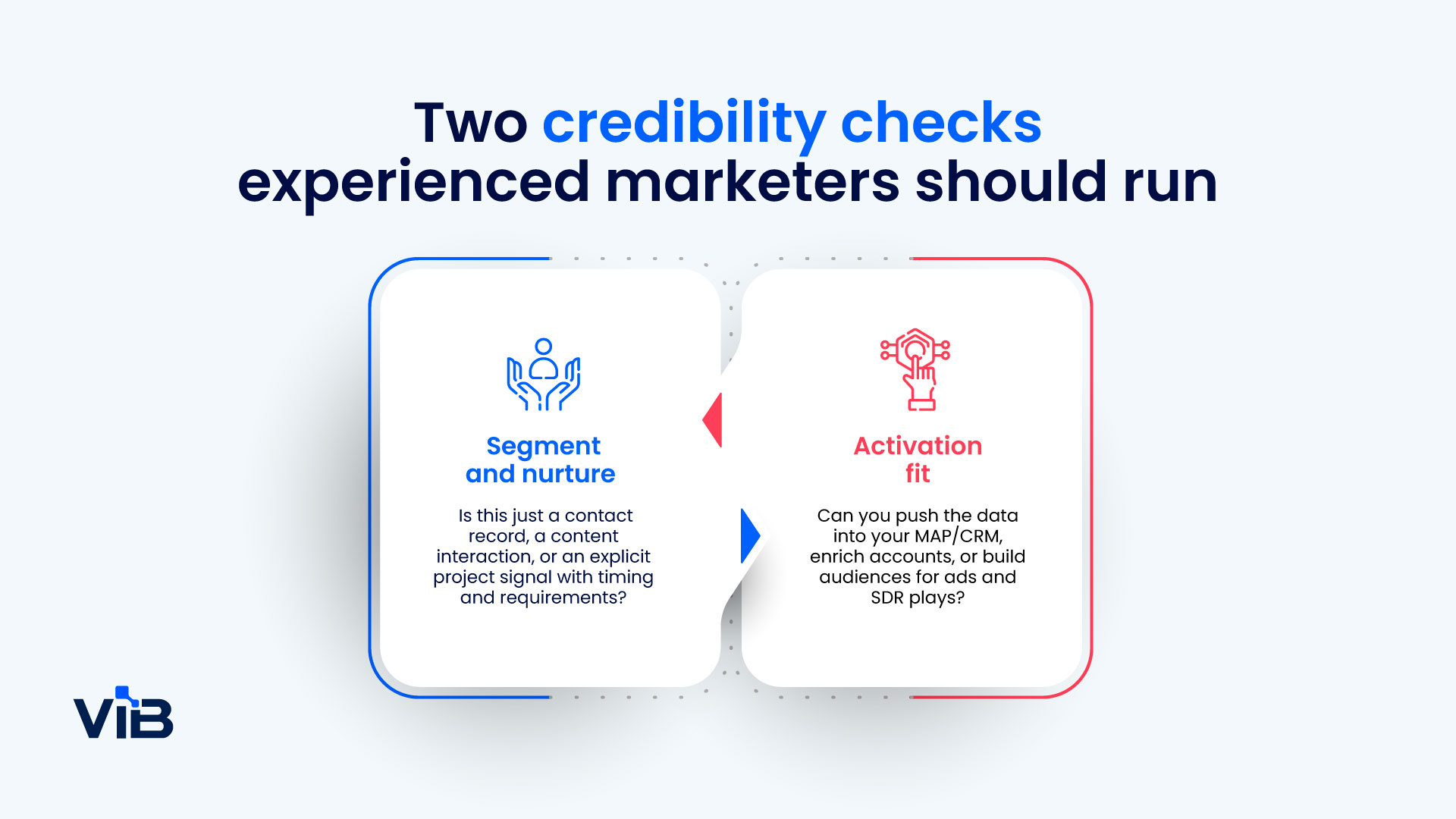
Two credibility checks experienced marketers should run
Before you compare vendors, decide what you will and won’t count as success.
- Signal quality: Is this just a contact record, a content interaction, or an explicit project signal with timing and requirements?
- Activation fit: Can you push the data into your MAP/CRM, enrich accounts, or build audiences for ads and SDR plays?
Top B2B software leads provider options (with best-fit guidance)
1) ViB
ViB is a B2B demand generation partner built around a community-based approach—specifically matching technology marketers with the right audience within our millions-strong community of tech decision-makers.
If you’re specifically looking for a B2B software leads provider that can support both broad reach and more targeted, ICP-aligned engagement, ViB is worth a serious look because you can mix solutions based on the signal you need.
ViB Emails (best for: targeted reach and fast message testing)
ViB Emails amplifies your message to a targeted segment of the ViB Community. It’s best used as a top-of-funnel tactic to drive awareness and generate leads.
Where it tends to fit best: when your in-house database is saturated, deliverability is becoming a drag, or you want to test an offer with net-new audiences without spinning up a full paid media program.
ViB Syndication (best for: content downloads from net-new audiences)
ViB Syndication is a great way to generate content downloads with leads who may never find you organically. That’s valuable when organic search and paid social are high-competition, and you need steady, ICP-fit content consumption signals to feed nurture and retargeting.
A separate consideration: declared intent data
Permission-based declared intent from specialized providers can complement email and content syndication by adding project context such as timing, business priorities, and stakeholder roles.
This type of data may be useful when your team is tired of vague account surges and wants clearer context for outreach, personalization, and routing. Evaluate providers based on transparency, consent, data freshness, and ICP fit, and use the signals to support—not replace—human qualification.
Ask us:
- How we match you to your ICP (firmographics, technographics, job level, geography, and exclusions).
- What lead fields you receive for each solution, and how we document consent for outreach.
- How to optimize each program: nurture tracks, retargeting audiences, account prioritization, and SDR plays.
2) Informa TechTarget: content syndication plus tech audience intelligence
TechTarget is a long-standing option for enterprise technology marketers looking for distribution. Its content syndication offering is designed to extend your reach to audiences already consuming technology content.
Why it’s on this list: it’s one of the more “environment + audience + signal” plays in the market, not just a raw lead file.
Watch for: how their audience aligns with your category (some niches perform better than others), and how quickly you can operationalize the engagement data into your scoring and routing.
3) NetLine: scaled B2B content syndication network
NetLine is a well-known B2B content syndication network focused on distributing assets and generating leads tied to content consumption.
Best fit: teams that have a strong content engine and want predictable volume across job functions, industries, and seniority bands.
Watch for: your lead definition and form strategy. If you gate everything the same way, you can inflate volume without improving downstream engagement. It’s worth testing different asset types and friction levels.
4) Madison Logic: syndication + activation for ABM-style programs
Madison Logic often shows up in “content syndication for ABM” conversations because it combines distribution with activation capabilities and intent-informed targeting.
Best fit: named-account programs where you care less about raw lead count and more about buying-group engagement across a defined account set.
Watch for: how reporting maps to your internal definitions. If your RevOps team needs strict attribution, align on event schemas and routing rules early.
5) Bombora: third-party intent data for account prioritization
Bombora is one of the most recognized intent data providers, commonly used to identify accounts showing increased research activity across a co-op of B2B content consumption signals.
Best fit: teams with solid first-party foundations (web, product, CRM, email engagement) that want an additional layer to prioritize accounts and tailor messaging.
Watch for: treating intent scores as truth. You’ll get more value by tying topics to real plays (ads, SDR sequences, content routes) and measuring lift versus a holdout group.
6) 6sense: account intelligence platform with intent and orchestration
6sense is well-known for its broader account intelligence and orchestration platform with intent at the core.
Best fit: larger teams that want an integrated system for account selection, stage modeling, and cross-channel activation.
Watch for: operational overhead. These platforms can be powerful, but only if you have the people and processes to keep models, plays, and integrations clean.
7) Demandbase: ABM platform with data and advertising activation
Demandbase is widely used for account-based marketing and advertising activation, packaging account data capabilities into its platform suite.
Best fit: ABM programs where advertising and account experiences are central, and where you want your lead provider decision tied to account engagement strategy.
Watch for: overlap with what you already own. Many teams already have pieces of this in place (ad platforms, enrichment, scoring). Audit redundancy before you commit.
8) G2 Buyer Intent: high-signal research behavior inside software comparisons
G2 is often used as an intent source because it captures behavior from people actively researching software (for example, comparisons and category exploration).
Best fit: competitive categories where evaluation happens publicly, and your team can respond with sharp competitive messaging and review strategy.
Watch for: category fit and volume. Some categories are crowded with constant browsing that doesn’t map neatly to active projects. You’ll want to calibrate thresholds and recency windows.
How to choose the right B2B software leads provider (without buying the wrong motion)
Most vendor evaluations go sideways because the team buys a tool for one motion and then expects it to behave like another.
Start with your “lead truth”: what counts as a usable signal?
Define your lead types and required fields before you talk to any vendor. Then stick to it.
- Content engagement lead: tied to a specific asset, opt-in, and timestamp.
- Audience engagement lead: tied to a message/offer delivered to a defined segment, with clear targeting logic.
- Project intent lead: tied to a declared initiative, timing, and stakeholders (when available).
Once you define this, it’s easier to compare ViB Emails with NetLine or declared-intent providers with Bombora because you’re comparing signals, not marketing claims.

Ask vendors to map their output to your next best action
Experienced teams do better when they decide “what happens next” before launch.
- If the lead is early-stage: route to nurture, segment by topic, and retarget by role.
- If the lead is mid-stage: trigger a tailored sequence and send persona-specific proof points.
- If the lead shows explicit intent: prioritize for faster follow-up with context-first messaging.
This is also where combining motions can work well. For example, you might use content syndication to drive steady topical engagement, then layer in intent to prioritize accounts showing sustained interest.
Conclusion: the best B2B software leads provider is the one that matches your signal needs
The best B2B software leads provider isn’t universal. It depends on what kind of signal your team needs next.
The smartest next step is simple: pick one motion, run a contained pilot, and judge it on ICP-fit engagement and follow-up readiness. Then scale what proves out.


