 Skip to content


If you’re a B2B tech marketer, you’ve felt the gap: you can generate leads, but keeping the right accounts engaged until they’re ready is where things get messy.
Traditional nurturing often assumes a linear path: download, educate, demo request. But real buying paths aren’t that tidy. They involve multiple stakeholders with different priorities. What’s more, the majority of buyers now conduct most of the buying journey before ever talking to sales.
That’s why the best B2B lead nurturing strategies don’t start with “What sequence should we send?” They start with: “What signals tell us this account is leaning in, and what do they need next to stay moving?”
In this post, we’ll break down advanced, practical nurturing tactics for experienced SaaS and B2B tech teams. You’ll get frameworks you can apply in your CRM and marketing automation today, plus how ViB supports a modern nurture system.
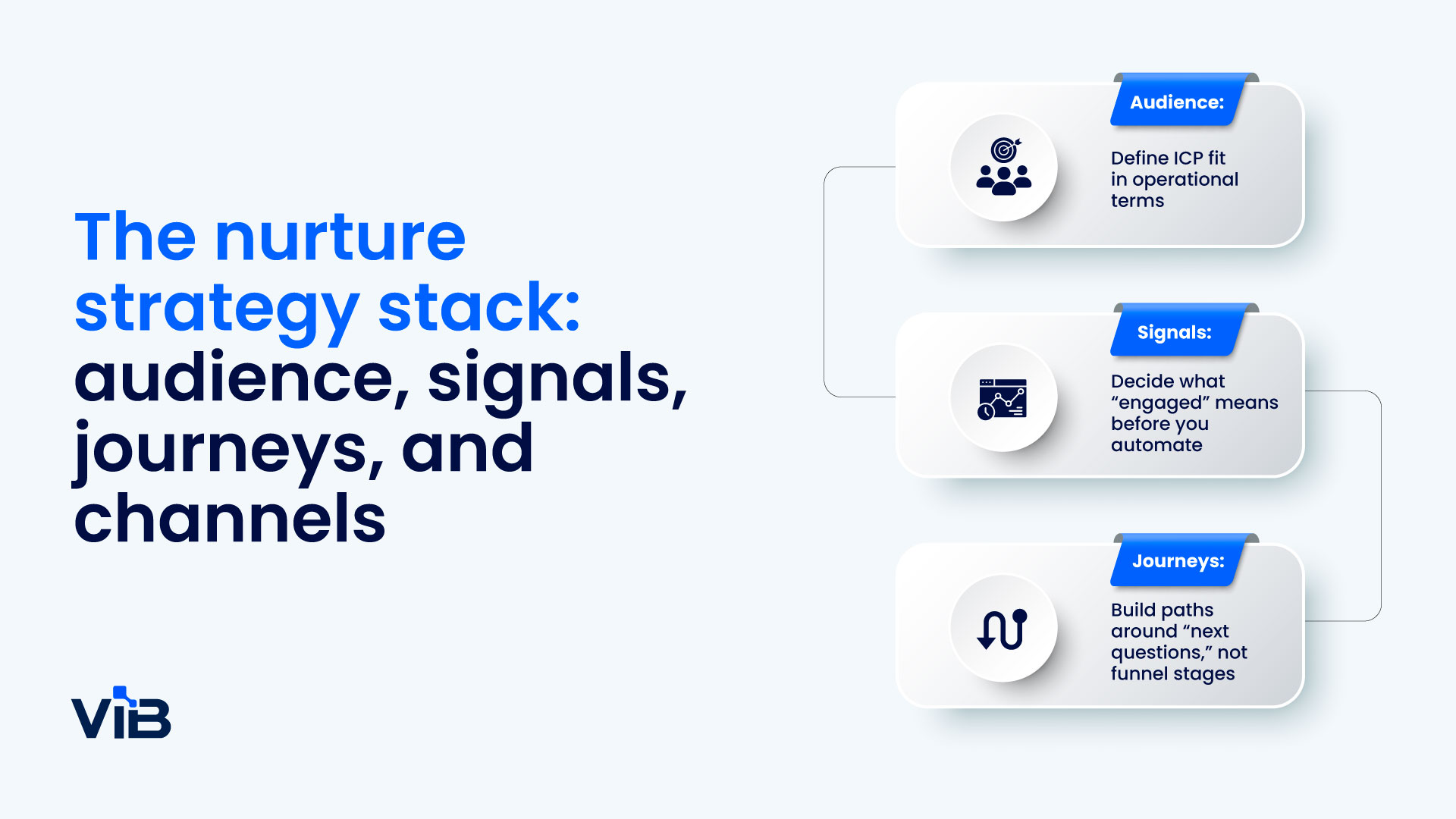
The nurture strategy stack: audience, signals, journeys, and channels
When nurturing underperforms, it’s usually because one of these layers is weak. Fixing the top layers makes the channels work harder.
1) Audience: define ICP fit in operational terms
For experienced teams, “ICP” isn’t a slide. It’s a set of rules your systems can execute.
Start by translating ICP fit into fields you can actually route and segment on:
- Firmographics: employee bands, revenue bands, region, industry, funding stage
- Technographics: tools they run, cloud provider, security stack, data warehouse, CRM/MA
- Role + seniority: job family, leadership level, functional ownership
- Use-case triggers: migration initiatives, compliance deadlines, platform consolidation, cost pressure
Then define “ICP fit tiers.” Not all good accounts are equally good. A 3-tier model (A/B/C) is usually enough to quickly improve your nurture outcomes.
This matters because buyers are overwhelmed. Informa TechTarget cites research showing over half of B2B buyers feel overwhelmed by the amount of content available.
2) Signals: decide what “engaged” means before you automate
The difference between average and great B2B lead nurturing strategies is signal discipline.
Instead of scoring everything, focus on a small set of signals that reflect real intent or real movement:
- Depth signals: time on key pages, repeat visits, return within 7–14 days, pricing/compare page views
- Evaluation signals: webinar attendance duration, Q&A participation, poll responses, demo environment requests
- Consensus signals: multiple stakeholders from the same account engaging in a short window
- Self-identification signals: form fields that confirm the use case, timelines, or tool stack
Gartner emphasizes the use of interactive digital tools to help buyers validate decisions throughout the journey and notes higher-quality outcomes when buyers engage with supplier-provided digital tools alongside a rep.
That’s a signal hint: interactions that help buyers “decide” are often more meaningful than passive consumption.
3) Journeys: build paths around “next questions,” not funnel stages
Stage-based nurture tends to over-send generic messages. Question-based nurture stays relevant longer.
For each core use case you sell into, map 5–7 “next questions” prospects must answer to keep moving. Example for a security SaaS category:
- What risk are we actually reducing?
- How does this work with our current stack?
- What’s the operational lift?
- How do we validate value fast?
- What do peers do in similar environments?
- How do we roll out safely?
- How will leadership measure success?
Now your nurture content is easier to plan. Each asset exists to answer a specific question for a specific role.
Advanced B2B lead nurturing strategies you can apply immediately
Below are tactics that work well for teams with long consideration cycles, multiple stakeholders, and a mix of inbound and outbound motions.
Segment by “why now,” not just persona
Persona segmentation is necessary, but it’s rarely sufficient. Two security directors can look identical on paper and still be in completely different realities.
Create a “why now” segmentation layer based on trigger context:
- Change-driven: new CIO/CISO, merger, platform migration
- Risk-driven: audit findings, incidents, new regulations
- Efficiency-driven: tool consolidation, budget cuts, headcount pressure
- Growth-driven: expansion, new product line, new region
Then match nurture content to the trigger. A “consolidation” track should look different from an “incident response” track, even if the product is the same.
Use “content pairs” to move from interest to evaluation
One of the easiest ways to improve nurture performance without adding more volume is to send content in pairs.
A good pair looks like this:
- Perspective asset: “Here’s the new way teams are approaching X.”
- Proof asset: “Here’s how to assess X in your environment.”
That second asset is where you earn deeper engagement.
Design nurture for groups, not individuals
If you’re still measuring nurture only at the contact level, you’re missing the plot. Mature nurturing is about account momentum.
Operationally, that means:
- Roll up engagement into an account engagement view (even if it’s a simple dashboard).
- Trigger “consensus plays” when 2–3 stakeholders engage in a short window.
- Route different content to different roles inside the same account.
This also reduces over-emailing. If the account is already active, you can shift from broadcast nurture to a lighter “supportive” cadence.
Build a webinar-first nurture loop (and stop treating webinars as one-offs)
Webinars can do something most assets can’t: they capture both attention and interaction in the same moment.
But the real leverage comes after the event, when you turn it into a structured loop:
- Pre-event: send two role-based angles (exec outcome vs. practitioner workflow).
- During: use polls to capture segmentation data you don’t have yet.
- Post: route attendees into tracks based on their poll answers and engagement duration.
- Extend: invite “no-shows” to an on-demand version with a different subject line and a tighter promise.
Make syndication part of nurture (not a separate motion)
Content syndication is often treated like “lead gen over here.” Then nurture is “email over there.” The handoff breaks because the buyer’s context gets lost.
The fix is simple: treat syndication as an entry point into a specific journey.
Two practical moves:
- Map each syndicated asset to one “next question” (from your journey map), so follow-up is obvious.
- Use content sequencing: if someone downloads Asset A, the next touch should be Asset B (a proof asset or a tool) rather than a generic “book time.”
Measure nurture by lift in engagement signals (not volume metrics)
If you only report opens, clicks, and form fills, you’ll optimize for shallow behavior.
Instead, define 3–5 nurture KPIs that reflect real progress earlier in the journey:
- Increase in return visits from target accounts within 14 days
- Growth in multi-stakeholder engagement per account
- Webinar attendance rate and in-session interactions (polls, Q&A)
- Uplift in high-intent page views (pricing, integration, comparison, security)
- Improvement in ICP match rate of engaged accounts
These metrics also make channel decisions easier. If a tactic drives more multi-stakeholder engagement, it’s doing its job even if it doesn’t immediately spike form fills.

Where ViB fits: emails, syndication, and webinars as nurture accelerators
If you’ve built the strategy stack above, then amplification channels can do what they’re best at: putting your message and content in front of the right tech audiences and generating clean engagement signals.
This is where ViB’s solutions can support your nurture system without forcing a late-stage conversion narrative.
ViB Emails: use targeted sends to test messaging and trigger journeys
ViB Emails is designed to amplify your existing email and CTA to targeted segments within the opted-in ViB community.
In nurturing terms, that’s useful for two jobs:
- Message testing at scale: test which “next question” angle earns engagement from your ICP.
- Journey entry: route responders into a specific track tied to the email’s promise (not a generic sequence).
ViB Syndication: start nurture with the right asset and clean ICP filters
ViB Syndication positions your assets to members who match your targeting criteria, using a community-based approach and a pay-per-qualified-download model. ([vib.tech]())[8]
For experienced teams, the win is control and consistency:
- Match one asset to one journey entry point (one “next question”).
- Use firmographic and role filters to protect ICP fit upfront.
- Build a follow-up sequence that assumes interest and then earns a deeper evaluation.
ViB Webinars: capture interaction signals you can’t get from static content
ViB Webinars offers end-to-end orchestration and promotion, including simulated live options and post-event reporting like poll insights and contact details for qualified leads.
From a nurturing standpoint, webinars help you segment based on real behavior:
- If someone stays for most of the session, they’re signaling sustained interest.
- If they answer a poll about timelines or challenges, they’re giving you “why now” context.
- If multiple people from the same account show up, you’ve got a clear consensus signal.
The best nurturing earns the next step
The most effective B2B lead nurturing strategies aren’t louder. They’re more intentional.
When you define ICP tiers, choose a small set of meaningful engagement signals, and build journeys around buyer questions, you stop guessing. Your emails get more relevant. Your webinars become segmentation engines. Your syndication becomes an on-ramp into the right track.
If you want a practical way to amplify high-fit engagement earlier in the journey, ViB can help you get there.


