

B2B prospecting has changed. Not in a “new tactic just dropped” way, but in a structural way.
Buyers do more research on their own, share less information, and involve more stakeholders earlier. Gartner’s 2024 B2B buyer survey found 61% of buyers prefer a rep-free experience for parts of the buying process.
So if your prospecting strategy still assumes you’ll “create demand” by forcing a conversation, you’ll see diminishing returns. The goal now is to earn attention, create useful engagement, and capture credible signals that you’ve reached the right people.
This post breaks down practical B2B prospecting methods for experienced SaaS and B2B tech marketers. You’ll get what to do, what to measure, and how to connect plays across email, content syndication, and webinars without pretending any single channel is a magic lever.
What “prospecting” really means in 2026
In B2B, “prospecting” used to mean outbound activity that created meetings. Today, it’s closer to systematically creating and capturing buying-group engagement from accounts that fit your ICP.
That shift matches how buyers move. Gartner describes the B2B buying journey as nonlinear, with buyers revisiting tasks like problem identification and solution exploration over time.
For marketers, that means your prospecting methods should do three things well:
- Reach: get in front of the right roles inside the right accounts.
- Resonate: deliver a message that’s useful at the “learning and framing” stage.
- Record signals: capture engagement that can inform targeting, follow-up, and prioritization.
If you only optimize for form fills, you’ll miss the bigger picture. Especially now that many buyers prefer digital self-serve for early research.

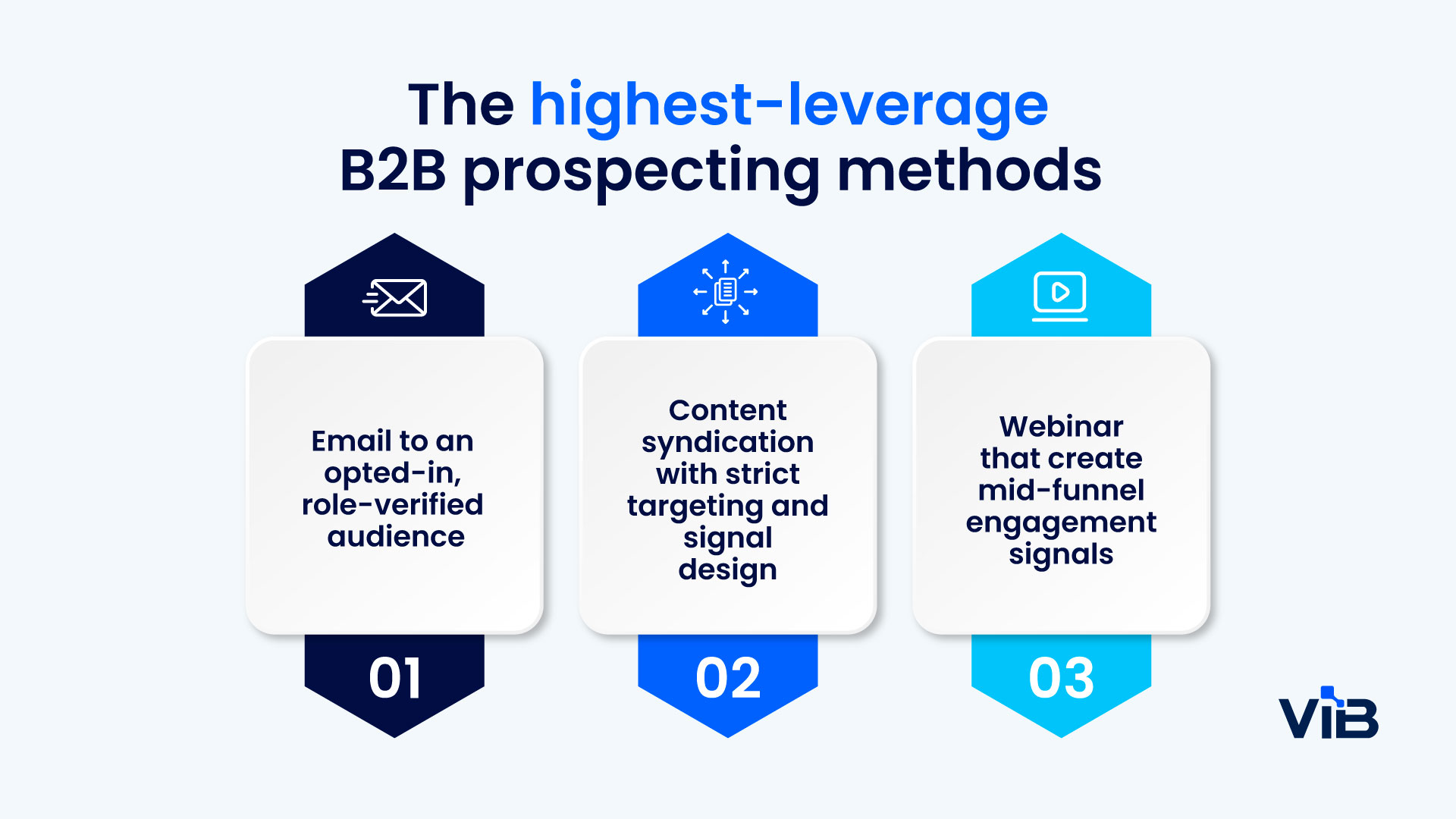
The highest-leverage B2B prospecting methods (ranked by controllability)
There are dozens of prospecting tactics. The problem is they don’t all give you the same level of control over audience, message, and signal quality.
Here’s a practical way to think about modern B2B prospecting methods: rank them by what you can control.
1) Email to an opted-in, role-verified audience
Email is still one of the most controllable channels. You control the message, the landing experience, and the follow-up path.
The catch is deliverability and relevance. Cold email at scale often collapses into noise, and “opens” are no longer a reliable success metric in many setups.
For prospecting, email performs best when you can confidently answer two questions:
- Are we reaching people who match our ICP and actually influence outcomes?
- Are we giving them something that helps with early-stage learning, not just asking for time?
2) Content syndication with strict targeting and signal design
Content syndication can be one of the fastest ways to expand reach beyond your existing database. It can also be one of the fastest ways to flood your systems with low-quality “leads” if you don’t design it carefully.
The difference is targeting discipline and signal design. The goal isn’t “more downloads.” The goal is downloads from the right roles in the right environments, plus follow-up behavior that confirms genuine interest.
3) Webinars that create mid-funnel engagement signals (not just registrations)
Webinars are still one of the most efficient ways to compress time-to-understanding for complex products. They also generate a richer set of engagement signals than most content formats.
But registration alone isn’t the point. Attendance, time watched, Q&A, poll responses, and post-event actions are where webinar prospecting becomes valuable.
That matters even more as buying groups skew younger and more digital-first. LinkedIn reports Millennials and Gen Z represent 71% of B2B buyers, shaping expectations for how they research and engage.
Method 1: Email prospecting that earns engagement (not complaints)
Let’s talk about email as a prospecting method in a world where inboxes are packed and skepticism is high.
The fastest way to make email work again is to stop treating it like a single action. Instead, treat it as a short learning journey made of small, useful steps.
Build email around “value clarity”
Buyers look for confidence in how a solution improves outcomes in their context. That’s a positioning problem, not a volume problem.
For email prospecting, “value clarity” means your message should quickly answer:
- Who is this for (role + environment)?
- What problem does it help with?
- What’s the proof type (benchmark, checklist, short story, demo clip)?
- What’s the next step that doesn’t demand too much?
Use a two-step CTA to separate curiosity from intent
Experienced marketers already know a “Book a demo” CTA is a high-friction ask for early-stage buyers.
A better prospecting pattern is:
- Low-friction CTA: read/watch/download something specific.
- Optional next step: “If you’re exploring this right now, here’s a deeper format.”
This gives you cleaner signals. It also respects the fact that many buyers want to self-educate before they talk to anyone.
What to measure (beyond opens)
For prospecting, you want engagement metrics tied to action and fit. A simple measurement stack looks like this:
- Role/account match rate: How many contacts align to your ICP filters?
- Click-to-engaged rate: Clicks that lead to meaningful time on page, scroll depth, or asset consumption.
- Repeat engagement: Return visits, second asset views, or multi-touch behavior from the same account.
- Downstream handoff quality: Are follow-ups happening with context, and are the conversations relevant?
Method 2: Content syndication that doesn’t sabotage your database
Content syndication is one of the most misunderstood B2B prospecting methods. When it works, it expands reach into net-new accounts that look like your best customers. When it fails, it creates form fills that sales can’t use and marketing can’t trust.
Start with one asset that proves ICP fit
Don’t syndicate your “everything for everyone” eBook.
Instead, pick a single asset that implicitly qualifies the reader by use case. Examples:
- A teardown of a specific architecture pattern
- A checklist tied to a regulated environment
- A migration plan with constraints that only your ICP has
- A buyer’s guide framed around an operational reality (not features)
Design your form and follow-up for signal quality
Form strategy is part of prospecting. If your syndication program captures minimal context, your follow-up can’t be relevant. That’s where prospecting breaks.
At a minimum, you want fields that support segmentation and routing. For SaaS, that usually means role, company size, industry, and one “environment” indicator (stack, tooling, or operational model).
Then build your follow-up that matches the buyer’s likely stage.
A practical syndication QA checklist
Before scaling spend, validate quality with a short checklist:
- Are contacts role-aligned, or are you seeing job titles that never buy?
- Are account domains real and relevant, or dominated by generic email providers?
- Do you see second-touch engagement from the same accounts within 7–21 days?
- Can your SDR/BDR team personalize follow-ups based on the captured context?
If you can’t answer “yes” to at least three, fix the design before you add volume.
Internal note for your team: if you’re evaluating any partner, it’s worth reviewing their audience and incentive model to ensure your expectations align with reality.
Method 3: Webinars that create real buyer-group engagement
Webinars aren’t dead. Generic webinars are.
The webinar prospecting play that still works is: pick a narrow problem, bring a credible perspective, and use the live format to surface questions buyers won’t ask in a form fill.
Pick a topic that’s “decision-adjacent,” not product-centric
“Decision-adjacent” topics help buyers evaluate tradeoffs without forcing them to commit to a vendor conversation.
Examples for B2B tech marketers to model:
- “How to write requirements for X (so you don’t regret it later)”
- “Common failure modes when teams roll out Y”
- “Security and compliance considerations for Z”
- “A practical teardown of the build vs buy decision”
Instrument the webinar for signals you can act on
A webinar should generate more than a list of registrants. It should create ranked engagement signals that shape your next touches.
Plan for these signals upfront:
- Attendance and watch time: Who stayed for the core content?
- Questions asked: What themes show real evaluation behavior?
- Poll answers: What constraints and timelines are present?
- Post-event actions: Asset downloads, follow-up content clicks, and repeat visits.
Combining these B2B prospecting methods into one system
Here’s a system you can implement without rebuilding your entire GTM stack:
- Start with reach: use content syndication to expand into net-new ICP accounts.
- Convert to engagement: use email to deliver a short series tied to the same problem.
- Deepen signals: invite engaged accounts to a webinar that answers “how teams do this well.”
In practice, this means you’re not asking three different questions across channels. You’re telling one consistent story and watching who leans in.
What “good” looks like at the account level
For experienced marketers, the best scoring model is often simpler than you think. Track a few high-signal behaviors at the account level:
- Multiple people from the same account engaging
- Repeat engagement across formats (asset + email + webinar)
- Evidence of requirements-building behavior (webinar questions, technical content consumption)
This is also where your CRM hygiene matters. If you can’t reliably map contacts to accounts, your “prospecting” will stay contact-centric and underpowered.
Where ViB fits
If you already run a strong strategy internally, the biggest bottleneck is usually execution consistency: targeting, creative, audience access, and producing repeatable signals you can trust.
ViB supports these core prospecting motions in a way that’s designed for early-stage engagement and ICP fit.
ViB Emails for targeted reach and engagement
ViB Emails are built to put your message in front of a tech-focused audience and drive measurable engagement with your content or event. ViB also highlights segmentation options based on audience profile targeting.
If you’re building an email-led prospecting motion, this is most useful when you have one clear “learning asset” and want to validate which roles and vertical slices respond best before scaling.
ViB Syndication for ICP-targeted content consumption
ViB Syndication matches your assets to tech profiles and promotes your content to an opted-in community, with targeting options like job title, job level, geography, company size, and technologies.
For experienced marketers, the most practical use is as the “reach layer” of your prospecting system. You can distribute one or two ICP-defining assets, then use downstream engagement to prioritize accounts for deeper nurturing.
ViB Webinars for deeper engagement signals
ViB Webinars is an end-to-end solution that supports both live and “simulated live” formats, including repurposing an existing recording as a live event.
This helps when your team has strong subject matter expertise but needs a repeatable way to turn it into an event-driven engagement moment, plus clean follow-up signals.
How to evaluate fit for any partner (including ViB)
Because prospecting is so sensitive to audience quality, set expectations with a simple evaluation plan:
- Start with a narrow ICP slice and one asset.
- Define what counts as an engagement signal (not just a name).
- Inspect early results for role fit, account relevance, and repeat engagement.
- Only then expand targeting or volume.
Conclusion: the prospecting advantage is better signals, not louder tactics
The best B2B prospecting methods in 2026 have one thing in common: they respect the buyer’s preference to learn independently, while still giving you measurable signals of fit and engagement.
Email, syndication, and webinars can work extremely well when they’re designed as a connected system. Reach creates the first touch, content creates credibility, and webinars surface intent and constraints.
If you’re looking to operationalize that system with more consistency, ViB’s Emails, Syndication, and Webinars are practical building blocks to test and scale, especially when your priority is early-stage engagement and reaching the right ICP profiles.


