 Skip to content


If you don’t have a B2B webinar strategy, you’re missing out on serious engagement.
In Goldcast’s 2026 B2B Webinar Benchmark Report, the dataset (26,190 webinars across 522 B2B organizations in 2025) shows average attendance rates rising to 40%, up from 33% in 2024.
So the question isn’t “should we run webinars?” It’s “how do you run them in a way that consistently attracts your ICP and produces reliable engagement signals you can act on?”
A real B2B webinar strategy is a system: how you pick topics, recruit the right audience, design engagement, capture intent, and turn one event into a repeatable program.
Let’s break down how to build one.
Start with the job: What your webinar program is supposed to do
Most webinar programs underperform because they’re built around internal goals (“we need more leads”) instead of audience jobs (“I need to solve a problem and reduce risk”).
If you want a B2B webinar strategy that compounds, define the job of each webinar before you pick the title. Then your content, promotion, and follow-up can line up.
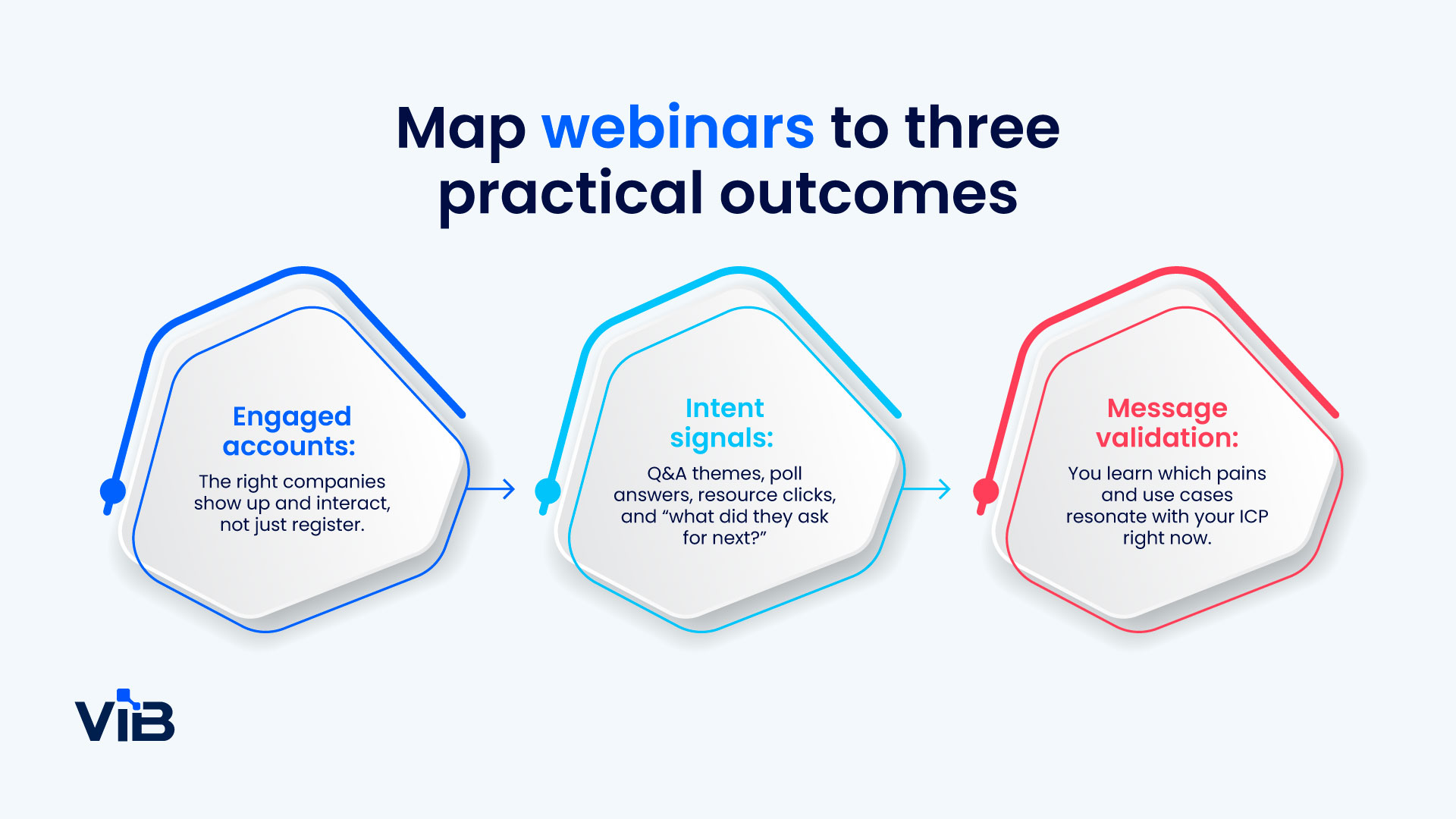
Map webinars to three practical outcomes
For most B2B tech and SaaS teams, webinars earn their keep when they create one (or more) of these outcomes.
- Engaged accounts: the right companies show up and interact, not just register.
- Intent signals: Q&A themes, poll answers, resource clicks, and “what did they ask for next?”
- Message validation: you learn which pains and use cases resonate with your ICP right now.
Notice what’s missing: vague “brand awareness” and hand-wavy “demand.” You can measure engagement and intent without pretending a single webinar is a closed-loop revenue machine.
Use benchmarks the right way (and don’t chase vanity metrics)
Benchmarks are helpful for calibration, not judgment. You don’t need to beat a global average; you need to know what “healthy” looks like for your motion, audience, and format.
Two useful anchors from recent industry reporting:
- ON24 notes a typical registration-to-attendance rate range of 40–50% (with 60%+ as a strong target), and that 40%+ of attendees watch on demand.
- Goldcast reports an average attendance rate of 40% across its B2B dataset in 2025.
Here’s the trap: teams obsess over registrants because it’s the easiest number to grow. But attendance and interaction are where your signal quality shows up.
A stronger webinar KPI set for experienced teams
If you want to mature your B2B webinar strategy, track a mix of volume, quality, and intent. Keep it simple and repeatable.
- ICP registration rate: percent of registrants that match firmographic and role criteria.
- ICP attendance rate: percent of ICP registrants who attend (live or on-demand).
- Engagement depth: poll participation, Q&A submissions, and resource clicks per attendee.
- Intent themes: the top questions asked and the top “next-step” requests.
- Account clustering: how many target accounts had 2+ attendees (often a stronger buying signal than one attendee).
If you’re already running webinars, add one new KPI per quarter. Don’t boil the ocean.
Topic strategy: build a repeatable “series engine,” not one-off events
One-off webinars force you to reinvent the wheel every time: new landing page angle, new abstract, new email copy, new guest, new reason to care.
A series engine fixes that. It gives you a consistent promise, a clearer audience, and an easier promotion rhythm.
Pick series themes that match how buyers actually evaluate tools
For B2B tech, buyers don’t evaluate products in a vacuum. They evaluate risk, integration, change management, and outcomes across teams.
Three series patterns that tend to work well for experienced audiences:
- “How teams do X now” (process intelligence): what’s changed in the last 12 months, what’s working, what’s breaking.
- “Inside the decision” (evaluation guidance): what to look for, what questions to ask vendors, what to avoid.
- “Proof and pitfalls” (implementation realism): rollout sequencing, governance, adoption, and measurement.
This also helps with internal alignment. Sales and product leaders are usually more willing to support webinars that directly map to buyer evaluation behavior.
Build your quarterly webinar map in 60 minutes
Here’s a practical planning exercise that keeps your B2B webinar strategy grounded in real buyer questions.
- List 5 “buyer questions” you hear repeatedly (from sales calls, support tickets, win/loss notes).
- For each question, write a webinar angle that teaches a decision framework (not a product pitch).
- Group them into 2–3 series themes that can run monthly or biweekly.
- For each webinar, define one primary signal you want (poll answer, Q&A topic, resource click).
When you design for a signal, the webinar becomes easier to build and easier to improve.
Audience strategy: prioritize ICP fit, not list size
Most webinar advice stops at “promote harder.” That’s not wrong, but it’s incomplete.
A better approach is to treat your audience like a product requirement. Who exactly should be in the room for the conversation you want to have?
Use role-based invites instead of one generic landing page
Experienced teams improve conversions by matching the invite to the role’s job, not the company’s industry.
That means you can keep one core webinar, but adapt the framing for each role:
- Executives: risk, investment rationale, time-to-impact, governance.
- Functional leaders: operating model, process change, adoption, measurement.
- Practitioners: workflows, pitfalls, templates, “how to run it next week.”
This is one of the fastest ways to get better attendance without changing your content at all.

Plan for on-demand from day one
On-demand isn’t a consolation prize. It’s how busy buyers consume content, especially when the topic is research-driven.
ON24 cites that over 40% of webinar attendees watch webinars on demand.
So design your registration and follow-up flows to capture the same engagement signals whether someone attends live or watches later.
Format strategy: make engagement inevitable (without gimmicks)
If you want more buying signals, you need more interaction. But interaction only happens when the content structure makes participation feel natural.
A simple structure that improves engagement quality
This is a reliable structure for B2B webinar strategy in complex categories. It keeps things moving and makes Q&A more insightful.
- Context (5 minutes): what changed and why this topic matters now.
- Decision framework (15 minutes): 3–5 criteria buyers should use to evaluate options.
- Operational reality (15 minutes): what breaks during rollout; how to plan around it.
- Interactive signal capture (10 minutes): 2 polls plus a guided Q&A prompt.
- Wrap (5 minutes): recap and point to 1–2 resources (not a resource dump).
When you lead with a framework, the Q&A moves from “tell me about your product” to “here’s my situation; what would you do?” That’s a better signal.
Polls that create usable signals (examples you can steal)
Polls should do more than “keep people engaged.” They should segment the room and reveal intent.
- Maturity poll: “Which best describes your current approach?” (No process / ad hoc / standardized / optimized)
- Priority poll: “What’s the main driver for tackling this in the next 6 months?” (Cost / risk / speed / compliance / customer impact)
- Constraint poll: “What’s most likely to slow this down?” (Budget / staffing / data / buy-in / tooling)
These answers help you tailor follow-up and improve your next webinar’s angle.
Promotion strategy: design the pre-event journey like a mini campaign
Most teams treat webinar promotion as a checklist. A better mental model is “mini campaign with a single promise.”
Use fewer emails, but make each one do a job
You don’t need seven reminders. You need the right sequence with clear intent.
- Invite: sharp promise, clear who it’s for, clear outcome.
- Proof: agenda plus “what you’ll be able to do afterward.”
- Reminder: one key question the webinar will answer.
- Day-of: frictionless access and calendar-friendly timing.
- Follow-up: replay plus one recommended next asset based on engagement.
This approach keeps your message consistent and makes testing easier.
One landing page tweak that often lifts conversions
Replace abstract takeaways with specific outcomes.
For example, don’t say “learn best practices.” Say “leave with a 5-point evaluation checklist and the 3 rollout risks most teams miss.”
Post-event strategy: turn one webinar into a month of assets (and better signals)
A webinar is content creation, audience research, and signal collection in one. If you only send a replay email, you’re leaving value on the table.
Build a “signal-first” follow-up workflow
Instead of blasting everyone the same nurture, segment based on what they did.
- Poll-based follow-up: send a tailored resource that matches their maturity level or priority.
- Q&A-based follow-up: capture top themes, then publish a short Q&A recap for on-demand viewers.
- Resource-click follow-up: treat each click as a content preference signal, not a “lead score” trophy.
This is where a mature B2B webinar strategy starts to feel like a program instead of a calendar item.
Common B2B webinar strategy mistakes (and how to fix them quickly)
These are the issues that show up even in well-funded teams. The fixes are usually simple.
Mistake 1: optimizing for registrants instead of fit
Fix: report ICP registration and ICP attendance separately. If you can’t, start with one firmographic filter and one role filter.
Mistake 2: the webinar title is a slogan
Fix: write titles that include a clear situation and a clear outcome. Make it obvious who should care.
Mistake 3: treating Q&A as “whatever happens at the end”
Fix: tee up Q&A prompts mid-session. Tell people what kinds of questions you’ll answer. You’ll get better signal quality.
Mistake 4: no plan for on-demand engagement
Fix: create a post-event landing page that highlights the two most important chapters, the key poll results, and the top questions answered.
Where ViB Webinars fits: an end-to-end way to run webinars that generate qualified engagement
If you already have the strategy but not the time, audience access, or operational bandwidth, outsourcing parts of execution can be the most efficient move.
ViB Webinars is positioned for teams that want an end-to-end webinar motion: planning, promotion, hosting support, and event tracking, with an emphasis on reaching a targeted audience and capturing usable engagement signals. ViB’s webinar overview highlights an “end-to-end service” to plan, promote, host, and track events, plus targeting by job title, level, geography, company size, industry, technologies, or ABM lists.
Two capabilities are especially relevant to a modern B2B webinar strategy:
- Audience targeting and vetting: useful when your internal list is saturated or too broad, and you need better ICP fit.
- Simu-live (repurposing recordings into live events): helpful when speaker time is the bottleneck and you want to run a series without starting from scratch each time.
Practically, that means you use ViB Webinars to build a series-based webinar strategy and execute more consistently: keep the topic engine running, get the right audience in the room, and capture the poll/Q&A signals your team can use in follow-up.
Conclusion: the best B2B webinar strategy is a system you can run every month
Webinars still work, but the bar is higher. Buyers have more choices, less time, and less patience for generic content.
When you treat webinars as a system—series themes, ICP-fit audience design, engagement-first formats, and signal-based follow-up—you don’t just “run events.” You build a repeatable program that earns attention and creates measurable intent signals you can act on.
If you want to keep that system running without draining your team, an end-to-end partner like ViB Webinars can help you execute consistently, reach a targeted audience, and drive higher-quality engagement from the right roles and accounts.


