Skip to content


Most webinar “promotion” advice you’ll find is just about louder distribution. More posts. More blasts. More reminders.
That approach might raise registration counts, but it often drags down attendee quality, damages your sender reputation, and creates a messy follow-up queue nobody trusts.
This guide gives you specific, usable webinar promotion examples for pre-event marketing: the emails, landing page patterns, partner plays, and targeting moves that improve ICP fit and generate cleaner engagement signals.
One quick benchmark to anchor expectations: ON24’s 2025 webinar benchmarks report shows an average registration-to-attendance conversion in the mid-to-high 50% range. That means no-shows are normal, so your pre-event plan should be built to increase show-ups, not just sign-ups.
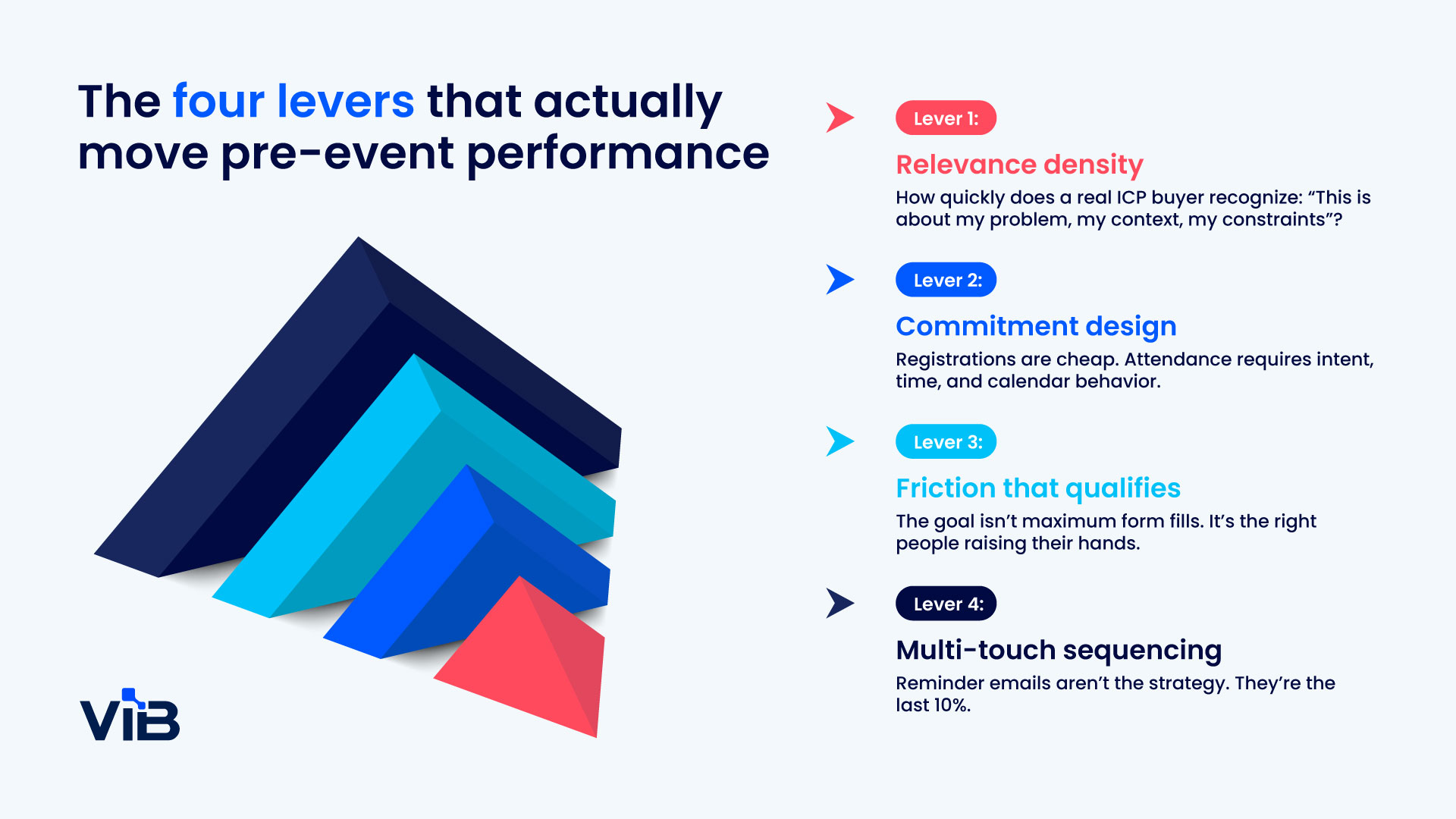
The four levers that actually move pre-event performance
Most webinar programs underperform because they over-index on channel volume and under-invest in four controllable levers.
Lever 1: Relevance density
How quickly does a real ICP buyer recognize: “This is about my problem, my context, my constraints”?
Your promotion should make the problem and use case concrete.
Lever 2: Commitment design
Registrations are cheap. Attendance requires intent, time, and calendar behavior.
Pre-event promotion that earns micro-commitments (calendar add, question submission, agenda selection) increases show-up rate and creates stronger engagement signals.
Lever 3: Friction that qualifies
The goal isn’t maximum form fills. It’s the right people raising their hands.
Strategic friction (role-based tracks, “who this is for,” or a single qualifying question) improves downstream routing and messaging without turning the form into a tax return.
Lever 4: Multi-touch sequencing (not reminder spam)
Reminder emails aren’t the strategy. They’re the last 10%.
The winning sequence builds a narrative over time: pain → stakes → approach → proof → practical takeaway → “see you there.”
12 actionable webinar promotion examples for pre-event marketing
Each example includes: what it is, when to use it, and copy or structure you can adapt.
1) The “problem-first” invite that disqualifies politely
Use when: your topic is broad, and you need a sharper ICP fit.
What to do: Lead with a symptom and a scenario, then explicitly say who should skip it.
Subject line examples: “If your SOC is drowning in false positives, this is for you” or “When renewals slip because usage is invisible.”
Body structure: 2–3 bullets describing the situation, then a one-line “Not for…” clause.
Why it works: It increases relevance density and builds trust fast. It also reduces low-fit registrations that inflate your list but weaken engagement.
2) The “3 takeaways” landing page hero (not a generic abstract)
Use when: you’re driving traffic from paid social, partners, or cold email.
What to do: Replace the vague webinar description with three specific outcomes.
Swipeable hero copy: “Join us to leave with: (1) a checklist to audit X in 30 minutes, (2) a decision framework for Y, (3) 5 questions to pressure-test Z with your team.”
Why it works: It aligns with how busy buyers decide. They’re scanning for usefulness, not your positioning.
3) The internal champion kit for account-based webinar promotion
Use when: you’re targeting named accounts and care about buying-group reach.
What to do: Send one email to your internal contact (or friendly stakeholder) with assets they can forward.
Include: a 2-sentence forward blurb, a calendar snippet, and two “send to” suggestions (e.g., Ops + Security, Finance + IT).
Forward blurb example: “Sharing this because it addresses the exact [constraint] we’ve been discussing. It’s practical and should help us pressure-test options.”
Why it works: Buyers trust internal referrals more than vendor promotion, and you get a healthier buying group mix in attendance.
4) The “choose your track” registration flow
Use when: your webinar serves two roles (e.g., IT + security, RevOps + marketing ops).
What to do: Add one required field: “Which track do you care about?” Then dynamically change the confirmation page and reminder copy.
- Track A: “Implementation and constraints”
- Track B: “Reporting and outcomes”
Why it works: It qualifies without interrogating, and it lets you tailor pre-event messaging so it feels personal instead of automated.
5) The “question-first” CTA to improve show-up rate
Use when: attendance is your issue, not registration volume.
What to do: Ask registrants to submit one question immediately after they register.
Confirmation page prompt: “What are you trying to decide in the next 90 days?”
Why it works: Question submission creates commitment. It also gives you language to mirror in reminders (“We’ll answer: ‘…’”).
6) The “proof in the reminder” email (not just date/time)
Use when: you have a credible data point, framework, or artifact to share.
What to do: In the T-minus-3-days email, include a preview image or a 3-step framework you’ll expand live.
Copy pattern: “Here’s the 5-line framework we’ll use. If you show up live, you’ll get the filled-in example for [use case].”
Why it works: It gives a rational reason to attend beyond politeness.
7) The “calendar hold” email for high-value segments
Use when: you’re promoting to a tight ICP and don’t want to oversell too early.
What to do: Send a short “save the slot” email 10–14 days out to only your best-fit segment.
Subject line: “Hold 30 minutes for a practical session on [job-to-be-done]”
Body: one sentence on who it’s for, one sentence on what they’ll leave with, then “Add to calendar.”
Why it works: it respects the audience and sets up a stronger invite later with higher open and click intent.
8) The partner swap that doesn’t feel like a list rental
Use when: you have a credible integration, ecosystem partner, or community relationship.
What to do: Run a co-branded landing page and let the partner send the invite in their voice, with their angle.
Key detail: Align on one shared pain and one shared artifact (template, scorecard, checklist). Make that the hook, not “Join our webinar.”
Why it works: Partner voice increases credibility and reduces the “vendor blast” feel, which can lift qualified registrations.
9) The “dark social” promo pack for your speakers
Use when: you have strong speakers but weak organic distribution.
What to do: Give each speaker a tiny kit: 3 LinkedIn post drafts, 2 short emails they can forward, and a one-line DM message.
- Post 1: problem and stakes
- Post 2: “what we’ll show” + teaser artifact
- Post 3: last-call + question prompt
Why it works: Most speakers will promote if you remove the effort and the awkwardness.
10) The “one-slide ad” for paid LinkedIn that qualifies in the creative
Use when: you’re spending on paid and want fewer wasted clicks.
What to do: Put the qualifiers in the ad creative, not buried on the landing page.
Creative text example: “For RevOps leaders fixing forecast drift in multi-product motions. Practical session + worksheet.”
Why it works: It filters earlier, improves lead quality, and can reduce cost per qualified registration even if total registrations drop.
11) The “reminder ladder” that matches real inbox behavior
Use when: you want a reliable plan you can standardize.
What to do: Run a structured sequence that escalates value, not urgency.
- T-minus 10 days: the core invite with clear takeaways
- T-minus 5 days: “what we’ll cover” agenda + who it’s for
- T-minus 2 days: proof preview (framework, slide, or short clip)
- Day of: “starting soon” with join link and the #1 takeaway
Why it works: It creates multiple entry points for different buyer motivations. It also avoids four near-identical reminders that teach people to ignore you.
12) The “48-hour replay sprint”
Use when: you know a chunk of your audience won’t attend live.
What to do: Treat the replay like a mini-launch with a tight window and clear packaging.
- 2 hours after: “Replay is live + here’s the artifact”
- 24 hours after: “Top 3 questions we answered”
- 48 hours after: “Short clip + jump to the section you care about”
Why it works: ON24’s benchmark reporting shows nearly half of webinar viewers prefer on-demand formats. Build your promotion plan accordingly.
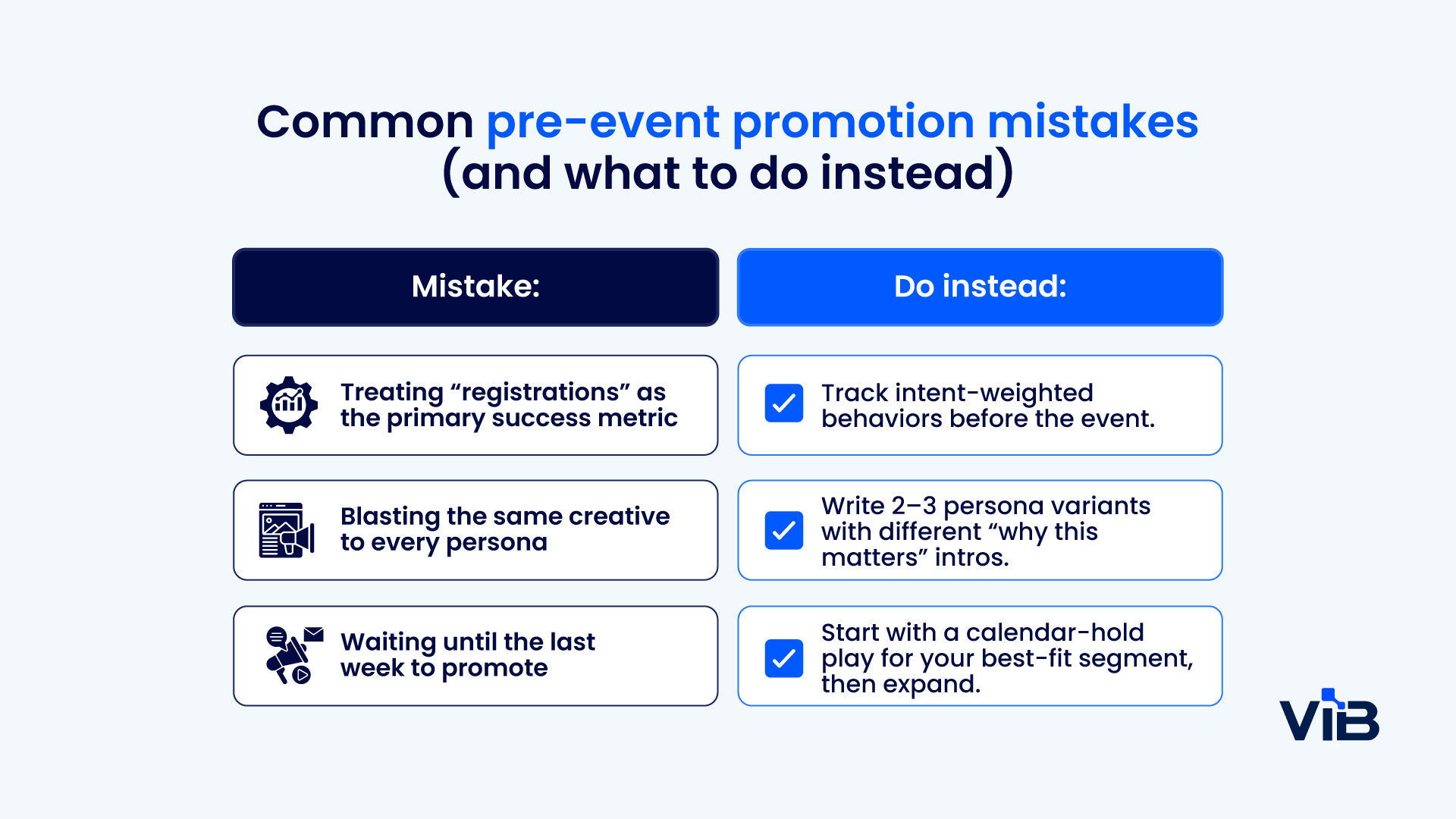
Common pre-event promotion mistakes (and what to do instead)
Mistake: Treating “registrations” as the primary success metric
Do instead: Track intent-weighted behaviors before the event: repeat site visits to the webinar page, agenda clicks, calendar adds, question submissions, and “attending live” confirmation clicks.
Mistake: Blasting the same creative to every persona
Do instead: Write 2–3 persona variants with different “why this matters” intros. Keep the content consistent, and personalize the stakes.
Mistake: Waiting until the last week to promote
Do instead: Start with a calendar-hold play for your best-fit segment, then expand. Your strongest prospects often need more time, not more urgency.
Where ViB fits when you want more consistent reach and cleaner engagement signals
If your strategy is solid but distribution is inconsistent, you usually have two problems: reaching the right audience reliably, and capturing engagement in a way your team can actually use.
This is where ViB can help.
Use ViB Emails to amplify pre-event promotion to a targeted audience
If you want a practical way to extend reach beyond your house list, ViB Emails can distribute your webinar invite to targeted segments in the ViB community.
That’s most useful when you already have strong messaging and landing page assets, like the “3 takeaways” hero and the “choose your track” flow.
Use ViB Webinars for end-to-end webinar management (live or simulated live)
If your bottleneck is execution, ViB Webinars is an end-to-end service for producing live or simulated live webinars, including the option to repurpose existing recordings for a live-style event.
This gives you a repeatable production motion, which makes it easier to run consistent multi-touch sequences and replay sprints.
Conclusion: Build promotion like a sequence, not a blast
The best webinar promotion examples don’t look like louder marketing. They look like clearer usefulness, smarter qualification, and better commitment design.
If you take one thing from this guide, make it this: your pre-event plan should create multiple reasons to attend, not multiple reminders that it exists.
Do that well, and the outcome is more than attendance. You’ll see cleaner engagement patterns, better ICP alignment, and follow-up that feels earned.