 Skip to content


In most SaaS categories, the old demand generation playbook was simple: drive traffic, gate an asset, score the lead, and let SDRs sort it out.
But that model is breaking down as buyer behavior shifts toward self-serve research and higher skepticism.
Gartner found that 61% of B2B buyers prefer a rep-free buying experience, and 73% actively avoid suppliers that send irrelevant outreach.
That combination pushes demand gen teams into a tighter box. You still need volume, but you also need fit, timing, and signals that show real engagement earlier in the journey.
“Better” B2B SaaS demand generation in 2026 usually means three things:
- You know which accounts are engaging, not just which individuals converted.
- You can separate light curiosity from active evaluation using multiple signals.
- You can create consistent engagement without relying on constant net-new spend.
This article breaks down the strategies that experienced B2B SaaS marketers are using to build demand, using these pillars.
Viable email programs for modern B2B SaaS demand generation
Email still works in B2B SaaS demand generation, but only when it’s designed like a product experience, not a broadcast channel.
If your email program is “monthly newsletter + launch emails,” it won’t create enough signal density to be useful. And it won’t create enough trust to earn replies when it matters.
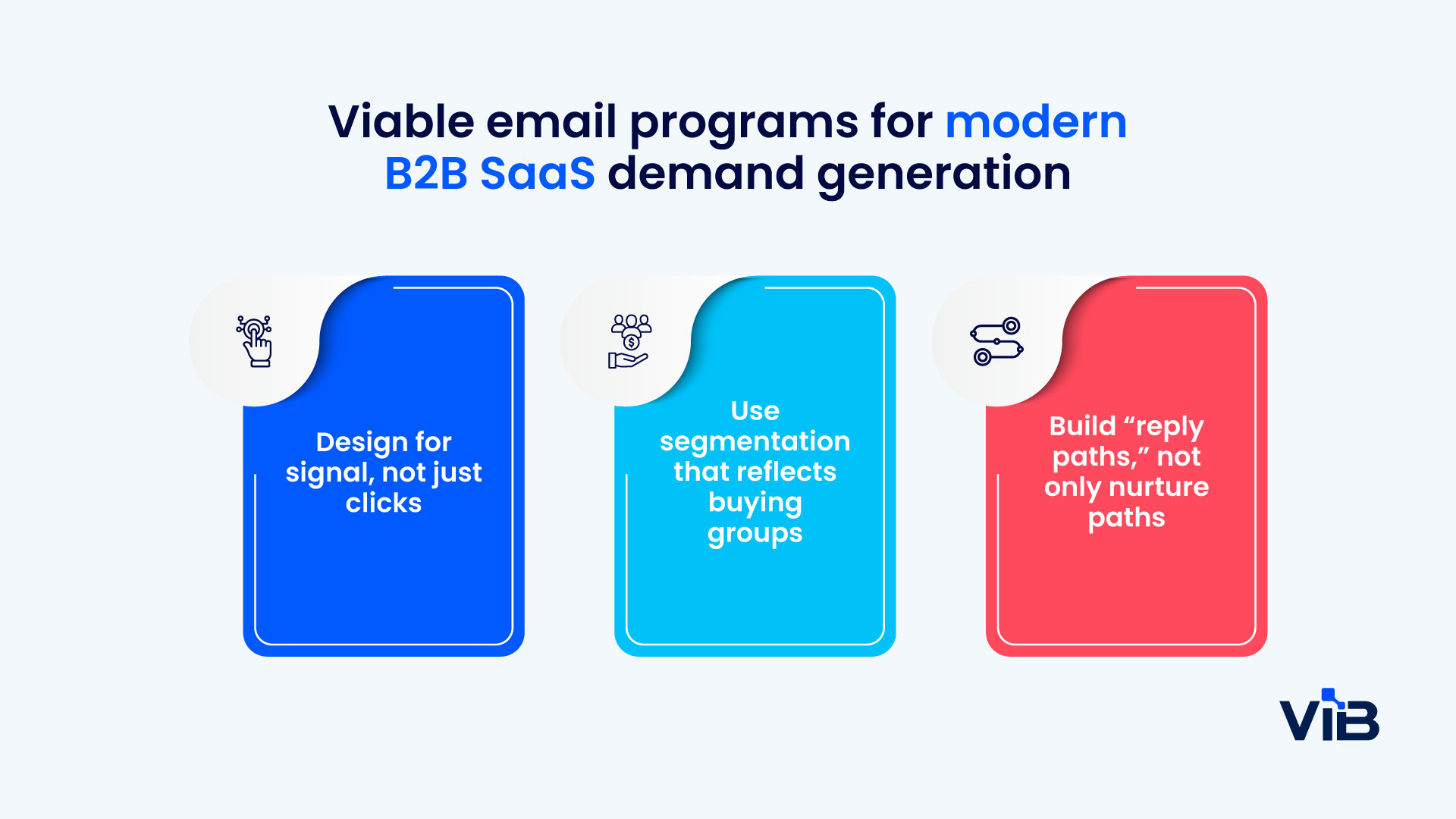
Design for signal, not just clicks
Clicks are fine, but they’re an incomplete signal in 2026. Many buyers read, forward, and discuss without clicking.
What you want is a pattern of engagement that helps you answer two questions:
- Is this account in our ICP, based on role mix and topic interest?
- Is this account moving from “learning” to “comparing” behavior?
Practical move: Structure your email streams around decision-stage themes, not content types. For example: “How teams fix X,” “What to watch out for,” “How teams evaluate options,” and “How teams justify the decision internally.”
That framing lets you tag engagement by stage and route people into webinar sessions that match their likely job-to-be-done.
Use segmentation that reflects buying groups
One-person segmentation is the default. But buying group segmentation is a much better way to go.
In practice, that means you don’t only segment by persona. You segment by persona + buying motion + risk concerns.
A few examples that tend to outperform generic persona tracks:
- “Security-involved” track: content and webinars that answer data handling, access controls, audit trails, and vendor risk questions.
- “Ops-led” track: rollout, integrations, workflow impact, and adoption measurement.
- “Executive sponsor” track: business outcomes, cost of inaction, and change management.
Build “reply paths,” not only nurture paths
For experienced SaaS marketers, the biggest email unlock is giving the buyer a reason to respond.
Try adding one consistent “reply path” per theme, such as:
- “If you’re evaluating this quarter, what’s the main blocker?”
- “Want the short checklist we use to spot misfit use cases?”
- “Should we run a version of this session for your team?”
Replies are a strong qualitative signal. They also help you identify who’s coordinating internally.
Webinars that generate high-quality engagement (not one-and-done attendees)
Webinars work when they feel like a working session, not a content dump.
Choose formats that buyers actually show up for
The “single speaker + slides + Q&A” format is fine, but it’s rarely the best option for experienced buyers.
Formats that often drive stronger engagement signals include:
- Implementation teardown: how a team operationalizes a workflow, including what broke.
- Evaluation panel: how buyers compare categories and what disqualifies vendors.
- Role-based breakout: separate tracks for ops, security, and business owners.
- “Bring your scenario” clinic: structured Q&A with pre-submitted context.
These formats generate better downstream signals because the questions are more specific. They also surface buying group involvement earlier.
Instrument the webinar for intent, not vanity
If all you capture is registration and attendance, you’re missing the best data.
Capture and operationalize these signals instead:
- Which topic got them to register (and which didn’t)
- Which questions they asked (and how “late-stage” those questions were)
- Whether multiple roles from the same account attended
- Whether they engaged with follow-up assets tied to evaluation tasks
How to use intent signals without fooling yourself
Intent data is powerful, but it’s easy to misuse.
The risk is treating any intent spike as a sign of readiness. The better approach is to use intent as prioritization and pattern detection, then validate with engagement.
Start with a clear definition of “intent” for your category
“Intent” should mean the account is showing behavior consistent with active evaluation, not just category research.
Common evaluation patterns include:
- Repeated engagement on competitor and comparison themes
- Buying group behavior (more roles engaging in a short window)
- Engagement that shifts from “how it works” to “how to roll it out”
- Signals that align with known triggers (new leader, initiative, tooling change)
Gartner’s buyer research reinforces why this matters: buyers prefer self-service for general learning, but they seek seller input when they need contextual fit for their company.
Your job in demand gen is to detect when the account is moving into that “fit and context” zone.
Use intent to reduce waste across paid and outbound
Intent is most valuable when it changes your behavior.
Three high-leverage uses in B2B SaaS demand generation:
- Paid suppression: Reduce spend on accounts showing no relevant activity, even if they match firmographics.
- Sales prioritization: Route accounts with both intent + engagement into faster follow-up motions.
- Content routing: Match email and webinar invitations to the topics the account is actively consuming.
The key is combining intent with your first-party engagement data. Either one alone can be misleading.
Putting it together: A practical operating model for B2B SaaS demand generation
Here’s a model that works well for experienced teams because it’s modular. It doesn’t require a full rebuild of your stack.
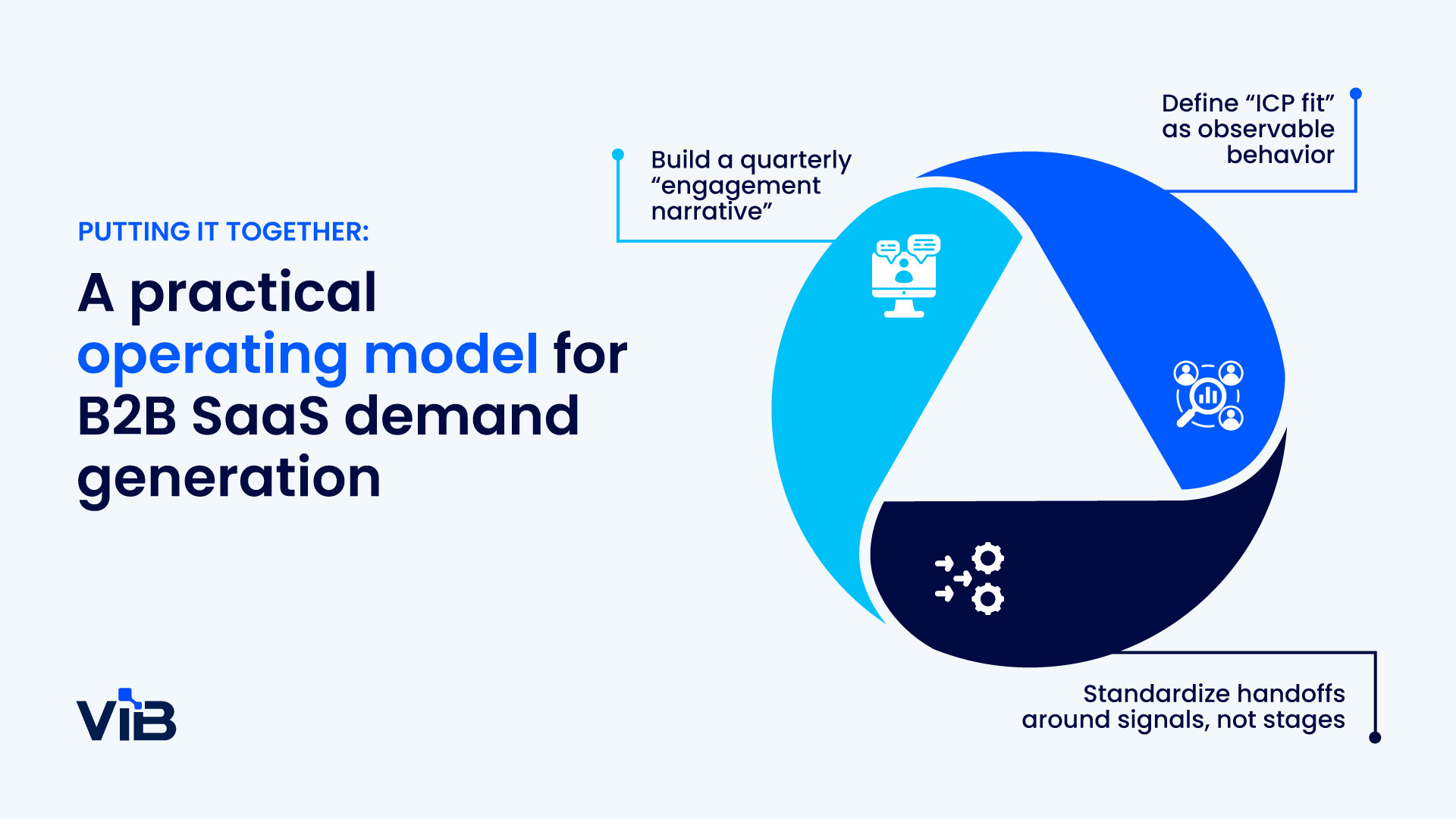
1) Build a quarterly “engagement narrative”
Pick one buyer problem and one wedge angle. Then build:
- a tight email theme with 4–6 sends,
- a webinar session that goes deeper,
- and a follow-up asset that supports evaluation tasks.
The goal is consistent, recognizable value. Not constant novelty.
2) Define “ICP fit” as observable behavior
Firmographics are necessary, but they’re not sufficient.
Add behavioral qualifiers such as:
- role mix engaging (not just one champion),
- repeat engagement across two themes,
- and question depth during webinars (implementation and risk questions matter).
This keeps your team focused on accounts that look like real opportunities, not just good fits on paper.
3) Standardize handoffs around signals, not stages
Stages can be fuzzy early. Signals are concrete.
Agree internally on a small set of triggers that warrant a different motion. For example: “two attendees from the same account plus a high-intent question,” or “three-week spike in relevant intent plus repeat email engagement.”
This kind of signal-based alignment matters because irrelevant outreach is actively harmful.
Where ViB fits: Using emails and webinars to create clearer engagement signals
If your strategy is sound but execution is uneven, this is where a focused partner can help.
ViB supports B2B SaaS demand generation earlier in the buyer journey by strengthening engagement and generating clearer account-level signals.
ViB Emails: Consistent, segmented engagement that’s built for signal quality
ViB Emails can support the “always-on” layer of your program, especially when you need reliable reach into a defined audience and want to learn which themes and roles are engaging.
This is most useful when your internal team has strong messaging but needs more distribution consistency, better segmentation, or tighter performance feedback loops.
ViB Webinars: Structured engagement you can measure and operationalize
ViB Webinars fits best when you want a repeatable webinar engine that produces practical engagement signals, like role mix, question depth, and topic interest across target accounts.
Used well, webinars also improve your email performance. They give you a real reason to reach out, follow up, and segment based on what people actually did.
Campaign engagement: Signals that help you focus on the right accounts
When you’re already running campaigns and outbound, use engagement from emails, webinars, content, and other touchpoints to sharpen account prioritization.
The practical win is reducing wasted touches and aligning follow-up to what the account is showing interest in now. That tends to improve buyer experience and protects your brand from “spray and pray” outreach.
Conclusion: The next evolution of B2B SaaS demand generation is signal-driven
B2B SaaS demand generation is no longer about capturing interest. It’s about building durable engagement and recognizing when an account is moving from learning to evaluating.
Email gives you frequency and segmentation. Webinars give you depth and buying-group insight. Together, their engagement signals help you prioritize and time your next best action.
When those channels work as one system, you don’t need to guess. You can focus on ICP fit, create better buyer experiences, and build a demand engine that holds up under scrutiny.


