 Skip to content


SaaS businesses thrive on well-targeted, data-driven marketing. However, over 50% of B2B marketers struggle to meet their marketing goals. What’s more, average SaaS user churn rates hover between 5% and 7% annually.
A strong B2B SaaS marketing strategy is important to drive demand, engage prospects, and increase retention. This blog will explore practical steps to create a winning plan for SaaS companies.
What makes B2B SaaS marketing unique?
SaaS companies operate differently from traditional businesses. Success depends on recurring revenue, rapid scaling, and solving customer pain points.
A typical SaaS sales cycle involves multiple touchpoints, making personalized marketing essential. Unlike other industries, SaaS demands:
- Churn management to retain customers.
- Education-focused content to guide prospects through technical decisions.
- Subscription models that rely on long-term relationships instead of one-time sales.
To stay ahead, you need strategies that focus on customer lifetime value (CLV), acquisition costs (CAC), and scalable growth.
Core elements of a B2B SaaS marketing strategy
A successful B2B SaaS marketing strategy isn’t built overnight. It requires a clear focus, smart tactics, and continuous optimization. Let’s break down what it takes to craft a strategy that delivers measurable results 💰.
1. Define clear goals
Start by setting measurable objectives. Use SMART goals (specific, measurable, achievable, relevant, time-bound) to ensure accountability. Common goals include:
- Boosting trial sign-ups (example: by 20%).
- Reducing churn (example: by 10% in six months).
- Improving lead conversion rates.
2. Build an omnichannel presence
Stay present across multiple platforms to reach decision-makers effectively. Here’s how to build a strong omnichannel presence:
- Leverage LinkedIn: As the go-to platform for B2B networking, LinkedIn is invaluable for targeting SaaS buyers. Use sponsored posts, InMail campaigns, and thought leadership articles to engage your audience.
- Content-driven initiatives: Publish ebooks, case studies, and blog posts to showcase expertise.
- Webinars and guides: Webinars allow you to showcase your expertise while creating direct interaction with prospects. Offer live Q&A sessions and product demonstrations to engage attendees in meaningful ways.
- Automate lead scoring: Use tools to rank leads based on their buying readiness. Stats show that companies using marketing automation see a 10% or greater increase in sales productivity.
3. Create value-driven messaging
Highlight your unique value proposition (UVP) to stand out in the crowded SaaS market. Here’s how to craft value-driven messaging:
- Speak to pain points: Address your audience’s challenges directly. Show how your solution solves problems like automating tasks or saving time.
- Customize for personas: Tailor your message to decision-makers, end-users, or financial stakeholders, focusing on each group’s specific needs.
- Simplify the complex: Use clear, jargon-free language to emphasize outcomes, making technical concepts easy to understand.
4. Leverage SaaS demand generation
SaaS demand generation drives awareness and builds interest. Unlike lead generation, it focuses on the top of the funnel.
To master this:
- Use LinkedIn Ads for hyper-targeted campaigns.
- Use tools that capture buyer intent signals, such as website activity and content engagement, to identify warm leads and tailor outreach efforts.
- Offer free trials or freemium models to attract potential customers.
- Create nurture campaigns that educate prospects over time.
Companies that prioritize demand generation see stronger pipelines and sustainable growth. It’s worth investing in this strategy.

5. Optimize content marketing for SaaS growth
Great content fuels your marketing engine. SaaS marketers need content that clicks with both technical and non-technical buyers.
- SEO-optimized blogs: Rank higher on search engines by targeting relevant keywords.
- Video tutorials: Show prospects how your solution works.
- Case studies: Prove your value with real-world success stories.
Over 70% of B2B marketers say their success is thanks to a solid content plan.
6. Lifecycle marketing
A customer-centric SaaS marketing strategy must address the entire customer lifecycle to maximize retention and advocacy. Here’s how to optimize for each stage:
- Awareness stage: Use SEO-optimized content like blogs and infographics to attract new leads. Topics should focus on broad industry challenges and solutions that highlight your brand.
- Consideration stage: Nurture leads with targeted email campaigns, case studies, and free trials. Demonstrating real-world applications of your SaaS product builds credibility and trust.
- Retention and advocacy stage: Maintain engagement with existing customers through loyalty programs, educational content, and personalized outreach. Satisfied customers often become advocates, boosting organic referrals.
A well-rounded lifecycle marketing strategy ensures your SaaS business remains competitive, drives growth, and builds long-term loyalty.
7. Measure ROI effectively
Track performance to refine your strategy. Use metrics like:
- CAC (customer acquisition cost): How much you spend to gain a customer.
- CLV (customer lifetime value): Revenue generated from a single customer over their lifecycle.
- Conversion rates: Percentage of leads that turn into paying customers.
Tools like Google Analytics and HubSpot simplify ROI tracking. Regularly review metrics to ensure your efforts deliver results.
👑 ViB’s community-centric approach
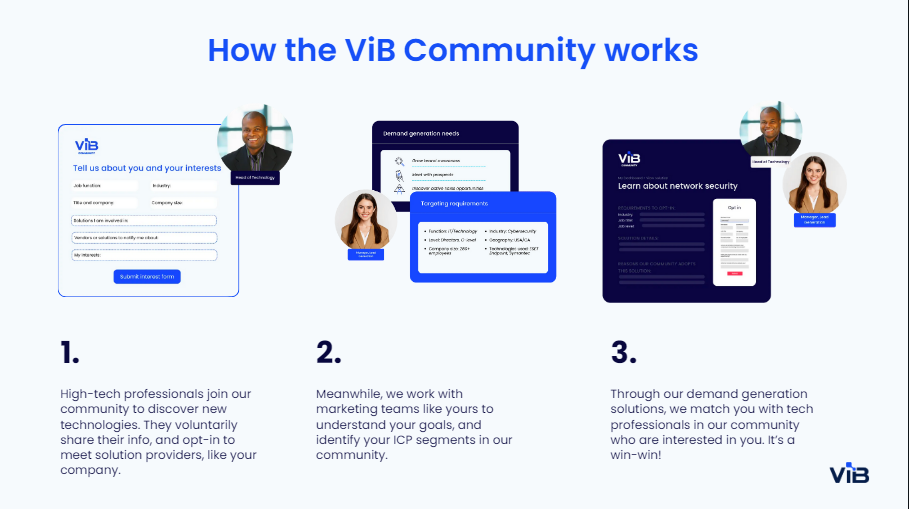
ViB’s demand generation strategies stand out thanks to our community-based model
- Zero and first-party data: Information comes directly from prospects through their interactions with the ViB Community.
- Self-qualified contacts: Prospects are genuinely interested, making them easier to convert.
By focusing on quality leads and accurate data, ViB simplifies your path to growth.
Ready to elevate your SaaS marketing?
Partner with ViB to tap into actionable insights, high-quality leads, and a scalable strategy.


