 Skip to content


If you’re responsible for B2B SaaS leads, you’re probably feeling the squeeze from both sides.
Executives want “more leads” while sales wants “better leads.” Meanwhile, your paid channels keep getting more expensive, and buyers are spending just a small slice of their journey talking to vendors.
So the real job is earlier than most dashboards reflect: generate engagement that proves ICP fit, then capture signals that show real interest (not just clicks). That’s where community-sourced leads, plus zero- and first-party data, start to matter.
In this article, we’ll explore why traditional B2B lead generation isn’t cutting it, how to leverage intent data to find higher-quality leads, and a practical framework to improve your outputs.
What “good” B2B SaaS leads look like in 2026 (and why most teams miss it)
Experienced marketers don’t confuse volume with quality. But it’s still easy to drift into proxy metrics because they’re simple to measure.
A “good” B2B SaaS lead is less about the form fill and more about the combination of fit + verified engagement + timing signals.
Fit: The lead matches your ICP, not just your targeting
Fit is not “IT manager at 1,000+ employees.” Fit is closer to: role, environment, constraints, and initiative type. The more complex your SaaS, the more fit depends on situational context.
This is why it’s so hard to rely solely on third-party enrichment. You can buy firmographics, but you can’t buy “we’re actively trying to replace vendor X this quarter.”
Engagement: The lead did something that indicated real attention
Attention is a scarce resource. Many B2B sites convert only ~2–3% of visitors into leads, so even small improvements in engagement can change outcomes.
For higher-consideration SaaS, real engagement usually includes things like attending a live webinar, consuming multiple assets, or answering qualification questions with intent.
Signals: you can act earlier than the demo request
Intent data exists because so much of the buying journey happens anonymously. In many orgs, by the time an account fills out a contact form, they’ve already narrowed options and requirements.
So your lead strategy has to do two things at once:
- Create enough value that the right people will raise their hand
- Capture enough signal that you can route and prioritize without waiting for late-stage actions

Why traditional lead gen breaks down for B2B SaaS (even when the spend is “working”)
It’s not that the classic playbook is wrong. It’s that it’s incomplete for modern buying behavior.
Problem 1: You’re optimizing for response, not relevance
When a program is under pressure, teams often bias toward offers that “convert.” That can mean lighter assets, broader messaging, and lower-friction forms.
The downside: you get B2B SaaS leads that look active, but don’t map to real initiatives. Sales sees it quickly, and you end up in an endless scoring debate.
Problem 2: Your data is passive when you need it to be explicit
Clickstream data is useful, but it’s inferred. For many decisions, you need explicit inputs.
“Zero-party data” is information a customer intentionally and proactively shares with a brand (preferences, intentions, context).
That kind of data is powerful because it reduces guesswork. And it can be collected without pushing people into a “talk to sales” moment too early.
Problem 3: You’re not using off-site research
First-party signals are inherently limited to what happens on your properties. That’s why teams blend first-, second-, and third-party intent approaches.
Gartner’s research highlights that buyers spend little time on a seller’s website, but hours gathering information elsewhere.
In practice, this means that if your B2B SaaS leads strategy doesn’t include a plan for community, partners, and off-site engagement, you’ll always be late to the party.
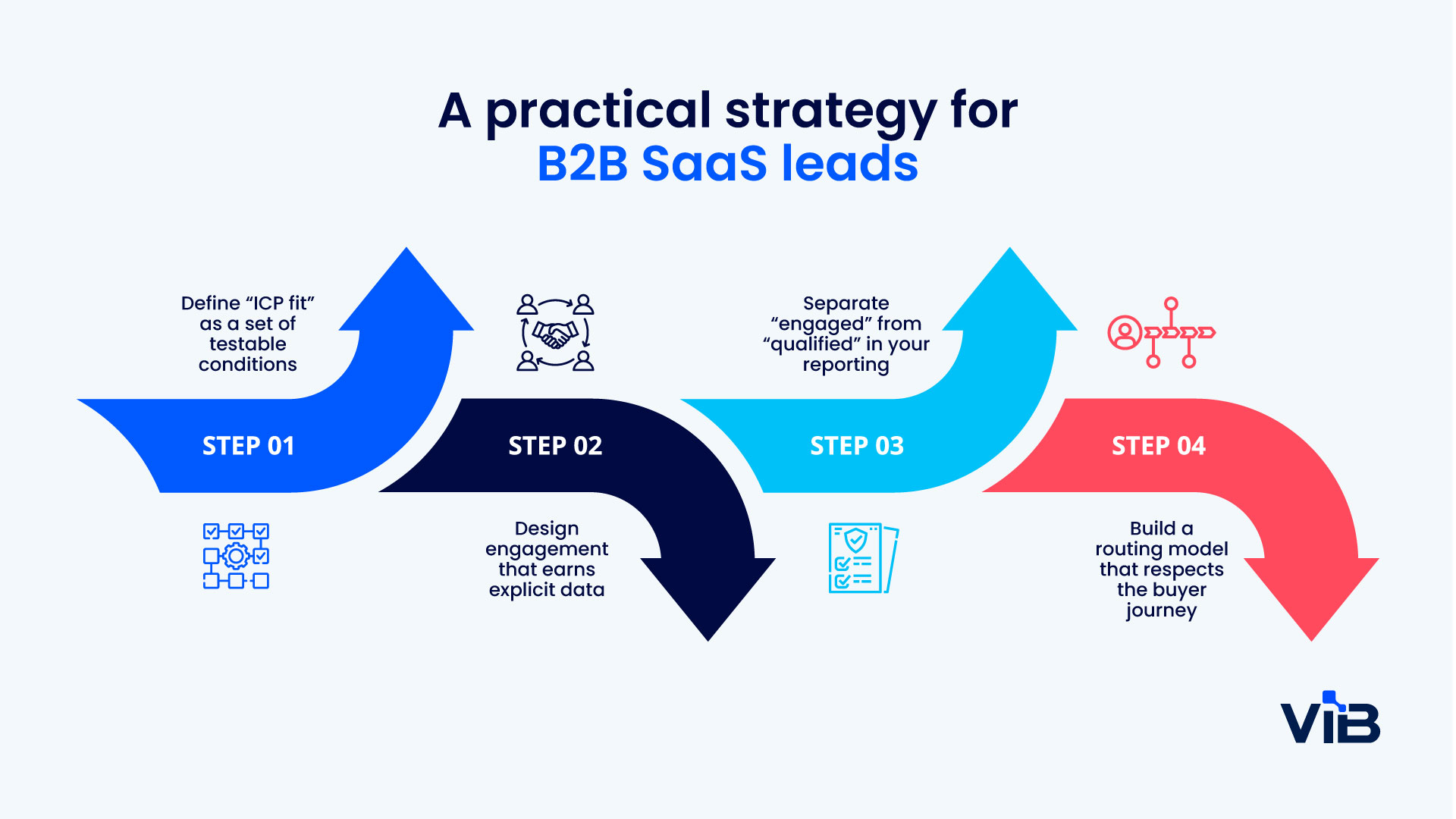
A practical strategy for B2B SaaS leads
Here’s a framing that tends to work for experienced SaaS teams: stop thinking about “lead capture” and focus instead on “signal capture.”
Signal capture is the system that turns early engagement into prioritized, ICP-fit actions for sales and lifecycle.
Step 1: Define “ICP fit” as a set of testable conditions
You likely already have firmographic and role filters. The unlock is adding environment and initiative qualifiers that you can actually collect.
Examples (pick 2–4 that matter for your category):
- Current system/tooling in place
- Primary driver (cost, risk, consolidation, speed)
- Project horizon (researching vs planning vs active selection)
- Non-negotiable constraints (compliance, deployment model, integration)
Those answers turn “lead” into “context.” Context makes outreach feel relevant rather than automated.
Step 2: Design engagement that earns explicit data (without forcing a sales motion)
If your only explicit data moment is a demo request, you’ll miss most of the journey.
Instead, use mid-funnel experiences where it’s normal to exchange some information for value. Webinars, benchmark reports, comparison guides, and “ask an expert” formats tend to work because they match how buyers prefer to learn. 👍
Step 3: Separate “engaged” from “qualified” in your reporting
This is a small analytics change that prevents big internal fights.
Create two layers:
- Engaged leads: people who opted in and consumed something substantial
- Qualified leads: engaged + meets ICP conditions + shows timing signal (explicit or inferred)
This makes it easier to run top-to-mid programs without pretending every engagement equals immediate readiness.
Step 4: Build a routing model that respects the buyer journey
If you send every engaged lead to sales, you’ll train sales to ignore marketing leads.
A better model is:
- Route “high fit + explicit project signals” to immediate outreach.
- Route “high fit + early research” into a personalized nurture with periodic check-ins.
- Route “unclear fit” into lightweight education until you collect more qualifiers.
It’s more respectful, and it usually improves conversion downstream because the first human touch is more relevant. ✅
Where community-sourced leads change the game (and where they don’t)
“Community-sourced” doesn’t just mean a big audience. It means you’re reaching people who have already opted into learning, sharing preferences, and participating in professional programs.
That matters for B2B SaaS leads because it shifts you from rented attention to earned participation.
What community sourcing is great for
Three outcomes tend to show up consistently:
- Faster signal generation: you can get explicit inputs (what they’re researching, what they care about) earlier.
- Cleaner ICP targeting: role and seniority filters become more reliable when members self-report and update profiles.
- More usable segmentation: you can run different offers for “researching” vs “evaluating,” without rewriting your whole engine.
What it’s not great for
Community-based programs still won’t fix:
- A fuzzy ICP definition
- A weak follow-up motion
- Messaging that doesn’t differentiate
- Offers that don’t match how your buyers learn
In other words, community improves your inputs, but it doesn’t replace strategy.
A realistic measurement framework for B2B SaaS leads (without overpromising outcomes)
If you’re operating earlier in the journey, your success metrics should reflect that. Otherwise, every program gets judged by late-stage expectations it can’t control.
Three metrics that map to early-journey performance
- ICP match rate: % of leads that meet your fit conditions.
- Signal depth: how many meaningful qualifiers you captured (not just form fields).
- Time-to-first-signal: how quickly you can identify “researching” accounts after launch.
This is also where benchmarks help you avoid unrealistic targets.
Use intent as prioritization, not a promise
Intent data is best treated as a prioritization layer. It’s about identifying interest and journey stage, not guaranteeing an outcome.
That framing keeps you honest internally, and it keeps your programs aligned with how buyers actually buy.
How ViB supports earlier-journey engagement and signal generation
At this point, the pattern should be clear: the most reliable B2B SaaS leads come from combining distribution, engagement, and explicit data capture.
If you want a practical way to run the integrated approach above through a single partner, ViB’s solutions are built around sourcing leads from its opt-in community and capturing zero- and first-party data directly from participants.
Here’s how the pieces connect when your goal is higher-quality B2B SaaS leads, not just more names:
- ViB Emails: amplifies your existing email to targeted community members, helping you reach net-new ICP accounts and capture early engagement signals.
- ViB Syndication: promotes your existing assets to the community to drive opted-in downloads and expand reach beyond your own site.
- ViB Webinars: supports a webinar program (live or simulated) that drives high-attention engagement and richer first-party intent.
- ViB Appointments: facilitates qualified 1:1 meetings based on defined ICP and qualification criteria, helping teams move from engagement to relevant sales conversations.
Conclusion: Better B2B SaaS leads come from better signals
The fastest way to improve B2B SaaS leads isn’t a new channel. It’s a more honest system.
Define ICP fit as conditions you can verify. Design engagement that earns explicit inputs. Treat intent as prioritization. Then route leads in a way that matches where buyers actually are, not where your dashboard wishes they were.
When you do that, lead gen stops being a volume game. It becomes an engine for consistent, explainable, and repeatable signal generation.


