

Email marketing for tech companies has become much harder than simply building a list and sending campaigns.
Technology buyers are overwhelmed with outreach, especially in crowded markets like SaaS, cybersecurity, cloud infrastructure, AI, and enterprise software. Many campaigns still generate opens and clicks, but very few create meaningful pipeline because the messaging feels generic, overly promotional, or disconnected from what buyers actually care about.
That’s why the strongest email marketing strategies for tech companies are becoming more targeted, more contextual, and much more audience-focused.
The goal is no longer just sending more emails. The goal is creating engagement from the right buyers at the right time with messaging that feels relevant to the challenges they are already navigating internally.
Why email marketing for tech companies is getting more competitive
Most enterprise buyers receive constant outreach from vendors promising better efficiency, more automation, increased visibility, and AI-powered workflows. After a while, much of it starts sounding interchangeable.
Technology buyers evaluate credibility quickly, especially when the messaging feels disconnected from their actual environment or operational priorities.
Many tech companies still rely heavily on broad outbound campaigns that target large audiences with generalized messaging. That usually creates weak engagement because buyers can immediately tell when a campaign was built for scale instead of relevance.
A campaign targeting infrastructure leaders, for example, should sound very different from one targeting security operations teams or compliance-focused healthcare organizations. The strongest campaigns recognize those differences early instead of grouping all technology buyers into the same messaging framework.
Generic campaigns create weak downstream pipeline
When campaigns are too broad, the problems usually extend far beyond low click-through rates.
Sales teams often end up with:
- Poorly aligned leads
- Weak meeting quality
- Low conversion rates
- Long nurture cycles with little engagement
The strongest email marketing for tech companies focuses less on raw campaign activity and more on whether the engagement is actually connected to potential buying intent.
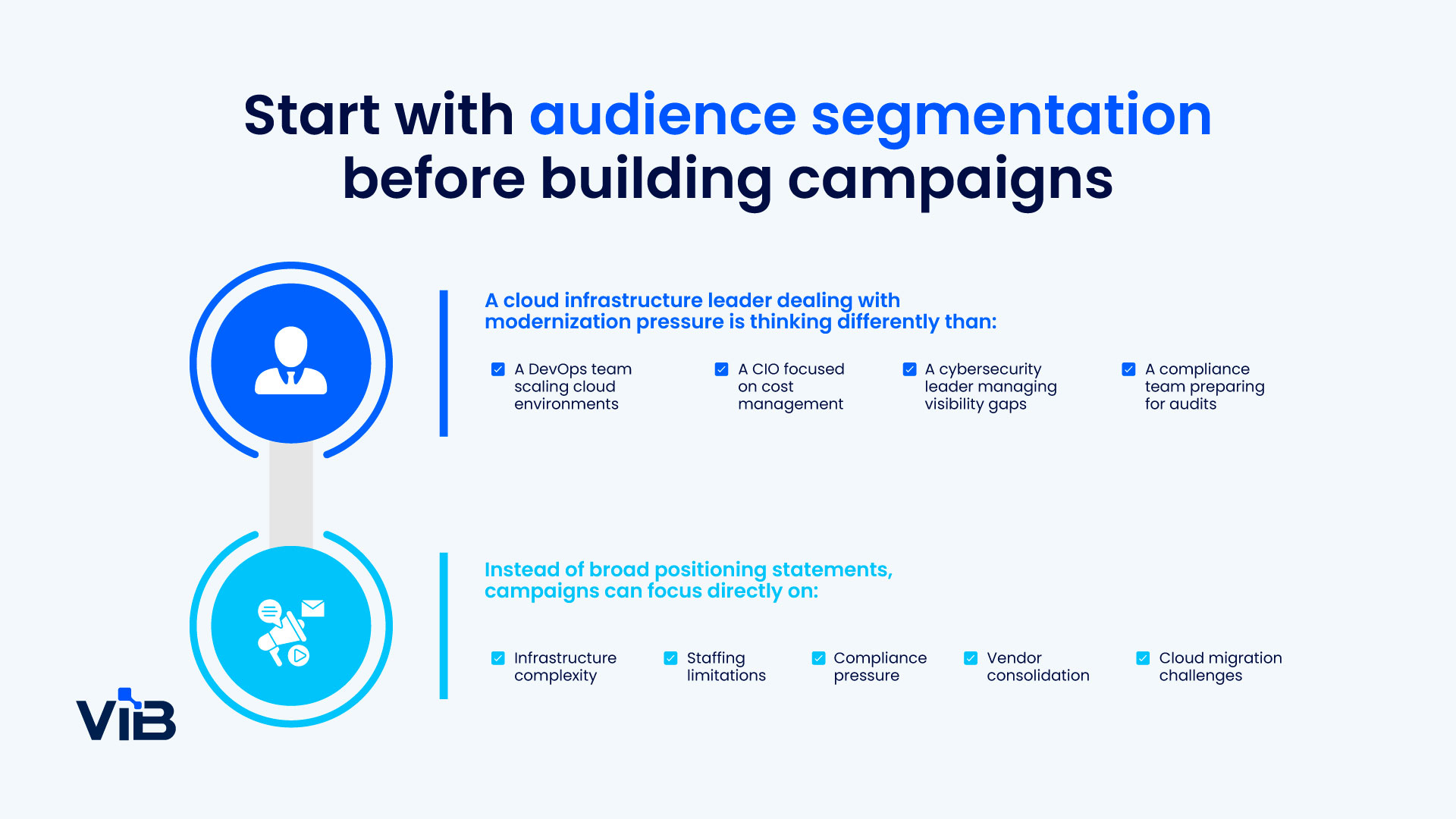
Start with audience segmentation before building campaigns
Many marketers think about segmentation after the campaign is already written.
That approach usually weakens performance because strong segmentation directly shapes the messaging strategy itself.
A cloud infrastructure leader dealing with modernization pressure is thinking differently than:
- A DevOps team scaling cloud environments
- A CIO focused on cost management
- A cybersecurity leader managing visibility gaps
- A compliance team preparing for audits
The stronger the audience segmentation becomes, the more specific and useful the messaging can become.
Better segmentation improves message quality naturally
When marketers know exactly who the campaign is targeting, the writing becomes much more operationally relevant.
Instead of broad positioning statements, campaigns can focus directly on:
- Infrastructure complexity
- Staffing limitations
- Compliance pressure
- Vendor consolidation
- Cloud migration challenges
That specificity usually improves both engagement quality and downstream pipeline relevance because buyers feel like the message actually understands their environment.
Build campaigns around business problems, not product features
One of the biggest mistakes in email marketing for tech companies is introducing product messaging too early.
Enterprise buyers are generally more interested in solving operational problems than reading feature-heavy emails about another platform.
A weak campaign might say:
“AI-powered observability platform for enterprise teams.”
A stronger campaign might say:
“How infrastructure teams are reducing operational blind spots during cloud expansion.”
The second example feels more connected to an active business challenge. That difference matters because enterprise buyers are constantly evaluating whether a vendor understands the operational realities they are dealing with internally.
Educational positioning performs better earlier in the funnel
Most enterprise buyers are not ready for a sales conversation during the first interaction.
That’s why educational offers often outperform aggressive demo CTAs earlier in the buying journey.
Research reports, benchmark studies, webinars, operational guides, and trend analysis typically create stronger engagement because they provide immediate value without forcing buyers into a decision too quickly.
Educational content also creates stronger intent signals. Someone engaging with cloud infrastructure benchmark content is showing a very different level of interest than someone casually opening a generic promotional email.
Create nurture campaigns that feel connected
Many nurture sequences fail because every email feels disconnected from the previous one.
The strongest nurture strategies create continuity so buyers move naturally through the conversation over time instead of feeling like they are receiving unrelated campaigns every few days.
For example, a campaign may begin with an industry benchmark report, transition into a webinar tied to the same topic, then follow with operational guidance content before introducing a conversation opportunity.
Each step builds on previous engagement instead of resetting the conversation repeatedly.
Timing matters more than frequency
Some companies assume sending more emails automatically improves performance.
In B2B technology markets, relevance and timing matter far more than volume. A well-timed campaign connected to active buyer interest will usually outperform a high-frequency sequence with weak contextual relevance.
This is one reason many tech marketers increasingly rely on signals like webinar engagement, content consumption behavior, technographic changes, and ABM activity to guide campaign timing.
The goal is not simply increasing email activity. The goal is engaging buyers while they are actively researching related priorities.
Align email with the rest of your demand generation strategy
The strongest email marketing for tech companies rarely operates independently.
Enterprise buyers typically interact with multiple trust signals before entering active sales conversations. Email works best when it supports a broader engagement strategy that also includes webinars, LinkedIn campaigns, retargeting, research distribution, and content syndication.
A buyer who recently downloaded cloud security research should receive follow-up messaging tied to that topic instead of completely unrelated outreach.
That continuity improves buyer trust and campaign relevance because the conversation feels connected instead of fragmented.
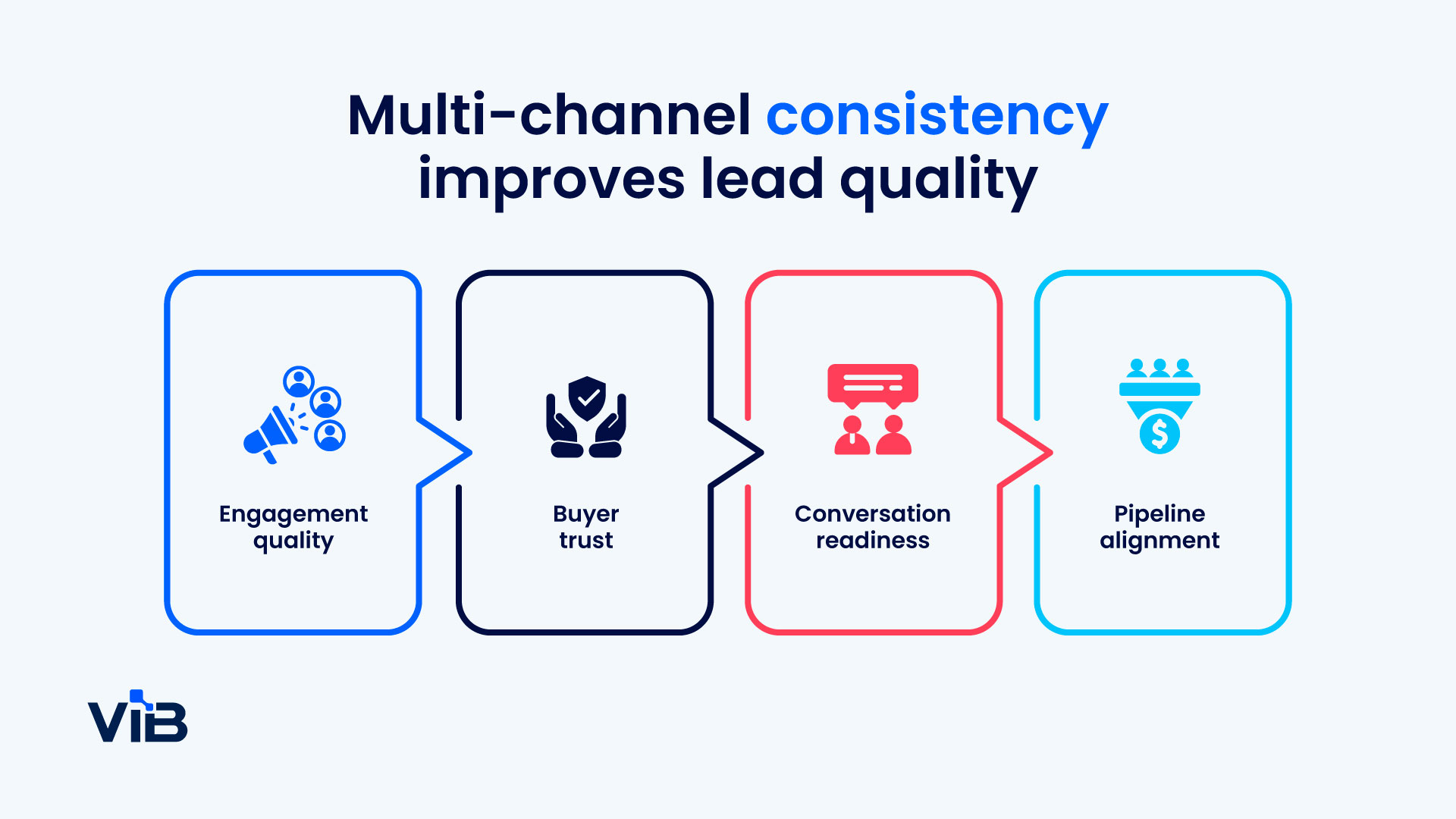
Multi-channel consistency improves lead quality
The strongest demand generation programs create alignment across channels instead of treating email as an isolated tactic.
That consistency usually improves:
- Engagement quality
- Buyer trust
- Conversation readiness
- Pipeline alignment
The result is not just more activity. It’s stronger engagement from buyers who are more likely to progress into qualified opportunities.
Where does ViB Emails fit into email marketing for tech companies?
As technology marketers look for better ways to reach enterprise buyers, many are reevaluating how they source audiences and execute campaigns.
That’s where ViB Emails fits into the strategy.
According to ViB, the platform helps companies generate targeted tech leads for their message, offer, or event through the ViB Community, a network of opted-in technology professionals and decision-makers.
Instead of selling static contact databases, ViB Emails executes campaigns through its own audience infrastructure. This approach helps companies avoid issues tied to list cleaning, sender reputation concerns, and low-quality third-party data.
ViB Emails supports targeted top-of-funnel engagement
As a top-of-funnel demand generation solution, ViB Emails helps companies promote webinars, distribute content, engage targeted technology audiences, and expand beyond their internal databases.
The platform also supports ABM and TAL initiatives by helping companies reach audiences aligned with specific technology interests and business priorities.
For B2B technology companies trying to improve engagement quality, that distinction matters because audience alignment heavily influences campaign performance.
What should tech marketers focus on next?
The strongest email marketing for tech companies is becoming more:
- Audience-focused
- Intent-driven
- Educational
- Contextual
- Multi-channel
The companies generating the best results are focusing less on mass email volume and more on campaign relevance, buyer timing, and audience quality.
The goal is no longer simply generating more names in a database. The goal is generating engagement from buyers who are genuinely aligned with the conversation and more likely to become qualified pipeline opportunities over time.
That shift is becoming one of the biggest competitive advantages in modern B2B technology marketing.


