 Skip to content


If you’re a B2B tech or SaaS marketer, you know the uncomfortable truth: “performance” is easy to claim and hard to prove.
Budgets get scrutinized monthly, buying cycles stretch, and the C-suite wants revenue answers, not channel stories. LinkedIn research highlights that pressure directly: Almost half of B2B marketers report they must justify monthly spend, and 87% say it’s getting harder to measure long-term campaign impact.
This performance-driven B2B marketing playbook focuses on measurable pipeline outcomes, not vanity metrics. It’s written for teams who already have funnels, tooling, and a CRM. You’re here to tighten the machine.
What “performance-driven” really means (and what it doesn’t)
Performance-driven B2B marketing isn’t “optimize to CPL” or “ship more MQLs.” It’s an operating model where every meaningful activity ties to a decision you can defend: who you target, what you say, where you show up, and how you measure business impact.
In practice, that means your marketing engine is built around:
- Funnel stage specificity: You know what stage each program targets (awareness, creation, acceleration, expansion).
- Buying group reality: You plan for multiple stakeholders and conflicting priorities, not a single ICP persona.
- Measurement you can operationalize: You use metrics that connect to actions and pipeline movement.
It also means you stop treating “attribution” as a report and start treating it as a product: defined, maintained, and improved.

The performance-driven B2B marketing system (built for experienced teams)
Here’s the system that tends to hold up in real “go-to-market” environments:
1) Start with the constraint, not the channel
Most B2B teams don’t have a “demand gen problem.” They have a constraint problem. Usually it’s one of these:
- Not enough in-market accounts are entering the funnel
- Poor MQL-to-SQL acceptance (sales doesn’t trust lead quality)
- Pipeline stalls at stage 1–2 because the buying group isn’t aligned
- Low meeting-to-opportunity conversion due to weak framing
- Late-stage no-decision because value isn’t internalized across stakeholders
Pick one constraint per quarter. If you try to “improve performance” everywhere, you’ll end up optimizing nothing.
2) Rebuild your KPIs around pipeline math
Performance-driven B2B marketing works when you stop treating the funnel as a linear journey and start treating it like a conversion system with multiplication points.
Instead of a single KPI stack, use a “physics” stack:
- Coverage: target accounts reached, buying group penetration, and frequency in the right window
- Progression: MQL→SQL, SQL→opportunity, stage-to-stage velocity
- Value: average opportunity value, pipeline created, pipeline influenced (with definitions you can defend)
- Efficiency: consumer acquisition costs by segment, cost per qualified meeting, and channel mix ROI
3) Design programs for buying groups, not individual leads
Your programs should create shared clarity, not just individual interest. After all, according to a Gartner survey, 74% of B2B buyer teams deal with “unhealthy conflict” during the buying process.
Three practical patterns that work well in tech/SaaS:
- Role-based narrative sequencing: same core POV, tailored entry points (security, finance, ops, IT).
- Consensus content: assets designed to help one stakeholder persuade others (decision matrices, risk frameworks, internal justification docs).
- Multi-threaded meeting motions: one meeting is good; parallel stakeholder meetings create momentum.
This is where many teams accidentally get “personalization” wrong. They personalize so hard to one persona that they create internal buyer conflict.
4) Treat intent as a spectrum (and validate it)
Not all intent is equal. In practice, you’re dealing with:
- Category interest (learning, exploring)
- Problem intent (actively trying to fix something)
- Solution intent (shortlisting approaches/vendors)
- Deal intent (timeline, budget, stakeholders, and decision process)
Your performance model should reflect this. Category interest is great for future pipeline, but it should not be measured like it’s next-quarter revenue.
5) Fix attribution with instrumentation, not arguments
Attribution debates usually happen when the system isn’t observable. If you want performance-driven B2B marketing, focus on observability first:
- Standardize lifecycle stages (and lock definitions with RevOps)
- Capture “qualified” conversions (not just form fills)
- Connect CRM + ad platforms where possible, using server-side signals
- Measure lift in conversion and cost after instrumentation changes
Use cases that show real performance outcomes (without fantasy metrics)
Use case A: Your CPL looks “fine,” but pipeline is under target
This usually shows up when you’re over-optimizing top-funnel conversions in channels that can’t reliably reach the real buying group.
What to do next:
- Shift reporting from CPL to cost per sales-accepted lead and cost per qualified meeting.
- Add a buying-group lens: track new contacts per target account in active pipeline.
- Introduce mid-funnel programs that create stakeholder alignment (webinars, workshops, role-based sequences).
Use case B: You’re getting meetings, but deals stall after discovery
This is commonly a “message-to-motion mismatch.” The promise that got the meeting doesn’t match the operational reality of evaluation.
What to do next:
- Build a discovery-to-consensus kit: an ROI model, a risk checklist, an integration map, and guidance on who needs to weigh in.
- Measure stage conversion from discovery to the next step, not just meeting counts.
- Rework nurture to support internal selling, since buying teams often face conflict.
Use case C: ABM is running, but it feels like a content treadmill
This happens when ABM is treated as a publishing cadence instead of a performance system. The fix is to anchor ABM to account progression milestones.
Try this structure:
- Account entry criteria: What signals make an account worth spending on now?
- Progression plays: What content + outreach combo moves them to the next milestone?
- Exit criteria: When do you pause spend, recycle, or re-qualify?
Where ViB fits when you need performance, not just activity
If the strategies above feel right but execution keeps breaking down, it’s usually because of one (or more) operational gaps:
- You can’t reliably reach the right stakeholders inside target accounts.
- You’re missing verified mid-funnel intent signals (timeline, budget, committee).
- You need more predictable moments that move pipeline (qualified conversations, not clicks).
That’s where ViB can act as a practical aid across the funnel, depending on your constraint:
When your constraint is buying group access: ViB Emails and ViB Syndication
If your issue is reach and relevance, you want programs that put your message in front of the right people without relying solely on broad outbound.
ViB Emails supports targeted distribution to engaged audiences, while ViB Syndication can help you place mid-funnel assets in-market. Use them to drive measurable downstream actions like sales-accepted leads, not just downloads.
When your constraint is meetings that turn into pipeline: ViB Appointments
If you’re generating demand but can’t convert it into quality conversations, ViB Appointments can support a performance-driven motion: define qualification tightly, align on acceptance criteria, then measure meeting-to-opportunity conversion and velocity.
When your constraint is stakeholder alignment at scale: ViB Webinars
Webinars work best when they’re built for consensus, not top-funnel education. Use them to address cross-functional objections, show decision criteria, and create shared language across the buying group. ViB Webinars can orchestrate your entire webinar, from planning and promotion to hosting and data collection.
How to implement this easily
If you want a simple way to apply performance-driven B2B marketing this quarter, use this cadence:
- Week 1: Pick one constraint and lock definitions (qualified lead, accepted lead, qualified meeting).
- Week 2: Align plays to buying-group outcomes (consensus assets, multi-threading, intent validation).
- Weeks 3–10: Run two programs max, but instrument them deeply (CRM fields, source mapping, stage tracking).
- Weeks 11–12: Evaluate on progression and value: MQL→SQL, SQL→Opp, velocity, and pipeline created/influenced.
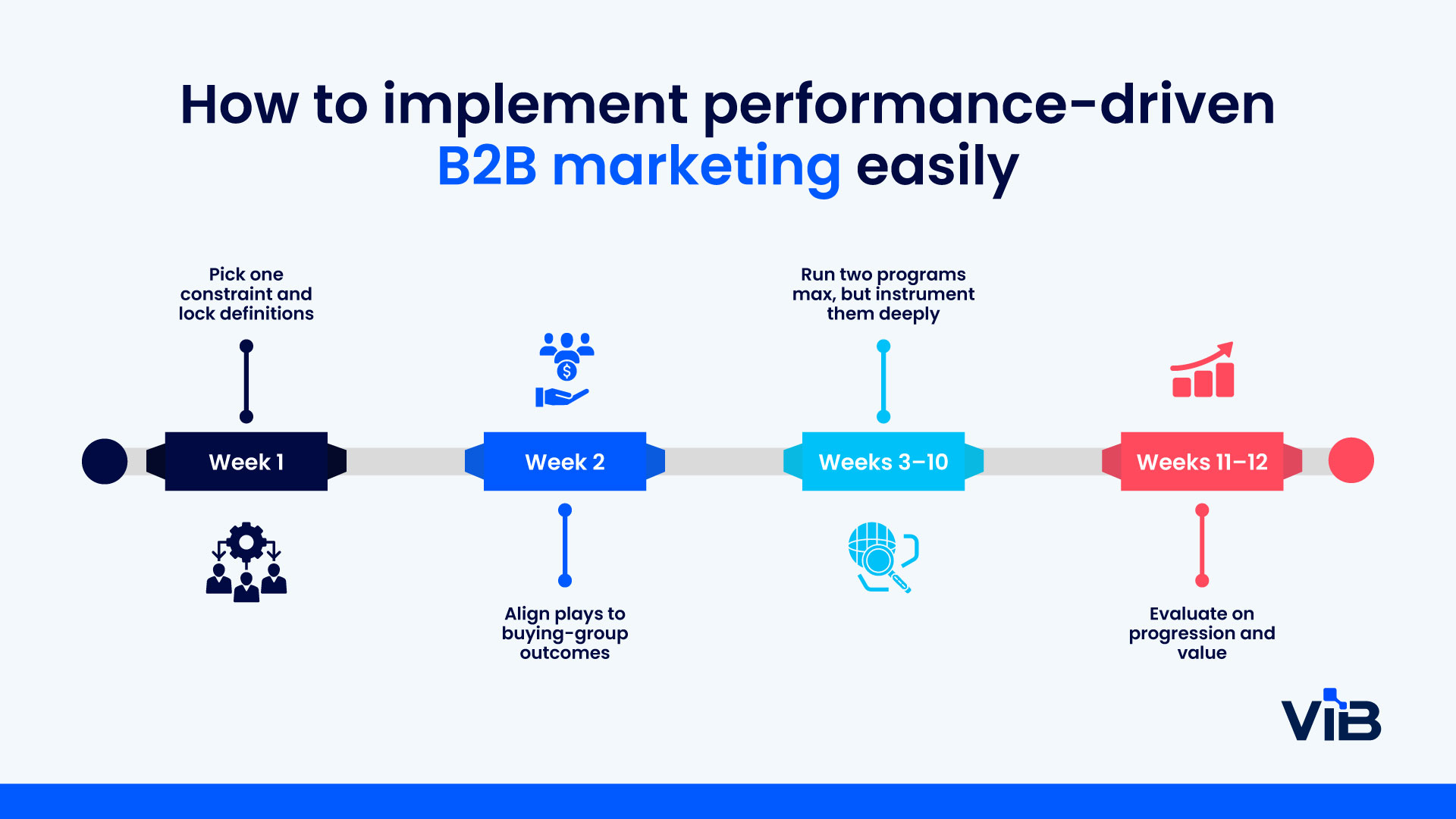
That’s the shift: fewer motions, cleaner measurement, stronger outcomes. It’s also how you earn the right to scale spend when finance comes calling.


