 Skip to content


If you’re shopping for B2B SaaS lead generation vendors, it can be difficult to figure out which is the best fit for you.
Which vendors produce the cleanest ICP match, strongest buying signals, and programs that your team can actually operationalize? And how do you know you won’t end up with low-fit form fills, inflated “intent,” messy routing, and SLAs nobody follows?
This guide compares some of the most commonly used vendors across B2B SaaS lead gen. We’ll explain the pros and cons of each, and share how to evaluate the right vendor for you.
A comparison list of B2B SaaS lead generation vendors (pros and cons)
Below is a practical comparison of vendors that many B2B SaaS teams consider. Each entry focuses on what stands out, plus the trade-offs you’ll want to pressure-test.
ViB
ViB is a B2B demand generation partner built around a millions-strong community of tech decision-makers. This enables B2B tech marketers to connect with their exact ICP. It offers multiple solutions that map to different demand goals, which you can run together or separately. That’s useful when you need to build a mix of engagement signals rather than rely on a single channel.
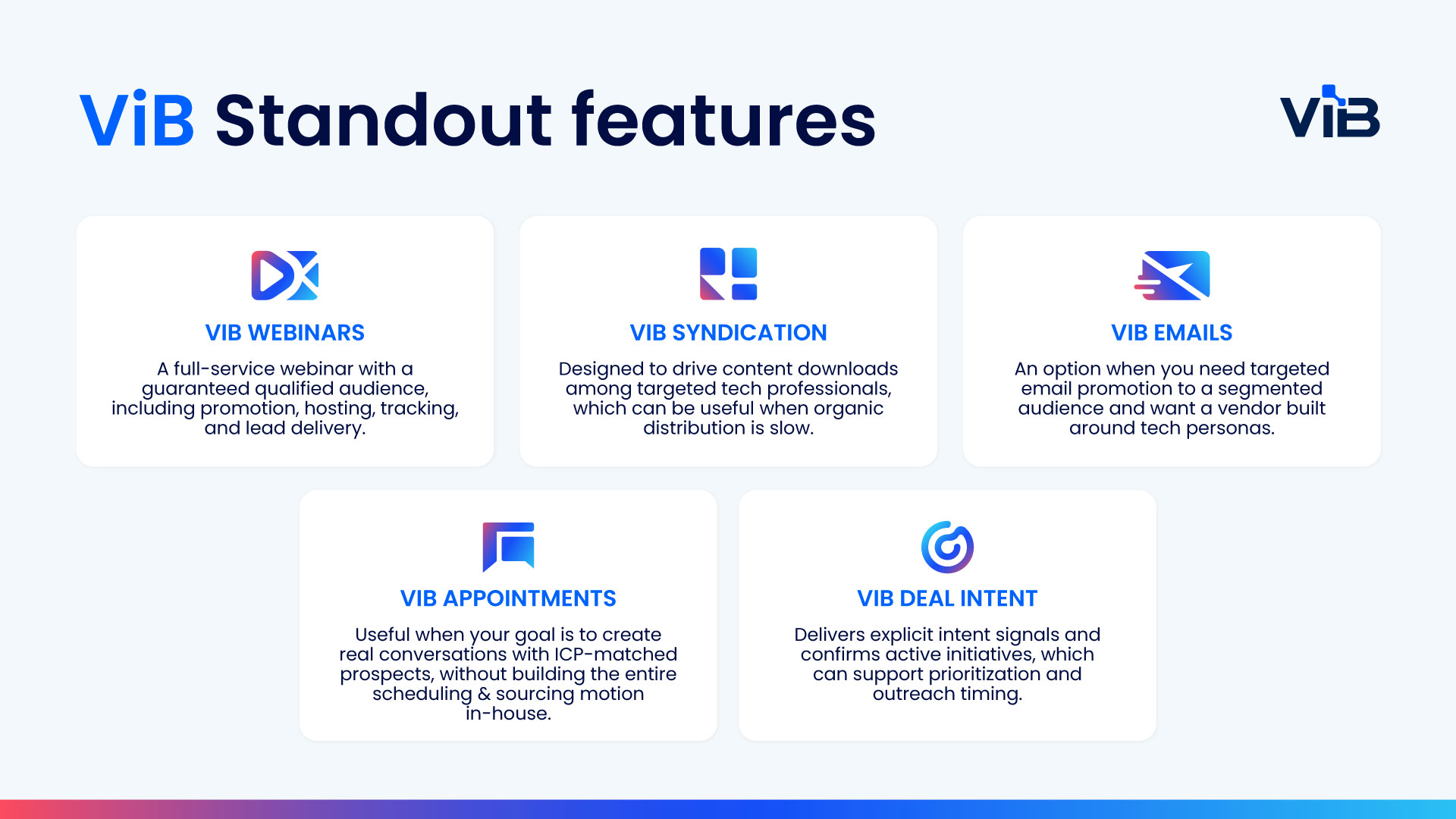
Standout features
- ViB Webinars: A full-service webinar with a guaranteed qualified audience, including promotion, hosting, tracking, and lead delivery.
- ViB Syndication: Designed to drive content downloads among targeted tech professionals (with a qualified download guarantee), which can be useful when organic distribution is slow.
- ViB Emails: An option when you need targeted email promotion to a segmented audience and want a vendor built around tech personas. ([vib.tech](https://vib.tech/?utm_source=openai))
- ViB Appointments: Useful when your goal is to create real conversations with ICP-matched prospects, without building the entire scheduling and sourcing motion in-house. And you pay only for qualified meetings held.
- Campaign engagement from ViB’s audience-based programs can be routed into existing nurture, scoring, and account-prioritization workflows.
Considerations
- You still need a strong follow-up system. Like any engagement and signal-generating motion, value comes from speed-to-lead, messaging, and nurture.
- Clear targeting inputs matter. You’ll want a tight ICP definition, exclusions, and conversion paths before launching.
- Program fit depends on your objective. If you only want one narrow tactic (like pure contact data), a community-driven partner may be more than you need.
6sense
6sense is often used when you want one system to unify account identification, intent, and multi-channel activation across ads and workflows. The platform positions itself around AI-driven account prioritization and intent/deanonymization capabilities.
Standout features
- Strong fit for ABM programs where you need account selection, prioritization, and orchestration in one place.
- Intent and journey visibility are designed to translate into activation, not just reporting.
Considerations
- More of a platform than a “vendor service,” so success depends on ownership, process, and adoption.
- Best outcomes usually require mature data hygiene and coordinated marketing + SDR motion.
Demandbase
Demandbase is a well-known ABM and account-based GTM platform. It’s also recognized in intent data provider evaluations, including being named a Leader in Forrester’s Intent Data Providers for B2B report (Q1 2025).
Standout features
- Strong for account-based measurement, buying group visibility, and GTM reporting when you need to explain “what’s working” beyond last-click.
- Credibility and category maturity can help when you need internal buy-in.
Considerations
- ABM platforms can be heavyweight if your team wants quick activation without substantial ops support.
- Make sure you’re clear on which intent sources are included and how they’re scored and refreshed.
Bombora
Bombora is best known for Company Surge, a widely used method for modeling topic-level interest at the company level. It describes its intent as being derived from its data cooperative of publishers and partners.
Standout features
- Useful for scalable account prioritization, topic clustering, and warming account lists for ads or outbound.
- A clear “surge” concept can make it easy to operationalize in targeting and reporting.
Considerations
- Topic surges can be noisy without tight ICP filters and good exclusions.
- Intent is only as valuable as your follow-up motion; many teams struggle with consistent activation.
Informa TechTarget Priority Engine
TechTarget Priority Engine is positioned around intent sourced from observed research behavior within TechTarget’s network, with offerings like Account Intent Feeds and sales enablement capabilities.
Standout features
- First-party style research behavior can be compelling for B2B tech categories where TechTarget coverage is strong.
- Designed to help teams act on intent, including sales-facing workflows like generated rep emails (IntentMail AI).
Considerations
- Coverage can vary by segment and niche; validate relevance to your category and regions.
- Align internally on whether you want account-level signals, contact discovery, or both.
G2 Buyer Intent
G2’s Buyer Intent is built on activity across the G2 marketplace, and G2 positions it as “verified” intent to help teams focus on accounts actively researching software categories.
Standout features
- Great fit if G2 is meaningful in your category and buyers use it during evaluation.
- Can complement other intent sources by adding clear, software-specific marketplace behavior.
Considerations
- Signal value depends heavily on category traffic and your review-site presence.
- Some teams over-index on “in-market” and under-invest in consistent nurture and retargeting.
Apollo.io
Apollo is commonly used as a contact data and prospecting layer. Apollo publishes details about its “Living Data Network” and email verification approach, including a stated email accuracy rate.
Standout features
- A fast way to build lists and segment by common firmographic and role filters.
- Helpful when you need volume for outbound tests, and you have a strong deliverability discipline.
Considerations
- Contact data freshness and deliverability risk are common concerns in practice, so many teams add a second verification step before sending.
- Works best with clear ICP rules; otherwise, it’s easy to generate activity that doesn’t translate into meaningful engagement.
Clearbit
Clearbit is widely used for enrichment and identifying de-anonymized companies visiting your site, with products like Visitor Report and Reveal. HubSpot completed its acquisition of Clearbit in December 2023.
Standout features
- Strong for improving routing, scoring, and personalization using enrichment across your CRM and MAP.
- Website visitor identification at the company level can add useful “hand-raiser adjacent” signals for ABM plays.
Considerations
- Visitor identification works best when you already have meaningful traffic and good on-site segmentation.
- Activation still requires a plan: who follows up, with what message, and how fast.
LinkedIn Lead Gen Forms
LinkedIn Lead Gen Forms are a common “capture” tool for B2B SaaS marketers because they reduce friction using pre-filled member data. LinkedIn’s documentation highlights that profile data can populate forms with one click.
Standout features
- Great for top-of-funnel content, event registrations, and paid retargeting when your offer is strong.
- Often easier to test quickly than landing pages, especially when you’re iterating messaging.
Considerations
- Lead quality can vary; you still need qualification logic and fast follow-up to keep engagement warm.
- Form friction is lower, which can also mean weaker intent than a high-commitment action.
What the best B2B SaaS lead generation vendors tend to do differently
Across the list above, the “best” vendor usually isn’t the one with the most features; it’s the one that fits your operating model and your buying journey.
They’re honest about where they sit in the journey
Intent tools are best at prioritization and timing. They help you focus and personalize.
Capture tools are best at conversion and list growth. They help you get identifiable engagement at scale.
Done-for-you programs can be best at consistency and throughput, especially when your team is resource-constrained.
They can explain their quality controls in plain English
Good vendors can tell you exactly how they validate contacts, handle duplicates, suppress existing customers, and define “qualified” for a specific program.
They make activation easier than DIY
If your team spends weeks stitching together exports, enrichment, and routing, you’re not buying leverage; you’re buying another system to manage.
How to evaluate B2B SaaS lead generation vendors (without getting fooled)
Before the vendor list, align on what “good” looks like. Most disappointment comes from mismatched expectations, not bad tools.
Start with the signal, not the channel
Two vendors can both say “intent,” but the underlying signal can be totally different.
Some are third-party content consumption patterns across a large publisher co-op. Others are first-party research behavior on owned properties. Others are marketplace actions, such as category comparisons or review-page activity.
Ask what buyer behavior is being observed, how often it updates, and how you’re expected to activate it.
Watch for operational friction
Look for clarity on integrations, data delivery (API vs. CSV), and how targeting and exclusions actually work (territory rules, customer suppression, competitor suppression, partner conflict).
Quality control is a feature, not a footnote
Whether you’re buying contact data, appointments, or syndication leads, you need to know how the vendor validates identity, deduplicates, and manages consent.
If their answer is “our data is great,” that’s not a process.

Conclusion: The best B2B SaaS lead generation vendors are the ones your team can activate
There’s no single winner among B2B SaaS lead generation vendors because “lead gen” is really a bundle of jobs: identifying the right accounts, detecting real interest, creating engagement, and operationalizing follow-up.
If your team is strong in ops and orchestration, ABM and intent platforms can give you a durable advantage. If resourcing is tight, done-for-you programs such as webinars, syndication, and appointment-setting can help you maintain consistent market activity without rebuilding everything internally.


