 Skip to content


B2B buyers don’t announce when they’re ready to engage. They research quietly, compare options, and narrow decisions long before marketing ever sees a form fill.
Intent data gives performance marketers visibility into that invisible phase. It shows what accounts are actively exploring, which problems are gaining urgency, and where attention is shifting in real time.
This guide lays out an operational system for performance marketing using intent data for B2B, built specifically for email execution. No theory, no generic “best practices,” just a practical way to move from signal to action without creating a messy, over-engineered workflow. 🔍
How do you build a signal-to-email system for performance marketing using intent data for B2B?
Think of intent as a prioritization layer, not a targeting trick. Your job is to translate “what they’re researching” into “what we send,” and do it fast enough that the signal still matters.
A solid system has four parts:
- Signal selection: what you trust and what you ignore
- Segmentation rules: how signals map to audiences and tiers
- Messaging frameworks: how you turn topics into offers and copy angles
- Measurement loops: how you learn and adjust without starting over every campaign
If any one of these is missing, you’ll feel it. Either campaigns become generic, sales lose confidence, or you end up debating intent in meetings instead of using it.

What intent signals should you actually use?
Not all intent is created equal. For performance marketing using intent data for B2B, you want signals that are both specific enough to act on and stable enough to repeat.
A clean starting set looks like this:
- Category intent (what solution space they’re exploring)
- Problem intent (what pain they’re trying to solve)
- Competitor intent (what alternatives they’re comparing)
Avoid building everything around ultra-granular keywords on day one. You’ll spend more time arguing about taxonomy than running campaigns.
How do you prevent intent data from turning into noise?
Create a “signal floor” before anything can trigger an email. If a signal cannot pass a basic credibility check, it should not change your marketing plan.
Examples of a simple signal floor:
- Require multiple signal events within a defined window (not a single spike)
- Require alignment to ICP basics (industry, size, geography, function)
- Require topic alignment to what you can credibly deliver (offer, content, POV)
This keeps performance marketing using intent data for B2B focused on action, not alerts.
How should you translate intent topics into email segmentation?
Segmentation is where most intent strategies get lazy. Teams either segment too broadly (“all intent accounts”) or too narrowly (“one segment per keyword”), and both approaches break performance.
Instead, segment by decision context. Your email should match what’s happening in their evaluation.
What segmentation model works best in practice?
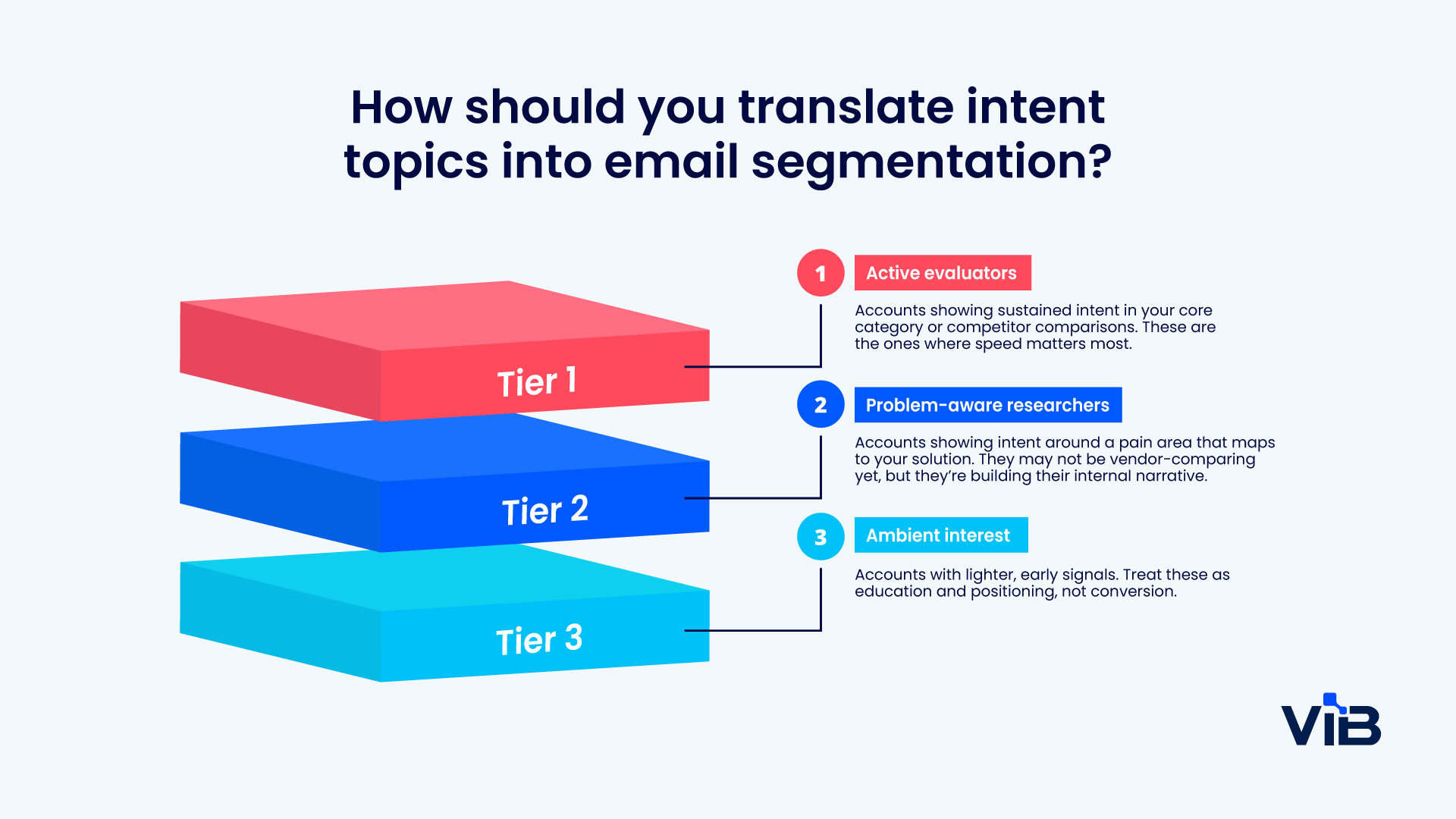
Use a 3-tier model that’s easy to explain internally and easy to run repeatedly.
Tier 1: Active evaluators
Accounts showing sustained intent in your core category or competitor comparisons. These are the ones where speed matters most.
Tier 2: Problem-aware researchers
Accounts showing intent around a pain area that maps to your solution. They may not be vendor-comparing yet, but they’re building their internal narrative.
Tier 3: Ambient interest
Accounts with lighter, early signals. Treat these as education and positioning, not conversion.
This model keeps performance marketing using intent data for B2B from becoming “spray and pray with a nicer list.”
How do you route intent segments without creating chaos?
Use one clear rule: every segment must map to one primary email job.
For example:
- Tier 1 email job: accelerate action with proof and a direct next step
- Tier 2 email job: shape the problem and position your approach
- Tier 3 email job: build familiarity and capture lightweight engagement
When the “job” is clear, creative, and measurement gets simpler.
What should intent-driven email messaging actually sound like?
Intent-based email is not about saying “we saw you researching X.” That’s the fastest way to feel creepy and tank trust.
It’s about meeting buyers where they already are, and making the email feel inevitable, like it arrived because it’s relevant, not because you’re watching them.
How do you turn intent into a messaging angle?
Use a simple translation:
- Intent topic = what they’re trying to understand
- Email angle = the decision they’re trying to make
- Email offer = what helps them make it faster
Example:
If the intent topic is “reducing CAC in enterprise,” the decision might be “which levers actually move cost per qualified meeting,” and the offer might be “a short framework + proof-based example.”
This is how performance marketing using intent data for B2B stays human while still being precise.
What email formats work best by intent tier?
Vary the structure on purpose, so your campaigns don’t feel templated.
Active evaluators (Tier 1)
Keep it tight, proof-forward, and action-oriented. One idea, one proof point, one next step.
Problem-aware (Tier 2)
Use a short narrative plus a practical framework. Give them language they can reuse internally.
Ambient interest (Tier 3)
Use lightweight insights, trend interpretation, or a simple diagnostic. The goal is to earn the next click, not force a decision.
A quick final check: if your Tier 3 email reads like a Tier 1 pitch, you’re compressing the buyer journey, and performance will suffer.
How do you design an intent-triggered email cadence without burning out your audience?
Most cadence conversations are backwards. Teams ask “how many emails should we send,” when they should ask “how long does this signal stay relevant?”
Intent has a half-life. Your cadence should match it.
What cadence patterns work without feeling aggressive?
Here’s a cadence pattern that tends to perform well because it follows buyer attention, not marketing calendars:
High urgency (Tier 1)
3 touches over 7–10 business days, each touch with a different proof angle.
Moderate urgency (Tier 2)
2–3 touches over 14 days, with a practical asset first, proof second, and a soft next step last.
Low urgency (Tier 3)
1–2 touches over 21–30 days, designed to build familiarity and capture engagement signals.
The goal is not to send more. The goal is to match the rhythm of evaluation so performance marketing using intent data for B2B feels timely, not noisy.
How do you keep the campaign from repeating itself?
Most repetition happens because the offer never changes. If your only lever is “book a demo,” every email will feel the same.
Instead, rotate the offer type:
- Framework (how to evaluate, how to avoid mistakes)
- Proof (customer story, outcomes, what changed after switching)
- Decision support (checklist, short benchmarking prompt, “what to ask internally”)
Offer rotation creates variety without needing a completely new campaign every week.
How should you measure performance marketing using intent data for B2B in email?
If you measure intent-driven email like a generic newsletter, you’ll miss the point. You’re not trying to “get clicks.” You’re trying to confirm that you reached the right accounts at the right time and moved them forward.
What should you measure instead of just opens and clicks?
Use a measurement stack that reflects momentum:
Engagement quality
Look at repeat engagement and depth, not isolated clicks.
Segment responsiveness
Tier 1 should behave differently from Tier 3. If everything performs the same, your segmentation is not doing any work.
Downstream behavior
Even if you don’t have perfect attribution, you can track things like return visits, follow-up engagement, or response rates.
Performance marketing using intent data for B2B is about improving signal-to-outcome alignment, not chasing vanity metrics.
How do you build a feedback loop that makes campaigns smarter?
Treat every send like a hypothesis test:
- Hypothesis: this intent topic responds to this angle + offer
- Test: run it against one tier with a defined window
- Learn: keep the angle, change the offer, or change the segment rule
This keeps optimization practical. You’re adjusting a system, not reinventing the strategy every month.
Where does ViB Emails fit into performance marketing using intent data for B2B?
Once you have intent segments and messaging built, the execution bottleneck is usually reached. Owned lists only cover a portion of your market, and scaling sends to the same audience can dilute performance over time.
That’s where ViB Emails can support this model by extending your intent-driven campaign to a curated community of verified, high-tech decision-makers that match your ICP. You keep your messaging and your performance strategy, and you gain reach without relying on list rentals or oversending to your existing database. 😊
If you want to see how ViB Emails works, you can review it here: ViB Emails


