 Skip to content


Content marketing often focuses heavily on creation. Teams invest weeks producing research reports, whitepapers, guides, or blog posts designed to educate potential buyers. However, even well-crafted content rarely performs if it is not consistently placed in front of the right audience.
This is where distribution becomes essential. Publishing content on a website or sharing it once on social media rarely generates sustained visibility. Without a structured approach to distribution, even valuable insights can remain largely undiscovered.
Understanding what content distribution actually involves helps marketing teams ensure their content reaches professionals who are actively interested in the topics being discussed.
Why content distribution matters as much as content creation
Many organizations devote most of their resources to content production while underestimating how difficult it is to get that content noticed. In practice, visibility often depends less on the quality of the asset and more on how effectively it is promoted.
Content distribution ensures that valuable insights reach relevant audiences through multiple channels rather than relying on a single point of discovery.
According to the Content Marketing Institute, content distribution is one of the biggest challenges B2B marketers face when trying to generate meaningful engagement from their content programs.
Without distribution, content often struggles to gain traction because potential readers simply never encounter it.
What is content distribution in B2B marketing?
Content distribution refers to the process of promoting and delivering content to targeted audiences across various channels. Instead of relying solely on organic discovery, marketers proactively place content in front of professionals who are likely to find it relevant.
In B2B marketing, distribution strategies are designed to support long buying cycles by introducing insights and educational resources to decision makers early in their research process.
Effective distribution typically combines several channels.
- Email campaigns promoting new resources
- Social media posts highlighting insights or research
- Partnerships with industry publications or communities
- Content syndication platforms that reach professional audiences
When these channels work together, content can reach a broader and more relevant audience than organic promotion alone.

Which content distribution channels do B2B marketers rely on most?
B2B marketing teams typically rely on a mix of owned, earned, and paid distribution channels to expand visibility for their content.
Owned channels
Owned channels include platforms directly controlled by the organization. These channels are often the starting point for content promotion.
Examples include:
- Company blogs or resource centers
- Email newsletters or nurture campaigns
- Corporate social media accounts
- Event or webinar promotions
Owned channels help distribute content to existing audiences who already recognize the brand.
Earned distribution
Earned distribution occurs when third parties share or reference content because they find it valuable.
This may include industry publications citing research, partners sharing reports with their audiences, or influencers referencing insights in their own content.
Earned distribution can significantly increase credibility because the content is recommended by external sources.
Paid distribution
Paid distribution involves promoting content through advertising or distribution platforms that target specific audiences.
These channels allow marketers to reach professionals who may not yet be familiar with their brand but who match their ideal audience profile.
Paid distribution often becomes important when organizations want to expand beyond their internal contact lists.
How does content distribution support demand generation?
Content distribution plays a critical role in demand generation because it introduces ideas and insights to buyers before they begin evaluating specific vendors.
B2B buyers rarely discover brands through a single interaction. Instead, they encounter multiple pieces of content over time while researching industry challenges or exploring potential solutions.
Distribution ensures that valuable resources appear throughout this research process.
Key ways distribution supports demand generation
Content distribution helps marketing teams:
- Introduce thought leadership to new audiences
- Drive traffic to educational resources
- Encourage engagement with research or reports
- Maintain brand visibility throughout long buying cycles
When distribution is consistent, content can influence how buyers understand problems and evaluate possible approaches.
What challenges do marketers face with content distribution?
Despite its importance, content distribution remains one of the most difficult aspects of content marketing.
Many teams encounter several common obstacles.
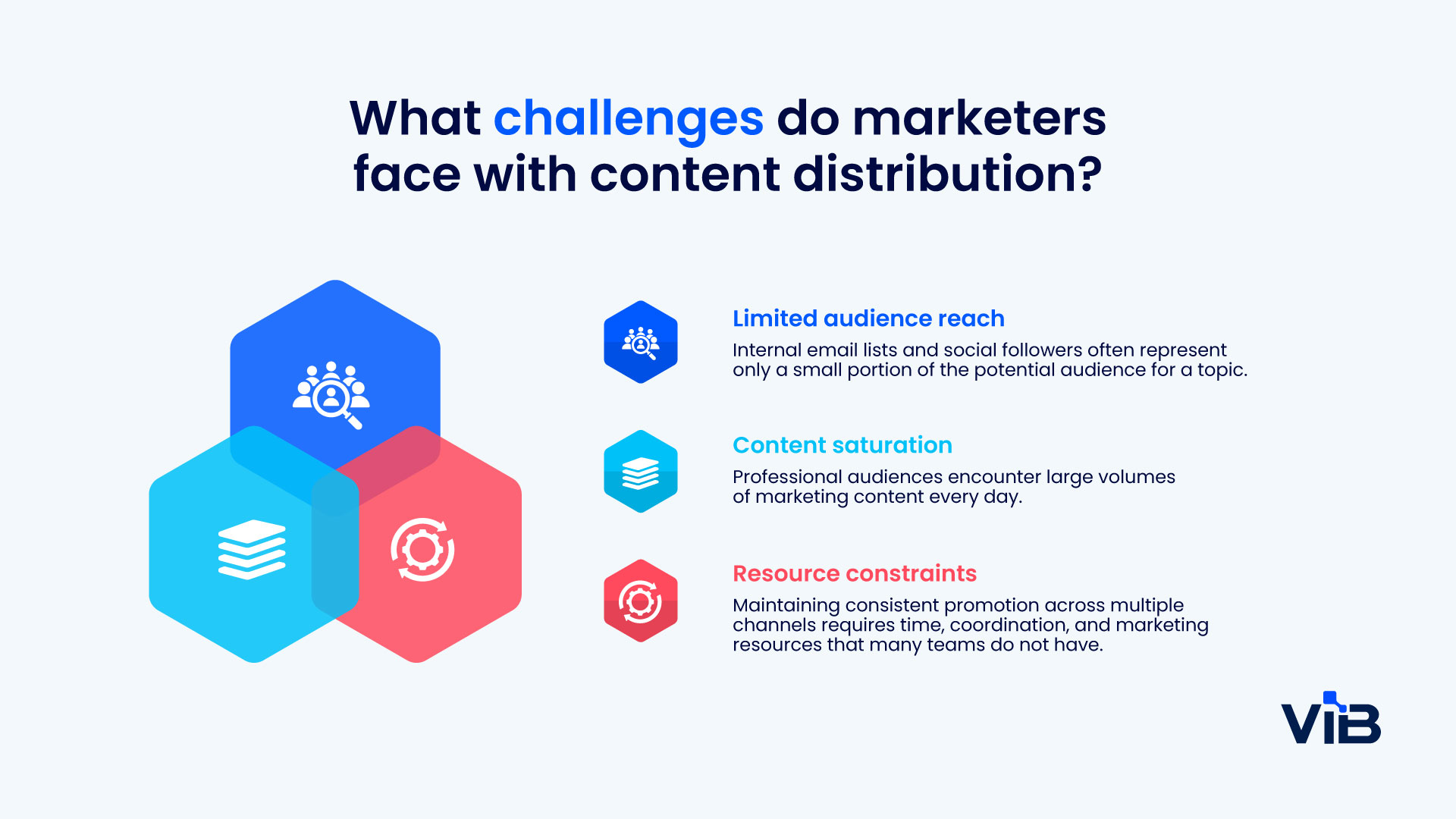
Limited audience reach
Internal email lists and social followers often represent only a small portion of the potential audience for a topic. Even strong content may struggle to gain traction if distribution remains limited to these channels.
Content saturation
Professional audiences encounter large volumes of marketing content every day. Standing out requires both valuable insights and effective distribution.
Resource constraints
Maintaining consistent promotion across multiple channels requires time, coordination, and marketing resources that many teams do not have.
These challenges explain why many organizations explore additional distribution channels to extend the reach of their content.
Where does content syndication fit into content distribution strategy?
Content syndication is one of the most widely used methods for expanding the reach of B2B content. Instead of relying solely on internal channels, organizations distribute their content through external platforms that connect them with targeted professional audiences.
Syndication allows marketers to promote valuable assets such as research reports, guides, and whitepapers to audiences who are already interested in the topic.
This approach can introduce content to decision makers who might otherwise never encounter it through organic discovery.
Where does ViB Syndication support content distribution?
While many distribution tactics focus on promotion through owned channels, content syndication helps expand reach beyond existing audiences.
ViB Syndication helps B2B marketers distribute their content to curated communities of professionals within the ViB network. Instead of relying only on internal databases, B2B tech marketers can place valuable resources directly in front of professionals who match their target audience profile.
This approach helps marketing teams ensure that their most important content assets reach the right readers.
1) Expanding audience reach
Many organizations produce high-quality research, guides, and reports but struggle to introduce these assets to new audiences. ViB Syndication helps extend visibility beyond existing contact lists.
2) Increasing engagement with valuable content
When content is distributed to professionals who care about the topic, engagement naturally increases. Readers are more likely to download, read, and interact with content that aligns with their professional interests.
3) Supporting broader demand generation programs
Content distribution often works alongside other initiatives such as webinars, email campaigns, and research launches. Syndication can amplify these efforts by introducing content to additional audiences who may later engage with the brand.
Rather than replacing internal marketing channels, ViB Syndication acts as a distribution extension that helps organizations ensure their content reaches professionals who are actively exploring industry solutions.
What should marketers focus on when improving content distribution?
For B2B marketers investing heavily in content creation, improving distribution often produces the greatest impact. Even strong content cannot drive engagement if the intended audience never sees it.
Effective distribution strategies typically prioritize several key principles.
- Promote content across multiple channels rather than relying on one platform
- Align distribution with the interests of specific professional audiences
- Introduce content to new audiences beyond internal databases
- Maintain consistent visibility over time rather than relying on a single launch
When these elements come together, content becomes more than a marketing asset. It becomes a strategic tool for sharing expertise, influencing industry conversations, and connecting with professionals who are actively searching for insights.


