 Skip to content


B2B demand generation is one of the most talked-about strategies, but it is also one of the most misunderstood.
Many teams say they are running demand gen, but what they are really doing is lead capture with a new label. The result is predictable: full dashboards, quiet buyers, and growth that feels harder to sustain every quarter.
If you are an experienced B2B tech marketer, this article is not here to rehash basics. Instead, it breaks down what B2B demand generation actually means in 2026, why it often underperforms, and how high-performing teams build demand that converts into real sales conversations. 🏅
What is B2B demand generation really meant to do?
At its core, B2B demand generation is about creating and capturing demand from the right buyers at the right moment, not just collecting names.
That distinction matters more than ever.
In complex B2B environments, buying decisions rarely happen after a single touch. Demand generation exists to support that entire decision journey, not just the first click.
True B2B demand generation focuses on:
- Building awareness among relevant buying groups
- Educating buyers before they raise their hand
- Staying visible as priorities shift internally
- Entering the conversation when intent becomes real
When demand gen works, sales conversations feel warmer, not forced. When it does not, teams confuse activity with progress.

How is B2B demand generation different from lead generation?
This is where most confusion starts. Lead generation is transactional. Demand generation is strategic.
Lead generation asks, “How do we get more contacts?” Demand generation asks, “How do we earn attention, trust, and timing across a buying group?”
Here is the practical difference experienced teams notice:
- Lead gen often optimizes for volume, regardless of readiness
- Demand gen optimizes for relevance, timing, and buying intent
Lead generation can exist inside a demand generation strategy, but it should never define it. When teams rely too heavily on lead gen alone, they often see:
- High form-fill rates with low follow-through
- SDR burnout from chasing unready prospects
- Marketing blamed for “low-quality” leads
Demand generation shifts the goal from filling the funnel to creating forward motion.
Why does B2B demand generation feel harder in 2026?
If demand gen feels tougher than it used to, that is not your imagination.
Several structural shifts are working against traditional playbooks.
Buyers harder to reach, not less interested
Organic reach continues to decline across search, social, and email. At the same time, buyers are still researching, just more quietly.
According to Bain, a growing percentage of buyers rely on zero-click research experiences, gathering information without ever visiting vendor websites. That means demand is forming earlier and elsewhere.
If your strategy depends on buyers finding you first, you are already behind.
Buying groups larger and more risk-aware
As budgets tighten, more stakeholders get involved. Each one needs different proof points, timelines, and reassurance.
- Early researchers looking for clarity
- Influencers validating options
- Decision-makers protecting downside risk
- Budget owners asking for justification
One-size messaging cannot do that job.
Content volume has exploded
AI has made it easy to publish more content than ever. Unfortunately, volume does not equal impact.
The teams that win do not create more content. They focus on distribution, relevance, and signal, not noise.
What are the most common B2B demand generation mistakes?
Even mature teams fall into predictable traps.
Are you optimizing for volume instead of intent?
Many programs still reward clicks, opens, and downloads without asking who is actually behind that activity.
If your reporting celebrates engagement but sales conversations stall, intent is missing.
Demand generation should prioritize:
- Signals tied to real buying interest
- Repeated engagement from relevant roles
- Behavior that suggests an active project, not casual browsing
Are you targeting one persona instead of the buying group?
It is easy to design campaigns for a single “ideal buyer.” It is also risky.
Forrester research consistently shows that modern B2B decisions involve multiple roles, from technical evaluators to financial stakeholders.
When demand gen speaks to only one role, deals slow down later.
Are you relying on outdated discovery channels?
If your demand gen still depends heavily on organic reach or one primary channel, resilience is low.
High-performing teams diversify discovery and stay present across:
- Partner distribution
- Targeted email
- Events and webinars
- Intent-informed outreach
What does strong B2B demand generation look like in practice?
Effective demand generation is less about tactics and more about alignment.
1) Start with a clear ICP and real signals
Demand gen works best when ICP definitions are validated by behavior, not assumptions.
Strong teams regularly revisit:
- Which segments convert fastest
- Which roles engage deepest
- Which signals correlate with sales success
This keeps programs focused and adaptable.
2) Prioritize timing over pressure
Pushing harder when buyers go quiet rarely works.
Instead, demand gen supports buyers until intent becomes explicit, then enters the conversation with context and relevance.
This approach protects trust and improves conversion rates over time.
3) Support sales, not just marketing goals
When demand gen is working, sales teams know:
- Why a buyer is engaging
- What content they consumed
- Which problem they are trying to solve
That context shortens ramp time and improves outcomes.
Where does B2B demand generation often break down?
The breakdown usually happens between interest and action.
Teams succeed at awareness but struggle to identify when curiosity turns into a real project. That gap leads to either premature outreach or missed opportunities.
This is where many demand strategies stall.
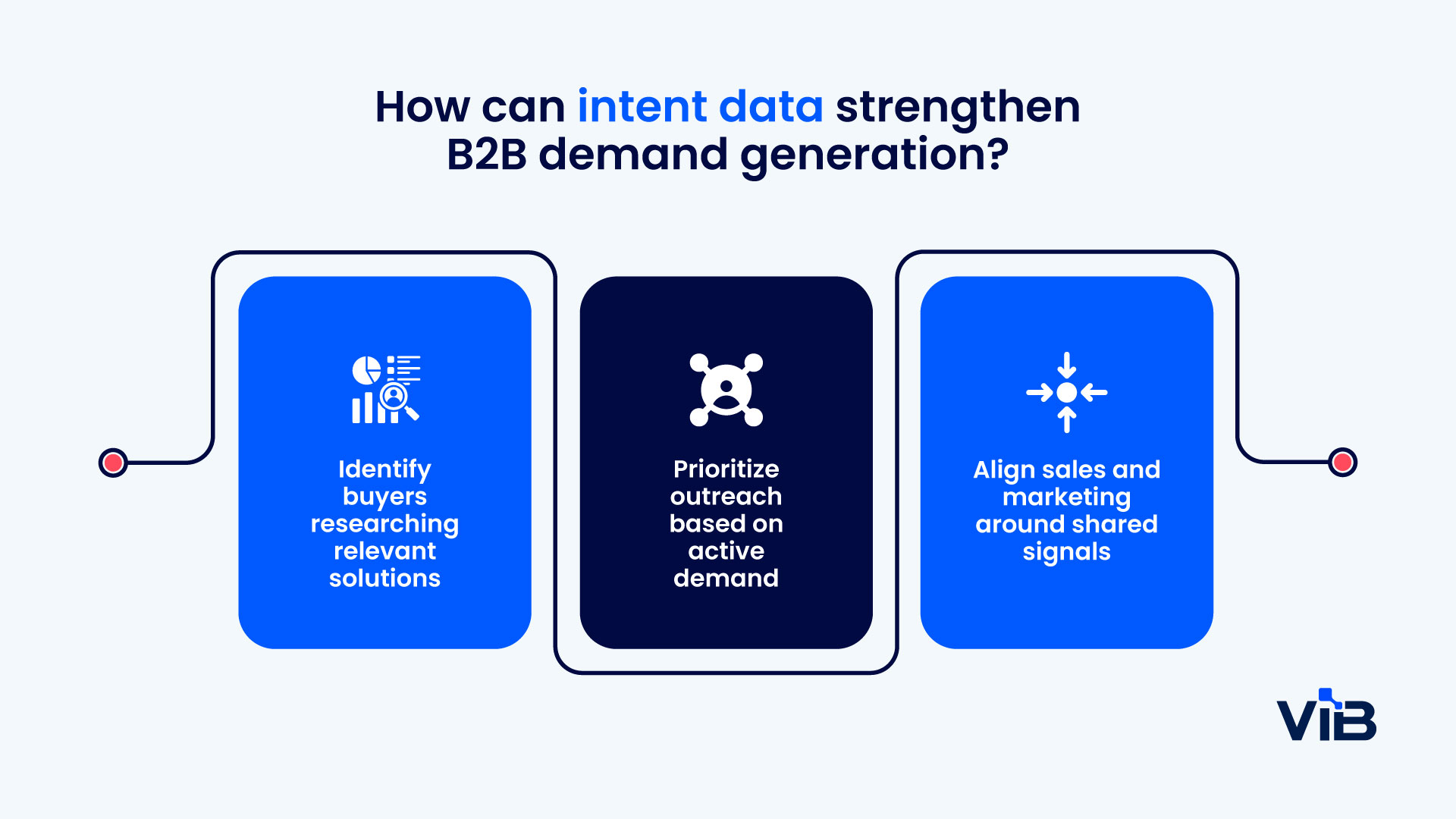
How can intent data strengthen B2B demand generation?
Intent data helps demand gen teams answer one critical question: who is actually in-market right now?
Instead of guessing, teams can:
- Identify buyers researching relevant solutions
- Prioritize outreach based on active demand
- Align sales and marketing around shared signals
Used correctly, intent data does not replace strategy. It sharpens it.
How can deal intent signals support demand generation outcomes?
As demand generation matures, the challenge shifts from generating awareness to knowing who to engage and when to engage them.
Deal intent signals can help bridge that gap by providing additional context about which accounts may be researching a category or moving closer to an active evaluation.
Rather than relying on any single activity as proof of purchase readiness, demand generation teams can combine multiple relevant signals to:
Focus outreach on accounts showing recent, relevant activity
Enter conversations with better context when timing appears right
Reduce effort spent on poorly aligned audiences
Deal intent signals do not replace education, content, or human qualification. They are most useful when combined with first-party engagement, clear ICP criteria, and responsible data practices.
Final thoughts on what B2B demand generation really is
B2B demand generation is not a campaign or a channel. It is a system.
When done well, it creates awareness before buyers ask for it, trust before they talk to sales, and momentum before deals stall.
For teams ready to move beyond surface-level tactics, demand generation becomes a competitive advantage, not just another metric to chase.


