 Skip to content


Telecom marketers operate in one of the most competitive and technical spaces in B2B. Between new technologies like 5G, rapidly changing customer needs, and fierce competition from both traditional carriers and emerging players, the pressure to stand out is intense.
Furthermore, telecom solutions often involve large contracts, multi-year commitments, and cross-departmental buy-in from CIOs, CTOs, IT leaders, and finance teams. That means longer sales cycles, more stakeholders, and higher barriers to entry.
So, the question is, how do you get in front of the right people, stand out from the crowd, and close deals faster?
Many lead gen vendors promise big results but deliver unqualified meetings that waste your team’s time and budget. 📉
Between chasing bad leads, inconsistent outreach, and paying high retainers for uncertain results, many teams are rethinking their approach.
That’s why forward-thinking telecom marketers are turning to appointment setting as a smarter, faster way to connect with the right buyers—and backing it with content marketing that builds trust long before the first meeting.
In the sections ahead, we’ll look at how appointment-setting companies can help telecom providers secure qualified conversations that convert, and how content marketing agencies can keep that momentum going from first touch to closed deal. ⚡
But first, let’s talk about why telecom marketing requires unique solutions.
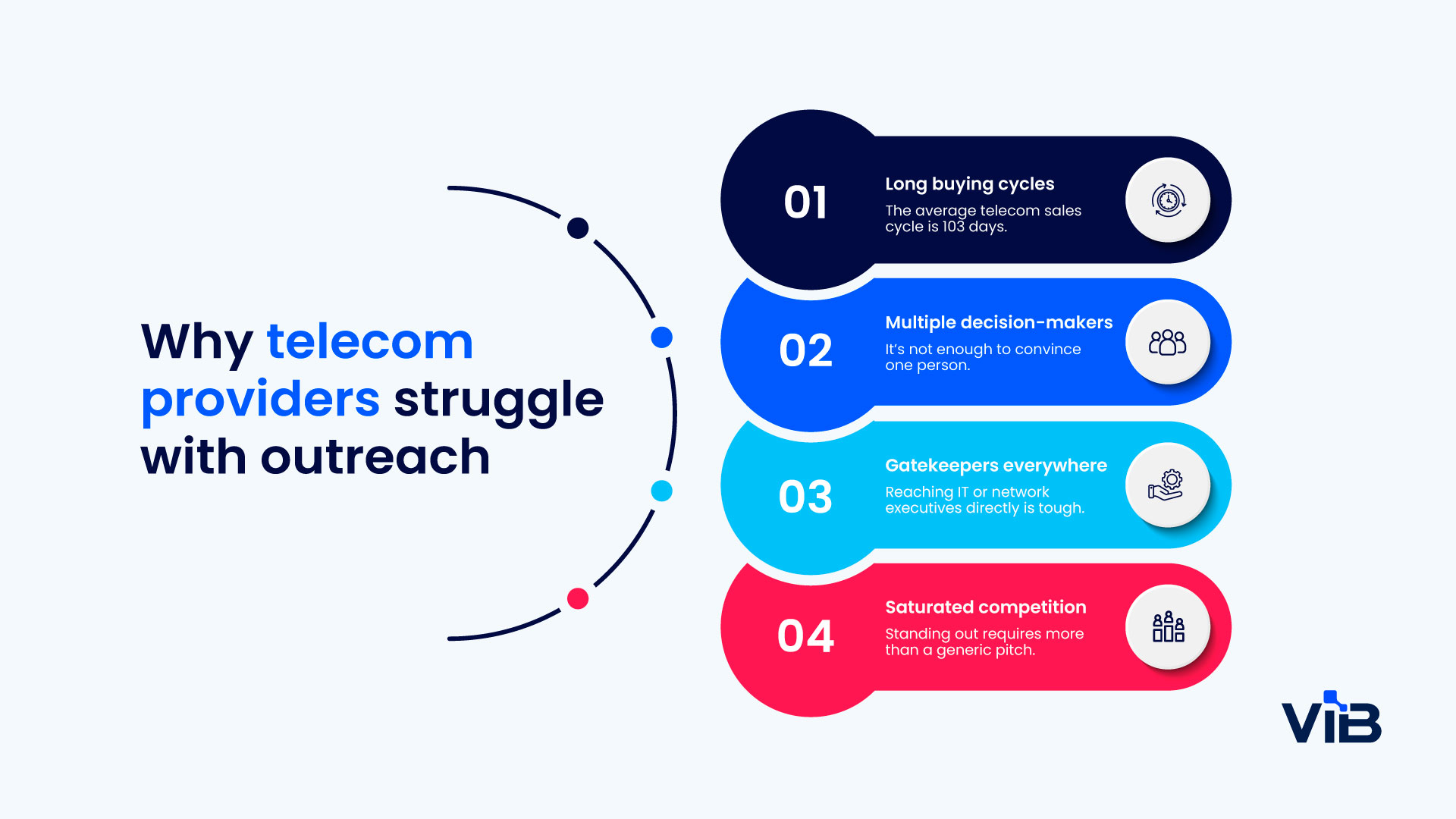
Why telecom marketers struggle with outreach
Telecom solutions aren’t impulse buys—they’re complex, technical, and mission-critical. But that complexity creates real marketing challenges:
Long buying cycles: The average telecom sales cycle is 103 days (over three months)—and it can be longer the more complex the solution is. Staying top-of-mind is exhausting without a strong pipeline of fresh conversations.
Multiple decision-makers: It’s not enough to convince one person. Successful telecom sales often require influencing a committee of technical and business leaders.
Gatekeepers everywhere: Reaching IT or network executives directly is tough. Many cold calls or emails never get past the first filter.
Saturated competition: Buyers are constantly approached by other telecom providers, cloud vendors, and managed services firms. Standing out requires more than a generic pitch.
For sales teams, the result is wasted time chasing leads that don’t convert—and missed opportunities with the accounts that really matter.
Benefits of appointment setting companies for telecom providers
Instead of leaving your team to grind through endless prospecting lists, appointment-setting companies can streamline the path to real conversations. Here’s how:
Accelerated access to executives: No more waiting months to land a conversation with the CIO—appointment setting partners can make introductions happen quickly.
Better ROI on sales resources: Instead of spending 60% of their time on prospecting, your sales team can spend 90% on closing deals.
Scalable outreach without added headcount: Appointment setting provides the horsepower of a larger sales team—without the cost of hiring.
Improved lead quality: Instead of chasing names from cold lists, your reps engage only with prospects who have shown real interest.
Consistent pipeline: Outsourced appointment setting smooths the peaks and valleys of deal flow, giving sales leaders confidence in forecasting.
The importance of the pay-per-performance model
With a traditional appointment-setting vendor, you pay a flat retainer, regardless of whether they book 0 meetings or 20. That model can work if you’re guaranteed high output, but in reality, it often leads to frustration and sunk costs.
Pay-for-performance appointment setting, on the other hand, flips the script. Instead of paying for time or effort, you pay only for completed, verified meetings with your ideal buyers.
It’s a results-first model designed to minimize risk and reward outcomes, not activity. Think of it as moving from “trust us” to “prove it.”
For telecom marketers under pressure to show measurable ROI, this approach offers transparency, predictability, and control.
Here’s why it works:
- You only pay for what works. Forget retainers that drain your budget without guaranteed results.
- Vendors are motivated to deliver. If they don’t book qualified meetings, they don’t get paid—simple as that.
- You get quality over quantity. The focus shifts from volume to verified, in-market buyers that actually fit your ICP.
- It scales with your success. You can increase or pause campaigns based on results, not fixed contracts.
- It drives alignment with sales. When meetings are vetted and relevant, reps are more likely to convert them into deals. 🚀
For telecom teams juggling multiple markets or verticals, that flexibility and accountability are game changers.

What to look for in an appointment setting company
Not all appointment setting companies are created equal—and pay-for-performance doesn’t automatically mean better. Before signing with any vendor, make sure they can back up their promises.
Here’s what to check:
Do they understand your industry?
Telecom sales cycles are very different from SaaS or SMB deals. You want a company that understands the unique decision-making dynamics in the telecom industry. Have they worked with telecom or IT clients before? B2B tech familiarity is crucial for positioning your offer correctly. Request testimonials or case studies that demonstrate their success with telecom companies.
Do they have proven reach?
Ask about the size and quality of their decision-maker network, especially in IT and enterprise accounts. If they’re relying on purchased cold lists or they can’t target your ICP, that’s a red flag.
Do they leverage intent data?
The most effective firms don’t just cold-call—they identify buyers already showing interest. Ensure your partner has a data-backed strategy with a track record of success.
Can they guarantee lead quality?
Do they have verified data and access to decision-makers in your specific telecom niche (networking, cybersecurity, managed services, etc.)? Avoid “spray-and-pray” tactics that damage your brand reputation.
Are they transparent? Can they provide measurable results?
Your partner should provide clear reporting and success metrics, performance benchmarks, and real-time updates on booked meetings. You should know exactly how meetings are sourced and qualified.
If a provider avoids direct questions about where leads come from or can’t show past performance benchmarks, that’s a major red flag. 🚫

How ViB Appointments stands out
ViB Appointments connects providers with high-intent prospects in the IT and enterprise tech space. Here’s why we’re different 🚀:
- Community-powered reach: We tap into ViB’s millions-strong IT buyer community, so your reps speak directly with the people who matter.
- Intent-based conversations: Every meeting is backed by buyer intent data—so you know each person you meet with is actively exploring telecom solutions.
- Do-it-for-you model: We handle the outreach, qualification, and scheduling. Your team simply shows up and starts the conversation.
- Proven results: Check out how telecom firm zLinq achieved its first closed-won deal in two weeks with ViB Appointments. (Plus, they reduced their sales cycle by 75%!)
The result: Telecom providers close more deals, shorten their sales cycles, and spend less time chasing uninterested leads.

Start booking more qualified meetings today with ViB
In an industry where timing and relationships mean everything, working with the right appointment-setting company can give telecom providers a critical edge. By outsourcing the heavy lifting of prospecting to appointment-setting companies for telecom providers, your team regains the most valuable resource of all: time to sell.
The content challenge for telecom marketers
Now, let’s move on to content marketing.
Telecom marketers face one of the toughest content challenges in the B2B space. 📡 The industry sits at the intersection of innovation and complexity. Telecom marketers aren’t just selling technology—they’re selling reliability, scalability, and trust.
That means their messaging must resonate with deeply technical audiences like network engineers while also appealing to business decision-makers focused on ROI.
It’s a tall order.
Moreover, telecom B2B services are projected to grow nearly 20% faster than consumer telecom segments in the next few years. That means the competition for visibility and share of voice is only getting tougher.
Too often, telecom marketers turn to generalist content agencies that don’t understand the nuances of the telecom industry. They can write general B2B copy, but they don’t speak the language of connectivity, infrastructure, or enterprise-grade performance.
Without that expertise, content risks sounding generic—and generic doesn’t convert.
This section explains how to evaluate a B2B content marketing agency for telecom companies, what pitfalls to avoid, and why content distribution matters as much as content creation.
What great content agencies do differently
A strong B2B content marketing agency for telecom companies goes beyond simple content creation. Effective telecom content marketing is part strategy, part storytelling, and part precision targeting—not just production. The best solutions understand that—and use real, data-backed insights to build personalized strategies for their clients.
Equally important is transparency. The best agencies don’t measure success in impressions or vanity metrics; they focus on qualified engagement. And that’s the difference between content that’s seen and content that sells.
Checklist: what to look for in a B2B content marketing agency for telecom companies ✅
When evaluating potential partners, look for agencies that can deliver on both content and outcomes:
- Industry expertise: They understand telecom trends, buyer roles, and technical terminology.
- Audience access: They can reach telecom decision-makers, not just general B2B contacts.
- Strategic balance: Their work connects storytelling, SEO, and measurable lead generation.
- Transparent metrics: They share performance data, not vanity stats.
- Distribution capabilities: They know how to get content in front of the right people, not just how to create it.
Agencies that check these boxes will not only elevate your content quality—they’ll amplify its impact.

Red flags to avoid ⚠️
On the flip side, be cautious of agencies that:
- Promise high traffic, but can’t prove lead quality
- Talk about “viral” content without a targeting plan
- Focus on deliverables, not outcomes
- Lack intent-based audience targeting
- Fail to connect your content to business priorities, such as customer retention or service innovation.
If an agency can’t clearly explain how your telecom content will reach the right audience—not just any audience—it’s probably not the right fit.
Why content distribution matters as much as creation
You can have the best content in the industry—but it doesn’t mean much if it never reaches the right audience. Without precise distribution, you risk filling your funnel with low-intent contacts.
That’s why it’s not enough just to produce content—you have to amplify it intelligently. In telecom, where audiences are narrower and buying cycles longer, it’s crucial to approach every engagement opportunity wisely.

Putting it all together
In an industry as competitive and fast-moving as telecom, you need more than outdated lead gen models or generic outreach. You need a strategy built on precision and proof — one that helps you connect with the right buyers, at the right time, with the right message.
That’s where appointment setting and content marketing work hand in hand. Appointment setting gets your team in the room with verified, high-intent prospects ready to talk. Content marketing builds credibility and trust that keep those conversations going—and turn them into long-term relationships.
Together, these approaches create a consistent, measurable engine for growth — one that saves time, strengthens your brand, and drives real results.


