 Skip to content


If your organic traffic has taken a hit recently, you’re not alone. Between core updates, SERP crowding, and shifts in buyer behavior, many B2B teams have watched “reliable” search-driven sessions turn into a slow leak (or a sudden cliff).
The problem isn’t just fewer visits. It’s fewer qualified visits: fewer return users, fewer repeat touches, fewer opportunities to learn which accounts are warming up.
This is where targeted email marketing for B2B traffic recovery earns its keep—not as a replacement for SEO, but as a controllable channel that can rebuild engagement, generate intent signals, and recreate momentum while search stabilizes.
Why traffic recovery is a B2B problem, not an SEO problem
When traffic drops, many teams default to an SEO-only response: fix technical issues, refresh content, consolidate pages, improve internal linking, publish more.
Those actions matter. But in B2B, search traffic is only one part of a long, multi-touch journey. Buying decisions typically involve groups, not individuals. Gartner research notes that B2B buying groups typically involve between 5 and 16 stakeholders.
If your recovery plan only optimizes pages, you’re ignoring the reality that your audience is distributed across roles, priorities, and timelines. You need a channel that can re-engage multiple stakeholders inside the right accounts, repeatedly, with message control.
Email is still one of the most direct ways to do that, especially when it’s targeted and integrated with your account strategy.
What does “targeted” email mean in a traffic recovery context?
In traffic recovery mode, “targeted” needs to mean three things:
- Audience precision: You’re speaking to an ICP slice with shared pains, constraints, and context.
- Message relevance: The email aligns with where the buyer is in evaluation, not where you want them to be.
- Measurement that maps to intent: You’re tracking actions that indicate interest (and routing those signals back into your marketing system).
The goal is simple: replace lost anonymous sessions with known (or knowable) engagement. That gives you leverage in every other channel, from retargeting to SDR prioritization to content planning.
Start with a recovery diagnosis: What kind of traffic did you actually lose?
Before you write a single email, pin down what changed at the segment level:
1) Did you lose top-of-funnel discovery, or mid-funnel evaluation?
Look at which landing pages declined, and what those pages historically drove. If your how-to content fell, you lost discovery. If your comparison and integration pages fell, you lost evaluation traffic.
Your email plan should mirror that. Discovery losses call for education and problem framing. Evaluation losses call for specificity: workflows, requirements, proof points, and change management.
2) Did your traffic quality degrade before it dropped?
Many teams see conversion rate and engaged time soften before sessions fall. That’s a sign that the SERP started sending you less-aligned clicks, or your pages stopped matching intent.
Email can help here because you can tightly control who sees what—if you segment on buyer reality, not just firmographics.
3) Did Google change, or did your category change?
Google’s March 2024 core update and spam policy changes were explicitly framed as efforts to reduce low-value and unhelpful results and improve search quality overall.
But not every traffic drop is “an update.” Sometimes your category got noisier, your competitors shipped better content, or the buyer’s attention shifted to communities, events, and peer channels.
Your recovery plan should assume a blended reality: some SEO fixes, plus a channel that you can scale without waiting on rankings. That’s where targeted email marketing for B2B traffic recovery becomes a practical hedge.

The segmentation model that actually works for experienced B2B teams
If you’re marketing to B2B tech buyers, segmentation has to reflect how decisions get made. A useful model is a 3-layer stack:
Layer 1: ICP fit (who should hear from you)
This is your baseline: company size, region, industry, tech environment, and known constraints (compliance, procurement, architecture).
Layer 2: Use case (why they’d care)
Use case segmentation is where email starts outperforming generic nurture. One product can map to 5–10 “reasons to change.” Pick the top 2–3 that align with your strongest proof and simplest onboarding.
Layer 3: Buying role (what they need to believe)
With multiple stakeholders in play for many complex purchases, you should assume you’ll need multiple versions of the same narrative.
Your job is to make each message legible to a specific role: the technical evaluator, the functional owner, the risk/compliance voice, the finance skeptic, and the executive sponsor.
That role-aware approach is how targeted email marketing for B2B traffic recovery goes from “a list send” to a buying-group engagement system.
What to send when you’re rebuilding engagement (without sounding like a nurture bot)
Traffic recovery emails tend to fail for one reason: they try to “convert” too early. If the buyer discovers you via search, they aren’t ready for a hard ask anyway.
Instead, build a sequence that earns the next click and generates usable signals. Here are formats that work well for experienced audiences:
1) “Decision memo” emails (fast, opinionated, skimmable)
Write a short internal-style memo: the decision, the trade-offs, and the recommended path. Keep it grounded and specific.
Add one clear link to a deeper page that matches the memo. Bonus if it’s a page you’re actively refreshing for SEO. This is how email supports traffic recovery in both directions.
2) “What changed in 2026” updates (when your category moves fast)
Experienced marketers respond to fresh context. If you can summarize what changed in regulations, platform capabilities, security expectations, or implementation patterns, you’ll earn attention.
Keep it practical. Avoid prediction theater. Link to a checklist or a compact guide, not a 4,000-word manifesto.
3) “Common failure modes” (the email version of a great postmortem)
Pick one painful scenario and walk through it: what teams try, what breaks, and what to do instead. This format generates high-quality clicks by filtering for people with genuine urgency.
It also sets up strong on-site behavior signals because readers tend to visit supporting pages (integration docs, security pages, architecture posts). That can help your broader recovery effort over time.
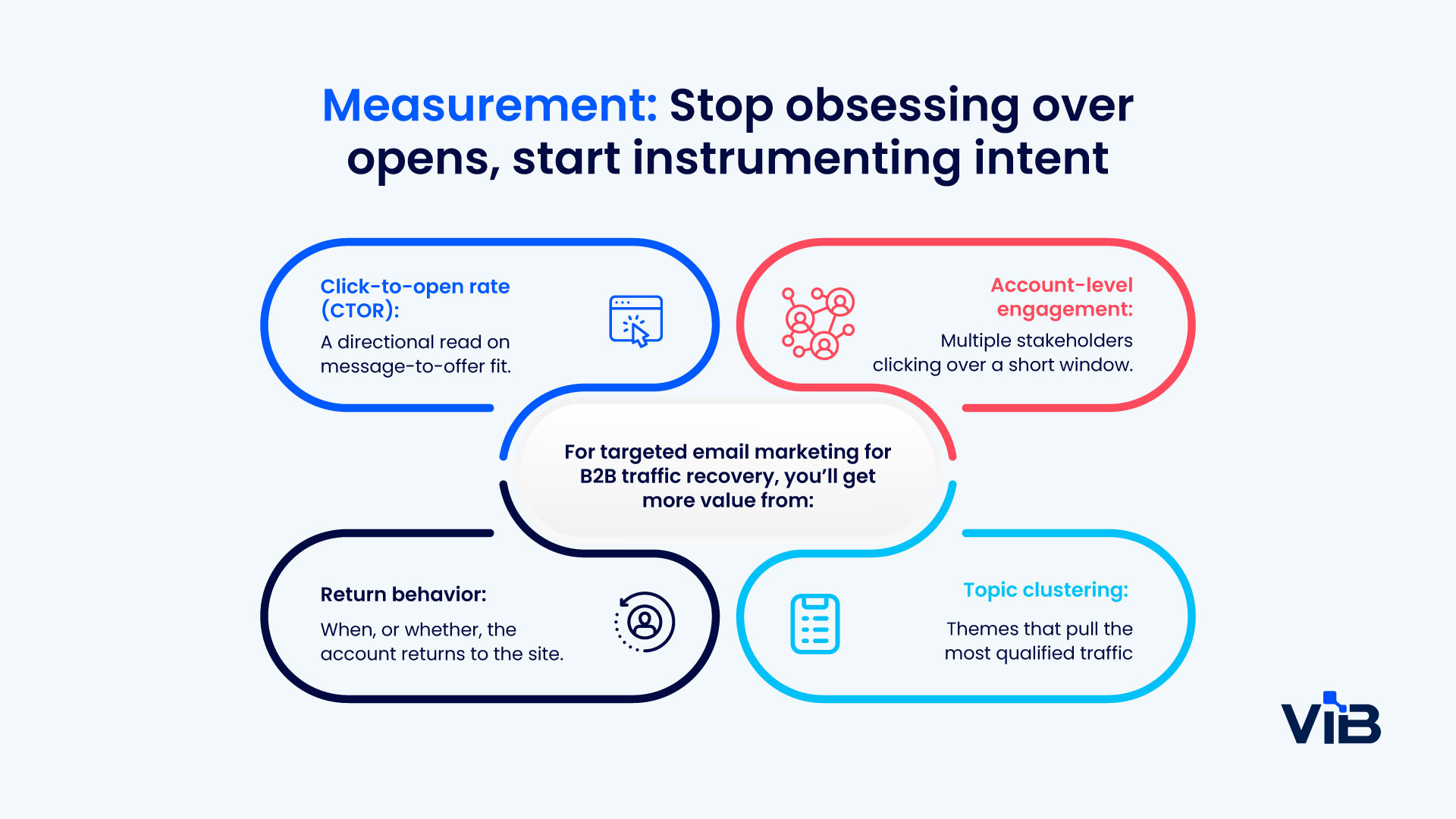
Measurement: Stop obsessing over opens, start instrumenting intent
Open rates are less dependable than they used to be, thanks to privacy changes and bot activity.
For targeted email marketing for B2B traffic recovery, you’ll get more value from:
- Click-to-open rate (CTOR): a directional read on message-to-offer fit.
- Account-level engagement: multiple stakeholders clicking over a short window.
- Return behavior: when, or whether, the account returns to the site.
- Topic clustering: themes that pull the most qualified traffic
In recovery mode, “right audience” beats “big number” every time. ✅
How targeted email supports SEO recovery (without pretending it’s an SEO hack)
Email won’t magically restore rankings. But it can support the conditions that make recovery more likely and more measurable.
Email helps you rebuild known audiences
According to 6sense research, 70–80% of site visitors remain anonymous. So when you’re losing traffic, you lose a big chunk of “invisible” demand.
Targeted email lets you reintroduce your best content to the people who matter, then learn from their behavior.
Email gives you faster feedback loops
SEO changes can take weeks to reflect. Email gives you a tighter loop to test positioning: which problems create clicks, which proof points get attention, and which pages keep people engaged.
You can use those insights to prioritize content refreshes, consolidate underperforming pages, and sharpen comparison pages designed to capture evaluation intent.
Common failure patterns (and how to avoid them)
Most “traffic recovery via email” efforts stall for predictable reasons:
Failure pattern 1: sending one newsletter to everyone
If your list includes different segments, one send usually satisfies nobody. You’ll see clicks, but they won’t map cleanly to ICP engagement.
Fix: Build 3–5 segment-specific sends per month, even if each one is smaller. Smaller but cleaner data is what you want right now.
Failure pattern 2: gating everything
When search is down, over-gating can starve your measurement. You’ll get fewer signals, and you’ll frustrate buyers doing early research.
Fix: Ungate at least one “core” asset per segment. Make it your email destination page. Use lighter conversion points (subscribe, benchmark download, event RSVP) only when they match the intent.
Failure pattern 3: optimizing for reply volume instead of account fit
Replies feel good, but in recovery mode, you’re trying to rebuild qualified engagement and identify which accounts are leaning in.
Fix: Optimize for engagement quality. Track which account cohorts click, return, and consume multiple assets. That’s your north star.
Where ViB Emails fits into targeted email marketing for B2B traffic recovery
If you’ve got the strategy above but you’re missing scale, the bottleneck is usually one of two things: reaching the right audience consistently, or generating reliable engagement signals from that reach.
This is where ViB Emails can help. ViB Emails is designed as a top-of-funnel tactic focused on awareness and lead generation from a curated community of B2B professionals.
Practically, ViB Emails maps well to traffic recovery when you want to:
- Rebuild reach inside your ICP with targeted sends aligned to your key segments.
- Drive engaged traffic back to specific pages (updated guides, comparison pages, event pages) you’re using to regain momentum.
- Capture and act on engagement signals to see which topics and segments are reactivating.
If your team is also running content refreshes, this can create a clean loop: Email drives qualified visits to the pages you’re improving, and the engagement data helps you prioritize what to improve next.
Conclusion: treat email as your engagement engine while search stabilizes
Traffic recovery in B2B is rarely a single fix. It’s a coordinated effort to rebuild visibility, rebuild trust, and rebuild repeat engagement with the right accounts.
Targeted email marketing for B2B traffic recovery works because it’s controllable. You can decide who sees what, when they see it, and what you measure next.
Start with a tight segmentation model, send content that matches real buyer intent, and instrument the signals that matter. Then, if you need additional reach and engagement at the top of the journey, solutions like ViB Emails can be a practical way to scale targeted distribution.


