 Skip to content


Performance marketing in B2B SaaS used to involve a simple trade: spend money, capture form fills, report cost per lead, repeat.
That playbook is breaking. Signals are noisier, buying groups are larger, and measurement is getting harder at the exact moment finance wants more certainty.
So the goal of performance marketing has to evolve: optimize for high-quality engagement and ICP fit, then prove that those signals predict revenue outcomes later. That’s the job now.
What performance marketing really means in 2026 (and why most teams misapply it)
Many teams still treat performance as a channel mix decision: search vs. paid social vs. review sites. That’s tactical, not strategic.
But in mature B2B orgs, performance marketing isn’t “lower-funnel only.” It’s a measurement discipline applied to every stage of the journey.
A better definition: Performance marketing is paid and owned distribution, instrumented to generate decision-grade signals that improve targeting, creative, routing, and next-step experiences.
The modern constraint: signal loss plus stakeholder sprawl
The measurement side is getting tougher. IAB reported that 95% of advertising and data decision-makers expect continued signal loss and/or privacy legislation impacts, and the majority expect it to be harder to track conversions and attribute channel performance.
Meanwhile, buying dynamics continue to shift toward group decisions. Purchase decisions involve many roles and often loop around rather than move linearly.
And the friction is real: Gartner found 74% of B2B buyer teams show “unhealthy conflict” during decision-making, and that consensus meaningfully changes outcomes.
That combination creates a new performance marketing mandate: stop optimizing only for individual conversion events, and start optimizing for buying group progression signals.
The performance marketing problems that experienced teams are dealing with right now
If you’re an experienced B2B marketer, you’re probably not asking, “What is performance marketing?”
You’re asking: “Why does my best-performing campaign create the least useful conversations?” Or: “Why did efficiency improve while downstream outcomes got worse?”
Problem 1: Conversion events don’t equal intent
Forms, demo requests, and webinar signups are actions. But they’re not intent by default.
Intent is closer to a pattern: repeated engagement, specific topic depth, role fit, and account alignment. That’s why “CPL down” can coexist with “sales says quality is down.”
Problem 2: Attribution confidence is declining
Between privacy changes, inconsistent identity, and walled-garden reporting, it’s getting harder to defend channel-level truth with a straight face.
The result: last-click (and even multi-touch) can drift from reality. Performance marketing teams need measurement methods that remain useful when user-level stitching is imperfect.
Problem 3: Stakeholders don’t consume content the same way
Even within the same account, your security lead, finance partner, and VP of product are looking for different “proof.”
If your performance marketing motion only serves one persona, you’ll generate activity without group alignment. Relevance needs to work at the group level, not just the individual level.
A practical performance marketing framework: Measure what predicts progress
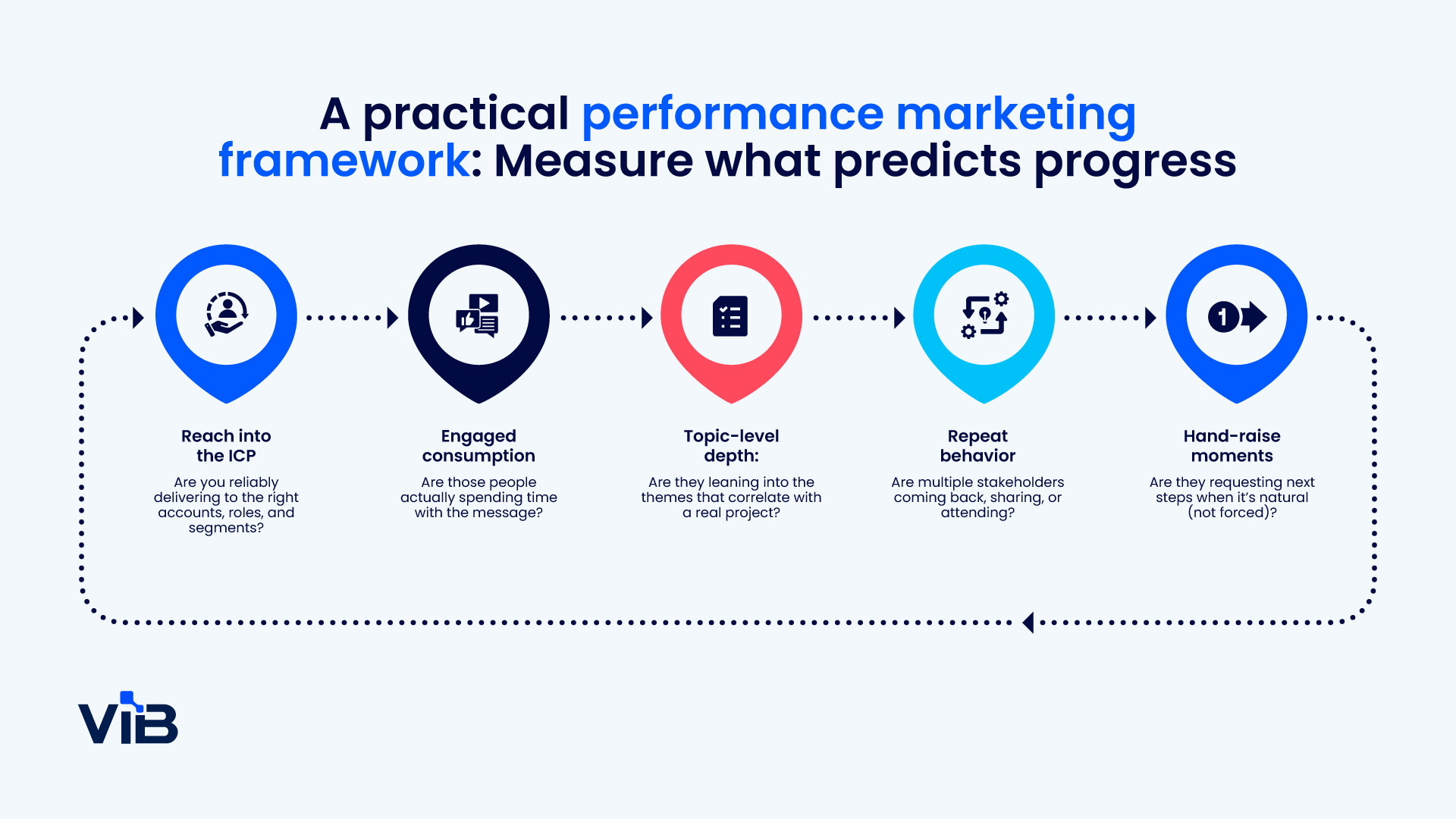
If you can’t trust a single conversion metric, you need a ladder of signals. Think of it as a measurement stack that gets stronger as engagement deepens.
Here’s a framework that works well for B2B SaaS performance marketing teams trying to stay accountable without overpromising certainty.
- Reach into the ICP: Are you reliably delivering to the right accounts, roles, and segments?
- Engaged consumption: Are those people actually spending time with the message?
- Topic-level depth: Are they leaning into the themes that correlate with a real project?
- Repeat behavior: Are multiple stakeholders coming back, sharing, or attending?
- Hand-raise moments: Are they requesting next steps when it’s natural (not forced)?
This matters because performance marketing frameworks are only as good as the signals you track. Better signals produce better decisions, even before you can confidently tie everything to revenue.
Upgrade your KPIs: from “leads” to “decision-grade engagement”
For experienced teams, the KPI upgrade isn’t philosophical. It’s operational.
Examples of engagement-first KPIs that still behave like performance metrics:
- ICP engagement rate by channel (not just CTR)
- Account-level engagement coverage (how many target accounts show meaningful activity)
- Buying-group participation (multiple functions engaging over a time window)
- Cost per engaged account and cost per engaged stakeholder
- Topic resonance (which narratives generate repeat consumption)
These let you tune performance marketing while respecting the reality that big B2B decisions take time and coordination.
Channel strategy that actually holds up under scrutiny
Experienced marketers don’t need another “test more creatives” reminder.
You need channel architecture that does two things at once: captures high-intent where it exists, and creates it where it doesn’t.
1) Search: keep it, but stop pretending it’s your whole market
Search remains foundational in performance marketing because it captures explicit demand. But it won’t create new demand for category entrants or complex, multi-stakeholder solutions.
The move: use search to harvest, then use engagement channels to expand buying-group reach inside the accounts that matter.
2) Paid social: optimize for qualified attention, not cheap clicks
On paid social, especially LinkedIn, the trap is optimizing for CTR because it’s visible and fast.
Instead, works towards: on-page engagement, video completion in the right roles, and multi-touch sequences that pull more stakeholders in. That’s where performance marketing becomes compounding, not just extractive. 📈
3) Content as an instrumented asset, not a library
Your content shouldn’t be “assets for the quarter.” It should be a measurable system that generates signals.
For example, your content strategy should intentionally support cross-functional alignment, not persona silos.
That means building content clusters that answer:
- What problem are we solving, in plain terms?
- What changes operationally if we adopt this?
- What does risk look like, and how is it managed?
- How do teams measure success after adoption?
Then instrument those clusters so performance marketing can see which themes attract the right people.
Measurement upgrades: how to stay credible when attribution gets messy
If your reporting still depends on perfect identity and last-click truth, you’ll keep having the same meeting every month. You know the one.
Here are measurement upgrades that typically land well with experienced stakeholders because they’re transparent about limitations.
Run incrementality tests for major bets
When you’re making a meaningful spend decision, incrementality testing (holdouts, geo splits, or time-based tests) can be more defensible than arguing over multi-touch models.
Shift reporting toward account-level truth
User-level reporting is fragile. Account-level reporting is often more stable for B2B performance marketing.
Practical examples:
- Engaged accounts by tier
- Stakeholder coverage within target accounts
- Intent-topic lift after a campaign flight
- Conversion lag by segment (so you don’t kill good programs early)
This doesn’t replace attribution. It keeps decision-making functional while attribution matures.
Where performance marketing teams can create an edge: earlier journey engagement
Most B2B SaaS categories are crowded. The edge often comes from identifying the right accounts earlier and guiding them toward clearer internal alignment.
That’s why engagement programs matter. Not as “top-of-funnel awareness,” but as a way to generate actionable signals you can route into:
- account prioritization
- persona messaging decisions
- retargeting sequences
- sales plays based on real topics consumed
If you’ve ever wished you could see intent before a form fill, this is the path. It’s also where a partner like ViB can help.

How ViB supports performance marketing without pretending to control the outcome
If your performance marketing strategy is moving toward engagement quality, ICP fit, and account-level signals, the next question is execution: how do you scale those signals reliably?
That’s where ViB’s solutions fit, especially for B2B teams that need measurable engagement earlier in the buyer journey and want those signals to flow into their existing GTM motions.
ViB Emails: targeted engagement that feeds account learning
When you’re running performance marketing, email can be either a spam cannon or a precision tool.
ViB Emails is best used to validate messaging and generate engagement signals in specific roles and segments, then use that learning to sharpen paid and SDR follow-up.
ViB Appointments: align conversations to verified interest
Appointments only help performance marketing when they’re rooted in real engagement. Otherwise, they become noise that degrades trust.
ViB Appointments can translate engagement and ICP-fit signals into timely conversations, especially when your goal is buying-group progression rather than volume.
ViB Syndication: scale content consumption with measurement in mind
Content syndication gets a bad reputation because it’s often measured like lead gen.
In an engagement-first performance marketing model, syndication is valuable when it expands reach into the ICP. ViB Syndication helps generate clean topic-consumption signals you can use for retargeting, sequencing, and account prioritization.
ViB Webinars: capture multi-stakeholder attention and consensus signals
Webinars are one of the few formats where you can naturally attract multiple stakeholders, in the same time window, around the same narrative. They can be a practical way to create buying-group relevance if you design them for cross-functional questions rather than product tours.
ViB Webinars fit well when your performance marketing goal is to generate measurable engagement and identify which accounts are leaning in. 🎯
Use engagement signals to prioritize accounts based on real behavior
When your performance marketing reporting is shifting toward account-level truth, engagement signals become a core input, not a nice-to-have.Use meaningful activity across email, syndication, webinars, and other campaign touchpoints to focus spend, sequences, and outreach where they’re most likely to resonate.
Conclusion: Performance marketing wins when it earns trust in the data
The best B2B performance marketing teams in 2026 aren’t the ones with the fanciest dashboards. They’re the ones with measurement discipline, clear signal definitions, and programs designed for buying-group reality.
That means shifting from “more conversions” to “better signals,” and from “channel debates” to “engagement systems” that consistently reach the ICP and reveal real interest.
When you build around engagement quality and account-level progress, performance marketing becomes more effective, easier to defend, and far more useful to the rest of the GTM team.


