 Skip to content


Scaling a cybersecurity startup is tough. Between long buying cycles, skeptical buyers, and limited resources, founders and sales leaders need every dollar to translate into measurable results. Hiring a full SDR team is expensive, and many outsourced providers charge for activity—not outcomes.
That’s where pay-for-performance appointment setting for cybersecurity startups comes in.
Instead of paying for dials or hours worked, you only pay for qualified, held meetings with your target buyers.
For cybersecurity startups that need to grow quickly while managing risk, this model is a game-changer. 🚀
But not all providers are created equal. In this post, we’ll compare five of the top pay-for-performance appointment setting solutions for cybersecurity startups. You’ll get a clear breakdown of their pros, cons, and differences, so you can decide which is the best fit for your startup.
Why cybersecurity startups turn to pay-for-performance appointment setting
Cybersecurity is one of the fastest-growing B2B markets—projected to rise from about $196 billion today to over $260 billion by 2030. That growth also means fierce competition. For startups, the challenges are especially steep:
Multi-stakeholder buying cycles: Selling into security means navigating CISOs, IT leaders, compliance officers, and finance executives—all of whom have veto power.
High trust barriers: Buyers are naturally cautious about new security vendors. They’re not going to risk a data breach because of an unproven partner.
Limited SDR resources: Building an in-house outbound team is expensive and slow. Most startups can’t afford to wait months to see results.
Need for quick ROI: Whether fresh off a funding round or preparing for the next one, startups need traction fast.
Pay-for-performance appointment setting for cybersecurity startups helps solve these challenges by aligning spend with real outcomes: held meetings with qualified buyers.
Top 5 pay-for-performance appointment setting providers compared
Here’s how ViB and four other providers stack up in the appointment setting market.
ViB Appointments
Pros:
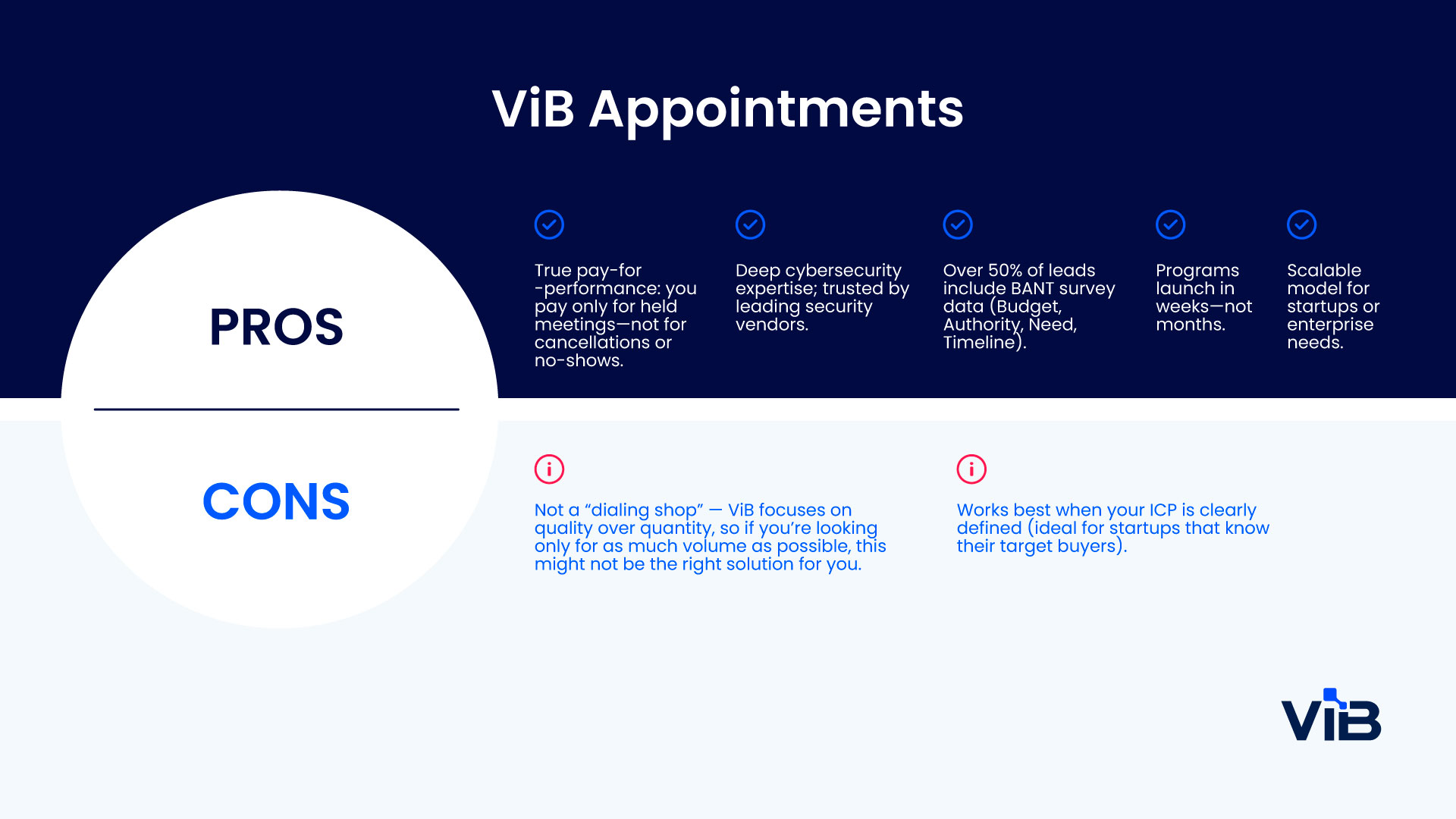
- True pay-for-performance: you pay only for held meetings—not for cancellations or no-shows.
- Deep cybersecurity expertise; trusted by leading security vendors.
- Over 50% of leads include BANT survey data (Budget, Authority, Need, Timeline).
- Programs launch in weeks—not months.
- Scalable model for startups or enterprise needs.
Cons:
- Not a “dialing shop” — ViB focuses on quality over quantity, so if you’re looking only for as much volume as possible, this might not be the right solution for you.
- Works best when your ICP is clearly defined (ideal for startups that know their target buyers).
👉 Learn more about ViB Appointments.
BAO (By Appointment Only)
Pros:
- Long-established in the market with decades of experience.
- Special expertise in FED/SLED sectors.
- High outbound activity (up to 30,000 dials/day).
Cons:
- The model is activity-driven; you’re paying for dials and effort, not guaranteed results.
- Appointment attendance isn’t guaranteed.
- Better suited for large enterprise programs, not lean startups.
Martal Group
Pros:
- Offers flexible engagement models (dedicated SDRs, hybrid, or per-appointment).
- Access to a global team of SDRs.
- Familiar with tech industries, including SaaS.
Cons:
- Reviews show mixed lead quality.
- Setup and ramp-up can take longer due to distributed teams.
- More generalist focus—lacks deep cybersecurity specialization.
CIENCE
Pros:
- Large global operation with advanced data and analytics.
- Broad targeting capabilities across industries.
- Some performance-based pricing options.
Cons:
- Primarily operates on fixed retainer or blended billing models.
- Minimums can be high for early-stage startups.
- Quality and consistency can vary by campaign.
MemoryBlue
Pros:
- Well-known SDR outsourcing provider in B2B tech.
- Emphasis on training SDR talent.
- Familiar with complex B2B selling environments.
Cons:
- Traditional retainer billing—not true pay-for-performance.
- Talent churn and handoffs can impact consistency.
- Less suited for resource-constrained startups needing fast ROI.
Comparison table:Pay-for-performance appointment setting for cybersecurity startups
Here’s a side-by-side look at how the five providers compare 🧐:
| Provider | Model | Cybersecurity focus | Pros | Cons |
| ViB Appointments | Pay only for held meetings | Strong security expertise | Data-driven, fast launch, quality-first | Works best with a defined ICP |
| BAO | Activity-based (dials) | FED/SLED | Established, high outbound volume | Pay tied to activity, no guarantees |
| Martal Group | Hybrid (retainer + P4P) | Generalist | Flexible models, global SDRs | Mixed quality, not security-specific |
| CIENCE | Retainer + activity | Broad tech | Scale, data-driven campaigns | Limited P4P, high minimums |
| MemoryBlue | Re tainer | Tech | Experienced in SDR outsourcing | Not true P4P, SDR churn risk |
So, which provider is right for your cybersecurity startup?
If you’re a cybersecurity startup, here’s the takeaway:
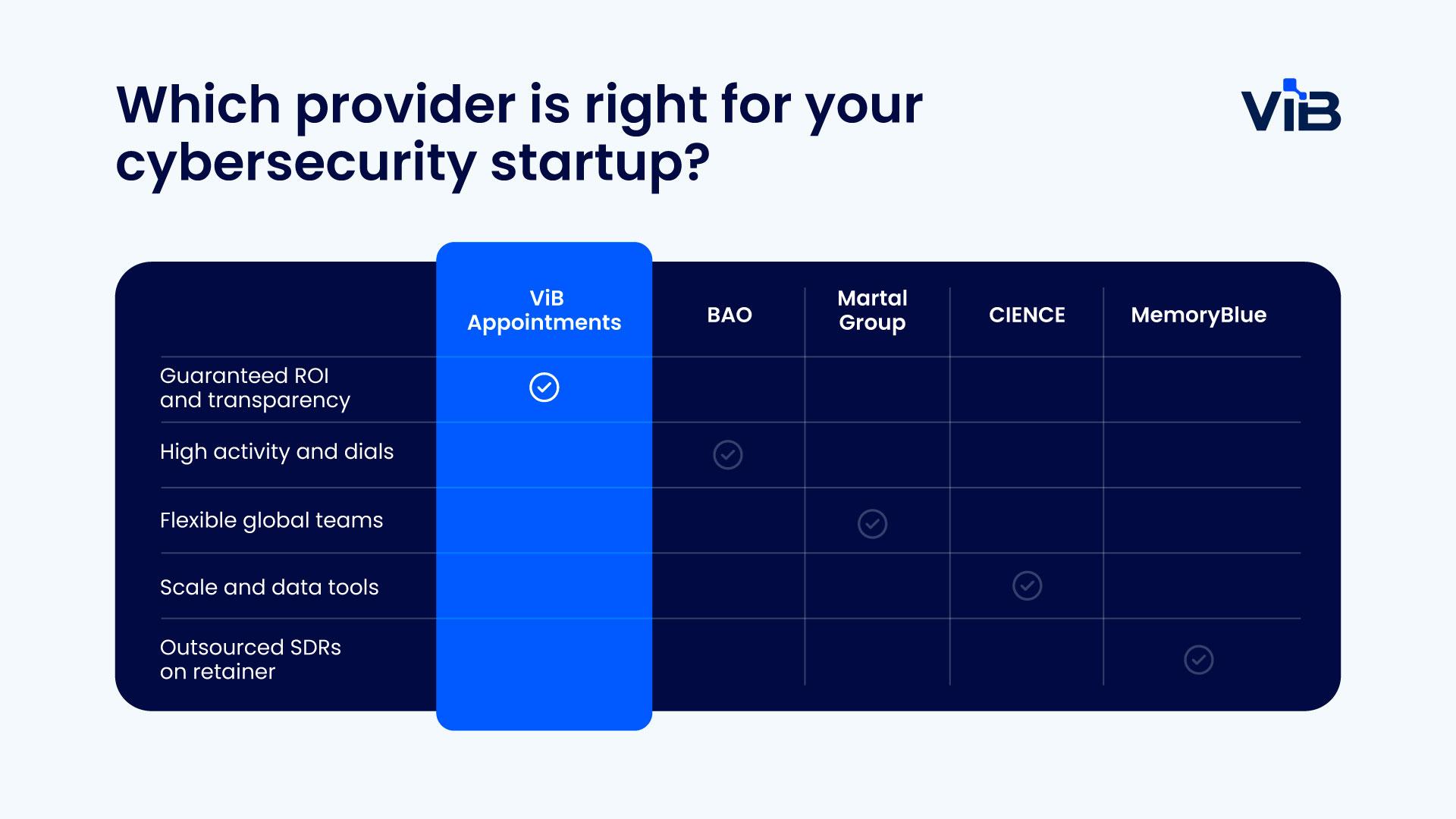
- If you want guaranteed ROI and transparency, ViB Appointments is the standout. With true pay-for-performance, you only pay for meetings that actually happen—with qualified buyers.
- If you want high activity and dials, BAO may be appealing, but results aren’t guaranteed.
- If you want flexible global teams, Martal Group is an option, but quality can vary.
- If you want scale and data tools, CIENCE delivers breadth but at a higher cost.
- If you want outsourced SDRs on retainer, MemoryBlue may fit, but it’s not risk-aligned for startups.
Final thoughts
Ultimately, most startups can’t afford to burn budget on activity-driven or fixed-cost models. That’s why pay-for-performance appointment setting for cybersecurity startups is often the smarter path. It offers a lower-risk, higher-reward approach—especially compared to traditional SDR outsourcing models.Among the top providers, ViB Appointments stands out for its true performance-based model, cybersecurity expertise, and focus on quality over quantity. That combination gives startups a faster path to real traction—without the wasted spend.


