 Skip to content


Outsourcing demand generation is rarely a first choice. Most B2B teams explore it after internal programs stall, pipelines become unpredictable, or sales questions the quality of inbound interest.
The challenge is that “demand generation” means very different things depending on who you outsource it to. Some vendors focus on volume. Others focus on meetings. A few focus on actual buying intent.
This guide breaks down when it makes sense to outsource demand generation, what models exist, and how experienced B2B teams evaluate partners without creating more noise.
Why B2B teams consider outsourcing demand generation
Most teams do not outsource demand generation because they lack ideas. They do it because execution and insight stop scaling.
Common triggers include limited internal bandwidth, declining performance from inbound channels, pressure to support sales more directly, or a lack of visibility into which accounts are actually in market.
In many cases, the internal team is doing “all the right things” but still guessing where real demand exists.
What “outsource demand generation” actually means in practice
Outsourcing demand generation does not mean handing over your entire growth strategy. In practice, it usually means outsourcing one of three functions.
Some vendors focus on top-of-funnel activity, such as content, paid media, or email volume. Others focus on sales-adjacent outcomes, such as meetings or opportunities. A third category focuses on intent visibility, helping teams identify real buying projects earlier.
Understanding which function you are outsourcing matters more than the vendor name.
The most common demand generation outsourcing models
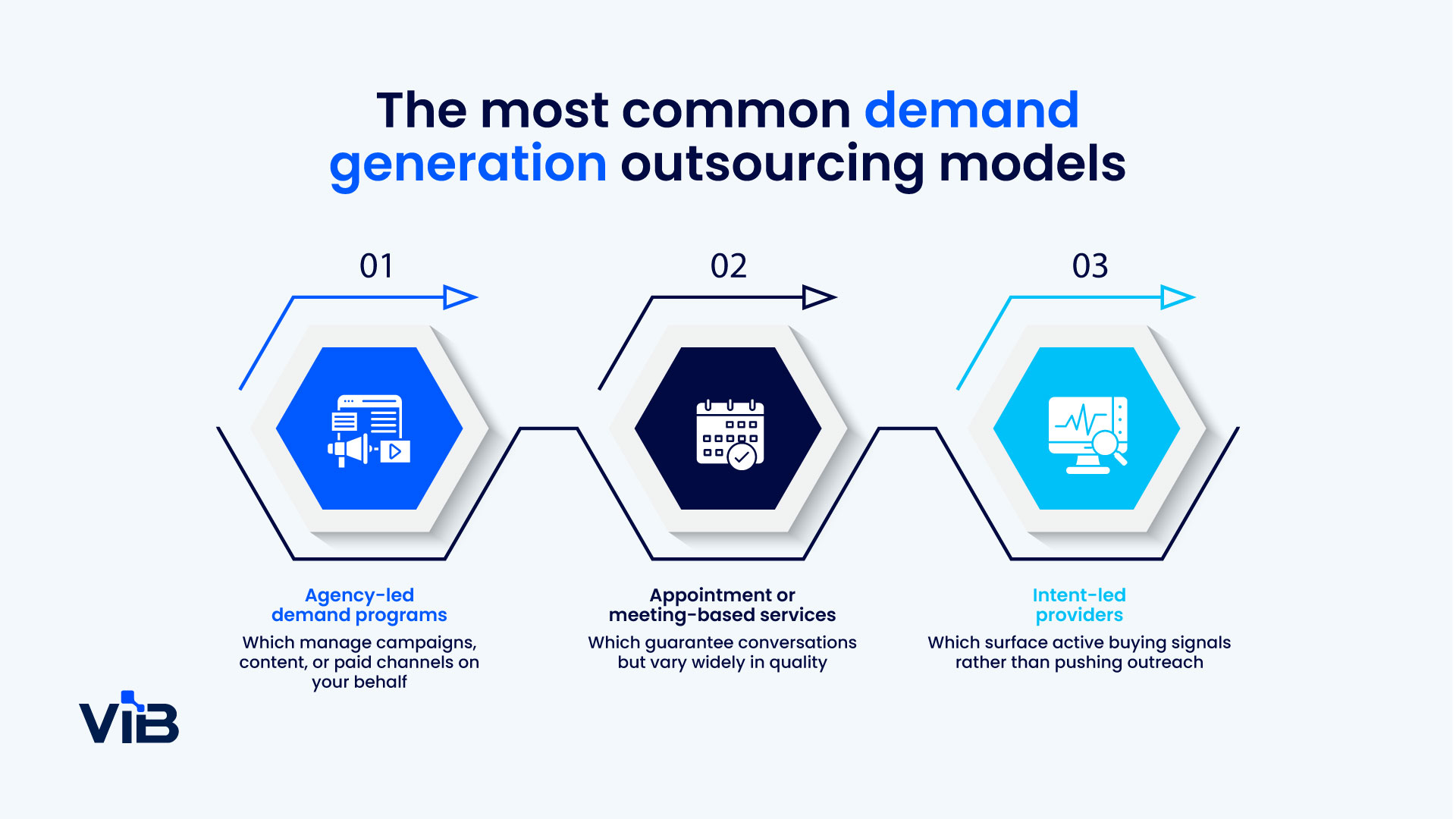
Not all demand generation partners operate the same way. Most fall into one of these models.
- Agency-led demand programs, which manage campaigns, content, or paid channels on your behalf
- Appointment or meeting-based services, which guarantee conversations but vary widely in quality
- Intent-led providers, which surface active buying signals rather than pushing outreach
Each model solves a different problem. Confusion happens when teams expect one model to deliver outcomes it was never designed to produce.
When outsourcing demand generation actually works
Outsourcing demand generation is most effective when the underlying challenge is clarity, not creativity. Teams often turn to external partners because internal efforts generate activity without clear insight into what is actually driving progress.
When done well, outsourcing should reduce guesswork and help teams focus effort where it matters most.
1) When outsourcing demand generation works best
Outsourcing works best when teams struggle to answer fundamental questions, such as which accounts are actually buying, when outreach should happen, or why sales conversations consistently stall. In these situations, outsourcing execution alone will not solve the problem.
Demand generation outsourcing delivers value when it helps prioritize effort, improve timing, and align activity with real buying signals rather than producing more volume.
2) When outsourced demand generation goes wrong
Most outsourced demand generation programs fail for predictable reasons. The most common issues include misaligned incentives, an overemphasis on volume, and limited transparency into buyer behavior.
Teams receive leads or meetings without understanding why those prospects engaged or whether interest is real. When success is measured only by activity, demand generation becomes transactional instead of strategic, creating friction instead of momentum.
What to look for when outsourcing demand generation today
Experienced B2B teams evaluate demand generation partners differently than they did a few years ago.
Key criteria often include:
- Ability to surface real buying activity, not inferred interest
- Transparency into how prospects are identified
- Alignment with how sales actually engages accounts
- Reduced reliance on cold or speculative outreach
Partners that cannot explain where demand comes from tend to create friction downstream.

How intent-led approaches fit into outsourced demand generation
This is where intent-led approaches differ from traditional outsourcing.
Some providers specialize in collecting declared or zero-party intent from professionals who confirm that they are evaluating relevant solutions. Depending on the source and consent model, this information may include project timelines, budget ranges, business priorities, and decision-making roles.
For teams outsourcing demand generation, this type of information can provide additional context for prioritization. Marketing and sales can use it alongside ICP fit and first-party engagement instead of relying only on activity volume.
Rather than replacing internal strategy or human qualification, declared intent data can support decision-making by reducing uncertainty and helping teams align outreach with relevant buyer priorities.
Intent-led outsourcing can support sales alignment
One of the biggest benefits of intent-led demand generation is improved sales alignment.
Sales teams are more receptive when demand signals reflect real buying projects rather than anonymous engagement. Conversations start with context instead of discovery. This reduces friction between marketing and sales and improves the quality of downstream interactions.
How to decide whether to outsource demand generation
Before choosing a partner, it helps to answer a few internal questions.
Are we trying to generate more activity or better insight? Do we know which accounts are actually buying? Is sales asking for volume or clarity?
Clear answers make vendor evaluation much easier.
When not to outsource demand generation
Outsourcing is not always the right move.
If your team lacks clarity on your ideal customer profile, messaging, or positioning, outsourcing demand generation can amplify confusion. In these cases, foundational work should come first.
Outsourcing works best when strategy is clear and execution needs focus.
Final thoughts on outsourcing demand generation
Outsourcing demand generation is not about doing more. It is about doing less guessing.
The most effective outsourced programs focus on identifying real demand, not manufacturing it. Intent-led approaches help teams engage buyers when timing and readiness align.
For B2B teams under pressure to deliver results, that distinction makes all the difference.


